
Congress’s $2 Trillion Stimulus Package Offers Many Benefits for Artists and Freelancers. Here’s a Step-by-Step Primer on How to Claim Yours
Many Americans will be receiving
$1,200 checks from the government as part of the Coronavirus Aid,
Relief, and Economic Security Act (the CARES Act). But many still
don’t understand everything that the bill, which passed unanimously
in the Senate on March 25, might mean for them—particularly those
who have non-traditional means of income, such as many
artists.
Unlike unemployment benefits in the past, the act
now makes it possible for
freelancers, gig workers, and the self-employed to apply for
assistance, even though they don’t have an employer who paid
unemployment taxes on their behalf. It also allows those whose work
was directly impacted by COVID-19 to apply for an additional form
of emergency assistance.
The bill is unprecedented in
terms of the scope of the benefits it provides to those impacted by
the pandemic, says Joseph Tedeschi, an attorney on the board
of the nonprofit organization Volunteer Lawyers for the
Arts. “It’s a universal
response to a universal impact,” says Tedeschi, who has been working to educate
artists on how to navigate the “very complicated” CARES
Act.
“There is help out there, but
you have to act and you have to seek the help,” he says. “You have
to submit applications, you have to be prepared, and you have to be
patient.”
Indeed, the coronavirus pandemic
has yielded an unprecedented number of unemployment claims. Within
the last three weeks alone, the US Department of Labor has reported
that 17 million Americans have filed jobless claims, and that
number might be a conservative estimate as overwhelmed state
offices are still sorting through the backlog of
applications.
For those who are considering
applying, there are several steps to keep in mind beforehand that
might help make the process smoother. We spoke with Tabeschi to
bring applicants this primer on who qualifies for the CARES Act,
what benefits they should expect, and other frequently asked
questions along the way.
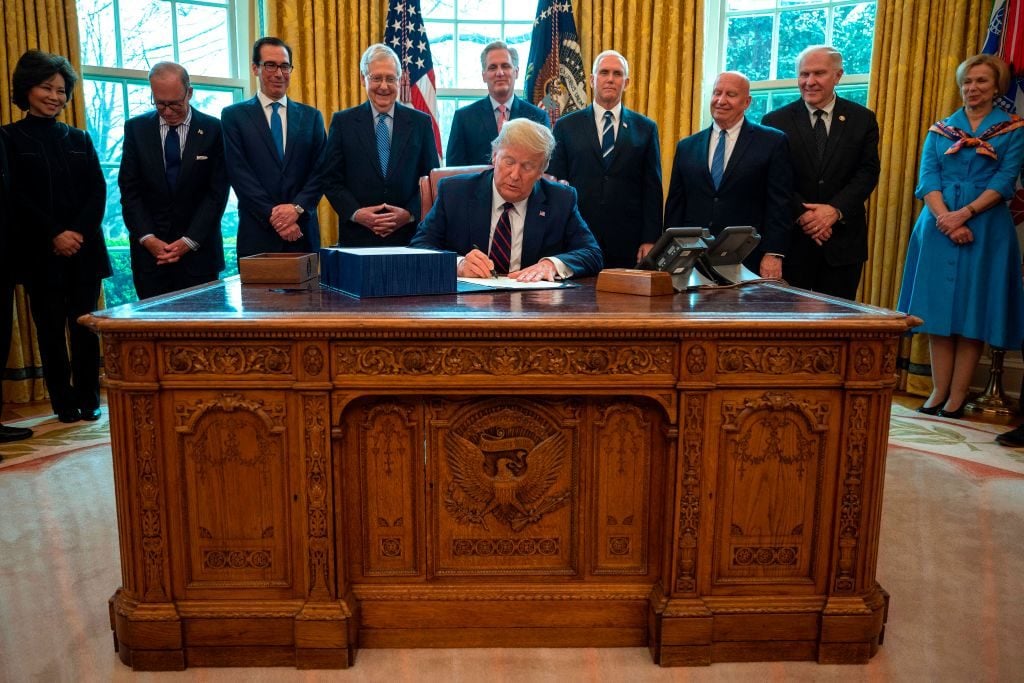
US President Donald Trump signs the
CARES act, a $2 trillion rescue package to provide economic relief
amid the coronavirus outbreak, at the White House on March 27,
2020. Photo by Jim Watson/AFP via Getty Images.
Which type of assistance should I apply for?
The first thing you should know
is what you’re applying for. In addition to extending the reach of
unemployment insurance, the CARES Act also created new temporary
programs to aid those impacted by COVID-19.
- Traditional unemployment insurance:
This is what you apply for if you were laid off from your full-time
or part-time job. The money is paid by the state, and therefore the
amount of money you’re eligible for weekly and the number of weeks
you’re allowed to collect is state-specific. The CARES Act has also
extended the reach of regular benefits by 13 weeks and applies to
those whose benefits lapsed after previously submitting a claim (as
long as their last valid claim expired on July 6, 2019 or later).
Whereas previously, in 42 states, jobless workers would be eligible
for 26 weeks of unemployment assistance, now they are eligible for
39 weeks. - Pandemic unemployment assistance:
This is a new form of unemployment aid and is available to those
who don’t qualify for traditional unemployment insurance—i.e.
self-employed artists and freelancers. It’s funded federally by the
CARES Act, but administered by the state. You apply for this the
same way you would traditional unemployment insurance. It will be
available through the end of 2020 and the loss of work doesn’t
need to be directly related to the pandemic. - Pandemic unemployment compensation:
In addition to unemployment
insurance, those whose work was directly impacted by the pandemic
are eligible for an extra $600 a week through July 31, 2020. This
payment will be administered automatically as long as you’re
eligible.
Who is eligible for these benefits?
If you are a full-time or
part-time worker who has recently lost your job, or if you are a
self-employed or freelance laborer who has recently lost work, you
will be eligible for either unemployment insurance or pandemic
unemployment assistance.
To qualify for the third type,
pandemic unemployment compensation, you have to have lost your job
(either full time or gig work) and have been directly impacted by
COVID-19. The applicable scenarios are quite broad. For example, if
you or a family member contracted the disease, or if quarantine has
prevented you from reaching your place of work, you are eligible
for the $600-a-week payment.
How much can I expect to receive in assistance?
Both traditional unemployment
checks and pandemic unemployment assistance are determined by the
state after looking at your 2019 tax return and the other benefits
you may be receiving (for instance, if you’re currently receiving
sick leave or severance payments from an employer, it will impact
how much money you’re eligible for).
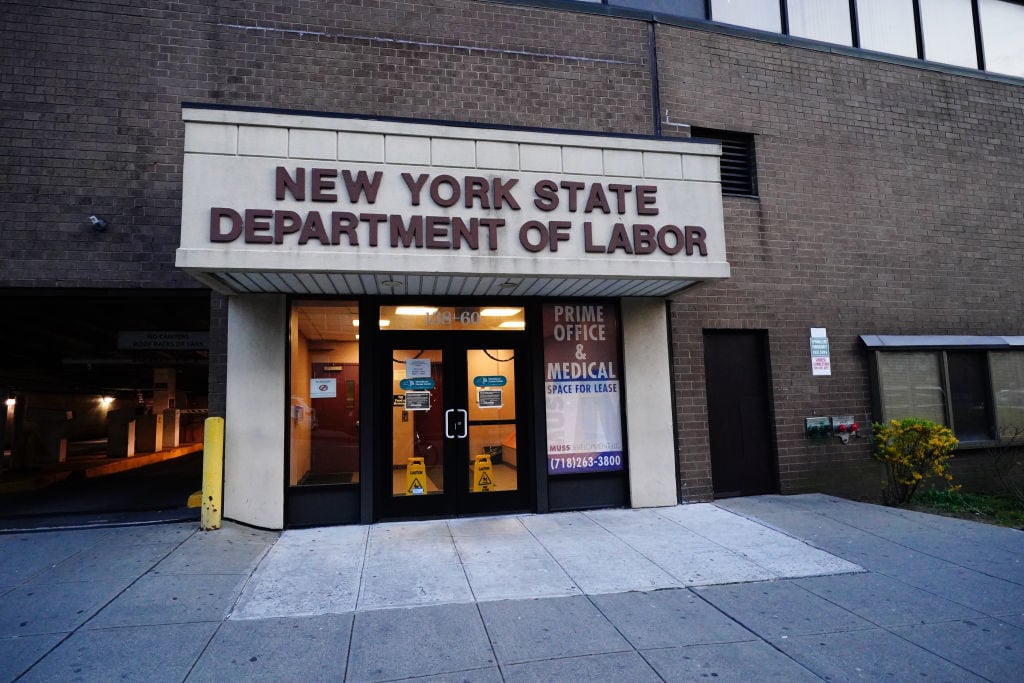
A view of new York State Department of
labor office in Queens on April 12, 2020. Photo: John
Nacion/NurPhoto via Getty Images.
Can you apply for unemployment insurance or pandemic
unemployment assistance because of future work that has been
canceled?
Yes.
I live in one state, but work in another. Where do I
apply?
You should apply in the state in
which you worked, via that state’s department of labor
website.
How long will these programs last?
Pandemic unemployment assistance
and the 13-week extension to regular unemployment assistance will
last through the end of December, 2020. Pandemic unemployment
compensation will last through the end of July 2020.
If you have a temporary work visa, can you
apply?
Yes, if you had work
authorization during the relevant period.
What do I need to apply?
First, you should create a
personal pin number through your state’s department of labor
website. After that, make sure you have at hand your social
security number, driver’s license or motor vehicle ID number,
mailing address, and (if you have a green card) your alien
registration card number.
The post Congress’s $2 Trillion Stimulus Package Offers Many
Benefits for Artists and Freelancers. Here’s a Step-by-Step Primer
on How to Claim Yours appeared first on artnet News.
Read more https://news.artnet.com/art-world/unemployment-benefits-for-artists-freelancers-coronavirus-1832913
Further reading


Leave a comment