
Frieze New York Unveils Plans for Online Viewing Rooms in Lieu of Its Cancelled Fair, Including a New AR Tool to Help Collectors Shop
Like so many other major art events planned for this spring,
Frieze was forced to call off its New York
fair—scheduled to be held in early May on Randall’s Island in
Manhattan—due to the global health situation. But instead of going
dark for 2020, the event is offering participating galleries the
chance to show their wares online instead.
Next month, Frieze New York’s organizers will launch a virtual
fair, allowing galleries the chance to have their own individual
viewing rooms (think: art fair booths under a big tent), where they
can showcase up to 30 works each. The site is also using augmented
reality technology to offer users the ability to virtually view
artworks to scale on their own walls. Plus, it will host video
tours from curators of the fair’s special sections, including a
special tribute to Chicago artists and a look at overlooked figures
from the 20th century.
The virtual fair will debut on the same day the IRL
fair was originally scheduled to open, kicking off with a VIP
preview from May 6 though 7, but it will remain live a bit longer,
through May 15. Like the in-person fair, it is sponsored by
Deutsche Bank. “This is really similar to what the fair’s
presentation would have been, just not in physical form now,”
Loring Randolph, the director of Frieze New York, tells Artnet
News.
Frieze’s viewing-room ambitions considerably predate the
lockdown era. Randolph said the fair first began considering it a
few years ago, when some of the bigger galleries—Gagosian, David
Zwirner—launched their own
individual platforms. Frieze sought to lower the barrier of
entry for smaller and midsize galleries, which do not have the same
development budgets as their behemoth peers. Of the more than 200
exhibitors at Frieze New York, the fair recently found that roughly
83 percent didn’t have their own dedicated viewing rooms, which
allow galleries to more efficiently field offers for artworks.
“We saw an opportunity to make a platform available to a much
wider group of galleries,” Randolph says. “And of course one of the
things that fairs do that I think is a benefit, is bring everybody
together under one roof in one place, so we thought we could do
that through a digital platform.” Viewing rooms, she says, also
offer dealers the opportunity to show projects that might not make
sense at a physical fair—like a creative solo project, perhaps, or
a video.
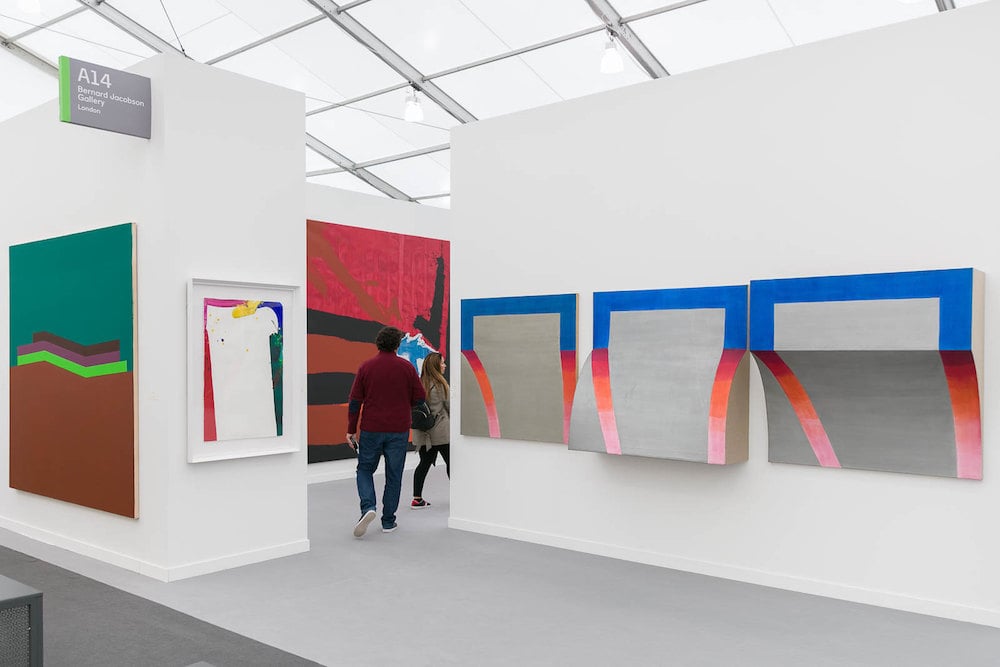
Frieze New York. Image courtesy of
Frieze.
During test runs before the official launch, Frieze organizers
worked closely with roughly ten galleries who experimented with
uploading works in order to see what worked and what
didn’t. “People are being thoughtful about what kind of works they
should present,” Randolph says. Galleries will begin to upload work
to the platform today; Frieze is encouraging them to include
prices, but will not require it. The fair will not disclose names
or contact information of anyone who enters the room to galleries
unless visitors inquire abut a work on view.
Frieze is one of many art-market players working to beef up its
online offerings in recent months. Within the past week alone,
mega-gallery Hauser & Wirth unveiled ambitious plans for a new
virtual reality platform and both Lisson Gallery and Massimo De
Carlo announced plans to
launch their own e-commerce VR platforms. Art Basel Hong Kong
launched an online viewing room—to mixed success—in
lieu of its physical fair in March. (Both Frieze and Art Basel
offered exhibitors the chance to participate in the first iteration
for free, although ABHK refunded dealers 75 percent of their booth
fees, while Frieze provided full refunds.) If the Art Basel
experiment is any indication, Frieze will face the test of whether
its platform can funnel sales to smaller galleries as effectively
as larger ones.
Randolph concedes the learning curve has been steep,
noting “the urgency of the cancellation of Frieze New York changed
the way we were thinking” about what was initially intended as a
complement to the fair. “I think museums are having similar
questions about how everything can translate from the physical
experience. Conceptually and ideologically, I don’t think that’s
possible. Nor do I or Frieze organizers think that an online
viewing room should be a replacement for a fair or for all of
us being together physically in one space and
experiencing art in person.”
Still, the platform seeks to feature some of Frieze New York’s
most highly anticipated projects, including “Spotlight,” a section
dedicated to pioneering figures of the 20th century curated by
Drawing Center executive director Laura Hoptman. Also available for
browsing is “Diálogos,” a celebration of Latin American, Latino, Latinx
artists organized by the leadership of El Museo del Barrio.
Meanwhile, Julie Rodrigues Widholm, director of the DePaul Art
Museum, has organized “Chicago
Tribute,” an homage to the pioneering female artists of
Chicago.
“This first iteration of the
platform,” Randolph says, “has become a digital version of Frieze
New York.”
The post Frieze New York Unveils Plans for Online Viewing
Rooms in Lieu of Its Cancelled Fair, Including a New AR Tool to
Help Collectors Shop appeared first on artnet News.
Read more https://news.artnet.com/market/frieze-new-york-digital-platform-1833342
Further reading


Leave a comment