
One Year After the Tragic Notre Dame Fire, the Cause of the Devastating Blaze Remains Shrouded in Mystery
One year ago today, the world watched in horror as
a fire swept through Paris’s
iconic Notre Dame Cathedral, sending its spire crumbling to the
ground, caving in its ceiling, and setting alight its historic
interior. And now, with the country on lockdown, restoration
efforts on the Gothic building have been put on hold,
forcing a team of 100 engineers, scientists, architects, and
archeologists to cease their tireless work on the damaged
structure.
The target date for completing the complex and delicate
restoration has always been 2024, in time for Paris to host the
Olympic Games. But experts have been skeptical of that timeline
from the start. And since President Emmanuel Macron
announced that ambitious target just two days after the fire, there
have been considerable delays.
“The aim is to reopen the cathedral in 2024 even though the work
won’t all be done,” Stéphane Tissier, director of operations on the
project, told TIME. “The objective
will be that that the public will be able to reenter in 2024.”
(Prior to the current lockdown, there was speculation that the cathedral’s forecourt
would be opened to visitors as early as March.)
With work at a standstill, engineers are relying on laser
monitoring systems to detect any structural movement that might
trigger another collapse. Although firefighters were able to save
the cathedral’s nave and twin bell towers, the intensity of the
fire still puts the church’s
structural integrity at risk.
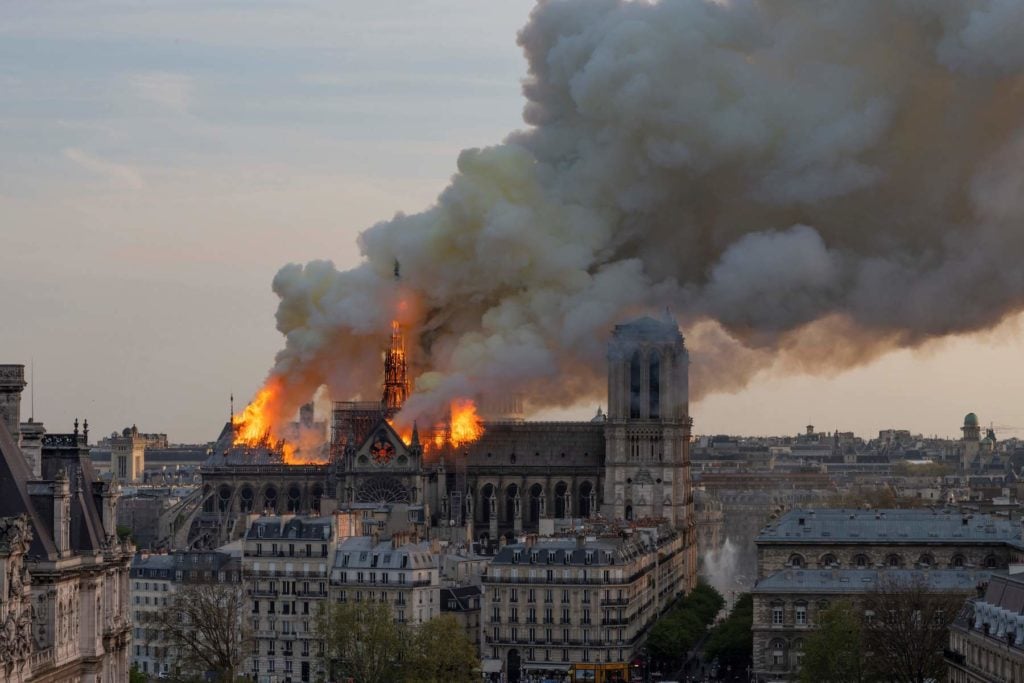
Smoke billows as flames burn through the
roof of the Notre Dame de Paris Cathedral on April 15, 2019, in the
French capital Paris. Photo courtesy Fabien Barrau/AFP/Getty
Images.
“All you’ve been hearing so far for the last few months is that
this is still a very fragile situation,” Lindsay Cook, a professor
of Medieval art and architectural history at New York’s Vassar
College, told National
Geographic. “And to just leave it there seems like it’s
just asking for trouble over time.”
Further complicating matters are the remains of scaffolding
erected six months before the disaster for a restoration
project. Removing the scaffolding is expected to take four
months of painstaking work, ensuring that falling pieces won’t
further damage the building or injure workers. Only after is it
removed can construction begin.
And although there was an international outpouring of €922
million (more than $1 billion) in promised donations in the
immediate aftermath of the fire, much of that money has yet to
materialize. Whether it will in the current worldwide economic
climate is an open question.
The delay in work is also preventing investigators from
definitively identifying the cause of the fire, reports Le Journal des
Arts. Experts still haven’t been able to gain access to
the area where the blaze is believed to have begin, and that area
will not be accessible until the scaffolding comes down.
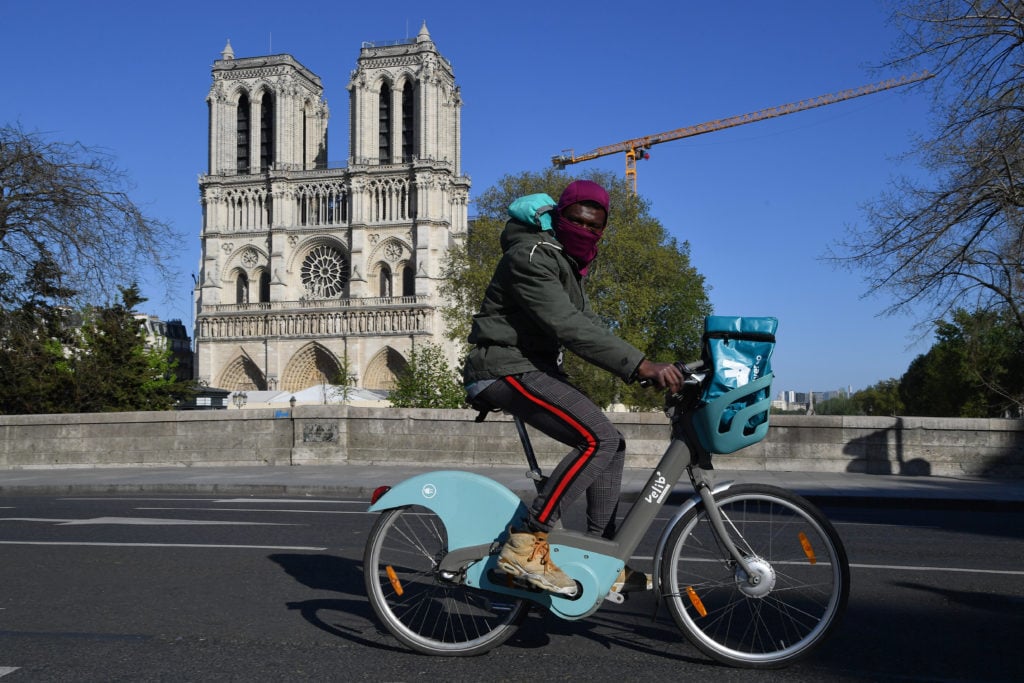
A man wearing a protective mask rides
his bicycle in front of Notre Dame Cathedral in Paris after repair
work stops due to the global health crisis. Photo by Stephane
Cardinale, courtesy of Corbis/Corbis/Getty Images.
But despite the long road ahead, there is reason for
optimism.
“What matters isn’t the roof and vault so much as the sanctuary
they protect. The heart of Notre Dame had been saved,” Aline
Magnien, director of the Historical Monuments Research Laboratory,
which is in charge of national monument conservation, told the
magazine Science.
Another sign of hope came during Holy Week, when a group
gathered at the cathedral to say mass for only the second time
since the fire.
“A year ago, the cathedral was destroyed,” the
celebrant, Paris Archbishop Michel Aupetit, told BFMTV. “Today the
country is ravaged by a pandemic. There’s always a message of hope,
and this celebration at the heart of the cathedral will be the sign
of our hope.”
The post One Year After the Tragic Notre Dame Fire, the
Cause of the Devastating Blaze Remains Shrouded in Mystery
appeared first on artnet News.
Read more https://news.artnet.com/art-world/notre-dame-fire-year-anniversary-1834668
Further reading


Leave a comment