
R2D2, Museum Docent? Some Art Spaces Are Now Using Robots to Give Locked-Down Visitors Virtual Tours of Their Exhibitions
As the art world adjusts to the new normal of virtual
exhibitions and online viewing rooms, a number of galleries have
adopted another tool to help audiences enjoy art from the safety of
their homes: robots.
Telepresence robots, to be precise, allow viewers to remotely
guide the machine through an exhibition while appearing on video
chat.
When the English gallery Hastings Contemporary began
offering robot tours on Monday,
they became an instant sensation. Self-isolating art lovers
inundated staff with hundreds of booking requests and Hastings has
since posted a notice on its website that says it is “overwhelmed
and delighted at the interest.” It is now offering priority for
“those who are most vulnerable and at risk due to isolation.”
Meanwhile, Avant Gallery, which has spaces in New York, Miami,
and Dubai, saw immediate results when it began piloting robot
visits for collectors last week. “Using this technology, we’ve just
sold a sculpture and a commission for $80,000 by Will
Kurtz,” Dmitry Prut, the gallery’s president and founder, told
Artnet News in an email. “During these challenging times,
we’re able to connect with our clients in a whole new way and bring
them back inside our establishment.”
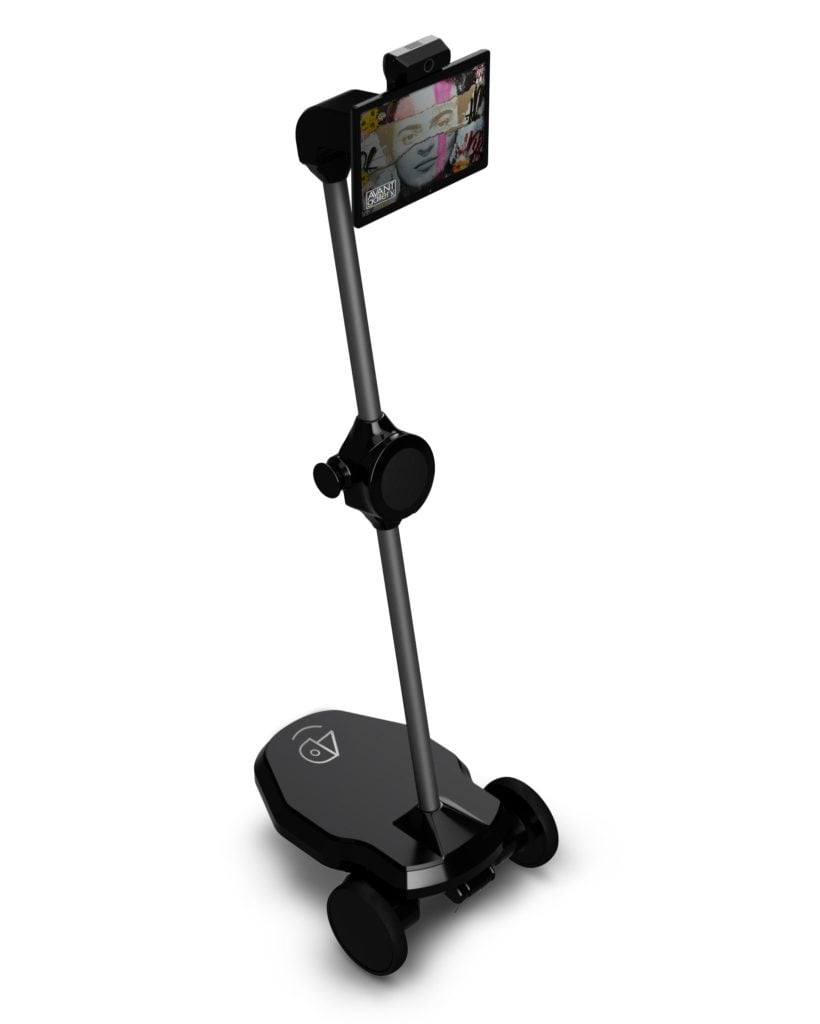
The Ohmni® Robot, giving telepresence
tours of Avant Gallery. Photo courtesy of Avant Gallery.
Both galleries’ robots are equipped with video screens that
allow the at-home user to appear on camera while staff members are
physically present during the experience.
“There’s real pleasure through the empowerment of driving and
socializing via the robot,” Hastings director Liz Gilmore told
Artnet News in an email. “What’s been so lovely is welcoming people
to the gallery, from Dubai to Melbourne, and also a wheelchair user
just down the road in our town Hastings.”
The appeal of telepresence robots is twofold: They offer a
much-needed dose of culture, connection, and escape from
self-isolation, and then there’s the sheer novelty of it.
“It’s not about looking at art,” Tommaso Lanza, creative
director of the creative technology studio the Workers, told Artnet
News. “If you really want to see a famous painting, it’s probably
easier to go on Wikipedia.”
Still, the new technology delivers a reasonable facsimile
to the art. “It’s good quality for a small camera, and some of the
works we have on show do appear in amazing detail, with faithful
color reproduction. And there’s the option to zoom in and get
really close,” Gilmore said.
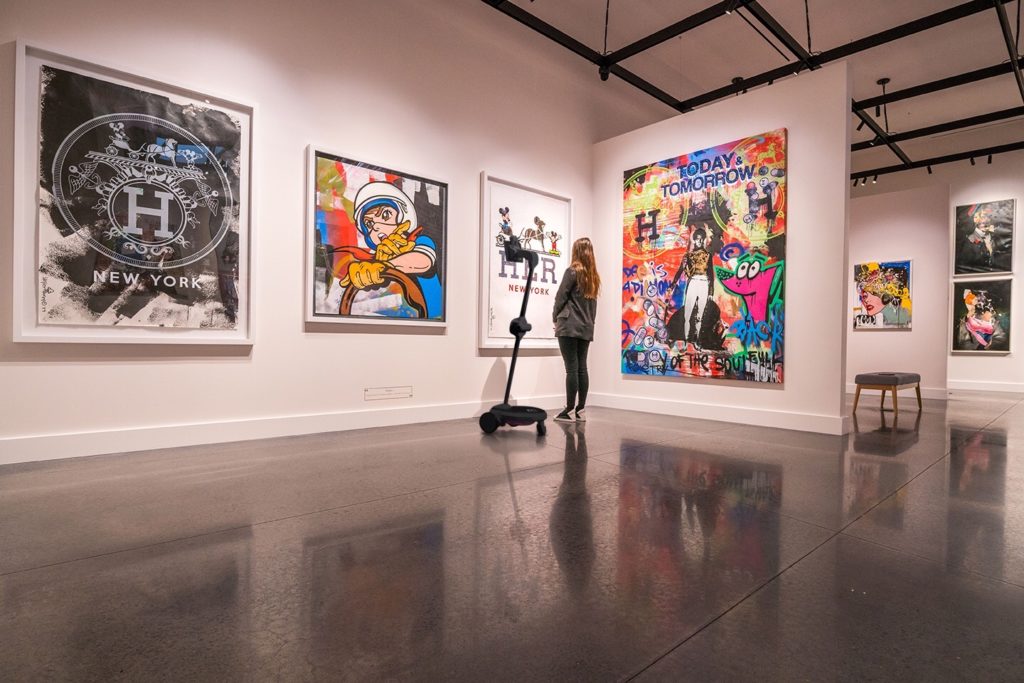
The Ohmni® Robot, giving telepresence
tours of Avant Gallery. Photo courtesy of Avant Gallery.
At Avant, rolling out the robots is part of its new “4D”
program that aims to incorporate new technologies into the
gallery’s operations. “The whole tech space is obviously even more
relevant now than anyone could’ve ever imagined,” said Prut. “Avant
is offering this service to its existing clientele who show serious
interest in acquiring, beyond seeing JPEGs and viewing rooms, and
want to actually ‘visit’ the gallery’s physical location via mobile
embodiment.”
The gallery is using an Ohmni Robot, developed by Silicon Valley
tech company Ohmni Labs in 2017. The technology includes a
13-megabyte camera on a tilting neck that swivels, offering the
operator a nearly 360-degree view of the environment. The gallery
sends clients with appointments a link and password to log in and
take control of the robot, which serves as the collector’s
avatar—or “avantar,” as they’ve taken to calling it.
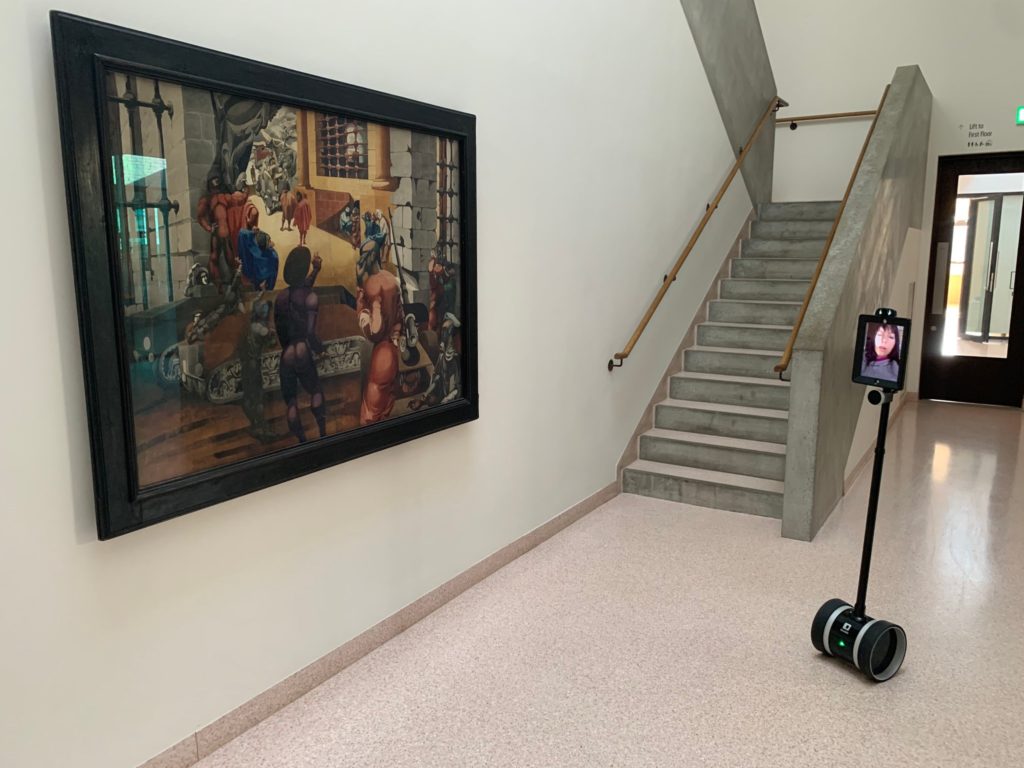
The Double Robotics telepresence robot
views Edward Burra’s War in the Sun at the Hastings
Contemporary. Photo by Will Barrett/Hastings Contemporary, courtesy
of the estate of Edward Burra/Lefevre Fine Art Ltd; via Daniel Katz
Gallery.
Lanza of the Workers, the London digital design
studio that pioneered after-hours robot
tours at Tate Britain in 2014, says galleries
can expect some challenges introducing the technology. “If anyone
thinks all it takes is putting a telepresence robot in the
galleries and calling it a day, they’re in for a rough ride,” he
said.
The biggest task is scaling up the project to meet demand, he
said. “If you have four robots and you have, say, 1,000 people
who want to control them, only a few of those people can experience
the visit.”
And, as innovative as robotic tours may seem, Lanza cautioned
about becoming too optimistic about their potential. “It’s not a
replacement for visiting a gallery,” he said. “It would be very sad
if this were all we were left with.”
But, for now, Gilmore remains hopeful. “The social experience,
perhaps because of lockdown, is heightened and visitors really
enjoy the interactivity of the visit—lots of questions are being
asked, and it’s a very convivial atmosphere.”
The post R2D2, Museum Docent? Some Art Spaces Are Now Using
Robots to Give Locked-Down Visitors Virtual Tours of Their
Exhibitions appeared first on artnet News.
Read more https://news.artnet.com/art-world/visit-shuttered-museums-with-telepresence-robot-1835271
Further reading


Leave a comment