
How the Social-Distancing Era Drove One LA Art Gallery to Develop New Tech Tools That Will Change Its Entire Business
Welcome to New Models, a
series that highlights galleries innovating beyond the traditional
ways of exhibiting and selling art in the primary market. From
forward-thinking collaborative initiatives to novel uses of
technology, the concepts it unpacks prove that there are more paths
to success and sustainability as an art dealer than the default
settings.
Ask members of the Los Angeles
arts ecosystem what they appreciate most about the city, and you’re
very likely to hear praise for its atmosphere of openness and
possibility. In contrast to more rigidly structured arts capitals,
LA feels like one of the rare places where new ideas enter the
arena with an advantage over old ones. This pioneering attitude
only strengthens at a time when nearly everything inside and
outside the industry is in crisis, and no gallery makes the case
clearer than Various Small Fires.
Cofounded in 2012 by Esther Kim
Varet and her husband, Joseph Varet, Various Small Fires set out
from the beginning to do things differently. Most notably, while
much of the Western art market fixated on Hong Kong and Shanghai in
its pivot to East Asia, VSF (as it’s commonly known) instead
embraced Kim Varet’s first-generation Korean-American heritage and
opened a permanent space in
Seoul in April 2019.
That decision now looks even savvier than it did at the time, since
Korea’s expert
response to the global
health crisis allowed the country and its arts-rich capital to
begin responsibly reopening weeks before any other nation in the
world.
With VSF’s location in
Hollywood’s increasingly muscular gallery district still shuttered
along with all other non-essential businesses, its Seoul space has
now become the nucleus of an innovative three-part strategy that
has leveraged physical space, digital engagement, and
coalition-building. And this strategy’s early success is worth
every dealers’ attention.
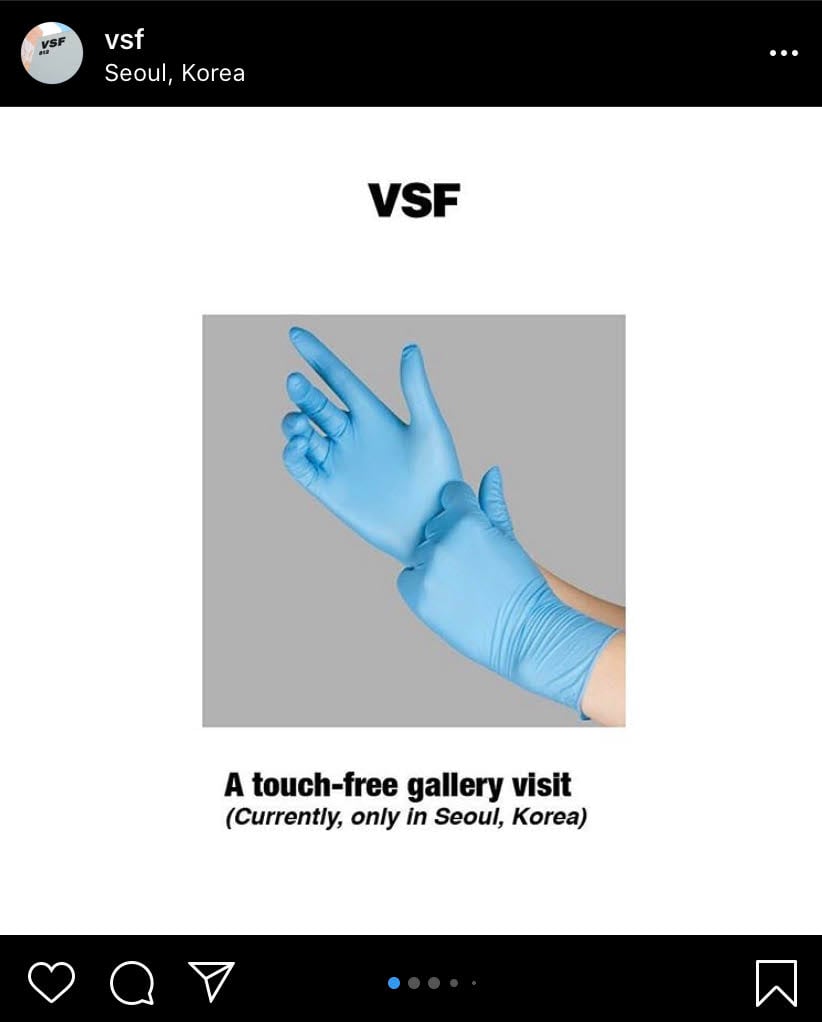
Instructional Instagram post explaining
how to book a touch-free viewing at Various Small Fires, Seoul.
Courtesy of Various Small Fires.
1. Online Appointments for “Touch-Free” IRL Viewings
The Concept: In the
anxious days leading up to each city’s respective shutdown, VSF had
begun piloting online reservations to keep its Los Angeles and
Seoul galleries active—yet
safe—spaces for aesthetic enrichment. Integrated
into VSF’s website, the system allowed users to book a 30-minute
private viewing at either location during its normal operating
hours. Crucially, when a visitor arrives for their appointment, the
front door is already open, and the gallery is clear of all but one
(masked and gloved) employee.
Although the reservation system
is on hold in Los Angeles while VSF’s space there (like all other
local non-essential businesses) remains shuttered, VSF Seoul has
been booking these “touch-free” IRL viewings of “Alternative
Facts”—its new exhibition of Trumpism-targeting,
wall-mounted cast-resin sculptures by Josh Kline—since
the show opened on April 11. Each appointment is also followed by a
30-minute buffer to eliminate any possible overlap between
visitors, as well as to give gallery staff enough time to
thoroughly disinfect the space before the next
reservation.
The Advantages: VSF’s
artists get to continue exhibiting; visitors get VIP treatment; and
the gallery gets to continue showing and selling, with maximum
peace of mind for all involved. The online bookings also give staff the
opportunity to prepare materials and brush up on vital information
in advance of the arrival of collectors, curators, and other key
figures who might otherwise have dropped in unannounced during a
calmer era.
The Results: Kim Varet
says the private-booking system was received enthusiastically in
Los Angeles and Seoul prior to the crisis, but it has been
especially popular since the debut of Kline’s show, which was
synced perfectly with Korea’s relaxation of social-distancing
guidelines. “By the time we rolled it out there,” she told Artnet
News, “people were ready to come out [of
isolation].”
She relays that museum
directors, major curators, and collectors have all visited in the
weeks since. And perhaps
most importantly, all but one of Kline’s works had found buyers by
publication time, with the last on hold for a corporate collection
in Seoul.
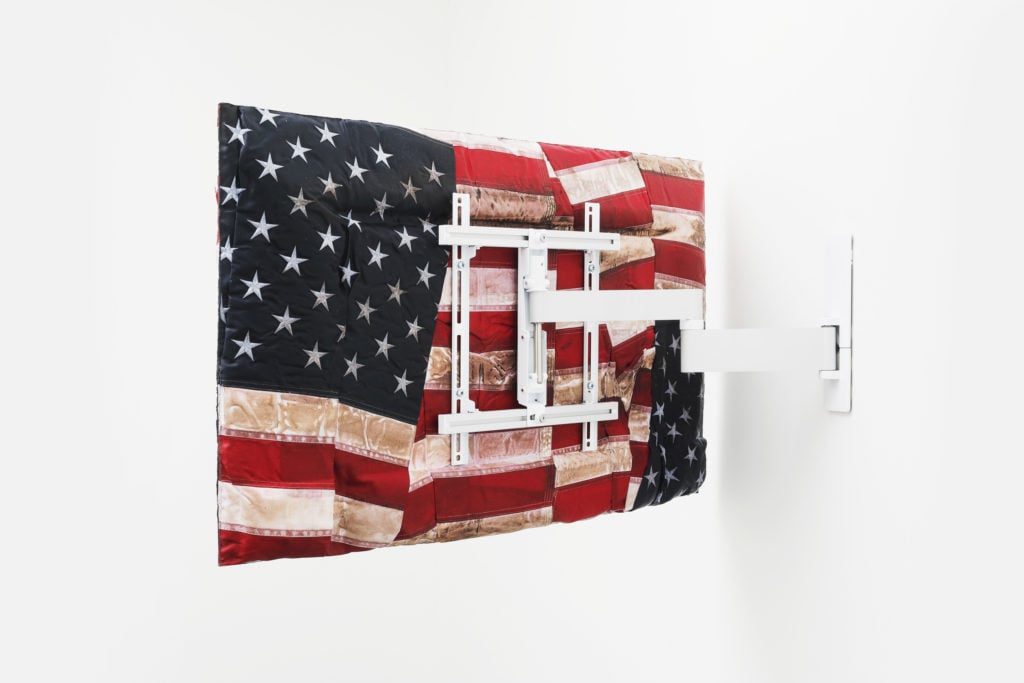
Josh Kline, detail view of Reality
Television 12, 2020. Courtesy Various Small Fires, Los Angeles
and Seoul.
2. Zoom Tours and Proactive Digital Outreach
The Concept: For those
who aren’t physically in Seoul (or who aren’t ready for an in-person visit
just yet) VSF is now also
providing 30-minute virtual walkthroughs of Kline’s exhibition via
the now-ubiquitous video-conferencing software Zoom. The remote
tours can be booked through the same page on the gallery’s website
as the traditional private viewings, but up to 10 concurrent
viewers can take part.
While the walkthroughs are not
elaborate productions—they
consist of a lone cameraperson shooting a tour led by a single VSF
Seoul staff member—the
gallery designs them in close collaboration with the featured
artist. Kline, for example, wanted to ensure that remote viewings
of “Alternative Facts” highlighted the wall mounts and wraparound
detailing of each sculpture almost as much as the frontal view. He
also communicated critical themes and talking points about specific
works during multiple rehearsal sessions in the days leading up to
the opening.
The Context: The Zoom
appointments are just one component of a larger campaign to make
digital engagement one of VSF’s core competencies. The effort
shifted into high gear when the gallery hired Hilde
Lynn Helphenstein
(AKA art-world meme champion Jerry
Gogosian) as its first digital director earlier this spring. Her
overarching mandate is to use a variety of platforms and
initiatives to make VSF as adept at the social-media game as the
best dealers are at IRL social functions. “Nothing will ever
replace viewing art in person, but technology is our best
prosthesis for this,” Helphenstein told Artnet News. “So we want
the most technologically advanced prosthesis, not a peg
leg.”
The Advantages: The
benefits of the virtual walkthroughs transcend the most obvious one
here in the age of social distancing. In the past, Kim Varet says,
the gallery would primarily have tried to interest local and
regional contacts in Kline’s exhibition at VSF Seoul. No longer.
“Now people are preconditioned to do these remote viewings, and we
can open it up to a wider audience.” If the Zoom tours transcend
the shutdown, as Kim Varet and her team hope, the associated
reduction in flights and drives to the physical gallery will also
further reduce VSF’s carbon footprint—a major goal for a business whose LA location
is already 100 percent solar-powered.
The Results: The Zoom
press preview attracted art writers from New York, Miami, Chicago,
and Los Angeles, and a VIP
walkthrough held the following week consisted of not only a mix of
local and international collectors and advisors, but also
board members at premier stateside
institutions, including the Whitney and LACMA.
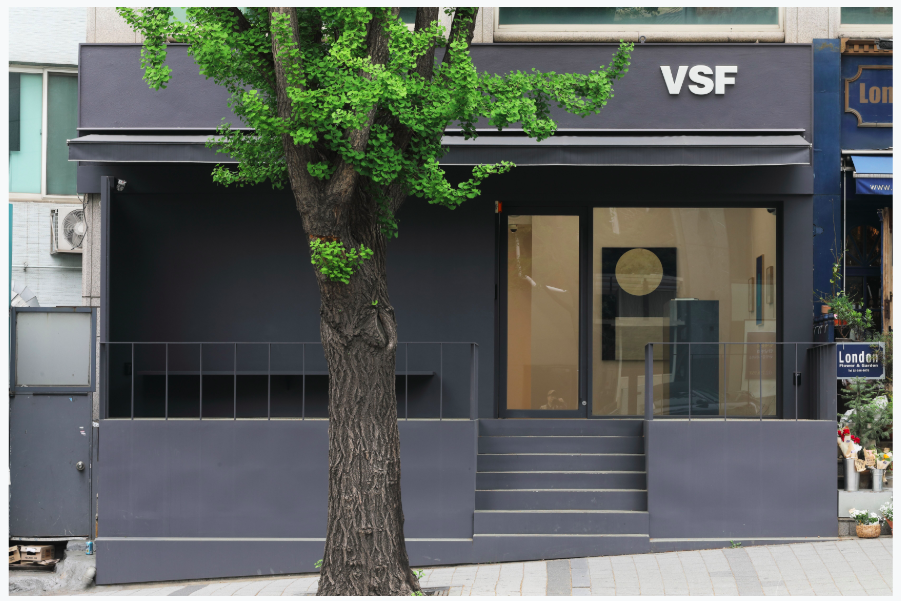
The facade of Various Small Fires in
Seoul, South Korea. Courtesy of Various Small Fires, Los Angeles,
and Seoul.
3. Ongoing International Gallery Shares
The Concept: At least
until the crisis is over (but possibly longer), Kim Varet plans to
alternate the Seoul space’s programming between a VSF show and a
show in partnership with a dealer based outside of Korea. In the
latter case, VSF and the visiting gallery split all costs and
profits associated with the exhibition.
The Context: Kim Varet
regards forming and strengthening alliances with her peers as a key
strand of VSF’s DNA. The
trait also manifests in VSF’s presence on the operating committee
of GalleryPlatform.LA, the recently announced online-sales platform
jointly presented by 60 Los Angeles dealers. This perspective
quickly came to the fore when she recounts her thought process
about the gallery’s good fortune in Korea: “It’s awesome for us
that we have Seoul open again. It’s a silver lining most galleries
don’t have right now. So how do we share that with other dealers
and collaborators going through a similarly traumatic period in
their business careers?”
The Advantages: The
long-acknowledged but under-utilized reality is that every dealer
is only as strong as their coalition. “The idea that needs to
change is that every gallery is its own island,” says Kim
Varet.
VSF Seoul’s collaborative
programming doesn’t just allow the gallery to deepen its
relationships with its peers on the sell side; by extension, it
also connects VSF to the artists, collectors, and other contacts
those peers bring in. And since VSF is incentivized to promote the
partnered exhibitions as enthusiastically as its own, the visiting
dealer benefits from Kim Varet’s local and regional network too.
Those bonds can propel everyone involved into new opportunities in
the future.
The Results: VSF has
already agreed to host multiple international dealers.
The first collaboration will be
with New York’s Karma, which will debut a two-person exhibition by
Henni Alftan and Dike Blair in July. Respected Berlin gallerist
Johann König will
follow this fall.
König
also proves how quickly one mutually beneficial exchange can create
a virtuous cycle. He told Artnet News that, upon reopening his
gallery on April 21, visitors would enjoy an online-booking system
for private viewings that was inspired by VSF—and enabled by Kim Varet’s willingness
to volunteer the
technological details of its own reservation system. (Incidentally,
König added that he reached out to Kim Varet
after being impressed by her appearance on
our The Art
Angle podcast.)
“I think she’s really at the
forefront of young dealers in terms of how collaborative and [open
to] sharing she is,” König told
Artnet News.
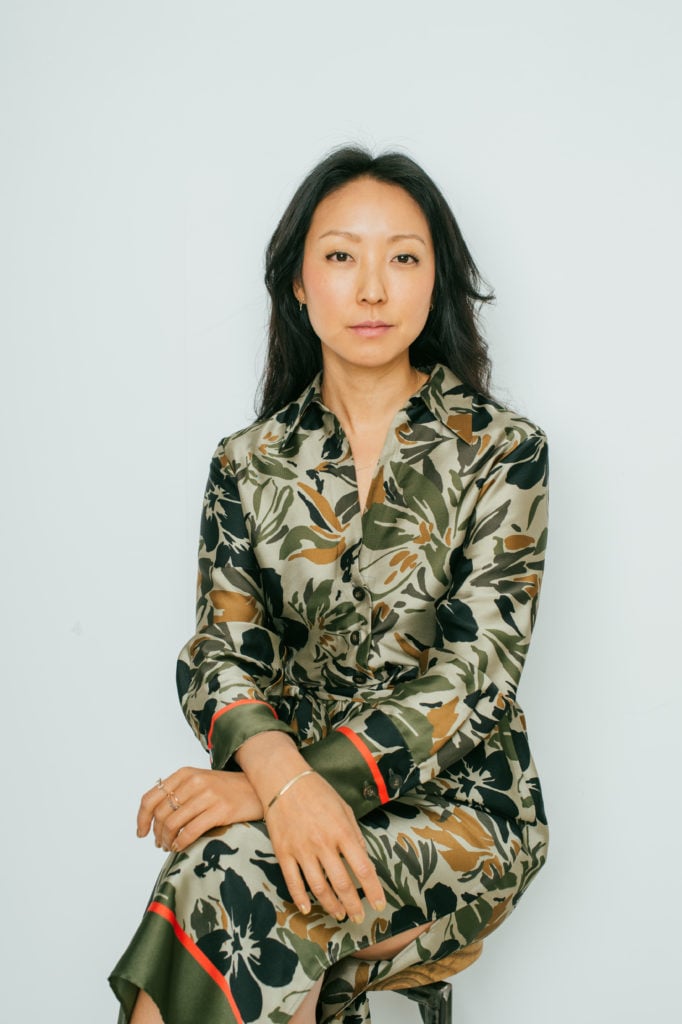
Esther Kim Varet, cofounder of Various
Small Fires. Courtesy of Various Small Fires, Los Angeles and
Seoul.
What Comes Next?
The changes VSF has implemented
is already leading to others. König
returned the online-booking favor by giving VSF guidance on how to
build a real-time chat tool on its website, which Kim Varet’s team
had wanted to implement early on but couldn’t quite execute
independently. That move will further VSF’s transition away from
email—she notes that it’s
long been treated as “a very snail-mail kind of correspondence” in
Asian countries—and toward
direct messaging on various platforms as the gallery’s primary
communication interface.
In contrast to the roughly
10-week-minimum exhibitions held at VSF Seoul in 2019, Kim Varet
says the gallery is also tentatively planning on shortening its
Korean shows to one month each starting in June—a shift she attributes to the changing
expectations of artists in an increasingly on-demand economy. And
while it would be naive to assume these are the only evolutions the
gallery will undergo, one certainty is that this brave new
model is driving VSF in the
right direction.
“For a while,” Kim Varet says,
“we were held back by art-world tradition. It’s liberating to feel
like we’re heading towards the art world we’ve always wanted to be
in.”
The post How the Social-Distancing Era Drove One LA Art
Gallery to Develop New Tech Tools That Will Change Its Entire
Business appeared first on artnet News.
Read more https://news.artnet.com/market/various-small-fires-new-technologies-1846614
Further reading


Leave a comment