
Before the Lockdown, the Public Was Agitating For a Revolution in the Way Museums Operate. Will This Crisis Finally Force Through Change?
In the early evening of Wednesday, February 26, the crowd
thronged the opening of “Young Rembrandt” at Oxford’s Ashmolean
Museum. We shook hands and brushed shoulders, air-kissed or
embraced our friends, and leaned in to continue conversations as
the director’s welcome rang through the thick atmosphere of wine
and canapés. Today, to our immense collective sadness, through the
time-warp and culture-shock effects of lockdown, our sociality of
just a few weeks ago feels like a half-remembered dream of some
distant ancient culture—one with radically different attitudes
toward bodily contact, public health, and freedoms of association
and assembly. In our absence, the galleries have gathered dust,
reduced to mere storerooms.
When we finally unlock the museums, how will be find them
transformed?
From comparable parts of the economy—the tourism, aviation or
hospitality industries, for example—we learn that the COVID-19 era
may accelerate certain structural changes that were already in
process. The weekend before “Young Rembrandt” opened its Oxford
chapter, Meta Knol, the director of the Museum De Lakenhal in
Leiden, the Netherlands, which had hosted the first stage of this
traveling exhibition, published her reflection on the so-called “Year of
Rembrandt” that overtook 2019. Knol’s assessment of this
celebration of the 350-year anniversary of the painter’s death,
titled “Blockbuster Addiction,” was unequivocal. “This was the last
time,” she wrote. “It really can’t go on.”
As cultural workers have adjusted to home-working, furlough, and
home-schooling while trying to keep their mental health together,
these past few weeks have also provided a time for reflection.
Knol’s words have frequently come to mind. The future of many
museum operations—events, education, outreach—could hardly be more
uncertain. Careers and livelihoods are on the line.
A sense of precariousness is not unfamiliar to museum workers
who were already living through austerity, Brexit, and the
deregulation of the workforce. But long before this current health
crisis, the skepticism about whether commercially-driven
blockbuster exhibitions could ever plug the widening gaps in public
funding for museums was already part of a much bigger existential
question: Is the dominant model for 21st-century museums
sustainable?
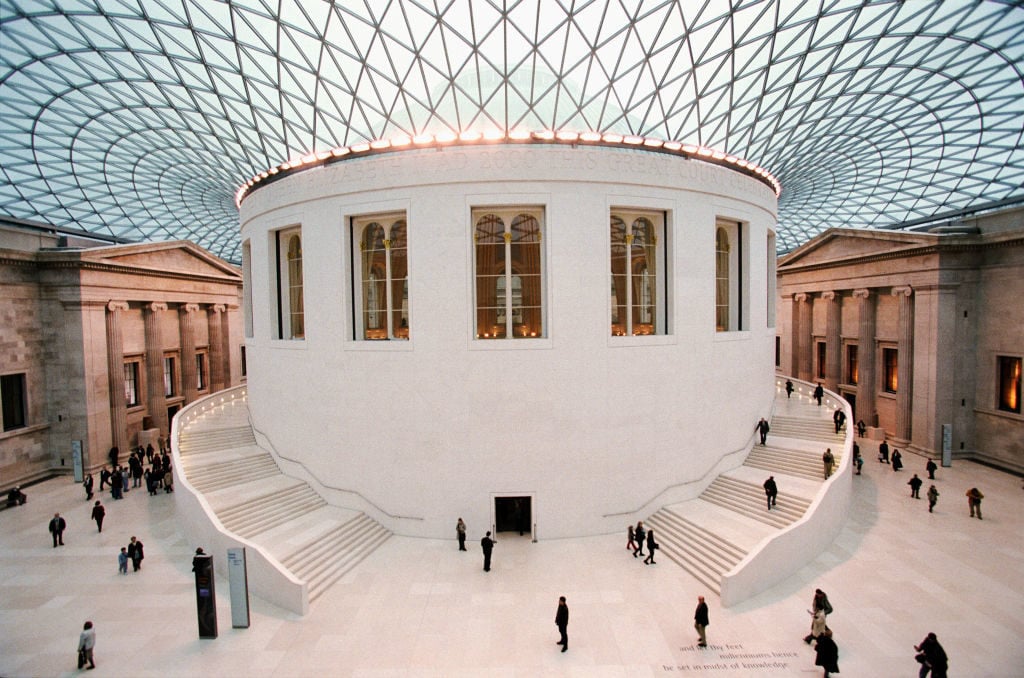
British Museum. Photo by Jean-Francois
Cardella/Construction Photography/Avalon/Getty Images.
The concept of the “universal museum” was thought up by a group
of museum directors as a coping mechanism for a prior crisis at the
start of the millennium. In November 2002, the declaration of “the importance and value of
universal museums” recast the most powerful cultural institutions
of the Global North as custodians of world heritage, instruments of
cross-cultural contact, and engines of destination tourism as the
post-9/11 aviation industry sought to get back on its feet. As
preparations for the 2003 Bush-Blair invasion of Iraq advanced, the
British Museum forged a new corporate partnership with oil giant
BP, and a light was shone on forgotten connections among extractive
industries, militarist colonialism, and the public display of
cultural property.
In the COVID-19 era, a different, more forensic light is now
being shone into these vast storehouses, the self-styled “universal
museums”—revealing fatigue in their shallow ideological
foundations. First, social distancing throws into relief the
absurdity of the hyper-concentration of cultural heritage in just a
handful of metropolitan galleries, in the name of accessibility to
an “international” public. Second, travel restrictions expose the
short-term quality of an institutional financial model based on
infinite growth in globe-trotting visitors. Some have even
suggested that budgetary pressures will lead to deaccessioning and
sales of artworks by museums, which would, in a
stroke, remove the third remaining leg of the universal museum
stool: their claim to safeguard culture for all humanity.
Social distancing and travel restrictions have exposed this
fatigue, and are precipitating processes of rupture, but here
coronavirus is a catalyst rather than a cause. A diminished airline
industry and a revolution in working from home may have arrived
sooner than expected—but neither comes as a surprise. And as a
result, the model of the “universal museum” has failed.
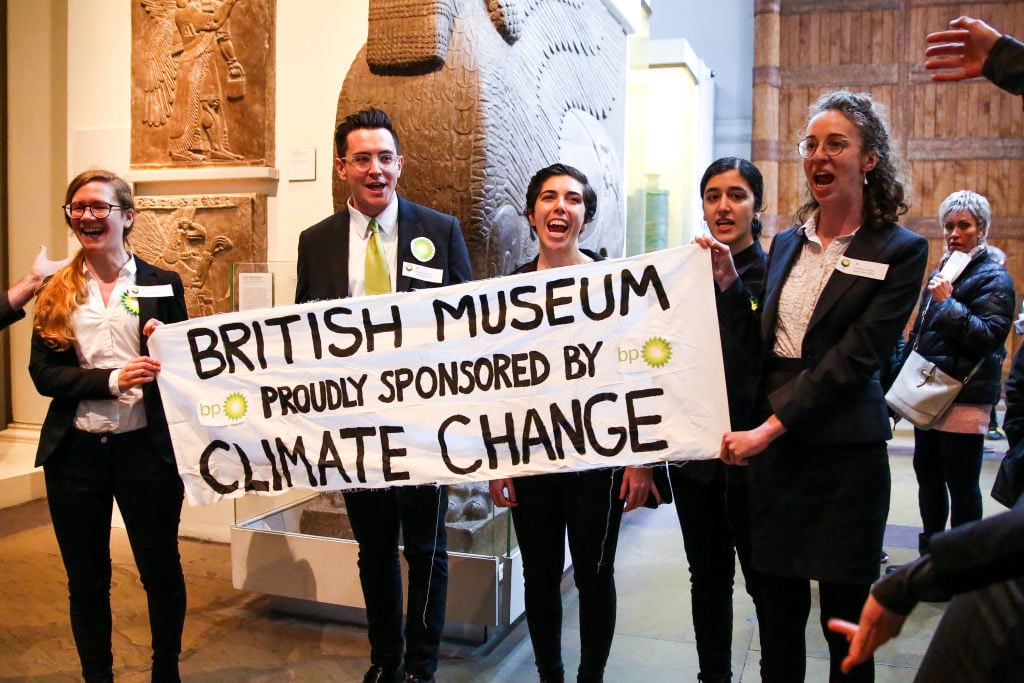
Activists protesting BP’s sponsorship of
the British Museum. Photo by Dinendra Haria/SOPA Images/LightRocket
via Getty Images.
This failure is one of economic resilience, but it also shows a
loss of social legitimacy, as we see most clearly in the field of
colonial restitution where the shaky moral justification offered
for exhibiting world culture in a few Euro-American capital cities
disintegrates as people stop flying. Over two decades, our most
powerful institutions have promoted the hyper-centralization of the
arts and heritage sector. In the UK, sustained cuts to local museum
services have served to lock in an unsustainable reliance on
domestic as well as international travel. The hubris of the richest
institutions has maximized, rather than mitigated, the museum
sector’s vulnerability to finding itself on a disorderly front
line, alongside the airlines and the oil industry, as the world
catches up with the reality of Net Zero and starts to reassemble a
new green economy.
The reality that preceded the coronavirus was already a period
of reflection and scrutiny and far from a Golden Age for Europe’s
museums. One major outcome of the Rembrandt-packed exhibition year
in 2019 was for the very notion of the Golden Age to be called
into question, since it serves to whitewash the ongoing legacies of
slavery and colonial violence.
Then, just days before “Young Rembrandt” opened in Oxford, on
February 7 and 8, the British Museum witnessed the largest protest
in its 267-year history. #BPMustFall climate activists staged an
extraordinary, peaceful occupation with a wooden Trojan Horse
to oppose BP’s sponsorship of the exhibition “Troy: Myth and
Reality”; in doing so, they joined the dots between the fights for
decarbonization and decolonization. Museums’ universalist model of
blockbusters was being questioned, including the green-washing of
disaster capitalism that bankrolls it, the carbon footprint that
lies behind it, and the ongoing geopolitical history of inequality
and dispossession that sits beneath it.
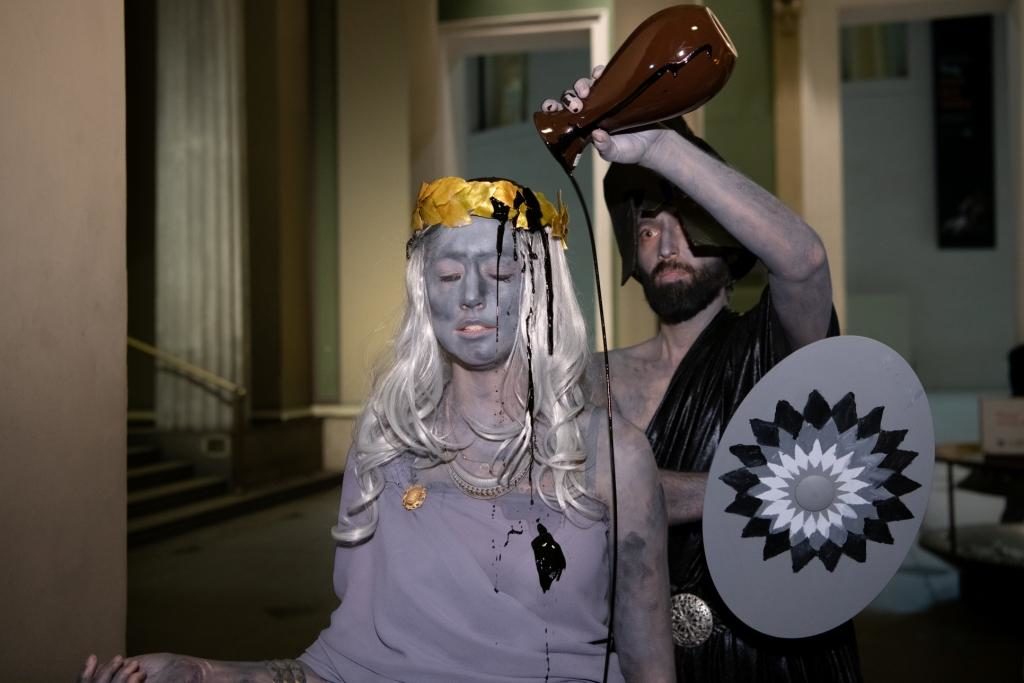
Activists from BP or Not BP protest at
the British Museum. Photo by Ron Fassbender.
The world has never needed museums more than it does today.
Before the present crisis, a new kind of humanism was already
emerging as curators sought to reframe their role as carers for
people, communities, places, and environments rather than just
conservers and presenters of objects for fleeting global audiences.
In her article, Knol from the Museum De Lakenhal called for museums
to start “telling local stories with a universal appeal, not as an
expression of provincialism, but explicitly because we need to find
new ways to understand the world.” The Ashmolean’s Rembrandt
exhibition closed within its first month, but it can now be visited online. Such digital innovation will without a
doubt proliferate and evolve—but that’s just one part of the story.
The improvisations now required of us are not dress-rehearsals for
the changes that climate emergency demands, but urgent and
necessary first steps in navigating sweeping structural change.
We can no longer justify these concentrations of art, heritage,
and culture in just a handful of metropolitan institutions, where
so little is on display. Cultural funding and objects must now be
equitably redistributed and no longer be used to prop up the most
powerful museums. At this tipping point, let’s rebalance the value
that we afford to smaller museums, those outside of the wealthiest
capitals and in smaller cities and towns, as well as across
the Global South, where museums are already being reimagined as
human processes rather than bank vaults. Let us learn from and
invest in non-universal museums that sustain different human
worlds, environments, and communities, “multiversal museums” that
care for people before caring for objects and that are unique
public spaces for building communities.
As the culture shock of these times sinks in, we must not cling
to the failed model of infinite visitor growth, but begin cultural
redistribution and de-growth that builds more equitable global
futures through art and heritage. A new sense of scale and a new
ethos of humanity, resilience, justice, remembrance, equality,
restitution, environmentalism, and care were already emerging in
the museums sector. These values must now be the building blocks of
our collective future.
Dan Hicks is an archaeologist, art historian,
anthropologist, professor of Contemporary Archaeology at the
University of Oxford, curator at the Pitt Rivers Museum, and a
Fellow of St Cross College, Oxford. Dan’s new book The Brutish Museums: The Benin Bronzes,
Colonial Violence and Cultural Restitution is now
available for pre-order from Pluto Press. Twitter: @ProfDanHicks
The post Before the Lockdown, the Public Was Agitating For a
Revolution in the Way Museums Operate. Will This Crisis Finally
Force Through Change? appeared first on artnet News.
Read more https://news.artnet.com/opinion/dan-hicks-humanism-museums-1853346
Further reading


Leave a comment