
A Vintage Hermès Address Book Bought on eBay Arrived With Some Very Notable Names Inside. Then the Buyer Discovered It Was Dora Maar’s
Author Brigitte Benkemoun’s husband bought a vintage Hermès
address book on eBay. When it arrived, Benkemoun discovered it
contained notes dated from 1951 and pages of contact information
for such artistic legends as Balthus, Brassaï, Andre Breton, Jean
Cocteau, Paul Eluard, Leonor Fini, and others. Eventually, through
some sleuthing, Benkemoun discovered the book had belonged to none
other than the artist and muse to Picasso, Dora Maar and she set
out on her own journey to discover more about Maar’s illustrious
life.
Achille de Ménerbes
22 rue Petite Fusterie
Avignon
A-B: The first entry is illegible because it is partly blotted
out with black ink. The second might be ANDRADE, then AYALA. On the
fourth line is the first familiar name: ARAGON! Followed by a few
contacts that call up nothing for me: ACHILLE de MÉNERBES, BERNIER,
BAGLUM . . . Then a few entries for whom he or she listed an
address as well, perhaps because they were closer friends: BRETON,
44, rue Fontaine; BRASSAÏ, 81, rue Saint-Jacques; BALTHUS, château
de Chassy, Blismes, Nièvre.
For the letter C, COCTEAU is the first entry: 36, rue de
Montpensier, RIC 5572, or 28 in Milly. But are the first entries
always the closest friends? And this poet was such a figure on the
Paris social scene that everyone must have known his number.
Followed by the painters COUTAUD, 26, rue des Plantes; CHAGALL, 22,
place Dauphine . . .
The gaze behaves like a paparazzo, snubbing the lesser-knowns to
focus only on the VIPs: ÉLUARD, GIACOMETTI, Leonor FINI, NOAILLES,
PONGE, POULENC, Nicolas de STAËL . . . But most of the names in the
address book were easy to identify on the internet: Lise DEHARME,
novelist and muse for the Surrealists; Luis FERNÁNDEZ, painter and
friend of Picasso; Douglas COOPER, major art collector and
historian; Roland PENROSE, English Surrealist; Susana SOCA,
Uruguayan poet . . .
This list was beginning to look like a postwar who’s who, a
roster of special guests posted outside a reception, an index of
names cited in a biography of a famous artist. It also made me
think of a group photograph as it was being developed in the
darkroom, each figure emerging from the red depths one by one.
Implicitly, the address book’s ownership was being revealed
through these relationships. This was someone who kept company with
the greatest poets of the time, many of them, though not
exclusively, Surrealists: ÉLUARD, ARAGON, COCTEAU, PONGE, André du
BOUCHET, Georges HUGNET, Pierre Jean JOUVE. Someone who moved even
more frequently among painters: CHAGALL, BALTHUS, BRAQUE, Óscar
DOMÍNGUEZ, Jean HÉLION, Valentine HUGO. Many Surrealists, some
gallery owners, a canvas restorer. This was probably a painter’s
address book! And since it included LACAN’s telephone number, this
painter must have stretched out on his couch.
A tormented, depressive, “hysterical,” or melancholic painter.
But not a bohemian, not a cursed poet: he or she kept both feet on
the ground and recorded contact information for a plumber, marble
mason, private hospital, veterinarian, and hairdresser. I was
certain the address book belonged to a woman.
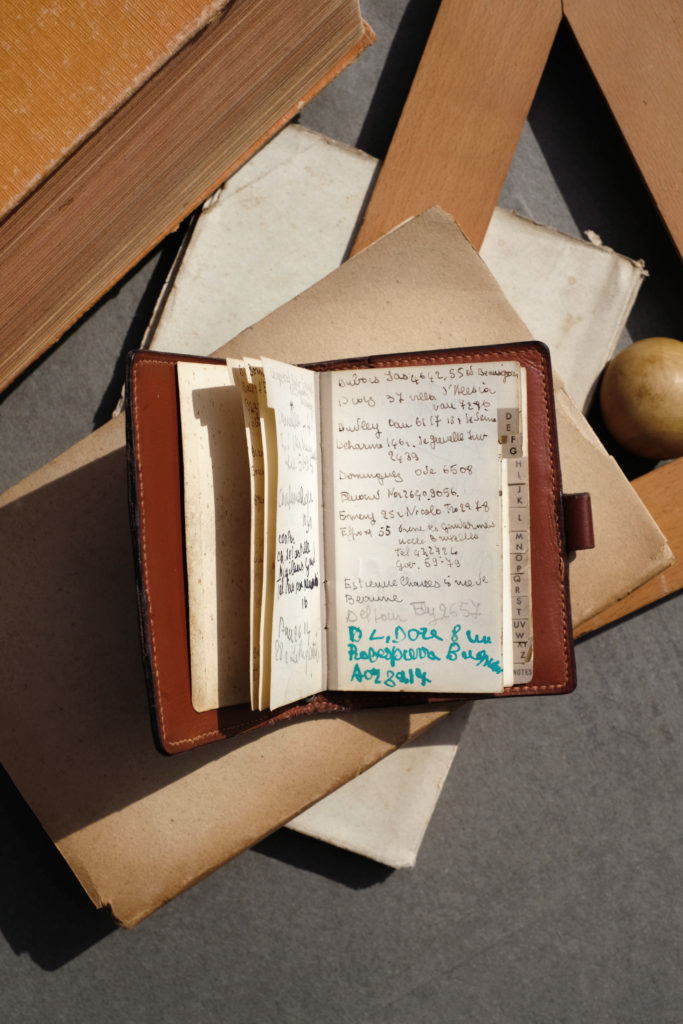
Dora Maar’s notebook. Photo by Roxane
Lagache. Courtesy of Éditions Stock.
To summarize: a woman, a painter, with strong ties to the
Surrealist movement, psychoanalyzed by Lacan, and associated with
the greatest of the great. If one wanted to quibble, four or five
of the century’s giants were missing here: Picasso, Matisse, Dalí,
Miró, René Char. But more important than those missing was the
missing owner: the woman who held the pen and gave us this
photograph of her world in twenty pages. Sometimes she made
spelling mistakes or got names wrong: she wrote Rochechaure instead
of Rochechouart, Leiris with a y, and Alice Toklace rather than
Toklas. She was a foreigner, or dyslexic.
At first, she made an effort. Each page begins with a list of
carefully written names—always using the same pen—undoubtedly
copied from an earlier address book. The letters are even, somewhat
rounded, the stroke energetic but neat. And then, after a few
lines, the handwriting becomes confused and disorderly. These were
the new contacts for the year 1951 whose numbers she added later,
scribbling them down, one hand holding the phone, the other
reaching for the closest pencil. Or maybe that day she was more
irritated, or tired, or in a hurry.
At a used-book stall, I discovered an enormous 1952 phone
directory. It weighed at least five kilos and had a weathered
orange cloth cover with advertisements printed on the spine. With
this new resource, I cross-checked the names and addresses in the
address book to compare and verify them. Jacques Lacan’s number did
correspond to the one in the book: LACAN, physician, 30, rue de
Lille, LIT 3001. But BLONDIN, avenue de la Grande Armée, with the
same name as the writer, was a surgeon. There were at least three
other numbers for doctors. More surprising: TRILLAT, graphologist.
So the owner was curious about other kinds of analysis. More
frivolous: a beauty parlor, a furrier on boulevard Saint-Germain. I
was beginning to imagine a stylish artist, maybe very beautiful as
well. MICOMEX, rue de Richelieu, import-export: she must have
needed to ship her paintings. I went back and forth between
directory and address book. From address book to Google. From
Google to Wikipedia. Each tiny discovery seemed like a victory.
But some names remained indecipherable or elusive. Camille?
Katell? Paulette? Lorraine? Madeleine? Women’s first names, jotted
down to be read only by the one who wrote them and knew them so
well that the surnames were superfluous. I was reminded of Patrick
Modiano’s remark, trying to track down Dora Bruder: “Often, what I
know about them amounts to no more than a simple address. And such
topographical precision contrasts with what we shall never know
about their life—this blank, this mute block of the unknown.”
Achille de MÉNERBES also remained a mystery. She had noted his
address, 22, rue Petite Fusterie, in Avignon, and his telephone
number, 2258. But seventy years later, it was as if this man never
existed. He had left not a trace. Why linger over this name? If I
were sensible, I would move on to the next one. Nevertheless, this
Achille was like a band-aid stuck to my fingers—good thing it
wouldn’t let go! Suddenly, under the magnifying glass, the letters
fell into place. I had been reading too quickly or not carefully
enough. She hadn’t written “Achille de” at all, but
“Architecte”!
“Architecte Ménerbes.” She must have owned a house in this
village in the Luberon, and she must have needed an architect from
Avignon to supervise the work. My fingers trembled as they punched
out the letters on my computer keyboard. The Wikipedia page on
Ménerbes revealed that only two painters spent time there in the
early 1950s. I automatically eliminated Nicolas de Staël, since he
appeared among the contacts. The second name was that of a woman:
painter, photographer, driving force behind the Surrealists, close
friend of Éluard and Balthus, analyzed by Lacan. Of course, it must
be her! Everything fit, it all matched, up to Picasso’s absence at
the letter P. In 1951, six years after their breakup, she did not
copy his address or his phone number into her new address book, not
being able to erase him in any other way. Maybe this wasn’t “a
Picasso.” But it was the address book of Dora Maar that I held in
my hand!
I think I remember letting out a cry, shrieking like a soccer
player who has just scored a goal, yelling and making fists,
screaming—bizarrely—“YES!” Then I called T.D. No answer. Stupid
telephone! No one to shout to—“I found it!”
“First I find, then I seek,” said Picasso. That was exactly what
I was going to do—seek to understand.
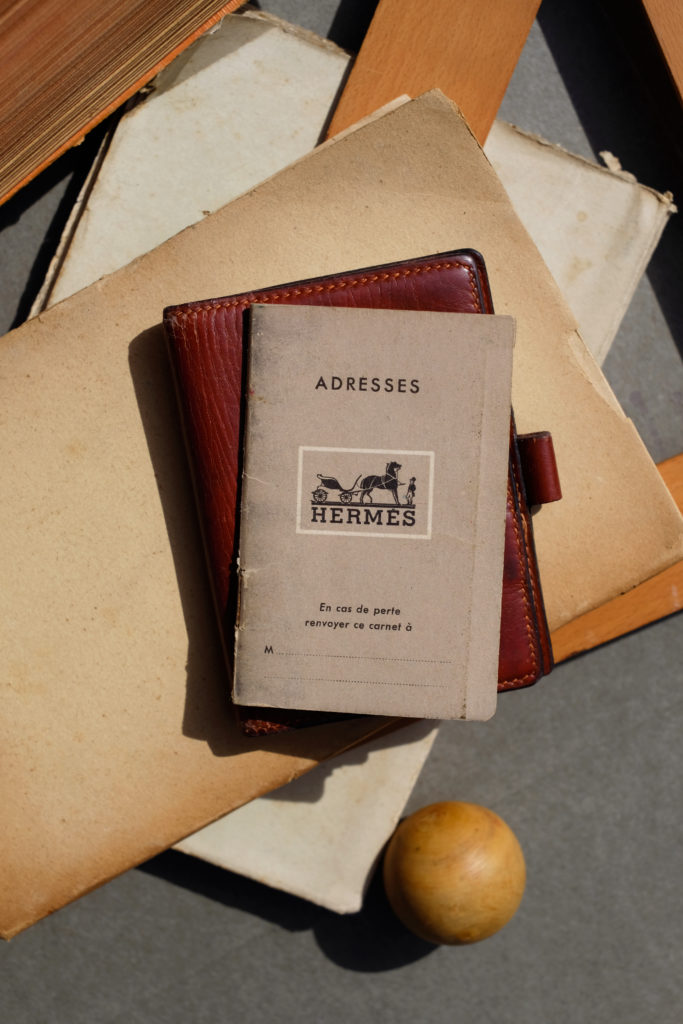
Dora Maar’s notebook. Photo by Roxane
Lagache. Courtesy of Éditions Stock.
Theodora Markovitch
6 rue de Savoie
Paris
Dora Maar. At first, only the photographs came to mind: Picasso
naked to the waist, Picasso in his striped swimming trunks, Picasso
painting Guernica . . . And then, all those paintings he did of
her, depicting her as “the weeping woman,” disfigured, devastated
by grief.
Thank goodness for Google. I surfed, I clicked, I did not read
so much as devour: “Dora Maar, French photographer and painter,
Picasso’s mistress . . .” “Dora Maar, from her given name Henriette
Theodora Markovitch, born November 22, 1907, in Paris . . .” “Only
daughter of a Croatian architect and Touranian mother . . .” “Spent
her childhood in Argentina before returning to live in France . .
.” “Friend of André Breton and the Surrealists . . .” “Mistress of
Georges Bataille . . .” Dates, cities, names. “Dora Maar,
remarkable twentieth-century figure . . .” “Profoundly original
style . . .” And always the references to Picasso: he “loved other
women more passionately, but none had so much influence over him .
. .” “Picasso pushed her to give up photography . . .” “Picasso
left her for the younger Françoise Gilot . . .” Snippets from a
life, flashes of suffering: institutionalized, electric shock
treatment, psychoanalysis, God, solitude. So the woman who owned
this address book had been Picasso’s companion for almost ten
years, from 1936 to 1945. Before him, she had been a great
photographer. After him, a painter who sank into madness, then
mysticism, and finally reclusion.
I had fun making a list of the adjectives attached to her,
hoping that a portrait would emerge from this cloud of words:
beautiful, intelligent, shy, willful, volatile, quick-tempered,
haughty, unyielding, impetuous, proud, cultivated, authoritarian,
snobbish, vain, mystical, mad . . .
Most of the newspaper articles about her dated from her death in
1997 and the sale by auction of her estate: 213 million euros
divided up among experts, auctioneers, genealogists, the state, and
two distant heirs in France and Croatia who had never met her.
In the end, I wrote down this sentence, copied and pasted so
often on the internet I don’t know how to credit it: “She was Pablo
Picasso’s mistress and muse, a role that eclipsed the entirety of
her work.” A cruel legacy that preserves only the role of mistress
and casts an entire life’s art in the shadow of a giant. Cruel but
irrevocable. Who knows Dora Maar’s work? Who remembers that she was
one of the rare women photographers accepted among the Surrealists?
Who recognizes that she devoted sixty years of her life to
painting?
Her most famous photographs are the portraits of Picasso. But
the most astonishing ones come earlier: dreamlike experiments,
Surrealist collages, shots capturing social issues. Before she had
even met the Spanish painter, she was more famous than her friends
Brassaï and Cartier-Bresson, and she had not yet turned thirty.
Even today, collectors and major museums fight over her prints at
auctions. But that is not the case with her paintings, to which she
attached much greater importance.
Many authors have already examined her fate: a few serious
biographies, some novels loosely based on her life, and many art
books. They are almost all written by women, fascinated by what
became of her and the mystery of a tragic heroine who, like Camille
Claudel or Adèle Hugo, devoted and abandoned herself to passion.
And here I was, joining their ranks.
She must have started entering names in the address book in
January 1951. In Paris, an icy wind was blowing from the north. It
snowed for New Year’s Eve. On rue de Savoie it must have been very
cold, especially since she had a tendency to scrimp on coal. From
the leather writing case on her mahogany desk, she took one of the
quill pens that Picasso had given her. Nothing had been moved in
six years. She still slept in the Empire bed where they had made
love and still lived among his gifts, his paintings, his
sculptures, his little makeshift constructions that she stashed in
drawers. Above all, she hadn’t repainted the walls; it would be
sacrilege to cover over the insects that the master had drawn in
the cracks to amuse himself.
I imagined her carefully filling the small booklet page by page.
She would have begun with the As, then moved on to the Bs. But
without strictly following alphabetical order. She must have used
this occasion to make a selection; the friends who betrayed her no
longer warranted an entry. Sometimes she hesitated: What was the
use? Sometimes she kept them as one keeps a photo or a memento. The
hardest to eliminate were the deceased, who must have seemed like
ghosts from the oldest address books. By deleting their names, she
buried them one more time.
This address book was a snapshot of her world in 1951: layers of
friends and acquaintances accumulated over the years, and a few new
ones, surely. But who really mattered in this list? Who telephoned
her? What numbers did she dial? If someone found our smartphone
contacts today, wouldn’t they see our favorites, reconstruct the
history of our calls, read our texts and emails, listen to our
messages? They would know our entire lives. This book of hers was
silent as the grave. Nevertheless, it could speak of the delicate
hands, fingernails forever polished, that slipped it into or
retrieved it from her handbag. It could name her true friends. It
could remember conversations, confidences, arguments, laughter, or
tears, for which it was the only witness. It could also recall her
moments of solitude, when it sat there closed, it and the cat her
only companions.
This excerpt is from the new
publication Finding Dora Maar: An Artist, an Address
Book, a Life by Brigitte Benkemoun and translated by Jody
Gladding © 2020 J. Paul Getty Trust.
The post A Vintage Hermès Address Book Bought on eBay
Arrived With Some Very Notable Names Inside. Then the Buyer
Discovered It Was Dora Maar’s appeared first on artnet
News.
Read more https://news.artnet.com/art-world/finding-dora-maar-excerpt-1854561
Further reading


Leave a comment