
Museums Have Long Relied on the Money They Raise at Glitzy Galas. What Can They Do Now That the Party’s Over?
The artist-designed centerpieces are in storage. The musical
guests are staying home. And the chicken, fish, and vegetarian
entrees are all off the menu.
For the first year in decades, almost no museum in the United
States will hold its annual spring gala, black-tie dinner, or
benefit as scheduled. Some events have been postponed indefinitely;
others have been cancelled outright. And that’s a problem: special
events can constitute as much as 20 percent of a museum’s operating
budget, according institutions surveyed by Artnet News.
But some museum leaders say that the temporary pause on galas
may also encourage institutions to become more inventive with their
fundraising, and may precipitate
lasting change to a model that, they believe, is long overdue for a
rethink.
When factoring in the cost of
renting space, paying caterers, printing invitations, and
dedicating extensive staff time to planning, galas are often not
efficient forms of fundraising. “The fact is that many museums have
annual ‘fundraising’ events, beloved by members and volunteers,
that don’t actually make a profit once you count in the staff time
needed to run them,” said Elizabeth Merritt, the founding director
and current vice president of the Center for the Future of
Museums.
To be sure, galas do bring in
cash. And they have benefits that are less immediate and tangible,
such as cultivating relationships and creating good memories. One
could describe them the same way Winston Churchill famously
described democracy: the worst option, except for all the other
options that have been tried before.
But now, institutions may be
forced to find other ways to encourage donations than orchestrating
the rush of a live charity auction or an inspiring speech.
“Can museums create efficient and
effective models that separate the experience from the request to
give?” Merritt asked. “I hope the answer is yes—as such a model
would also be far more resilient in the face of
disasters.”
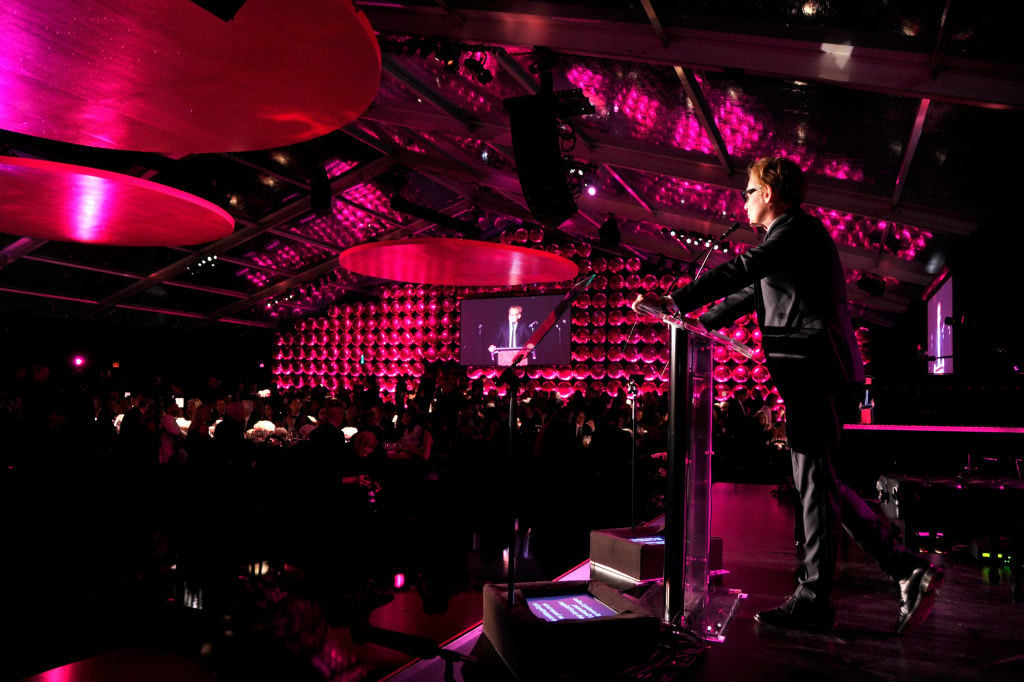
MOCA Director Philippe Vergne speaks at
the MOCA Gala 2017 honoring Jeff Koons at The Geffen Contemporary
at MOCA on April 29, 2017 in Los Angeles, California. Photo: John
Sciulli/Getty Images for MOCA.
Gaga for Galas
For many museums, galas and
benefits represent a significant portion of the annual operating
budget. The Museum of Contemporary Art, Los Angeles’s big
benefit—which last year welcomed guests including Katy Perry, Billy
Idol, and Sharon Stone—represents roughly 10 percent of its annual
purse. (This year’s event was originally scheduled for the third
week of May before being pushed to the fall.) The New Museum’s
spring benefit, which typically takes over the cavernous Cipriani
Wall Street, provides 15 percent of its budget. (It was recently
cancelled altogether.) For comparison, a recent survey conducted
by the Association of Art Museum Directors estimated admission
fees comprised, on average, six percent of a museum’s total
revenue.
The Contemporary Austin’s May
Art Dinner, a black-tie dinner for approximately 300 guests that
has been moved to October, accounts for $1.2 million, or a full 20
percent of the museum’s budget. In the best-case scenario, the
Contemporary may indeed see that money eventually. But until then,
the institution’s books will be thrown out of balance—and
museums in Texas
are already starting to reopen.
Indeed, even as museums are
juggling the difficult logistics of preparing to welcome visitors
for the first time since the lockdown, they are simultaneously
trying to figure out whether they can safely hold the fundraising
events they rely on this year, or further down the line. When will
mass gatherings be allowed? Will the recession leave the donor base
in a position, financially, to give? Will they even be in the mood
to attend a party? Who wants to toast with a mask on?
“If we are able to hold our Art
Dinner in October, we imagine it will likely be modified in some
ways,” Margie Rine, the Contemporary Austin’s interim executive
director, told Artnet News.
Rine is uniquely positioned to
navigate the challenges of fundraising: She also serves as the
museum’s director of development. And she agrees the gala model is
ripe for change. “Although special events can generate
excitement, enhance a museum’s profile, and raise important funds,
they also require a great deal of effort and resources and can be
adversely affected by weather and, as we are now seeing, by a
pandemic,” Rine said. “Although special events have always been
part of a museum’s fundraising revenue strategy, I believe they
will play a less prominent role.”
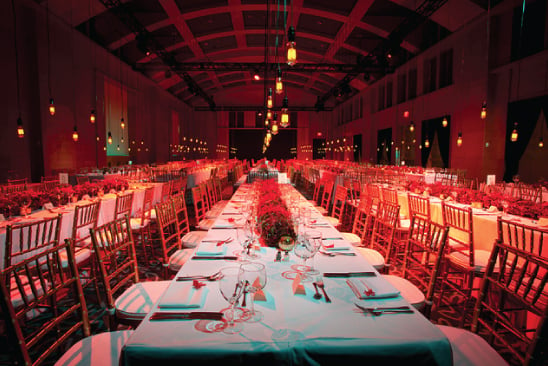
The Minneapolis Institute of Art Gala.
Courtesy of the Minneapolis Institute of Art.
New Models
As IRL events were cancelled
this spring, museums and other cultural institutions quickly worked
to develop a new kind of benefit event: one that adapts the
in-person experience to the virtual realm. Though so far, they have
perhaps been less an example of innovation than a product of
desperate improvisation.
On the first Monday in May, the
Metropolitan Museum of Art’s Fashion Institute was supposed to hold
its annual star-studded gala—one that costs $35,000 a ticket and is
said to fund the department’s operations for a year. Instead, it
launched a virtual challenge, soliciting Met Ball-inspired looks
from social media users. #MetGalaChallenge didn’t raise any money for the Costume
Institute, but it was a hit publicity-wise. “It was far more
accessible and egalitarian than the ultra-exclusive physical
event,” noted Merritt. (After initially being “postponed
indefinitely,” the real 2020 Met gala was canceled outright last
week. Page
Six reports that organizers have been reaching out to
ticket-holders to encourage them to make donations rather than ask
for a refund.)
The Metropolitan Opera was one
of the first to transition its annual event online when it held
an At-Home Gala
in late April, replete with
musicians performing on a livestream. Meanwhile, New York’s Tenement Museum offered
to send the attendees of its 2020 virtual
gala “a Lower East Side
box dinner when things return to normal.”
This week, MoMA PS1 is hosting
its own virtual benefit in the form of an artist-run “participatory
cyberspace sitcom.” The dress code for the variety show, which,
according to the invitation, will feature “live performances,
music, and ¯\_(ツ)_/¯,” is “webcam glam.”
While the impulse to find
alternative ways to host a benefit is understandable, it remains to
be seen whether it will be sustainable. “Philanthropy will likely reduce its reliance
on special event fundraising,” Rine said, “and increase its focus
on building stronger and longer-term relationships with individual
donors, foundations, and corporations.”
The National Museum of Women in
the Arts in Washington, DC has found some success in this regard.
After the institution was forced to cancel its spring gala, which
in the past has generated on average $800,000, 100 percent of
event’s would-be attendees and sponsors agreed to “transfer their
support into fully tax-deductible contributions to the museum,” a
representative said.
“We are most grateful to all our
supporters and are amazed to report that we experienced no loss
from a fundraising perspective,” the representative added. “The
support this year was truly a miracle.”
The post Museums Have Long Relied on the Money They Raise at
Glitzy Galas. What Can They Do Now That the Party’s Over?
appeared first on artnet News.
Further reading


Leave a comment