
The Lost Jean-Michel Basquiat: A New Auction House Just Sold the Only SAMO Tag to Ever Come to Market
In late May, Capsule Auctions, a small house established three
years ago out of a storefront in New York’s Alphabet City,
announced that it would be auctioning off an oil-on-tarp
work by Jean-Michel Basquiat that had never been sold by its
original owner. When bidding on the work, which depicts Basquiat’s
SAMO tag, opened on May 28, several collectors pushed the
price well past the high estimate of $25,000, and it finally
hammered, with fees, for $71,875.
“It’s exactly what we want to be selling,” said Simon Baranoff,
the cofounder of Capsule. “It’s the kind of unique New York work
that we want to bring to market. We’ve sold things for more, but
it’s really the direction that we’re excited about—to bring a fresh
discovery to market.”
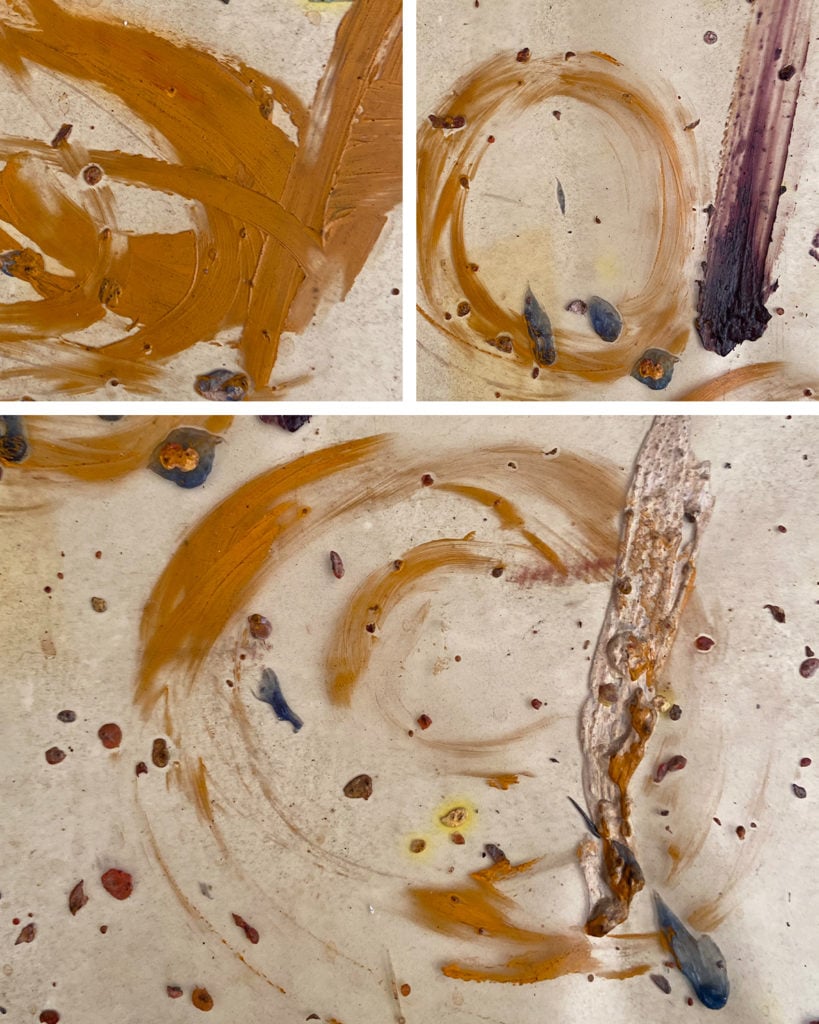
A detail of the lot. Photo courtesy
Capsule Auctions.
There and Then Not
Just under $72,000 for a modestly sized work by Basquiat is a
once-in-a-lifetime steal. Drawings at its scale (it’s five feet by
two-and-a-half feet) often sell into the millions, and in 2017, the
Japanese billionaire Yusaku Maezawa bought a gigantic Basquiat
skull painting for $110.5 million.
What’s more, the Capsule lot is a special rarity in the artist’s
oeuvre: a work with his SAMO tag had never before gone to
auction, according to the Artnet Price Database. It
stands for “same old shit,” but that shrugged-off energy was
typical Basquiat-ish misdirection. Basquiat cared deeply about the
tag, which he used to plant around Manhattan with artist Al Diaz.
Before Basquiat took it over on his own (and killed it off with
great fanfare at the end of 1979, writing SAMO IS DEAD all
over the city), the tag appeared throughout the East Village,
Lower East Side, SoHo, and very prominently around the urban campus
of the School of the Visual Arts.
But besides the tag, there’s no other indication that the
Capsule work is a Basquiat. It’s not in any catalogue. Nor was
it authenticated by the artist’s estate, which disbanded its
authentication committee in 2012, after reviewing 2,000 works and
deciding it had “fulfilled its goal.” Diaz and other
contemporaries that checked out the painting confirmed for the
auction house that, from their perspective, it was made by the
hand of the artist.
But its official status is still up in the air. Unlike the
world-creating landscapes and gigantic canvas-eating skulls
Basquiat would make later in his career, the work is something of
an intriguing curio, a Basquiat-related object.
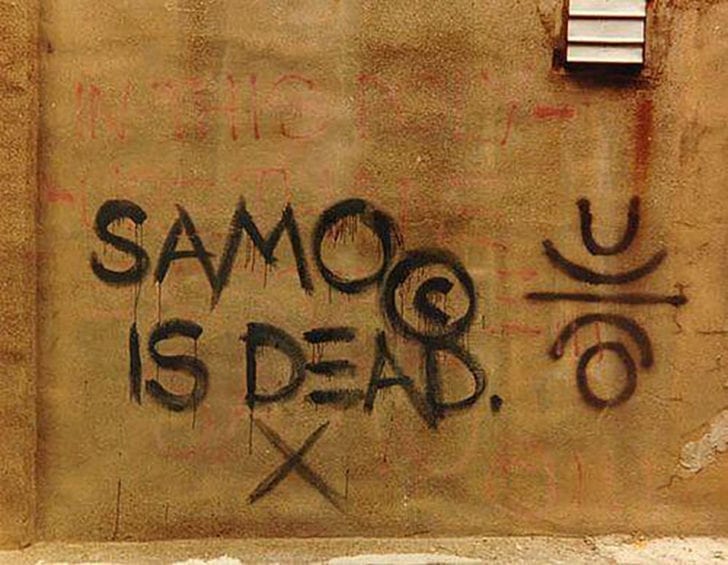
A SAMO tag declaring, somewhat
antithetically, that SAMO is dead. Photo courtesy YouTube.
“We priced it as a unique ephemeral work, and then let the
market decide where it should be,” Baranoff said.
It clearly had an allure for a Basquiat completist, or even an
ardent fan. It’s an artifact from his graffiti days, and such
artifacts are rare. “It is a unique situation, an early tag
not from a spray can, but from a brush,” Baranoff said. “We hadn’t
seen a truly comparable work offered at auction before.”
Though such works are often separated from the paintings and
drawings Basquiat made under his own name, his early followers
treated them as part of his practice. “Back in the late
seventies, you couldn’t go anywhere interesting in Lower Manhattan
without noticing that someone named SAMO had been there first,”
Jeffrey Deitch wrote in the first-ever published review of
Basquiat’s work in Flash Art. “His disjointed
street poetry marked a trail for devotees of below-ground art/rock
culture.”
But no SAMO works were in the show at Annina Nosei that Deitch
reviewed, and not just because Basquiat had moved on. The tags were
ephemeral by nature, meant to be impermanent, washable, there and
then not.
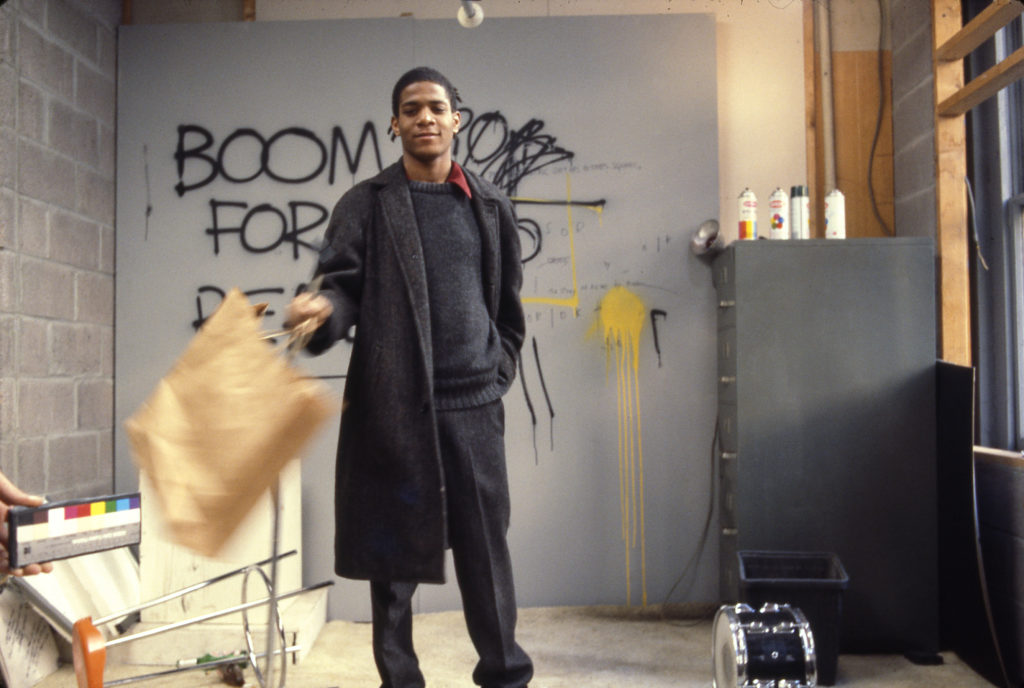
Edo Bertoglio, Jean-Michel Basquiat on
the set of Downtown 81, 1980–81, © New York Beat Film LLC, By
permission of The Estate of Jean-Michel Basquiat, Licensed by
Artestar, New York, Photo: Edo Bertoglio.
“Jean-Michel Was Kind of a Pompous Jerk”
Where did such a strange Basquiat object/artifact/tag came
from?
It came to Capsule as part of the estate of a man named
Vincent Strautmanis, who died in 2018. The trove, consigned by his
widow, Maryellen Strautmanis, mostly consisted of
canvases by Strautmanis’s father, a first-wave SoHo artist named
Edvins.
Growing up in his father’s Greene Street loft in the 1970s,
Vincent spent time with neighborhood kids, including
19-year-old Brooklyn exile Basquiat, who was at the time tagging
his nom de graffiti around the gallery-stuffed district and
sleeping in Tompkins Square Park and at pads of girlfriends, all
the while hustling and self-promoting on the verge of fame.
“My husband was friends with Jean-Michel, he would come over and
crash, as everyone knew that Vincent’s father was an artist, and
they would hang out and talk art and smoke pot,” Maryellen
Strautmanis told me on the phone this week. “Jean-Michel had
kind of a crush on my husband’s sister, so he spent a considerable
amount of time hanging out on the sofa crashing.”
One day while at the Greene Street loft, in what the family says
was 1979, Basquiat approached the tarped-off corner of the
apartment where the elder Strautmanis had his studio. Trying to get
his attention, the young Jean-Michel found a paintbrush and
promptly defiled the makeshift studio’s tarp wall with his
notorious tag.
“My father-in-law…—the artist was very upset,”
Maryellen Strautmanis said, laughing. “Jean-Michel wasn’t really a
fun guy to hang with, he was kind of a pompous jerk, I don’t know
why my husband was such good friends with him.”
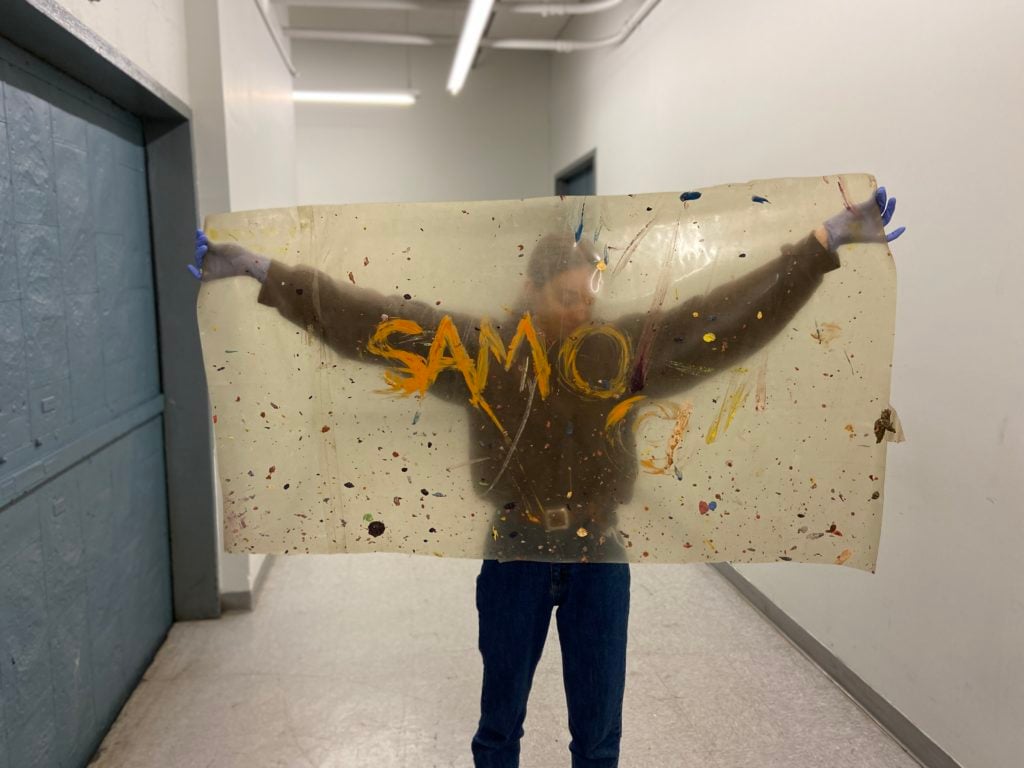
The SAMO-tagged tarp, helped by an art
handler. Photo courtesy Capsule Auctions.
Still, Maryellen Strautmanis couldn’t deny the power of having a
large Basquiat tag installed in the apartment, both for its
historic resonance and aesthetic urgency.
“It’s big, it’s beautiful, and you can totally see the
brushstrokes—he dipped it in the paint and slopped this thing on
the tarp,” she said. “It was distinctly him.”
Strautmanis doesn’t regret parting ways with it—it had been in
the loft for years, and her six children grew up their dad’s
stories about how his long-gone famous pal once made a custom work
in the same place they grew up. (There’s still a SAMO-tagged
haiku that Basquiat left in one of the bedrooms, and Strautmanis
says she will sell that one day as well.)
She added that, yes, the tag is more of a piece of Basquiat
ephemera than one of his full-fledged artworks. But authenticated
or not, it’s imbued with the old magic of the art scene that once
flourished around her apartment.
“It was really a piece of SoHo, and a piece of history,” she
said. “There’s some great value to have it out there in the
world.”
The post The Lost Jean-Michel Basquiat: A New Auction House
Just Sold the Only SAMO Tag to Ever Come to Market appeared
first on artnet News.
Read more https://news.artnet.com/market/basquiat-samo-tag-capsule-auctions-1878054
Further reading


Leave a comment