
Why the Art World Needs Actionable Plans, Not #BlackoutTuesday, to Fix Racial Injustice (and Other Insights)
Every Monday morning, Artnet
News brings you The Gray Market. The column decodes important stories from the
previous week—and offers unparalleled insight into the inner
workings of the art industry in the process.
This week, asking whether “doing
better” is really doing enough…
THE PUBLIC SQUARE
On Tuesday, dozens of Instagram
accounts run by for-profit and nonprofit companies, both inside and
outside the arts, posted a monochrome black square with the hashtag
#BlackoutTuesday, ostensibly in solidarity with the Black Lives
Matter movement and the push for lasting change on issues of racial
justice. The question now is how many of those pledges will be
matched by meaningful action.
Although the meme began in the
arts, it wasn’t in the visual arts. Jamila Thomas and Brianna
Agyemang, who describe themselves as simply “two Black women in
music” (both are marketing executives), originally proposed
the black square with the hashtag
#TheShowMustBePaused. They wrote that its purpose was to encourage
people to “take a beat for an honest, reflective, and productive
conversation about what actions we need to collectively take to
support the Black community.”
By Tuesday, it had spread far
beyond its music-industry focus with the #BlackoutTuesday verbiage,
reaching everywhere from art museums, galleries, and art-media
properties (including Artnet) to tech companies, fashion brands,
and carmakers.
Despite its good intentions,
though, the campaign had both fans and detractors. Anny Shaw and
Gareth Harris at The Art
Newspaper rounded up
reactions from both camps in the art industry, and Joe Coscarelli
at the New York
Times found
essentially the same spectrum of complaints in the music
world.
Critics argued that some
participants were accidentally crowding out actual resources and
news related to Black Lives Matter by hashtagging the movement’s
name alongside (or in place of) #BlackoutTuesday or
#TheShowMustBePaused. Others seemed content to use the black square
and the “day of reflection” concept as an opportunity to mimic
Michael Jordan’s “Republicans buy sneakers,
too” playbook and avoid anything but the blandest possible
language about peace and equality. (Some, like the Getty, later apologized.) Still others felt that,
even when the black square was accompanied by an unequivocal
statement of support for the Black community, the space would have
been better used to signal boost works by Black artists,
information directly assisting protesters, or encouragements to
donate to nonprofits involved in the struggle.
In one way or another, all of
the above circles the fundamental question about the art world’s
#BlackoutTuesday: Memes and statements are nice, but who’s
actually doing
anything to address the
problem?

Walker Art Center in Minneapolis,
Minnesota. Photo: Wikimedia Commons.
At least a few entities in the
art world deserve recognition for taking small but positive steps
this past week. The Walker Art Center made the biggest splash
by ending a
deal with the
Minneapolis Police Department in which off-duty cops doubled as
museum security guards. Gladstone
Gallery and
Galerie
Lelong raised a combined
$52,000 for nonprofits combating racial injustice by matching
donations up to a certain dollar figure. The Brooklyn Museum
became the first major New York art
institution to aid protesters by allowing them to use their
restrooms from 2 p.m. to 6 p.m. daily.
Still, with so many arts
organizations now making contrite public statements pledging to do
better, it’s time to ask what “do better” actually means, analyze
whether the specifics will make a difference, and follow up to see
who actually follows through.
This tweet
from the New Museum Union, in
response to a statement the museum emailed over the weekend, is a
great example of both the problem of hazy commitments (see:
implicit-bias training, internal working groups, “further
diversifying” the staff and board), and the watchdogging
we—especially we in the media—need to do going forward. (In a later
tweet, the moderators
of the union’s account claim that, in the “several” years they’ve
worked at the institution, they “haven’t heard shit about” the
implicit-bias training that will supposedly continue
there.)
In their BLM statement today, the @newmuseum admits they know they are not doing
enough and commits to absolutely nothing pic.twitter.com/vYwUzJXUWW— New Museum Union (@newmuseum_union) June 6, 2020
There’s been a lot of this going
on. Two weeks after George Floyd’s murder by Minneapolis police, my
inbox and social-media feeds suggest that announcing vague
diversity initiatives in solidarity with Black Lives Matter is the
new launching an online viewing
room: almost no one seemed to think it was important enough to
address in any concrete way for the past several years, and now all
of a sudden the entire industry wants us to believe it’s one of
their core operating principles. Crises are a hell of a
thing.
In fairness, it’s not just arts
organizations that are bombarding us with messages of dubious
sincerity on this front. Seemingly every corporation in America is
riding the wave. For instance, thank you, Gushers Fruit
Snacks, for confirming
that racial justice is indeed central to your mission to produce
small grenades of high-fructose corn syrup for children everywhere,
and that you will be “working with Fruit by the Foot on creating
space to amplify that.”
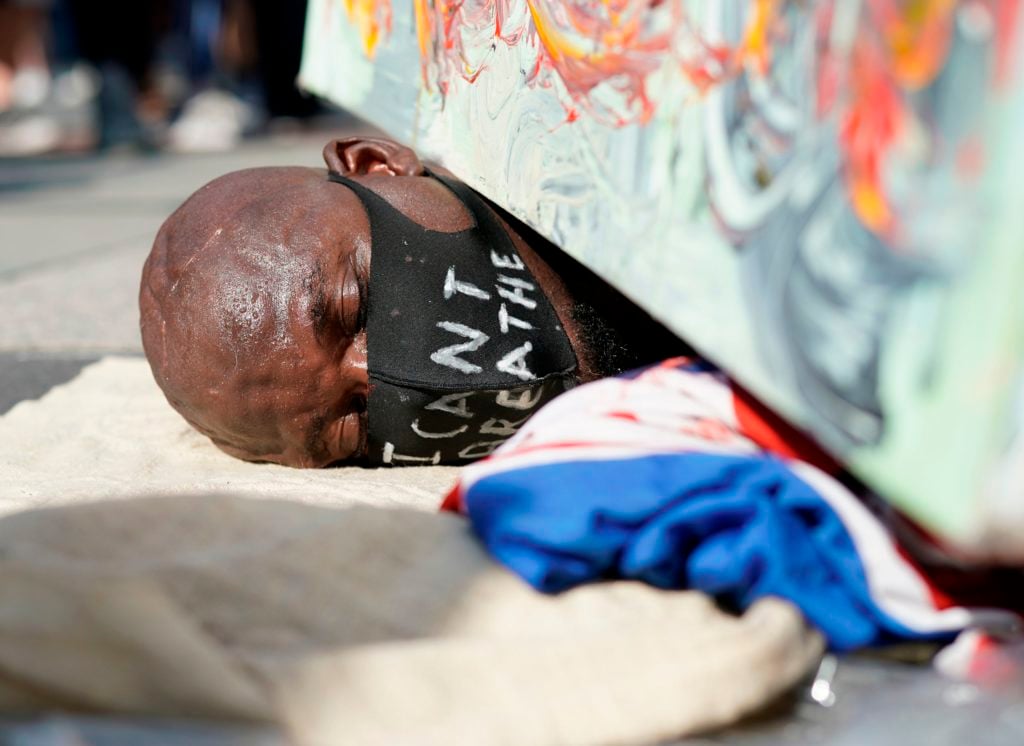
A protestor lays on the ground mimicking
the final moments of George Flyod on May 29, 2020, at Foley Square
in New York during a “Black Lives Matter” protest. (Photo by
TIMOTHY A. CLARY/AFP via Getty Images)
Back to the arts. Ironically, if
you want to know why these pledges for change demand specifics and
oversight, look at what’s resulted from similar alleged moments of
reckoning in American policing itself. US law enforcement has paved
a long road of promises for transformative action that has actually
led to no transformation at all.
In a recent episode of NPR’s
Throughline podcast,
Harvard historian Khalil Gibran Muhammad traced the racist history
of police forces in America all the way back to their inception.
Near the episode’s conclusion, Muhammad recounts acclaimed
sociologist Kenneth Clark’s testimony before then-President Lyndon
Johnson’s Kerner Commission, which sought to identify the root
causes of the civil-rights uprisings that rocked America during the
mid-1960s:
[Clark] said, I read the
report of the 1919 riot in Chicago, and it is as if I were reading
the report of the investigating committee of the Harlem riot of
1935, the report of the investigating committee of the Harlem riot
of 1943, the report of the McCone Commission of the Watts riot of
1965. I must again in candor say to you members of the commission,
it is a kind of “Alice In Wonderland” with the same moving picture
re-shown over and over again, the same analysis, the same
recommendations, and the same inaction.
Muhammad goes on to link this
shameful repetition to the review boards and investigative
commissions formed in response to the police killings of Black
teenagers Michael Brown in Ferguson in 2015 and Laquan McDonald in
Chicago in 2017, saying:
[I]t seems to me that what’s
possible is recognizing that police officers and police agencies
are incapable of fixing themselves. They’ve never been able to do
it, and they’ve never particularly been compelled to do it. The
incentives have never quite added up to be strong
enough.
We’ve seen a similar movie play
out in the arts, as well, particularly on the
nonprofit side. Time to
see if this industry, unlike the police, is finally ready and able
to hold itself accountable—or whether it too can only achieve
justice by being dismantled.
That’s all for this week. ‘Til
next time, remember: If you’re not part of an actionable solution,
you’re part of the problem.
The post Why the Art World Needs Actionable Plans, Not
#BlackoutTuesday, to Fix Racial Injustice (and Other Insights)
appeared first on artnet News.
Read more https://news.artnet.com/opinion/the-gray-market-blackout-tuesday-and-other-insights-1880847
Further reading


Leave a comment