
5 Curators, Artists, and Art Historians on the Most Consequential News Images Since the Death of George Floyd
In the weeks since the police killing of George Floyd in
Minneapolis, an international protest movement has sprung up with
widespread grassroots support.
Aided by the rapid-fire spread of images and information on
social media and through news publications, the protests have
emerged as a new civil rights movement, with clear demands for
changes in law enforcement, new approaches to the distribution of
resources, and uncontroversial demands for the right to life.
Photographers around the US—amateurs and professionals—have
captured demonstrations and memorials in images that are at once
inspiring and harrowing. We asked a handful of curators,
artists, and historians to tell us which images have struck them
especially, and why.
Isolde
Brielmaier
Curator at Large, International Center of Photography
A protester takes a knee during a #SanJose protest on Friday after #GeorgeFloyd‘s death in #Minneapolishttps://t.co/F7x74e8xmq@mercnews @EastBayTimes #GeorgeFloydprotest pic.twitter.com/2vfUo3IO9o
— Dai Sugano (@daisugano) May 30, 2020
This was taken by photographer Dai Sugano in San Jose in May
2020, during a Black Lives Matter and George Floyd protest.
The image is so powerful and embodies the ways in which Black
people (and here, Black women) have always taken, and continue to
take, a stand and speak truth to oppressive power and systemic
racism, even when that power comes face-to-face with you and
threatens your very being, your life.
This picture embodies what is right and what is deeply, deeply
wrong with our country, and it confronts us with the standstill—the
roadblock—that we will continue to run up against until we honestly
address our country’s history of racism, violence, terror against
Black people.
Rujeko Hockley
Assistant Curator, Whitney Museum of American Art
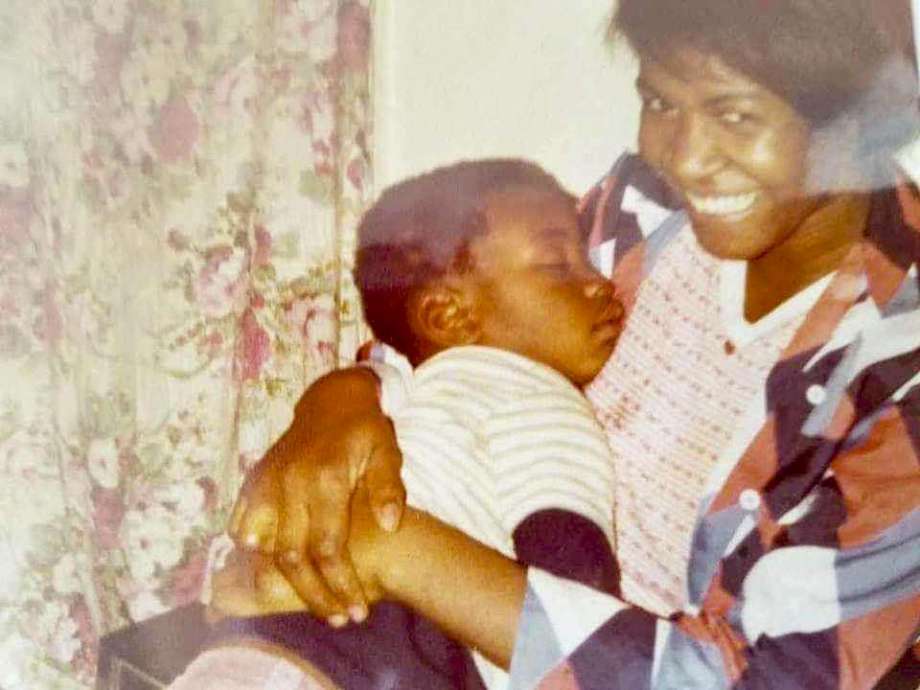
George Floyd as a small boy with his
mother.
Whenever I think of George Floyd, I think of this photograph—a
pieta of sorts. His mother smiling sideways at the camera with her
arms around her sleeping boy, his face soft and sweet and utterly
trusting. This image is seared in my mind, maybe because it is so
regular, so familiar. I feel the warmth and weight of his head on
my chest like I feel my child’s, like I remember the safe haven of
my mother’s arms. As his life was violently taken, as he narrated
his own murder, he cried “Mama.” At 46 years old, himself a father,
he called out for his mother. It pierces me to my core.
Everyone is someone’s baby, everyone has been rocked to sleep in
someone’s arms, everyone is fiercely loved by someone. George
Floyd, Breonna Taylor, Tony McDade, Ahmaud Arbery, Nina Pop, Robert
Fuller, Oluwatoyin Salau, and every single other person, known or
unknown: they were stolen from us and from the people who love
them. As James Baldwin told us, a person is more important than
anything else. It’s time we started acting that way.
Valerie Cassel
Oliver
Curator of Modern and Contemporary Art, Virginia Museum of
Fine Arts
"background:#FFF; border:0; border-radius:3px; box-shadow:0 0 1px 0 rgba(0,0,0,0.5),0 1px 10px 0 rgba(0,0,0,0.15); margin: 1px; max-width:500px; min-width:326px; padding:0; width:99.375%; width:-webkit-calc(100% - 2px); width:calc(100% - 2px);">
View this post on Instagram
I was struck by an image that popped up on Instagram during the
protests at the Robert E. Lee monument in Richmond. A man is
holding a sign stating, “Rumors of War Wasn’t a Rumor.”
It struck me, as it showed how the Kehinde Wiley monument
[titled Rumors of War], now permanently installed at the
VMFA, reverberated in the larger imagination. Artists and
their works are often prescient!
Jasmine Wahi
Social Justice Curator, Bronx Museum
"background:#FFF; border:0; border-radius:3px; box-shadow:0 0 1px 0 rgba(0,0,0,0.5),0 1px 10px 0 rgba(0,0,0,0.15); margin: 1px; max-width:500px; min-width:326px; padding:0; width:99.375%; width:-webkit-calc(100% - 2px); width:calc(100% - 2px);">
View this post on Instagram
Kevin Claiborne, who’s currently a first-year student in
Columbia’s MFA department, captures this moment—memorializes it—in
such a reflective and maybe even introspective way.
The caption (“If you see this, please don’t give up”) is the
refrain in an epic song that’s lasted 400-plus years. What I am
especially drawn to are these moments of quietude and pause.
Mainstream media painted a grim and one-sided picture of what the
protests look like. These photos show another reality and depict
people embracing, people taking a beat, people in communion and
camaraderie in the belief that Black Lives Matter.
Hank Willis
Thomas
Artist
"background:#FFF; border:0; border-radius:3px; box-shadow:0 0 1px 0 rgba(0,0,0,0.5),0 1px 10px 0 rgba(0,0,0,0.15); margin: 1px; max-width:500px; min-width:326px; padding:0; width:99.375%; width:-webkit-calc(100% - 2px); width:calc(100% - 2px);">
View this post on Instagram

A Wildcat whispered, “Put your Wake Up capes on.” Take the red
pill. This is a moment of time, space, and revolution. If money is
speech, we believe everyone should have enough to be heard. What we
ask is simple! Give us our own future.
The post 5 Curators, Artists, and Art Historians on the Most
Consequential News Images Since the Death of George Floyd
appeared first on artnet News.
Read more https://news.artnet.com/art-world/news-images-george-floyd-protests-1888635
Further reading


Leave a comment