
7 Scientific Pioneers Who Were Also Artistic Visionaries, From the Inventor of the Morse Code to the Founder of Neurobiology
Art and science are often
thought to fall on opposite sides of the left-right brain divide,
but history has proven time and again that many of the brightest
minds are polymaths.
Leonardo da Vinci, the greatest
of all the artist-scientists, once wrote, “To develop a complete mind: Study the science
of art; Study the art of science. Learn how to see. Realize that
everything connects to everything else.” His suggestion is being
taken even today, with many medical schools requiring soon-to-be doctors to take
art and art history classes, while contemporary artists
including Trevor Paglen, Anicka Yi, and Neri Oxman find
influences in astronomy, biology, and geology.
From adventuring woman botanists to the
drawing-enthused father of modern neuroscience, learn more about
art history’s great scientific minds below.
Maria Sibylla Merian
(1647–1717)

Maria Sibylla Merian, Metamorphosis
insectorum Surinamensium (1705). Courtesy of Wikimedia
Commons.
Scientific Contributions:
A 17th-century naturalist and botanist, Merian was one of the first
European scientists to directly observe insects.
When she started her research,
insects were still commonly referred to as “beasts of the devil”
and were thought to spontaneously generate from mud.
Her most influential studies
detailed the metamorphosis of caterpillars into butterflies—a
phenomenon that was largely undocumented before her
investigations. She penned a two-volume book on caterpillars,
with each accompanied by 50 plates of engravings, and is today
considered one of the pioneers of the field
of entomology.
Artistic Pursuits: Before her scientific
investigations, Merian first
earned acclaim as a botanical artist, publishing a three-volume
series, each of 12 illustrated plates of flowers, in 1675. As was
common at the time, these decorative illustrations, which were not
drawn from direct observation, were intended to be used by
upper-class ladies as designs for embroidery, drawings, and
paintings. Merian’s interests extended far beyond the parlor,
however; an adventurer to
the umpteenth degree, she traveled to Dutch Surinam on a
self-funded journey in 1699 (raising many eyebrows) and documented
a wealth of flora, creating some of the first color illustrations
of the New World.
Samuel Morse
(1791–1872)
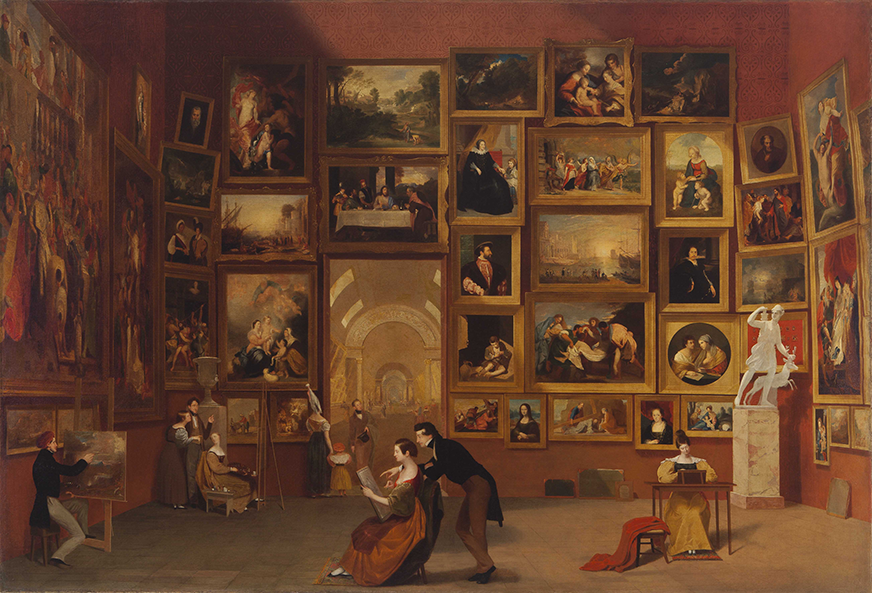
Samuel F. B. Morse, Gallery of the
Louvre (1831–33). Courtesy of Terra Foundation for
American Art,
Scientific Endeavors: As a student at Yale, Samuel Morse studied
philosophy and math, but dreamed of a career as an artist of great
history paintings. After that dream cooled, he went on to pursue
his interest in the burgeoning field of electromagnetics—and for
the future of telecommunications, his shift in studies was a
godsend. Morse would go on to develop both the telegraph and the
Morse code, absolutely dazzling the world when,
on May 24, 1844, he
sent the biblical line, “What hath God wrought?” from the US
Capitol in Washington, DC, to Baltimore, with his new
invention.
Artistic Pursuits: Though
his career in the arts was overshadowed by his stunning
accomplishments in the field of communications, Morse made a
serious go at art, studying under the painter Washington Allston,
and then with Benjamin West at the Royal Academy of Arts in London.
Large-scale Neoclassical paintings of myth and history scenes were
his passion, and the most famous of his works is the
monumental Gallery of
the Louvre, measuring an impressive six by nine feet.
Returning to the United States, he found the American public
unreceptive to his style, which he blamed on a culture of
prevailing bad taste.
Ralph Eugene
Meatyard (1925–1972)
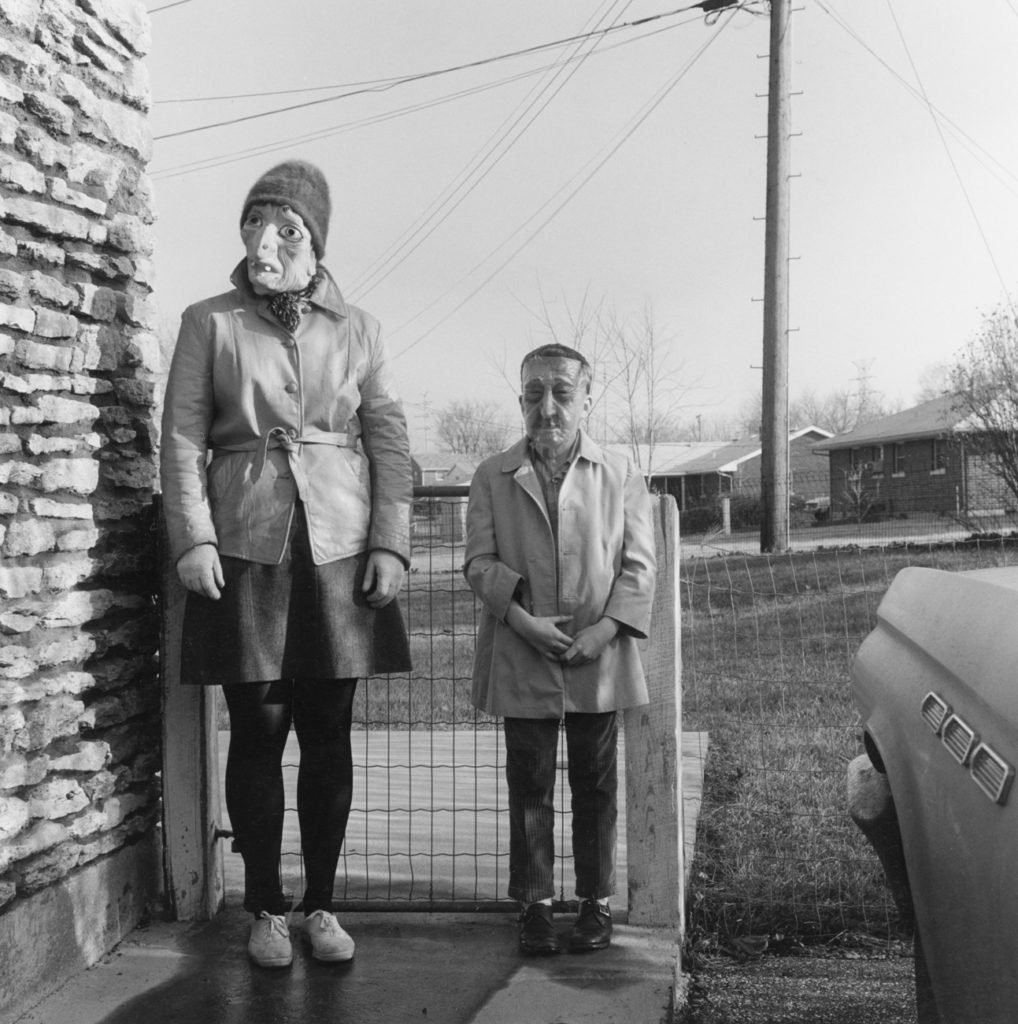
Ralph Eugene Meatyard, Lucybelle
Crater and her 45-year-old husband’s photo-Bell friend’s sonshine,
Lucybelle Crater (1970-72). Courtesy of DC Moore Gallery.
Scientific Endeavors: Ralph Eugene Meatyard extended both of his
careers, as a photographer and an optician, from a scientific and
philosophical fascination with light and vision. Born in Normal,
Illinois, Meatyard served in the military before becoming a
licensed optician in 1949. A position with an optical firm would
bring him to Lexington, Kentucky, in 1950. This firm also owned a
photography company, which introduced the doctor to the medium.
Profoundly influenced by Zen Buddhism (and a pen pal of the
Trappist monk Thomas Merton), Meatyard would spend some three
months looking through an unfocused camera to attain what he called a
state of “No-Focus,” in which the appearance of an object was
detached from its meaning.
Artistic Pursuits: Meatyard began taking photographs in the 1950s
and would pursue the practice until his early death in 1972. His
photographs were unusual for the time, and often included blurred
figures, and, later, portraits of his children and himself wearing
odd, monster-like masks. Meatyard earned little critical acclaim in
his lifetime, though his works was presented alongside those of
Ansel Adams, Aaron Siskind, and Harry Callahan in “Creative
Photography,” an exhibition curated by Van Deren Coke for the
University of Kentucky. His peculiar style often left him relegated
to a regional style of Southern Gothic, though his posthumously
published photo-book, The Family Album of
Lucybelle Crater (named after the main character in Flannery
O’Connor’s short story, “The Life You Save May Be Your Own”),
earned him increasing institutional attention.
Anna Atkins
(1799–1871)
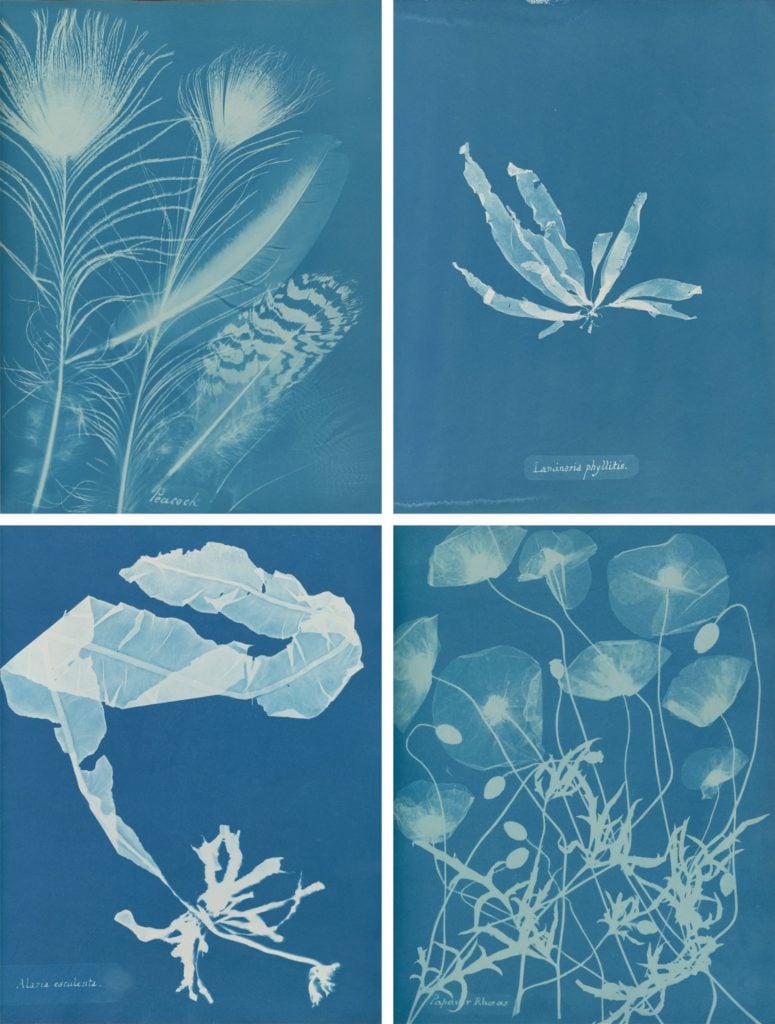
Anna Atkins, (clockwise from top left)
Peacock (1861), Laminaria phyllitis (1844–45),
Papaver rhoeas (1861), and Alaria esculenta
(1849–50). Courtesy of Hans P. Kraus Jr., New York (top left and
bottom right); the New York Public Library, Astor, Lenox and Tilden
Foundations.
Scientific Endeavors: This English botanist Anna Atkins was
fascinated by the delicate and diverse varieties of algae to be
found in the waterways of Great Britain. In 1843, Atkins published
the first half of her scientific reference book,
British Algae: Cyanotype
Impressions, using
light-sensitive materials to capture her specimens, thereby
establishing photography as a scientific tool.
Artistic Pursuits: Atkins
is regarded as the first person to publish a book illustrated with
photographs and is considered by some to be the first woman to
create a photograph to begin with. Moreover, she learned about the
photographic process directly from her frequent correspondent Henry
Fox Talbot, the man who invented the salted paper and calotype
processes, the precursors to modern film
photography.
Leonardo da Vinci
(1452–1519)

Leonardo da_Vinci’s drawing for his
“aerial screw,” a prototype for a helicopter with a lifting wing.
Courtesy of Wikimedia Commons.
Scientific Endeavors: A
true Renaissance man, Leonardo da Vinci was fascinated by anatomy,
botany, astronomy, and geology, among an unending litany of other
fields. Today he is best remembered for his artistic
accomplishments, but his contributions to science were
revolutionary and wide-reaching. He posited that the earth was not
the center of the sun’s orbit and dissected bodies to learn the
inner workings of organs and human bone structure. His notebooks
are filled with inventions that could not be realized in his
lifetime, including the parachute, helicopter, and even the
calculator.
Artistic Pursuits: Da
Vinci believed that art, science, and nature were inextricably
linked and could not be fully be appreciated except in
synthesis—and his contemporaries and later followers seemed to
agree. His paintings
the Mona Lisa
and The Last Supper still draw unbelievable crowds, and
his sketch of the Vitruvian Man, another
cultural touchstone, is perhaps the best representation of his
belief that scientific study could reveal harmony and proportion in
the universe.
Santiago Ramón y Cajal
(1852–1934)
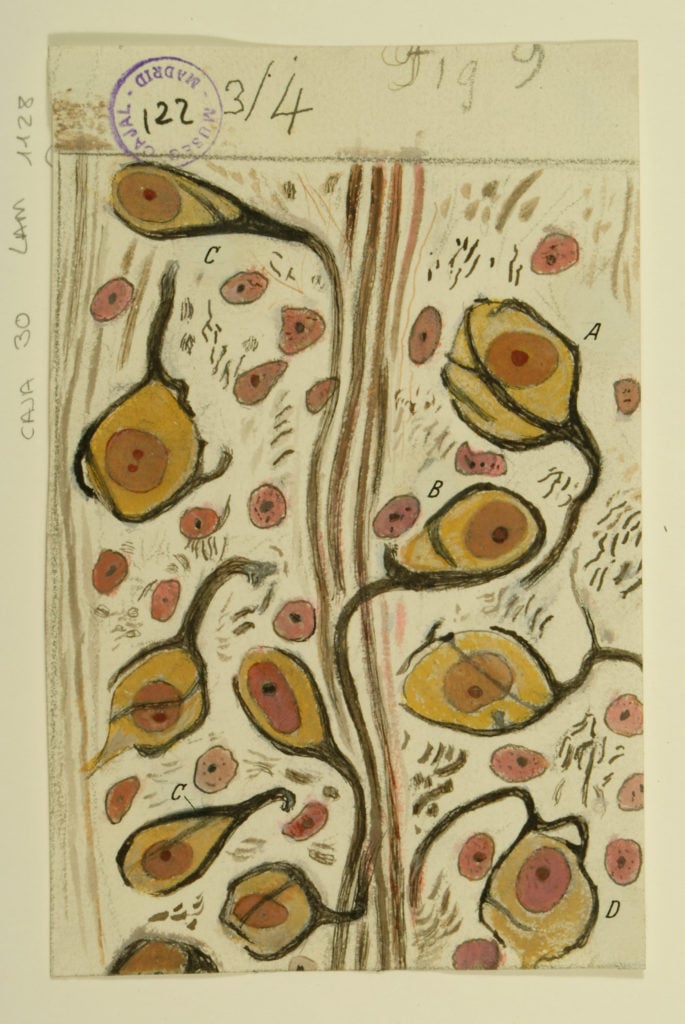
Santiago Ramón y Cajal’s Calyces
of Held in the nucleus of the
trapezoid body (1934). Courtesy of Cajal Institute (CSIC),
Madrid.
Scientific Contributions: The Spanish-born Cajal has been called the father
of modern neuroscience, and in 1906 won the Nobel Prize for his
revolutionary research into the nervous system. He was the first
person to suggest that the brain is composed of individual cell
structures, and his contributions to the understanding of how the
brain actually works are still studied today.
Artistic Pursuits: Cajal aspired to be an artist before his father encouraged him
to pursue medicine, but his initial passion never waned. During his
career, he made thousands of detailed drawings of brain matter
based on what he saw through microscopes, and today these drawings
remain valued sources for neurological study. His images range in
style from Vienna Secession-inspired tree-like branches of the
nervous system to inky, amorphic images of neurons.
John James Audubon
(1785–1851)
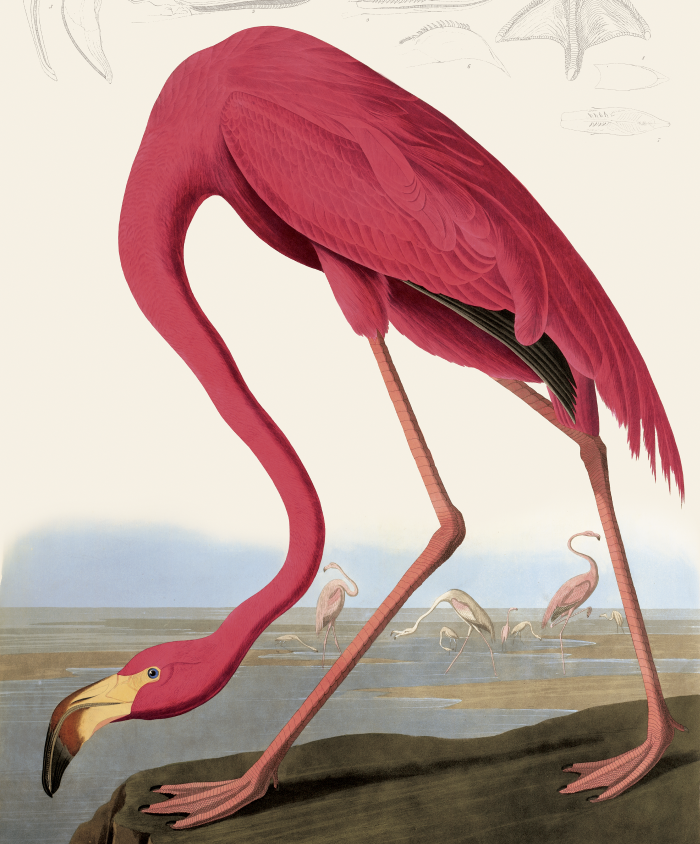
John James Audubon, American
Flamingo from The Birds of America. Courtesy of the
Field Museum, Chicago.
Scientific
Endeavors: Ornithologists around the world revere his
name to this day. John James
Audubon was born in
Haiti and raised in France, then immigrated to Pennsylvania at the
age of 18. His love of birds translated into an impassioned and
scientific pursuit, as he studied their migratory habits and depicted them
realistically in their habitats. He traveled the US endeavoring to
depict all the birds in the county and was America’s leading
wildlife artist for half a century. The Audubon Society is named
after him and is inspired by his mission.
Artistic
Pursuits: Audubon’s depictions of birds were far from
purely scientific. He depicted his creatures with delicacy, color,
and often bits of flora for their habitats. His
Birds of
America, a collection of
435 life-size prints, remains the standard for wildlife artistry.
An early copy of the mammoth book sold for $11.5 million at Sotheby’s in
2010.
The post 7 Scientific Pioneers Who Were Also Artistic
Visionaries, From the Inventor of the Morse Code to the Founder of
Neurobiology appeared first on artnet News.
Read more https://news.artnet.com/art-world/artists-who-were-scientists-1821906
Further reading


Leave a comment