
The Gray Market: Why This Chinese Fashion Designer Could Have a Solution for the Gallery Crisis (and Other Insights)
Every Monday morning, artnet News brings you The Gray Market. The column decodes
important stories from the previous week—and offers unparalleled
insight into the inner workings of the art industry in the
process.
This week, turning the news
cycle into a thought experiment…
WARNING SHOT
On Tuesday, Andrew Russeth
of ARTnews
alerted the art world to an
Instagram
post from longtime
path-breaking New York dealer Mitchell Algus, in which he announced
his Lower East Side space “is on the verge of closing.” Algus writes that
“after nearly 27 years of exhibitions and with a lease pending
renewal, the gallery may be unable to continue.”
While this foreboding
announcement provides another, all-too-familiar illustration of the
challenges of sustainable mid-level art dealing in the 21st
century, it also reminds me of an unorthodox possibility for a way
out.
For the uninitiated, Algus has
earned a well-deserved reputation over the past 27 years for
exhibiting colossal but then-under-appreciated talent. Among other
artists, he gave early or inaugural shows to Barkley L. Hendricks
(whose estate is now with Jack Shainman), Betty Tompkins (now with
PPOW, Rodolphe Janssen, and Gavlak), Judith Bernstein (who has held
solo exhibitions at Kasmin, the Box, and pre-incarceration Mary
Boone in recent years), and Lee Lozano (whose estate is now
represented by Hauser & Wirth).
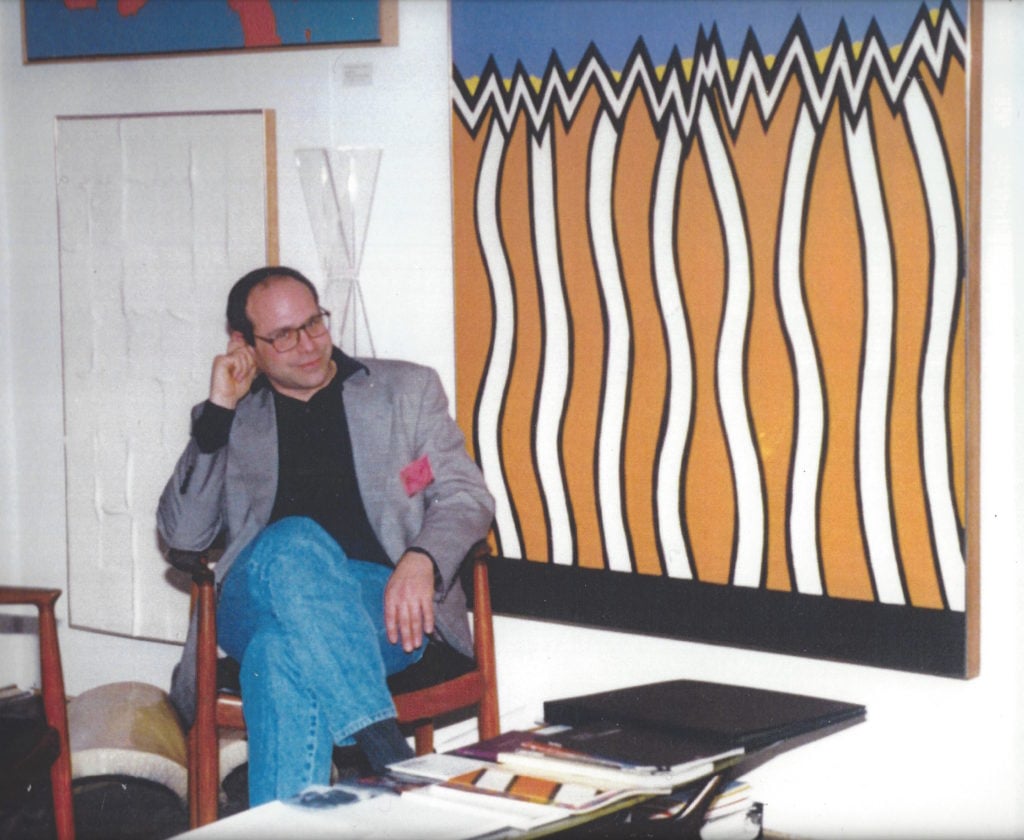
Mitchell Algus, circa 1998, in front of
a work by Nicholas Krushenick.
Algus is also refreshingly old
school. He does not do art fairs. (In a recent op-ed
proposing booth fees be
retroactively determined by sales, he accused fairs of “crippling
the gallery show.”) He has no permanent staff. He is, in the
context of many trust-fund dealers today, shockingly middle-class,
supporting most of his art career by teaching science at a Queens
public high school from the early ’90s until 2014.
But Algus’s frugality and
pension appear to be no match for, on one side, the vampiric New
York real-estate market, and on the other, the brand-centric global
art market. The only way for him to wriggle out of this vise seems
to be by selling more work—a task he has always considered an ill
fit with his temperament and his aptitudes. In 2012, he
admitted to
Russeth that listening
to “very well-known dealers” ply their trade “makes my skin crawl,”
and in a profile by my
colleague Rachel Corbett last spring, he recalled his late-’90s
inability to place the same Lee Lozano drawings at $1,500 that
Hauser & Wirth began selling shortly thereafter for
$65,000.
Hauser’s brand equity and client
list weren’t its only advantages. Ironically, the mega-gallery also
enjoyed the benefit of a Lozano survey held at MoMA PS1 after
curator Bob Nickas discovered the artist’s work at Algus’s gallery.
But the point stands: For more than a quarter-century, people have
primarily (if too sporadically) bought from Algus because they
trust his eye or simply want his influence on the art world to
continue, not because of his sales patter or his financial profile.
Here’s Russeth:
Without naming names, the
amount of money spent by some collectors at one of the
mega-galleries for a single trophy artwork could buy a boatload of
venturesome art from Algus’s gallery, supporting an enterprise that
has been instrumental in making this city, its art scene, and its
art historical narratives a great deal more
thrilling.
Now, I think the implied
exchange here is more important than it might seem at first. By
acquiring work from Algus, the argument goes, you aren’t just
supporting a given artist and a single dealer. You’re supporting a
force (however modest) that has by many accounts continually pushed
the entire art ecosystem in compelling directions for decades. It’s
about helping to preserve a whole greater than the sum of its
parts—and almost doing so in defiance of the traditional gallery
business model, which is so brutal in so many ways that I sometimes
feel like it could only have been conceived as some form of
entrepreneurship S&M.
The whole setup also jogged my
memory about an idea from years ago…
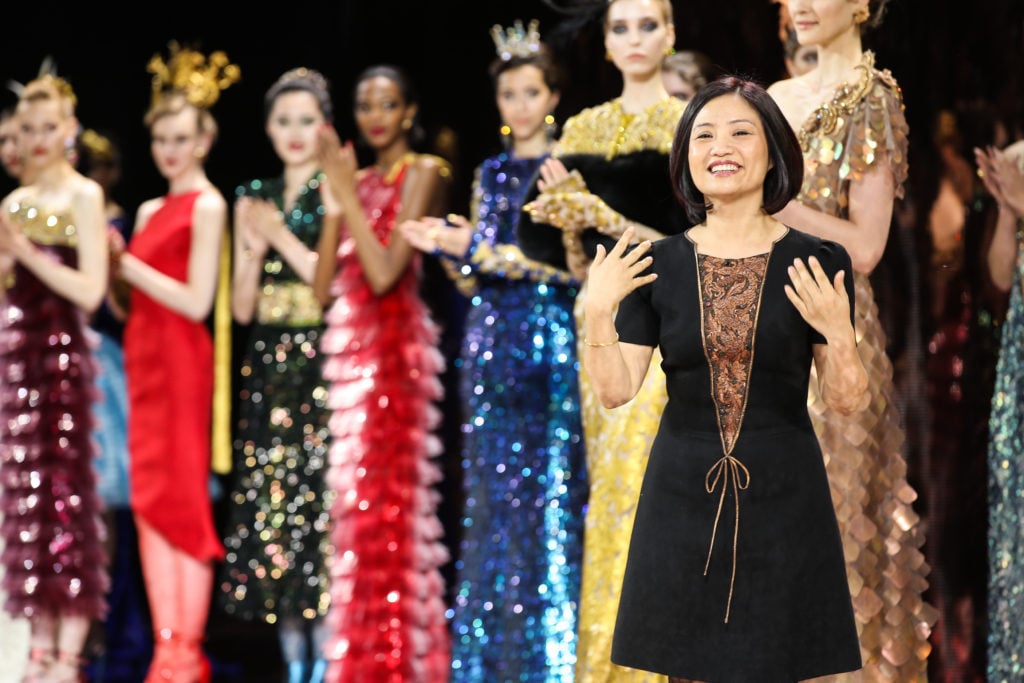
Designer Guo Pei walks the runway after
her fall/winter 2016-2017 runway show at Paris Fashion Week. (Photo
by Richard Bord/Getty Images)
EASTERN PROMISE?
In a 2016 New
Yorker piece, Judith Thurman profiled Guo Pei, billed as
China’s “first homegrown haute couturier.” Regional novelty aside, Guo’s story stayed
with me because of her innovative business model, conceived to
counteract the traditionally high-risk, high-reward proposition of
(ahem) trying to stay profitable by selling a small number of
extremely expensive, labor-intensive objects to wealthy people
primarily drawn in by the beauty and prestige of owning something
inessential for which they have plenty of other, cheaper
options.
Here’s Thurman’s description.
(FYI, the “Liu” below is a client, and “Jack” is Guo’s husband,
birth name Cao Bao Jie, an “importer and converter of luxury
textiles” whose “wealth staked Guo to her career.”)
“We’re all a part of the
club,” Liu said gaily, which wasn’t a metaphor. Jack and Guo have a
shrewd business plan. “You can’t trust Chinese people to pony up,”
Jack told me, “and we can’t afford to spend months on a dress if
they don’t.” So patrons of the house pay an annual fee, from which
their orders are deducted. The club has four tiers of membership,
with subscribers in the top tier spending roughly $800,000. There
are about 4,000 subscribers.”
To flesh it out, clients of
Guo’s agree to send a (substantial) payment to her every year, even
before she has a specific garment they actually want. This payment
becomes a credit the client cashes in over the course of the next
12 months (or perhaps more, if it rolls over from year to year) as
Guo and her team produce new couture. Guo gets a guaranteed wage up
front, which she can use to keep the quality of her line high, and
her clients get their choice of new work from a designer they
trust. Everybody wins.
Could this same idea work in the
gallery world, particularly for someone like Algus, who seems to be
valued more for advancing a vision than pushing
commodities?
I would actually argue that
an ad hoc
version of it has been ingrained in
the primary market for decades. Many galleries have managed to
survive over the years solely because one or two of their most
trusted collectors have been willing to buy work they didn’t need
to, and in some cases may not even have particularly wanted, just
to keep a favorite dealer upright during periods of financial
turmoil.
Although I can’t know for sure,
I still suspect I experienced at least one of these fairy-godparent
deals during the carnage of 2009, when one of my then-gallery’s
best clients spontaneously bought almost $200,000 worth of
extremely
difficult work, by an artist we
didn’t even technically represent (and whose work was available
elsewhere), roughly a month after nearly all of my coworkers were
laid off. I was asked to ship everything directly to storage, and
it didn’t leave for years. What I do know is that the gallery
survived the recession.
More formal versions of this
exchange have been attempted, too, but I think all of them have
problems for galleries that Guo’s model barrel-rolls around. Let’s
bullet through them, shall we?
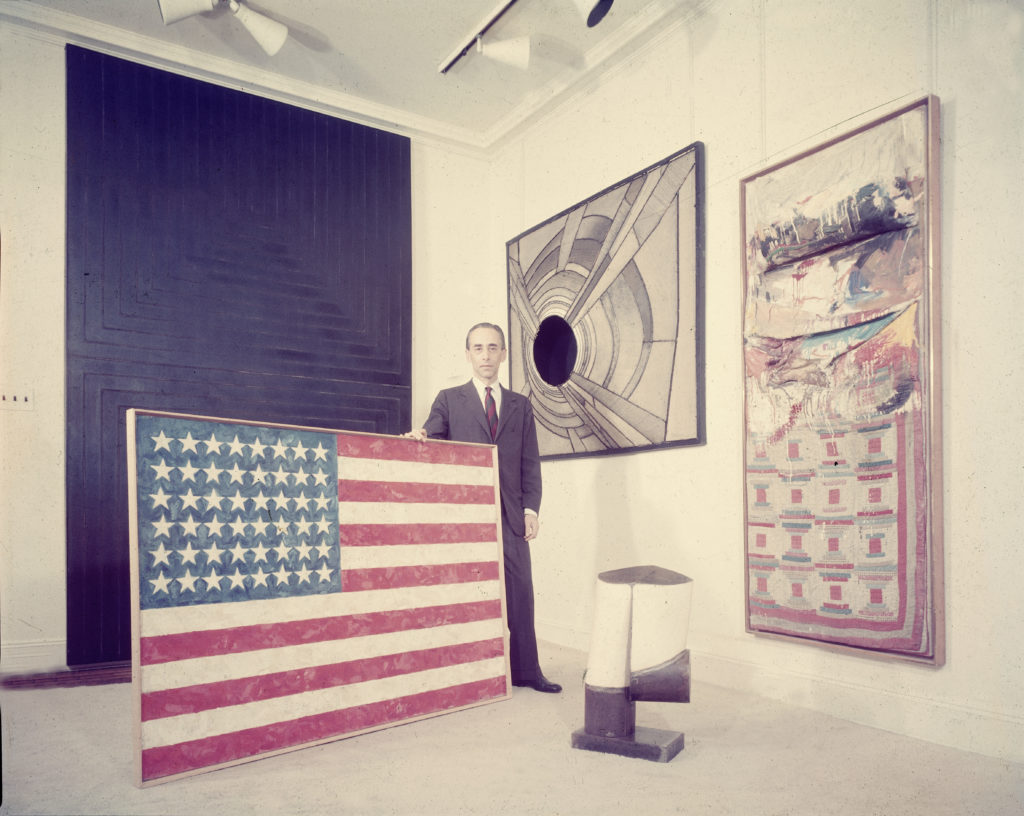
Leo Castelli in his gallery. (Photo by
Eliot Elisofon/The LIFE Picture Collection/Getty Images)
COMP TIME!
Dealers from Peggy
Guggenheim to Stefan
Simchowitz have sometimes paid artists on contract for the
rights to most, or all, of the work they produce over a given time
period. But the scheme collapses if the dealer cannot consistently
find buyers who want all the work they amass. (The same
vulnerability applies to the much-romanticized monthly stipends Leo
Castelli gave his artists.)
The Friends of Liste
program asks collectors
to pay into a fund used to subsidize select galleries’
participation in the fair. But Liste is a nonprofit, which
justifies why patrons receive nothing tangible in
return.
A handful of galleries have
launched Patreon campaigns for ongoing crowdfunding from a
mostly-online audience. But the low fees, niche appeal,
often-intangible incentives, and risk of being viewed as a charity
case have so far drastically limited
their value.
The most encouraging comparison
is probably artist Brad Troemel, who
runs a different kind of Patreon business. Among other incentives, he enters subscribers
into a monthly lottery for works he has previously exhibited in
galleries for prices in the thousands of dollars, as well as a
guaranteed “wall work” of some kind for patrons who fund him at
certain levels for an entire year.
But this example raises
questions, too. The value proposition of Troemel’s Patreon is at
least as much about access to a steady torrent of meme-based
art-market snark on his subscriber-only social-media feed as it is
about acquiring physical artwork. (Depending on your perspective,
that online snark may qualify as viral commentary, immaterial art
of its own, or just straight-up trolling.) Since a dealer would
only be offering the latter in a Guo Pei-like model, and at much
higher fees than a few dollars a month, would it
translate?
And does the success of
Troemel’s largely web-based model actually torpedo the idea that a
gallerist like Algus would be able to get funding to maintain a
physical space that he has admitted vanishingly few people visit,
even in an art capital like New York? Would he even want
to?
Can a dealer even strike the
necessary balance between the number of “club members,” the cost of
membership dues, and the amount of trust necessary to ask for tens
of thousands of dollars worth of pre-payment on work when they may
not even be able to tell members in advance who the artist(s)
making it will be?
In the end, the answer to all of
these questions may be “no,” leaving the idea as nothing more than
a wild flight of imagination—the business equivalent of former
hair-metal icon Bret
Michaels describing himself to a contestant on his mind-melting
reality-dating show Rock of
Love as someone who
doesn’t “live inside the box, and [doesn’t] live in the next box
outside of that, either.”
But during the one month of the
art-world calendar that may actually allow us to downshift, it’s a
high concept at least worth thinking about. Just keep in mind that,
when we rev back into high gear after Labor Day, not every gallery
you love may have survived the heat.
That’s all for this week. ‘Til
next time, remember: there’s more than one way summer can be the
cruelest season.
The post The Gray Market: Why This Chinese Fashion Designer
Could Have a Solution for the Gallery Crisis (and Other
Insights) appeared first on artnet News.
Read more https://news.artnet.com/opinion/mitchell-algus-guo-pei-1616491
Further reading


Leave a comment