
Behind the Oakland Museum’s $20 Million Plan to Transform Its Roof Into a Public Art Oasis
When the Oakland Museum of California was
completed in 1969, its terraced roof garden
was the first of its kind for a US museum. Half a century later,
the institution has tapped landscape architect Walter Hood,
founder of Oakland-based social art and design practice Hood Design Studio, for a massive $20
million renovation project to the outdoor portion of its seven-acre
campus.
The original Brutalist building was the first major project by
Pritzker Prize-winning architect Kevin
Roche, working with landscape architect Dan Kiley (the same duo was
also responsible for the landmarked Ford Foundation headquarters in
New York City). But maintenance of the museum’s plantings was left
to city workers and local gardeners, who struggled to find trees
and shrubs that would grow in the museum’s untested rooftop
beds.
“Today, we understand sustainable aspect of landscape in a way
that we didn’t 50 years ago,” said Hood at a luncheon in New York
unveiling the museum’s plans. Figuring out how to replant the
gardens while staying true to the spirit of Kiley’s original
design, he said, “was almost a research project.”
Hood’s other museum projects include landscaping work at the
de Young Museum in San Francisco, the
Broad in Los Angeles, and the Cooper Hewitt Smithsonian Design Museum in
New York. He is also working on the forthcoming International African American Museum in
Charleston, South Carolina.
Groundbreaking on the new project is scheduled for September,
timed to the 50th anniversary of the museum’s original opening.
Construction is set begin in earnest in January, and to be
completed by fall 2020. (The museum will remain open throughout,
with sections of the garden closing on a rotating basis.)

Rendering of the renovated gardens at
the Oakland Museum of California. Image courtesy of the Hood Design
Studio.
Opening to the City
Oakland mayor Libby Schaaf is already looking forward to
personally taking a sledgehammer to the northern garden wall, as
part of an effort to open up the space not only to the public, but
also to adjacent Lake Merritt.
“We have this gorgeous lake in the middle of our downtown,” said
Schaaf, who has made improving access to the lakefront a priority
since taking office in 2015, recently unveiling a protected bike
lane. “Every resident deserves access to art and culture.” She
noted that the new gardens at the museum will be free and open to
the public seven days a week, during daylight hours. (General
admission to the galleries is $16.)
As Hood delved into the museum’s history, he actually discovered
an early plan from Kiley that featured a row of trees instead of a
wall. His new plan will create a prominent public entrance, clearly
visible from the lake, at the place where the wall now stands.
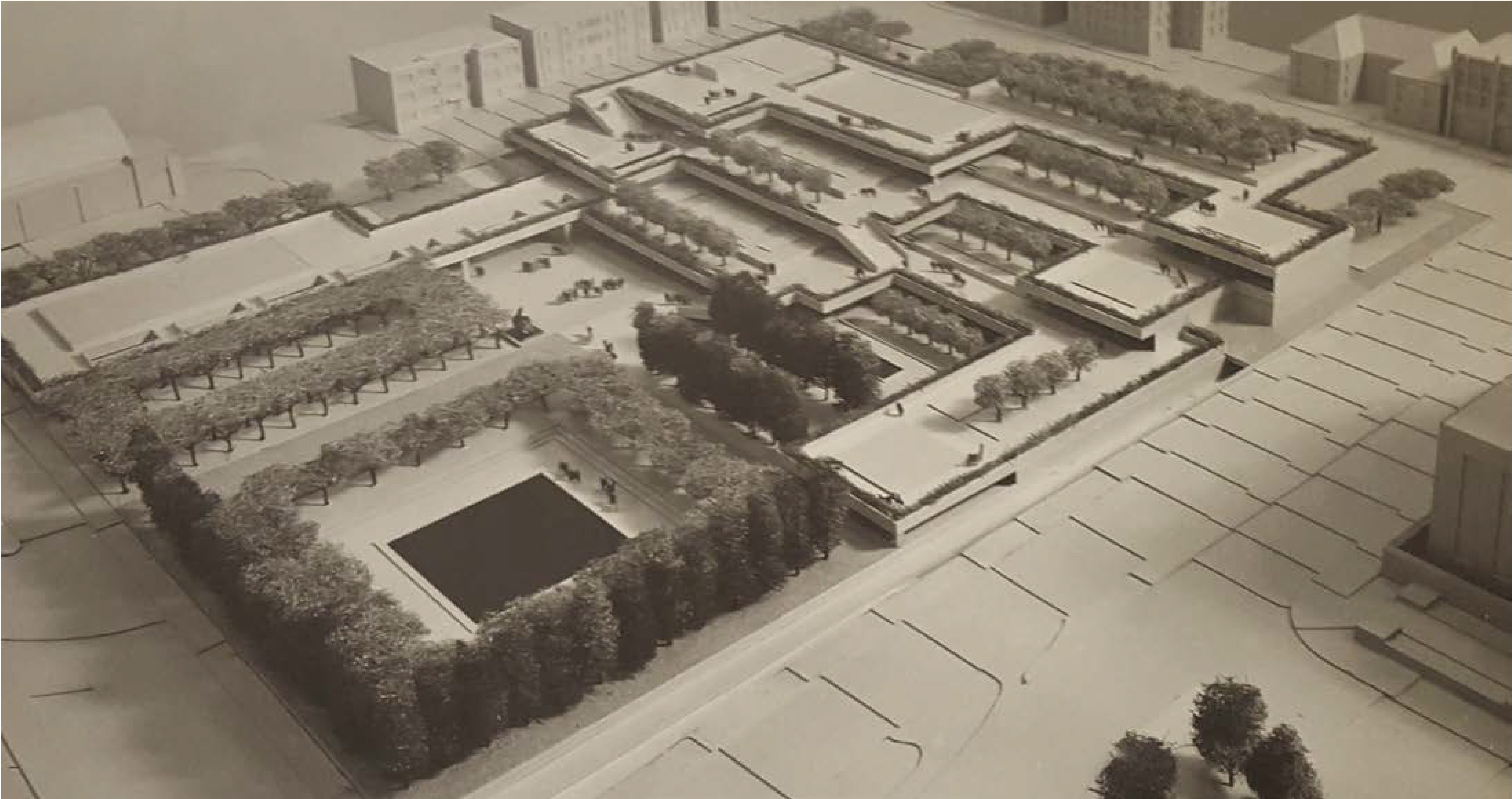
An early design for the Oakland Museum
of California from landscape architect Dan Kiley, without the
exterior wall. In the upcoming renovation, Hood Design Studio will
create a new entry where there is currently a wall. Courtesy of the
Oakland Museum of California.
“In the late ’60s, Oakland was in turmoil,” Hood said, noting
that Black Panther co-founder Huey P. Newton was in jail not far
from the museum’s future home, which led to protests in the
streets. “We think the idea of walling the museum in may have been
a product of the times.” The new entrance will serve as a public
porch, hopefully attracting members of the public who might not
have known the museum was even there.
Over the decades, the garden has become overgrown, the museum
largely hidden behind a monotonous grove of dull, bushy evergreen
trees. In photos taken of fans flooding the streets of downtown
Oakland after the Golden State Warriors’s 2015 NBA championship,
it’s nearly impossible to pick out the museum perched on the hill
just behind the crowds.
Museum director Lori Fogarty had overseen a massive renovation
of the building in 2010. She saw the roof garden revamp as a key
next step in raising the museum’s profile and bringing in a larger
audience.

Golden State Warriors fans take to the
streets of Oakland after the 2015 NBA championship. The Oakland
Museum of California is behind the trees in the center of the
photograph, next to the large white building on the left, but is
almost impossible to make out. Photo by Greg Linhares, courtesy of
the city of Oakland.
A New Landscape
Another priority? Rethinking the varieties of vegetation in the
garden. “To have a museum of Californian art history and natural
sciences with a garden that has no native plants wasn’t really
serving our interpretive mission,” said Fogarty. “We’re one of
the very museums in the country that has art, history, and natural
science.”
“A lot of the plants were not native, and they were not
sustainable,” added Hood. “Since the museum’s mission is about
California, why shouldn’t the landscape be about California?”
His new design calls for each of the terrace’s four levels to
represent one of the different ecological regions in the state,
with plants found in the low
desert, the coastal forests, the chaparral and woodlands, and
the Mediterranean climate. The plantings will be put in
gradually, and Hood expects it will between 10 and 15 years for new
trees to reach maturity.
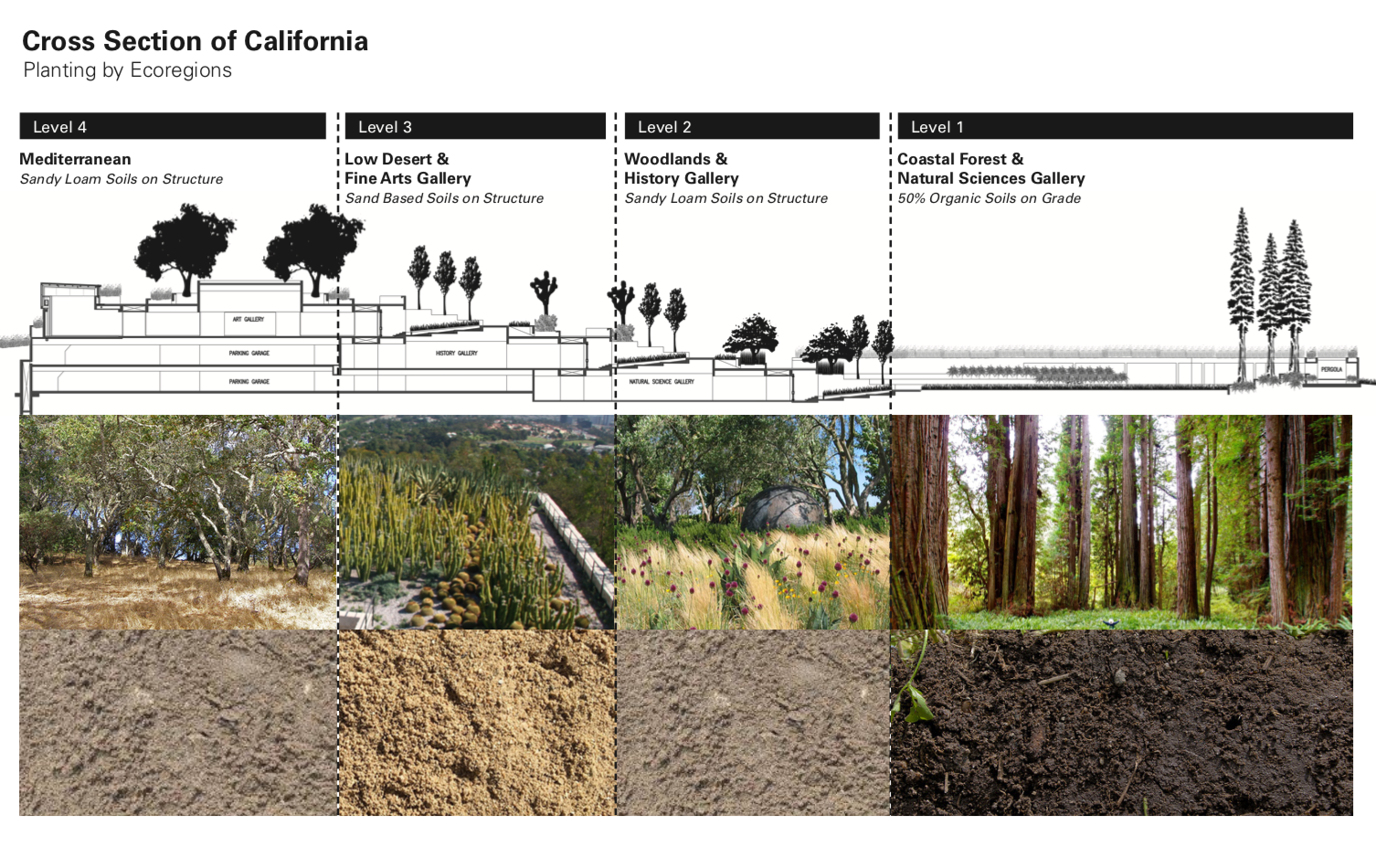
The terraces of the renovated gardens at
the Oakland Museum of California will correspond to the state’s eco
regions. Image courtesy of the Hood Design Studio.
Hood hopes the different landscapes will make the terraces
easier to navigate, helping visitors orient themselves on each
level. Other aspects of the new design include seating
throughout the terraces and a permanent stage for performances and
film screenings in the main courtyard.
The work will also give curators the chance to reconsider
display of the 20-odd artworks currently on view throughout the
garden, which include large-scale pieces by Mark di Suvero, George
Rickey, and Tony Labat. “We have a wonderful collection of outdoor
sculpture, but honestly, it’s become a little bit haphazard over
the years—much like the landscape,” said Fogarty.
Some pieces on loan to the museum will be returned to the
artists, and others will be relocated with input from Hood and his
team. This fall, the garden will welcome a massive, 40-foot-tall
Burning Man temple,
commissioned by the museum from artist David Best for the traveling exhibition
“No Spectators: The Art of
Burning Man,” on view October 12, 2019–February 16, 2020. (Due
to fire code regulations, it won’t be burned down.)

David Best, Temple (2018).
Photo by Ron Blunt.
A Place to Heal
The multi-disciplinary museum, which has nearly 2 million
objects in its collection, prides itself on tackling the issues
facing the city and the state as a whole. In 2016, for instance,
ahead of the passage of the bill legalizing recreational marijuana,
the museum presented “Altered States: Marijuana
in California,” exploring the history of the plant in the state
and inviting museum visitors to form their own opinions on the
issue.
“The museum is not some dusty, static tomb that houses culture,”
said Schaaf. “It is a dynamic interactive place in one of the
proudest, most diverse cities in America, where people come
together to feel a sense of belonging and to understand our history
and engage in an incredibly important dialogue about the
present.”
Last year, the city unveiled its first cultural plan in
30 years. “It talks about racial inequity and how culture is a
place to heal,” said Scaaf, who recognizes the difficulty in
creating and maintaining affordable spaces for arts and culture in
a rapidly gentrifying city.
“The hard part of being in a city like Oakland,” said Fogarty,
“is that there’s always a sense that we have to settle for second
best, that we can’t aspire to the kinds of dreams that New York or
San Francisco or Chicago can dream about—but this city needs to
dream big.”
See more renderings of new museum garden below.
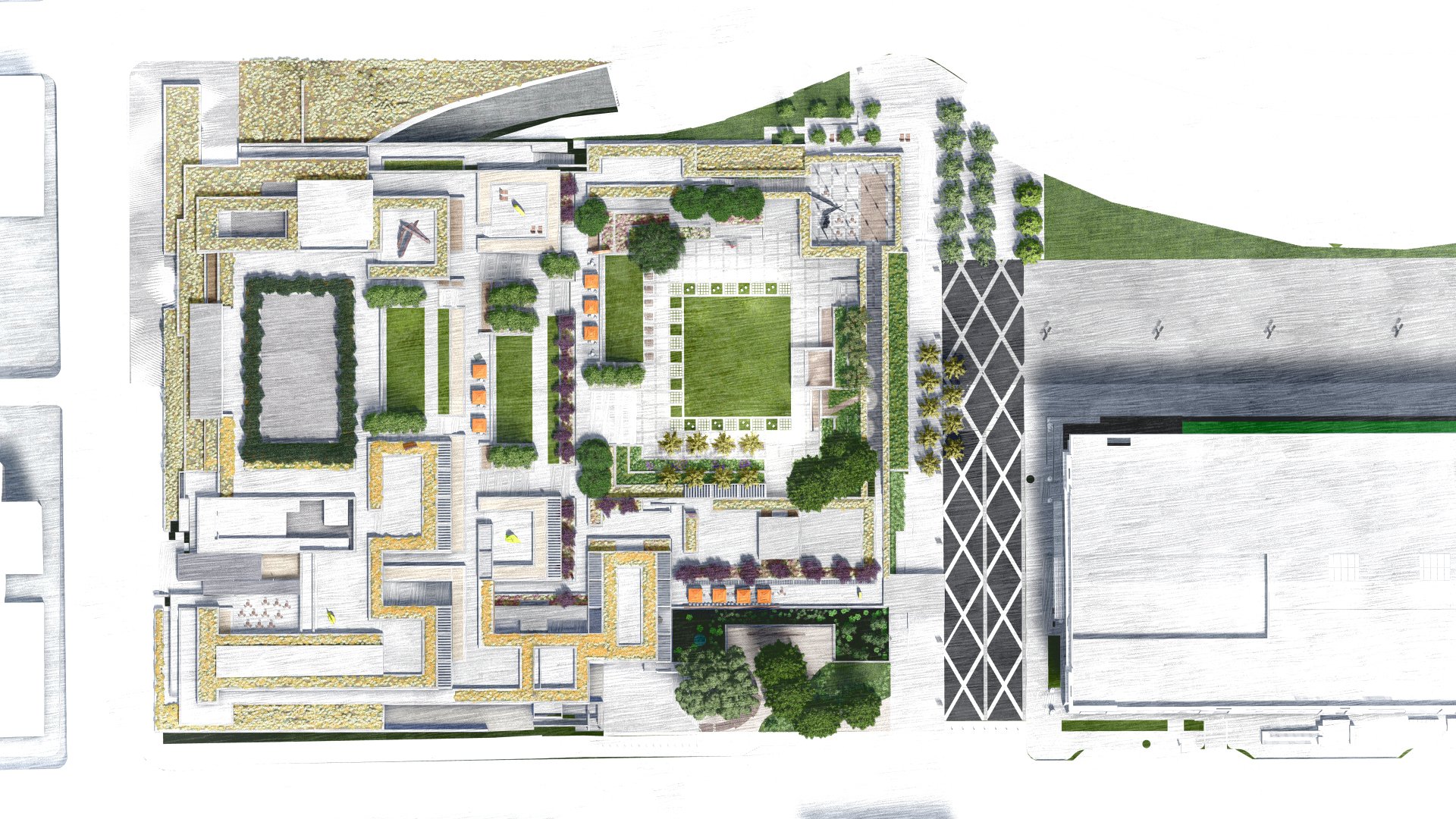
Rendering of the renovated gardens at
the Oakland Museum of California. Image courtesy of the Hood Design
Studio.

Rendering of the renovated gardens at
the Oakland Museum of California. Image courtesy of the Hood Design
Studio.

Rendering of the renovated gardens at
the Oakland Museum of California. Image courtesy of the Hood Design
Studio.

Rendering of the renovated gardens at
the Oakland Museum of California. Image courtesy of the Hood Design
Studio.

Rendering of the renovated gardens at
the Oakland Museum of California. Image courtesy of the Hood Design
Studio.

Rendering of the renovated gardens at
the Oakland Museum of California. Image courtesy of the Hood Design
Studio.
The post Behind the Oakland Museum’s $20 Million Plan to
Transform Its Roof Into a Public Art Oasis appeared first on
artnet News.
Read more https://news.artnet.com/art-world/oakland-museum-roof-garden-1614979
Further reading


Leave a comment