
Art Dealer Hildegard Bachert, Who Championed Käthe Kollwitz and Grandma Moses, Has Died at Age 98
Hildegard Bachert, an indefatigable art dealer who brought to
the fore Grandma Moses, Paula Modersohn-Becker, Käthe Kollwitz, and
other under-known artists through her 80-year career at New York’s
Galerie St. Etienne, died yesterday at age 98.
Bachert, who was born in Mannheim, Germany, in 1921, got her
start in the industry as a gallery secretary after fleeing the Nazi
regime as a teenager and settling in New York. She was 19 when she
met the Austrian art dealer Otto Kallir, another refugee, who
had shuttered his gallery in Vienna, the Neue Galerie, and reopened
in New York under the name Galerie St. Etienne. Kallir agreed to
give Bachert a job on the condition that she teach him English.
At the time, French art was in vogue in the city but Kallir
largely promoted the work of Egon Schiele, Max Liebermann, Oskar
Kokoschka, and other Austrian and German artists. In 1941, the
gallery hosted Schiele’s first solo show in the US. It was, Bachert
said in her memoir, “a total dud.”
Two years later, she convinced Kallir to mount the gallery’s
first exhibition of works by Kollwitz, which fared better. “One of
the first artists I was able to sell was Kollwitz,” Bachert said.
“Kallir always said, ‘It’s because you identify with her. You know
her language, where she comes from.’ Indeed, I did identify with
Kollwitz, much more so than with Schiele or Klimt.”
“Hildegard, simply as a woman with a significant influence in a
major 57th Street gallery, was largely responsible for the relative
gender balance of our program,” said Otto Kallir’s grand-daughter
Jane Kallir. “She pushed the gallery to give Paula-Modersohn Becker
her first one-person American show in 1958, and her devotion to
Käthe Kollwitz was legendary. She was one of the top Kollwitz
experts in the world.”
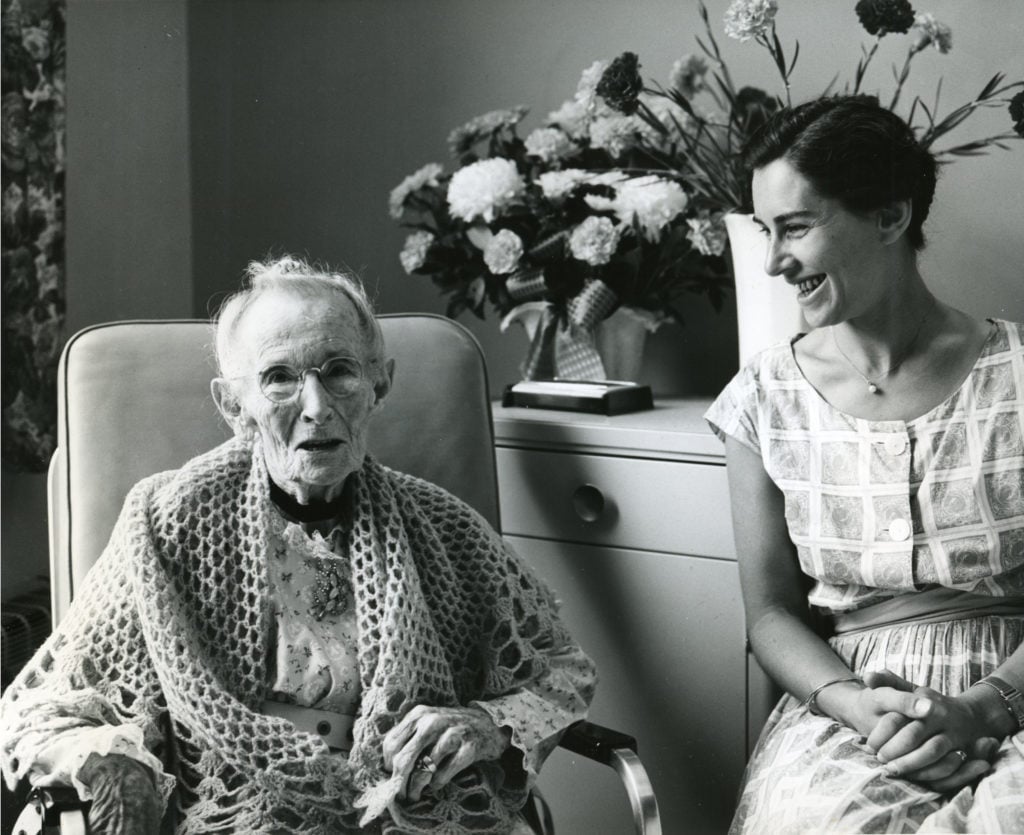
Hildegard Bachert, at right, with
Grandma Moses on her 100th birthday in 1961. Photo by Otto Kallir,
courtesy of Galerie St. Etienne.
Around that time, Kallir also discovered an elderly “farmwife”
who painted extraordinary country scenes from her home in rural
upstate New York. He sent Bachert to visit the woman, who would
come to be known as Grandma Moses. It was “love at first
sight,” Bachert said of the encounter.
Moses was “at ease with everyone. She had intrinsic manners, a
perfect sense of tact and amazing self-possession. The first thing
she asked when I visited was, ‘How are your folks in New York? How
is everybody?’ She really wanted to know. Then of course, I heard
all about her family. We developed a very close relationship. She
was like my own grandmother to me.”
Otto Kallir died in 1978 and Bachert became co-director of the
gallery with Jane Kallir. Together they worked to preserve St.
Etienne’s founding principles: “The gallery isn’t about buying and
selling art like a commodity. We don’t show art that we don’t
believe in. We want to be as knowledgeable as possible about what
we do.”
Still, it had to adapt to changing market forces, such as art
fairs. “Otto Kallir wouldn’t have dreamed of participating in an
art fair,” Bachert wrote. “He didn’t believe art should be
displayed like merchandise, and neither, in principle, do Jane and
I. We resisted exhibiting at fairs for many, many years, but they
have become a necessity. Even I like Art Basel, in
Switzerland.”
In the 1980s, “all of a sudden, fin-de-siècle Viennese
art was ‘hot,’” and Bachert found herself hiring her own secretary.
“When our new secretary first referred to me as ‘my boss,’ I did a
double-take!” she said. The gallery loaned works to the Museum of
Modern Art and consulted on its “Vienna 1900″ show—”probably the
most exciting moment of my entire career,” Bachert recalled in her
memoir. The following decade saw a booming interest in Schiele, who
was the subject of a show at the National Gallery of Art in
Washington, DC, and “prices started going through the roof.”
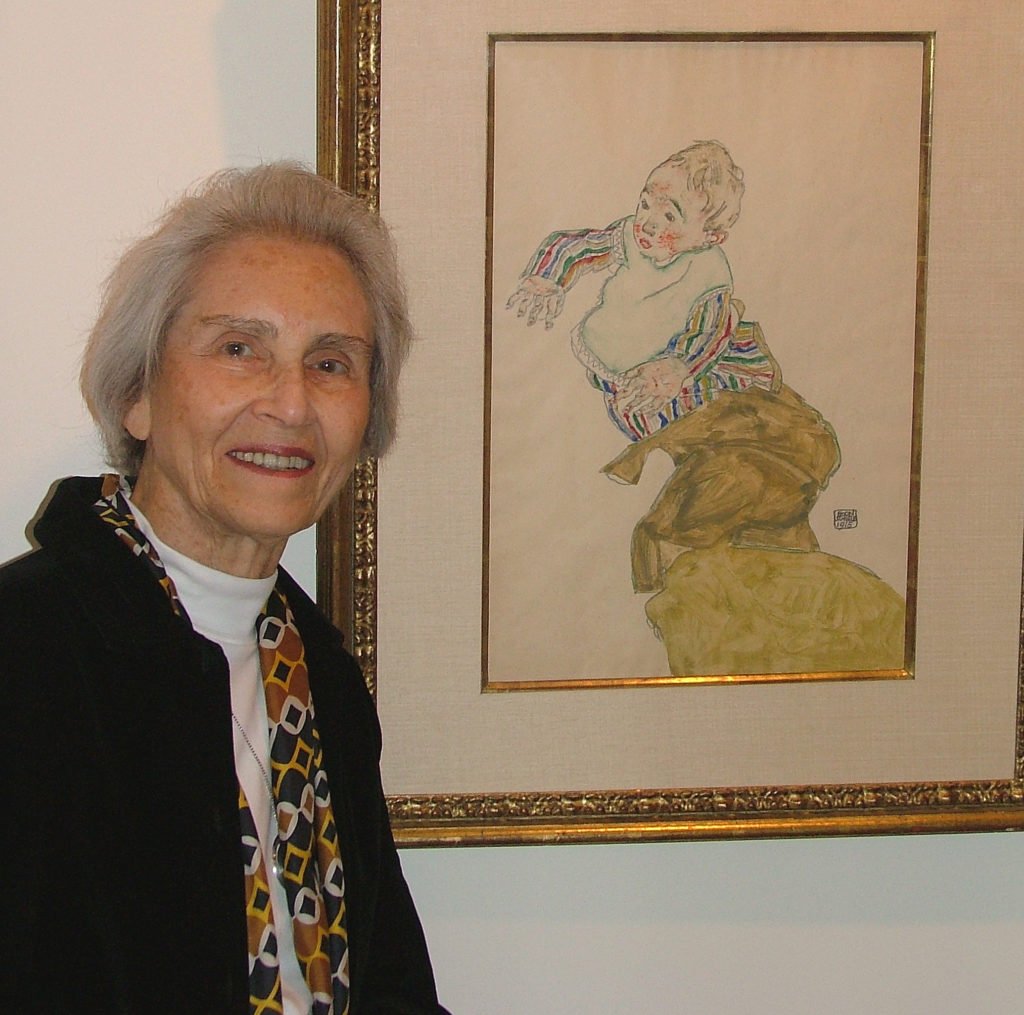
Hildegard Bachert with a work by Egon
Schiele. Courtesy of Galerie St. Etienne.
In 2001, the collector Ronald Lauder opened a museum in New York
and named it after Otto Kallir’s original Vienna space, the Neue
Galerie. “Never in my wildest dreams would I have thought that in
my lifetime there would be a museum of Austrian and German art in
New York,” Bachert said.
Bachert moved to Vermont last year, but continued her work with
the gallery until her final days. “I could have retired 20
years ago, but I can’t unglue myself,” she told the New York Times
in 2015. “I’m too connected. It’s my baby.”
“The thing that I just keep coming back to is how principled she
was,” Jane Kallir said. “Art has become such a big business, a
corporatized enterprise, which it really never was for almost the
entire 20th century. People think of dealers as promoters,
charlatans, opportunists. Hildegard was none of those things. She
had this enduring sense of a mission beyond herself. She was
really, really dedicated in service to the art.”
The post Art Dealer Hildegard Bachert, Who Championed Käthe
Kollwitz and Grandma Moses, Has Died at Age 98 appeared first
on artnet News.
Read more https://news.artnet.com/art-world/hildegard-bachert-obituary-1683094
Further reading


Leave a comment