
Scholar and Dealer Francis Naumann on the ‘Ironic’ Aspect of the Art Market That Led Him to Close His Venerated New York Gallery
Earlier this month, dealer and
scholar Francis Naumann announced that he would
be closing his eponymous New York gallery next spring,
ending a nearly 20-year run.
An accomplished art historian
and one of the world’s leading experts on Marcel Duchamp, Naumann
opened his gallery in 2001 to present works by European Dadaists
and Surrealists. But
waning interest in early 20th-century art has rendered the
venerable dealer’s business untenable.
“There are fewer and fewer
collectors of 20th-century art because the younger generation
wishes to identify with the art of their times and feel that the
art of the past is—by definition—passé,” Naumann tells artnet News
over email, before quoting his favorite artist: “When Duchamp was
asked if he had any advice to give young artists, he said, ‘The son
must hate the father in order to be a good son. Such hatred seems
to be the only means of producing that necessary reaction against
the achievements of the previous generation.’”
The closing of Naumann’s
enterprise seems to speak to a bigger issue than the “mid-market
squeeze” that everyone is talking about these days. For
generations, European modernism has reigned over the Western
art-historical canon. Yet those hierarchies seem to be collapsing
as the world becomes more globalized.
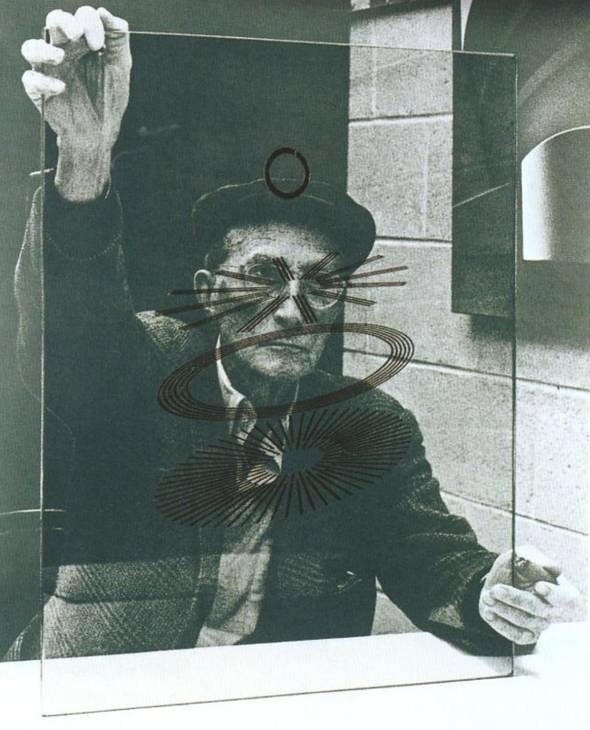
Richard Hamilton, Marcel Duchamp,
(1967). © The estate of Richard Hamilton. Image courtesy of
Tate.
“Globalism, per se, is not a
phenomenon that will alter our appreciation of European modernism,”
Naumann says. “Rather, it only expands our view of what can be
considered part of the modernist evolution, building upon it in a
way that could very well cause us to appreciate the art of the past
even more.”
However, the dealer is quick to
note that this doesn’t mean there will be no financial
implications. The market for such work has shrunk as the
contemporary art market has exploded.
“I feel that it is ironic that
work by contemporary artists sells for more than work by the
artists who inspired them. A sculpture by Jeff Koons, for example,
sells for considerably more than the highest price ever paid for
any work by Duchamp, whom he admits is a great influence on his
work.
“For my nineteen years of
running a gallery, I have tried to combine my scholarly past with
my business practice, organizing museum-quality exhibitions with
accompanying scholarly catalogues that were not designed for sale,
but to disseminate a broader knowledge of the works presented in
the exhibition,” he says. “When I opened the gallery in 2001, I was
unaware of the fact that the essential goal of art-historical
scholarship—to uncover the underlying truth of works of art—could
be in direct conflict with the goals of an art dealer, who is
forced to focus on money and meeting the bottom line.”
An exhibition of New
York Dada artists, which
Naumann classifies as the “most scholarly and comprehensive”
presentation of its kind since his landmark “Making Mischief: Dada
Invades New York” show at the Whitney in 1996, is currently on view
at his gallery. His final exhibition will go on view in January.
Fittingly, it will present portraits of Duchamp.
The post Scholar and Dealer Francis Naumann on the ‘Ironic’
Aspect of the Art Market That Led Him to Close His Venerated New
York Gallery appeared first on artnet News.
Read more https://news.artnet.com/market/francis-naumann-art-market-1683646
Further reading


Leave a comment