
The Lyon Biennale Responds to the Post-Industrial Economy, Only to Get Lost in Post-Human Reveries
The 15th edition of the Lyon Biennale is unusual, unique, and
complicated—both in its scope and conceptual underpinnings. It is a
large-scale, ambitious, and impressive survey that at times feels
like it’s standing on shaky ground, struggling to fit a multitude
of concepts (and massive artworks) into one open-ended theme. And
yet, more often than not, it is able to find its footing within a
maze of formidable artworks and complex ideas.
“Là Où Les Eaux Se Mêlent,” the title of the exhibition—a
mellifluous translation of “Where Water Comes to Meet Other Water,”
a poem by Raymond Carver—is a hazy phrase that serves as the
central theme of the biennale, both literally (Lyon is the site
where both the Saône and Rhône rivers converge) and metaphorically.
As the curators stated in their catalogue essay, the title is meant
to suggest “the flow of capital, goods, information, and people
that characterizes the times we live in.”
The overarching theme of “water” also lends itself to
environmental, ecological, and also more pointedly—as the curators
suggest—“biological,” “bacterial,” and even “cosmogonical” (i.e.
anything related to the study of the origins of the universe)
concerns. This is all to say that this year’s biennale leaves quite
a bit of room for interpretation.
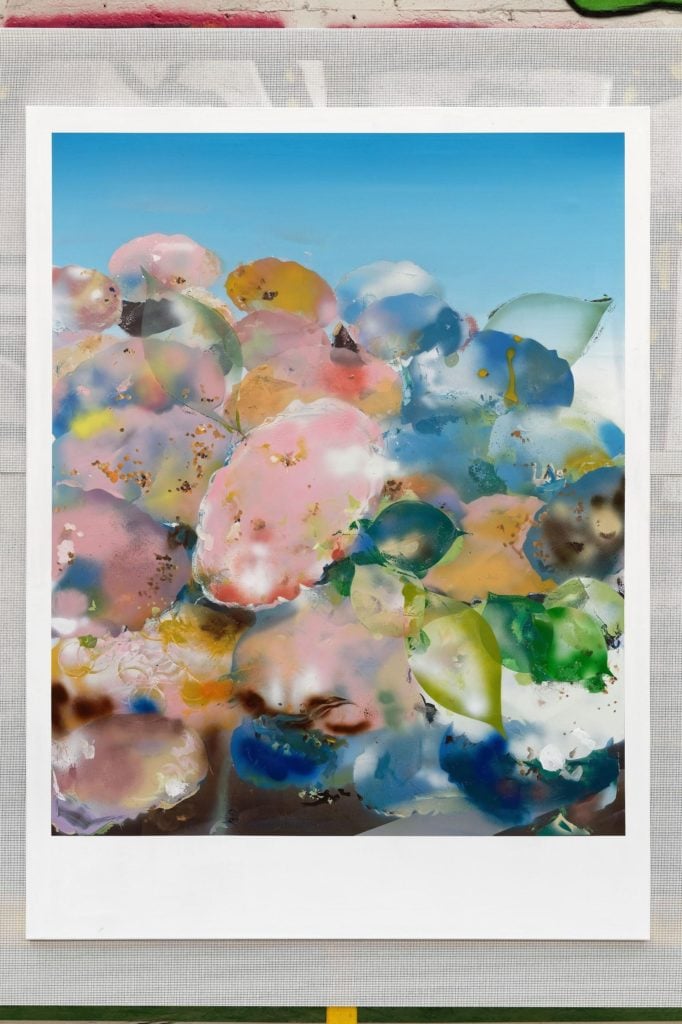
Stéphane Calais, Vie et mort de
Cristof Yvoré (Hortensia) (2019). Acrylic and graphite on
canvas. Courtesy of the artist.
There are a number of works that are either too opaque—like
Stéphane Calais’s colorful abstractions of blobs, curves, and
lines—or too on the nose. For myself, the latter includes Minouk
Lim’s Si tu me vois, je ne te vois pas (If you
see me, I don’t see you) (2019), a large installation
implanted in the main venue involving an artificial hot spring and
leftover shrouds of traditional Korean clothing, which seems merely
to combine a symbol of the artist’s own country’s past (South
Korea) with an allusion to the past of the site where the work is
situated, an old washing machine factory.
![Minouk Lim, Si tu me vois, je ne te vois pas [If you see me, I don’t see you], 2019. Hot water canal, mixed media.. Courtesy of the artist and Tina Kim Gallery](https://news.artnet.com/app/news-upload/2019/10/lyon-Lim-1024x683.jpg)
Minouk Lim, Si tu me vois, je ne te
vois pas [If you see me, I don’t see you] (2019).
Courtesy of the artist and Tina Kim Gallery.
whole. In some ways, it is quite honestly the first of its kind,
breaking new ground in the cultural landscape of Lyon’s (or even
France’s) most important art show.
It is the first Biennale to be conceived and organized by seven
different curators: the talented curatorial team from the Palais de
Tokyo in Paris. It is the first to not be housed in Sucrière
building since 2003, instead finding a new home in the massive
29,000-square-meter Fagor factory in central Lyon—a recently
abandoned site.
Is it the first with gender parity and the first to be held
across the entire region with associated exhibitions and various
programs in and around the city. Because of this last aspect, one
of the more exciting and distinctive features of this year’s
biennale is its attempt, within a stream of lofty ideas, to ground
its curatorial investigation concretely in the social,
economic concerns of the city of Lyon.
![Renée Levi, Là où les eaux se mêlent [Where the waters mingle], 2019. Wall painting, dimensions variable. Image courtesy of the artist.](https://news.artnet.com/app/news-upload/2019/10/lyon-Levi.jpg)
Renée Levi, Là où les eaux se
mêlent [Where the waters mingle] (2019). Image
courtesy of the artist.
A Loaded Landscape
As Yoann Gourel, one of the curators of the biennale, mentioned
at the press preview, “this is not a neutral site.” The massive
Fagor factory is one of the three main venues of the biennale and
where most of the artworks are housed: 47 of the 50-odd artists are
exhibited here. The other two locales are the Museum of
Contemporary Art (MACLyon), and the LPA (Lyon Parc Auto) Cordeliers
parking lot in Presqu’île. Fagor, however was previously the place
of work for many of the inhabitants of the Gerland neighborhood,
where the giant facility sits. The factory closed down only 4 years
ago and has since been completely abandoned.
Fagor has a long history that is deeply tied to Lyon’s
industrial heritage, providing jobs for almost 2,000 people in the
early ’80s. By the early aughts that number shrank to 400. After
some uncertainty about its future, the factory was finally sold to
Centro Motors in 2015 with the promise that it would become a newly
refurbished site for manufacturing electric cars. That plan quickly
fell through and left many workers unemployed. The space was left
behind, almost unscathed—except for the occasional flurry of
graffiti art and broken windows—perfectly ripe for appropriation as
an arts and cultural venue.
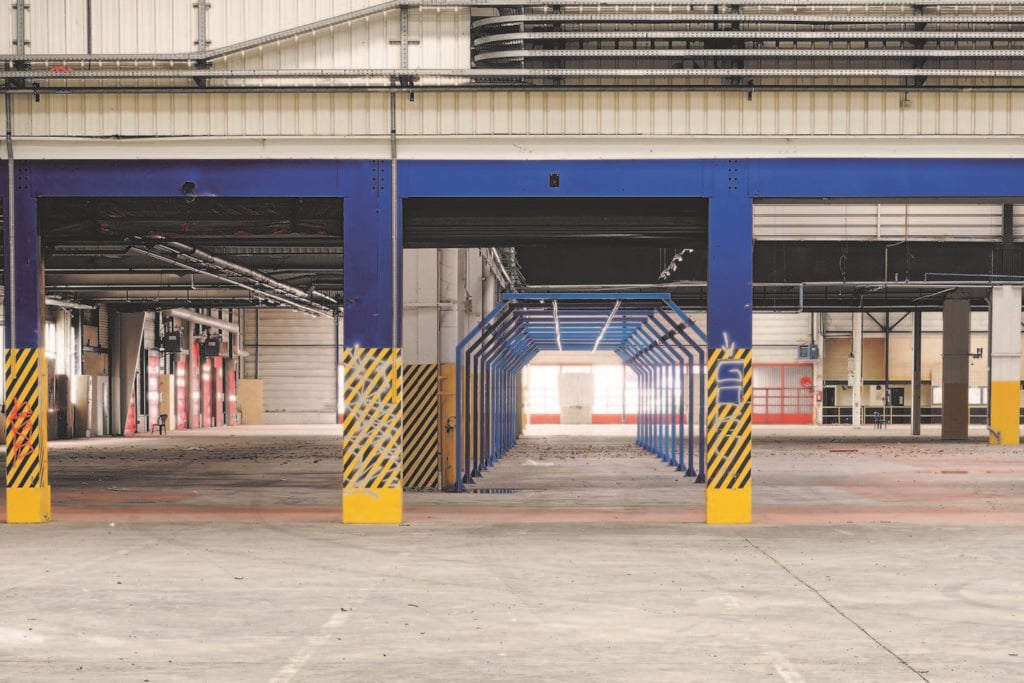
Interior of the Fagor Factory. Courtesy
of the Lyon Biennale.
The potential for the event to be read as a case of a wealthy
and long-established arts organization swooping in and taking
advantage of an unfortunate situation, claiming a space that had
its own recent history of economic distress with the false hopes of
“revitalizing” the community through arts and culture, has
(fortunately) not gone over the heads of these curators. In fact,
their stated aim is to shine a bright light on this inherent
problematic, mustering thoughtful engagements with the politics,
architecture, and history of Fagor.
For this reason, the space is left bare and raw, leaving all
traces of what was once a working industrial space: paint markings
on the floor, leftover machinery, etc. Additionally, there are no
white walls and no bifurcations to separate the works, just four
massive open halls where art seems to blend in with its
environment, creating a somewhat labyrinthine locale, despite the
large expanse these spaces provide.
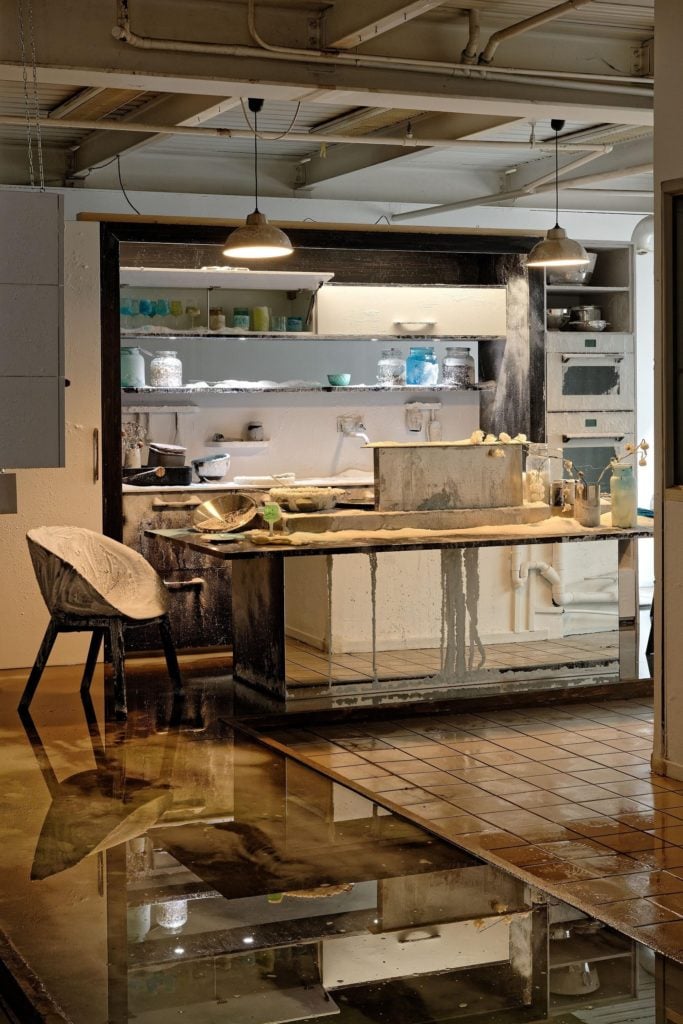
Bianca Bondi, The sacred spring and
necessary reservoirs (2019). Mixed media. Courtesy of the
artist.
More importantly, the artists were asked to create site-specific
works that speak directly to this environment. This is evidenced,
for example, by Bianci Bondi’s whimsical The Sacred Spring and
Necessary Reservoirs, for which the artist encrusted an
existing dilapidated kitchen with mounds of salt that, in reaction
with other chemicals, transform the room into a colorful and
magical place.
For the Romance of Community
The art world’s presence and economic influence at the site and
in the region is itself also a point of focus. Stephen
Powers’s Open Door (2019), a giant mural on the
facade of Fagor that reads “Warm in Your Memory,” offers a wisp of
an indication that the recent loss of jobs and financial
instability still haunts the vacant building. Aguirre Schwarz’s
Ma mère et son double (My mother and her
double) (2019), featured at the entrance of MACLyon, is a
video presenting the logos of all the corporate sponsors of the
biennale. The corporate emblems appear on the screen and then,
after a visual glitch, begin to liquify and slowly drip across the
screen—perhaps a tempered remark on the immense flow of capital
that has gone into the presentation of expensive art objects and
drips of paint.
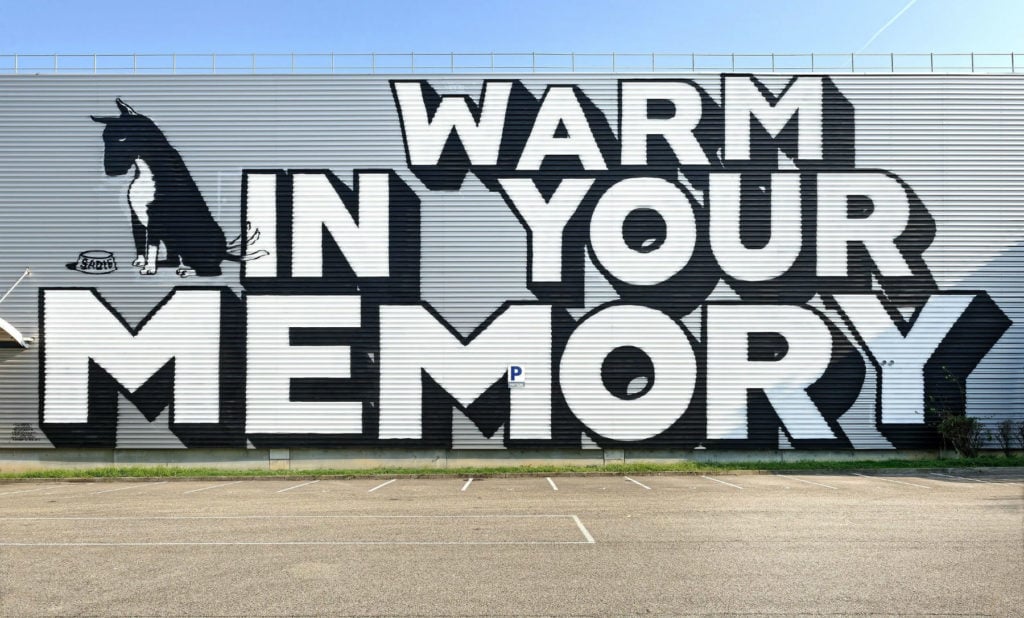
Stephen Powers, Open Door
(2019). Courtesy of the artist..
The Lyon-based art collective Bureau des Pleurs (Office of
Tears) takes a more direct approach to the area, involving folks
from the community in Gerland. In collaboration with François
Piron, coordinator of the post-graduate program at the École
Nationale Supérieure des Beaux-Arts in Lyon, the group created a
large installation inside the former administrative office spaces
of Fagor, detailing what it saw as the past, present, and future of
the factory. The ground is coated with sand providing a ruined look
to the surroundings, but the videos by Carla Adra, a founding
member of Bureau des Pleurs, are the centerpiece. After collecting
300 testimonials from the inhabitants of Gerland, the artist
reinterprets their stories herself through a series of webcam diary
entries to keep her subjects confidentiality.
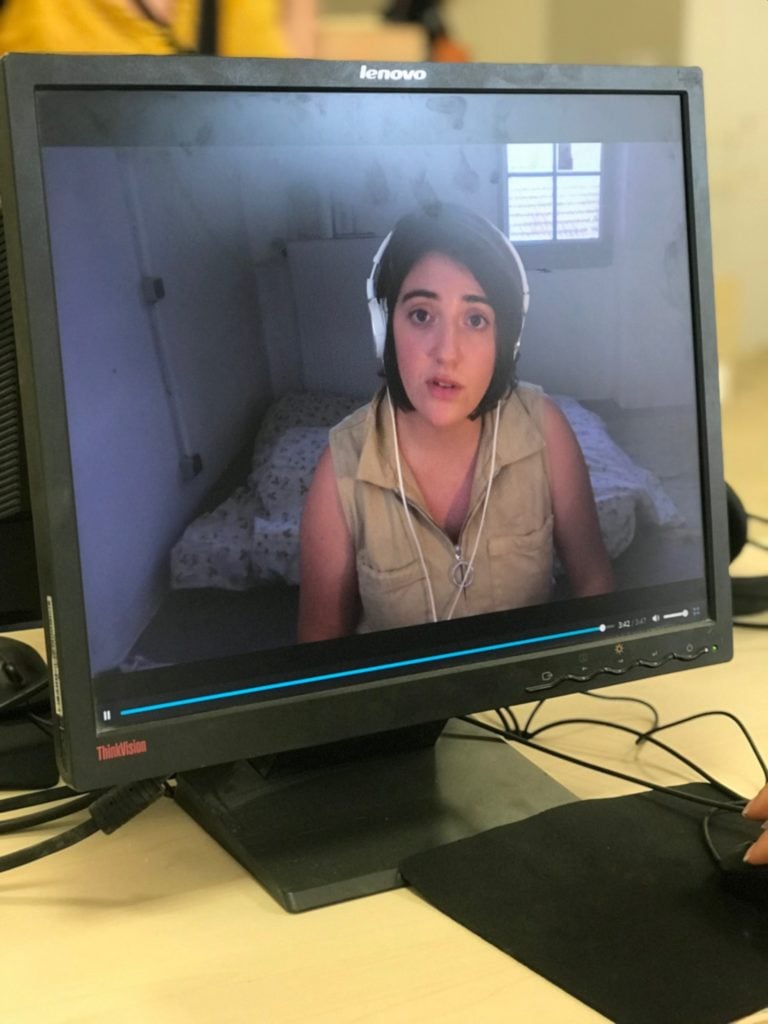
Bureau des Pleurs, Collective
installation produced by a Lyon-bases group of artists, 2019. View
of a Carla Adra’s contributions, 300 CD, and 300 videos searchable
on two computer screens. Photo: Terence Trouillot.
The result is a form of conceptual candor, the stories dutifully
and poetically revealing the grievances and injustices felt by this
community while also showing how they have been already displaced
into art.
Similarly, Argentine artists Julieta Garcia Vazquez and Javier
Villa present The Society of Secret Images (2019), a
social experiment that invites residents of Gerland to contribute
to a collection of images representing “knowledge and sensory
experience specific to the Gerland district.” (The work is part of
the “Veduta” project, an arts initiative first started in Lyon in
2007 by Adeline Lépine that seeks to engage different urban areas
of the city through the convergence of art and social practice, in
effect activating different parts of the region through dialogue
and artistic explorations.) The Society of Secret
Images it installed just outside the Fagor factory, in an
empty space. A cone-shaped hole recedes into the wall. Inside, a
video of a mouth spews poetic musings, maybe loose descriptions of
some of the images collected for the project, which remain
invisible to the greater public.
What rings true about most of the works in the show is not only
the absence or concealment of the community members themselves, but
the deliberate absence of actual human bodies. This may be
due the post-humanist bent of the biennale, in some ways reflecting
a post-apocalyptic view of its surroundings and a deference towards
non-living, inanimate objects. This post-industrial biennial
gestures towards a future that sees, at its most basic level, a
world in which human labor is quickly dwindling to zero in response
to mechanical advancements.
The Chtulucene
One of the main takeaways of this year’s biennale is a focus not
only on the realities and projections of the Anthropocene, but
rather a resonance with Donna J. Haraway’s notion of the
Chthulucene, a theory that explains our current epoch as a time
where living and non-livings things are inextricably linked via
social, economic, physical, and emotional bonds. The notion,
moreover, suggests relationships in conflict with each other, that
need remedying, or more diplomatically, some understanding.
![Le peuple qui manque, Et que demandent-t-ils? À y devenir quelque chose [And what do they ask for? To become something], 2019. Mixed media. Courtesy of the artist.](https://news.artnet.com/app/news-upload/2019/10/lyon-Le-peuple-qui-manque-1024x683.jpg)
Le peuple qui manque, Et que
demandent-t-ils? À y devenir quelque chose [And what do
they ask for? To become something] (2019). Courtesy of the
artist.
people) playfully addresses this idea in Et que
demandent-t-ils? À y devenir quelque chose (And what
do they ask for? To become something) (2019). The work, a
large installation in the shape of a circular auditorium with an
array or audio recordings and videos, invited philosophers,
historians, and poets to pontificate on the possibility of giving
politically agency and rights to plants, animals, and
objects.
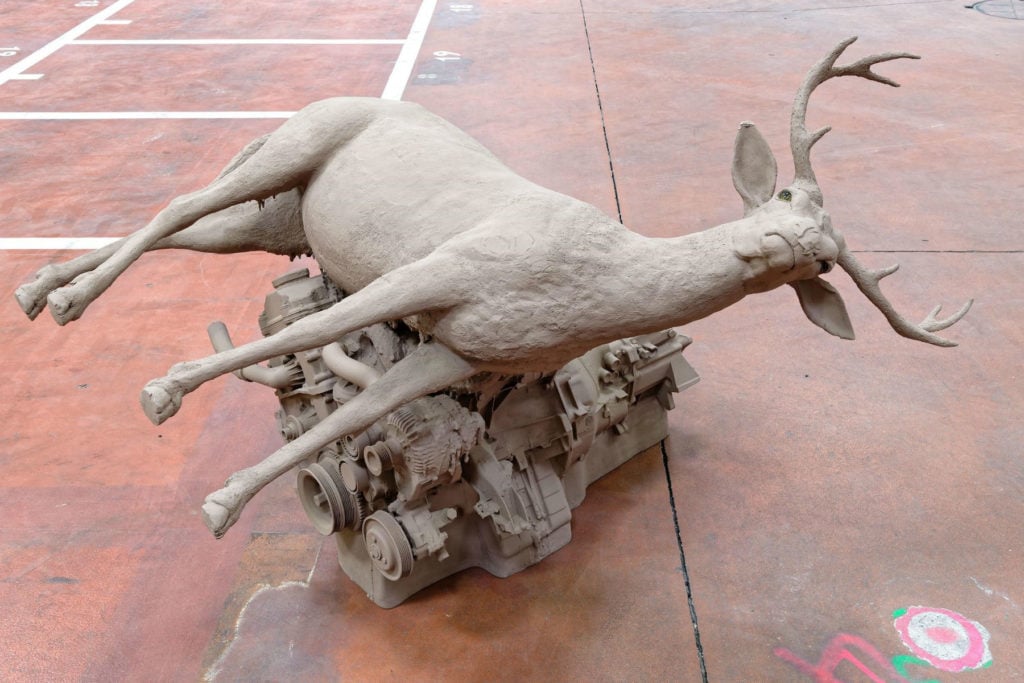
Nico Vascellari, Horse Power
(2019). Mixed media. Courtesy of the artist.
Other examples are more expressive, like the chimerical
sculptures of the Italian artist Nico Vascellari, fusing
animals to car engines or body parts carved out of wood, and the
French-British artist duo Daniel Dewar & Grégory Gicquel, who
present works featuring body parts morphing out of wood.
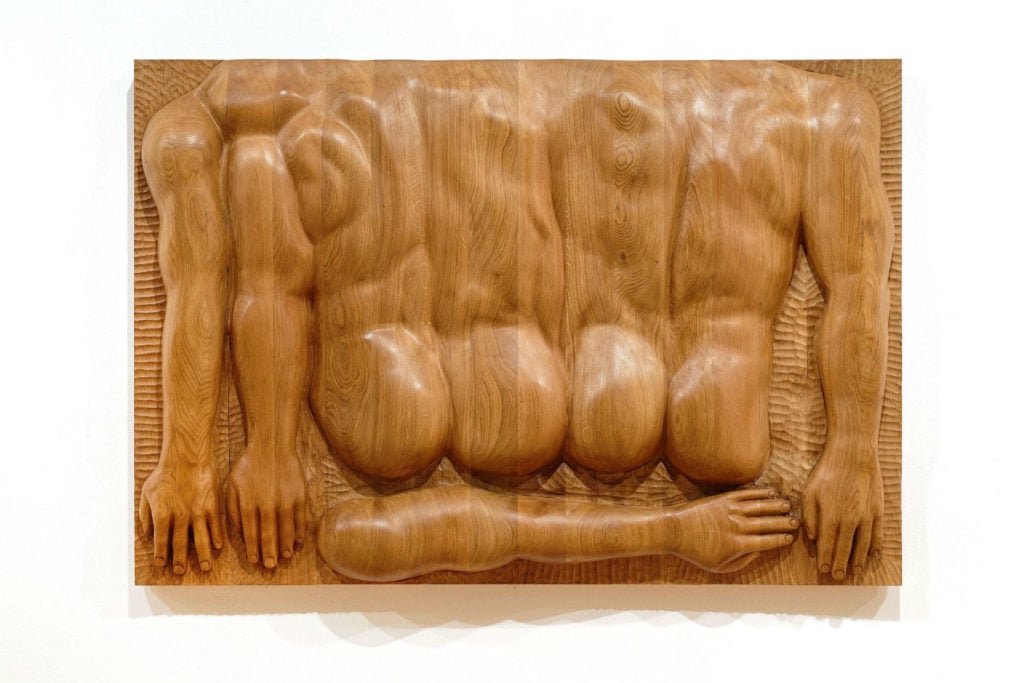
Daniel Dewar & Grégory Gicquem, Oak
mural with body fragments (2018). Courtesy of the artists and
CLEARING, New York/Bruxelles; Loevenbruck, Paris; Jan Kaps,
Cologne.
Most examples, however, are more sinister in their approach.
Isabelle’s Andriessen’s sculptures, which she calls “zombie
materials,” are irresistibly eerie: amorphous synthetic objects
that ooze and decompose on the floor. Thomas Feuerstein’s
Prometheus Delivered (2017–2019), an imposing installation
that retells the story of the mythological Titan is also menacing.
Here a statue of Prometheus is decomposing from stone-eating
bacteria, while tubes attached to it try to revive the figure with
a mixture of human cells and the same bacteria, to somehow
alchemically generate a human liver.
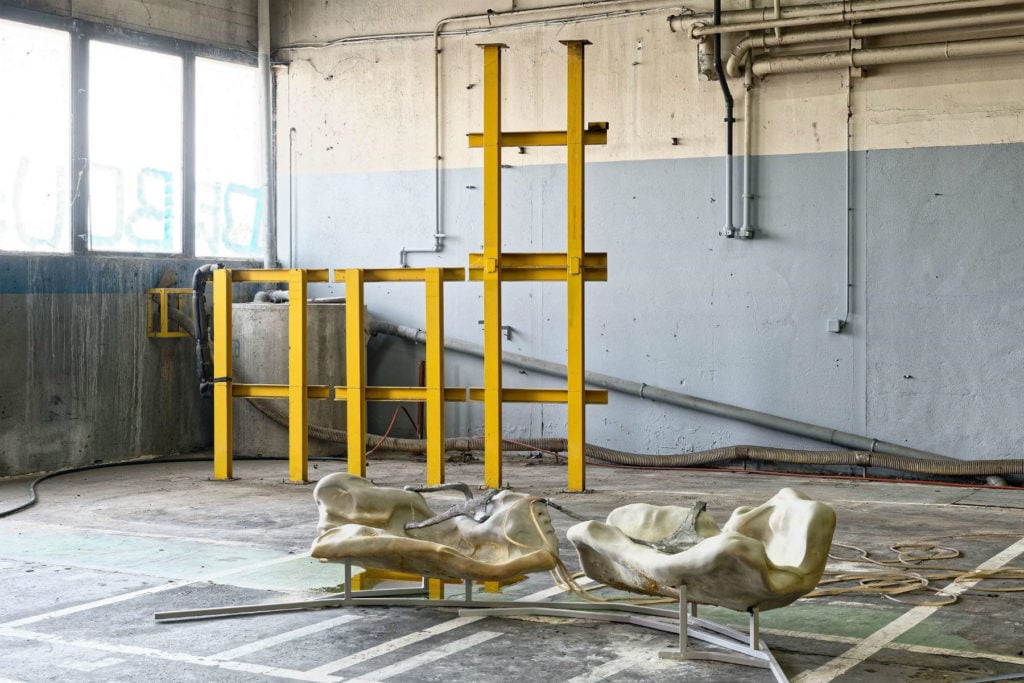
Isabelle Andriessen, Terminal
Beach (2018). Courtesy of the artist.
Finally, the Belgian artist Eva L’Houest also offers a
discomforting, although alluring, view of hybrid forms. Her video
and sculptural work draw fractal and distorted imagery from 3-D
scans and MRIs, to create humanoid figures that blend with and move
through other objects (e.g. trash, detritus, fences, and plaster
sculptures) and space.
A great many of the works in “Là Où Les Eaux Se Mêlent” promote,
in however disturbing a way, a fluidity between the mechanical and
the human. The implicit post-humanist perspective here tries to
insinuate that we must learn to live with this new reality, giving
some agency to non-living things. (That blurring of borders is
reflected, I’d argue, in the way the show is installed at the Fagor
factory, where art and ideas feel ironically crammed into a
gigantic open space.)
But in the end this conceptual framework may actually erase the
actual, very-human tragedy that this post-industrial site
represents. Human greed is not some new philosophical condition,
and machines are still just instruments used by humans on other
humans. It’s worth remembering that this history is obscured when
the conversation directs us to a new reality of
human-machine-nature hybridity.
The 15th Lyon Biennale is on view in Lyon, France, through
January 5, 2020.
The post The Lyon Biennale Responds to the Post-Industrial
Economy, Only to Get Lost in Post-Human Reveries appeared first
on artnet News.
Read more https://news.artnet.com/exhibitions/lyon-biennial-2019-1682167
Further reading


Leave a comment