
What the New $450 Million MoMA Means for the Art Market of Tomorrow
For some art lovers, considering
how the Museum of Modern Art’s latest architectural expansion will
affect the art market is like asking how the back-to-school
shopping surge will impact international sweat-shop labor: it’s
uncomfortable and maybe a little offensive. Yet MoMA has been
integral to the market arc of artists’ careers and legacies almost
since its inception.
The museum’s founding in 1929
played a significant role in establishing New York as the epicenter
of the American avant-garde. Its esteemed former chief curator of
painting and sculpture, William Rubin, awarded Frank Stella not one
but two MoMA retrospectives, making Stella the sole living artist
to earn that distinction. And more recently, MoMA’s gamble on
Marina Abramović’s
surprise 2010 blockbuster, “The Artist Is Present,” proved that
performance art can be not only viable, but even essential viewing
for the public at large.
To pretend these choices, and
countless others made by MoMA over the past 90 years, changed
nothing about the commercial art world would require a level of
innocence rarely seen outside a hospital nursery. It’s not only
fair, then, but necessary to ask how the museum’s monumental new
form will affect the market.
Any serious attempt at answering
that question has to account for the building itself, remade at a
cost of $450 million by Diller Scofidio + Renfro in conjunction
with Gensler. But just as important as the architectural changes,
if not even more so, are the accompanying curatorial shifts that
will determine what fills new and old spaces
alike.
It’s the interaction between
these two elements that will determine how MoMA’s latest changes
will reverberate into the art trade. And a considered analysis
leads me to believe that, unlike the reworked central staircase or
refreshingly easy-breathing lobby, the most consequential effects
demand some digging to uncover.
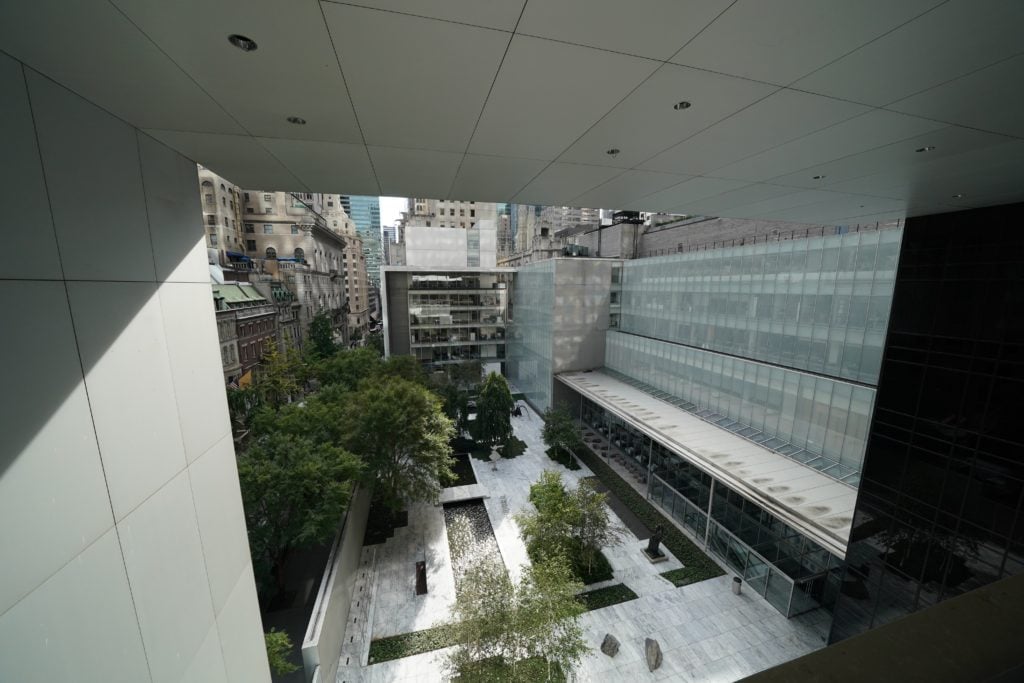
A look at the new MoMA, designed by
architects Diller Scofidio + Renfro in collaboration with Gensler.
Photo by Timothy A. Clary/AFP via Getty Images.
How Old Ideas Live On
Had DS+R and Gensler continued
with the original
vision unveiled in
2014, you’d be reading a very different analysis right
now.
That splashier redesign is now
best remembered for the proposed Art Bay, a physically and
conceptually convertible, triple-height space that many critics,
after the earlier reveal of DS+R’s plans for the Shed, treated as
if it were yesterday’s math homework re-submitted with today’s date
scribbled up top. Less enduring is the memory of the Gray Box, a
smaller gallery directly above the Art Bay that would have been
equipped with acoustic-absorption paneling and dedicated solely to
performances.
The museum and architects
composted both the Art Bay and the Gray Box in a chastened rethink
of the expansion presented in 2016. A few tweaks aside, those updated plans gave
us the MoMA we have today, one roughly 47,000 square feet larger
than before, and dedicated largely to its permanent
collection. This choice
alone heavily affects the expansion’s potential impact on the art
market.
That isn’t to say the earlier
plans would have been the right choice, considering the decidedly mixed reviews
for the Shed’s programming to date. For every rapturously
received Arca performance, there seems to be a Norma-Jean Baker
of Troy that sends
theater-goers scurrying to the exits early. But MoMA’s need for an
ongoing series of ambitious, site-responsive, marquee commissions
would have registered on the art market’s Richter scale in a major
way.
Instead, the expansion turns
MoMA inward. While temporary exhibitions will continue to unfurl in
most of the same designated spaces as in its prior iteration, the
revamp is largely premised on maximizing the potential of its vast
existing holdings.
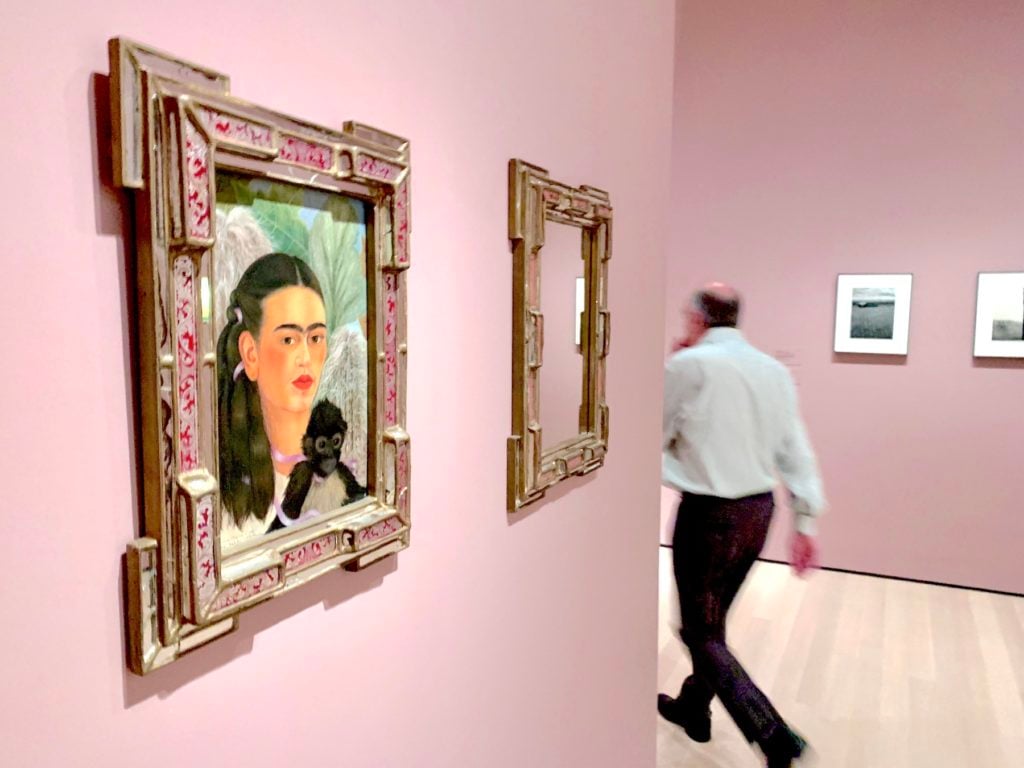
Frida Kahlo, Fulang-Chang and I
(1937). Image: Ben Davis.
I Think You Should Leave
This focus is underscored by the
museum’s commitment to rotating one-third of its collection
galleries every six months. On paper, the policy counteracts one of
the inefficiencies that led MoMA director Glenn Lowry to propose
that museums should “deaccession
rigorously” to acquire
great works or (if the major American museum associations would
change their guidelines to allow it) build their endowments: that
many, if not most, institutions own far more pieces than they can
ever exhibit. To paraphrase University of California public policy
professor Michael
O’Hare, a vocal champion
of selective deaccessioning, what cultural value are these legions
of works providing from inside storage crates?
In actuality, though, MoMA’s
cycling strategy comes nowhere near to solving the problem of its
overcrowded storage. Lowry told our own Andrew
Goldstein that the
inaugural rehang comprises nearly 2,500 works, and the museum’s
website states that its collection currently surpasses 200,000
objects. If MoMA stopped collecting today, but continued turning
over the entirety of its permanent collections galleries every 18
months, it would still need more than 80 years to put everything it
owns on view to the public just one time. I’m pretty confident
Lowry and his colleagues aren’t doing celebratory keg stands over
that ratio.
Will the collection’s regular
churn make this problem obvious to the museum’s trustees and
advisers, leading MoMA to bonsai its holdings with unprecedented
urgency and at unprecedented scale? If so, that outcome would
fertilize the market with thousands of works carrying impeccable
provenance—better than even the most esteemed estate—in large part
to equip the museum with the funding to fill the non-male,
non-white, non-Western holes in its permanent
collection.
I just find it hard to believe
this will happen. Lowry’s comments show that MoMA’s
decision-makers, from the curators to the trustees, were already
well aware of this issue. Since they haven’t been compelled to
embark on such a paradigm-shifting deaccession campaign before, I’m
not sure why their minds would change after spending $450 million
to make the museum
bigger. And who can
blame them, when selling a handful of works every few years
provokes a throat-shredding outcry
from certain segments of the art
world?
The renovation could certainly
nudge the museum to make a few targeted deaccessions to diversify
the collection, as some of MoMA’s peer institutions
have done recently. But
short of spending the resulting funds on artists with almost no
prior museum pedigree, this strategy wouldn’t cause a dramatic
shift in the trade. Remember, private collectors now set an
artist’s market by dint of having vastly more money to spend than
public institutions. It would require a never-before-seen rampage
of deaccessioning for MoMA to reverse that trend. Las Vegas could
not generate odds favorable enough to convince me to bet more than
a token amount on that outcome.
Does this mean that the revamped
MoMA will have no effect on the art market, then? Not exactly. It
just means the consequences are likely to be
subtle.
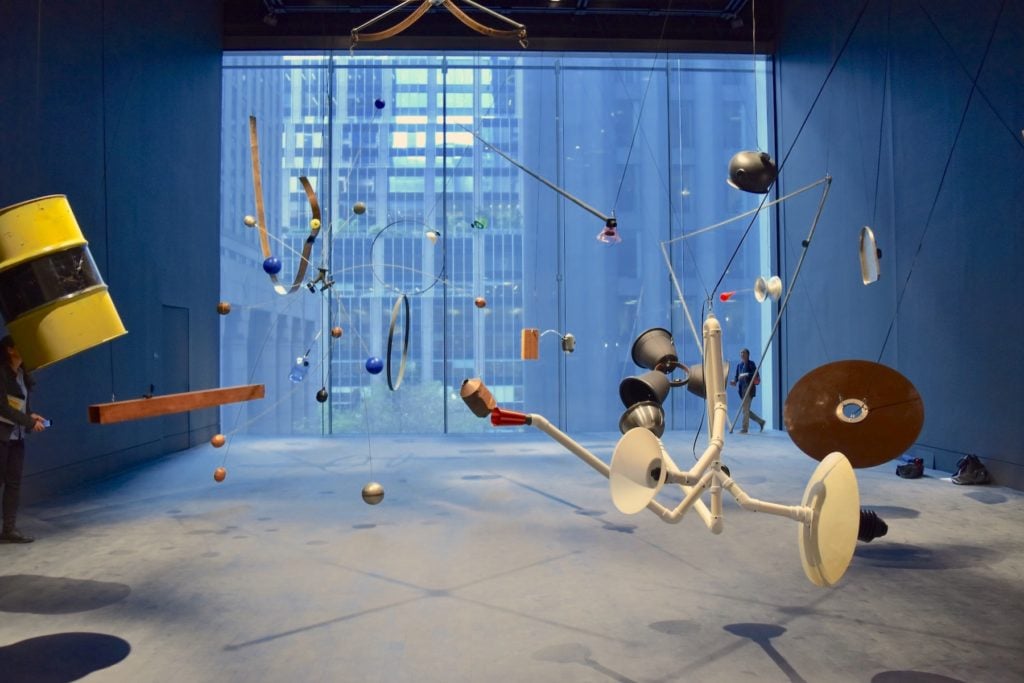
David Tudor and Composers Inside
Electronics Inc., Rainforest V (variation 1). Image: Ben
Davis.
Everything in Moderation
Although the Gray Box was
pine-casketed almost four years ago, its spirit lives on in the
form of the new Marie-Josée and Henry Kravis Studio on the museum’s
fourth floor. Overlooking 53rd Street just west of the central
staircase, the modestly sized space is the actualization of a unit
innocuously labeled as a “new gallery/studio” in the 2016
rethinking of the museum. MoMA now bills the Kravis Studio as “the
world’s first dedicated space for performance, process, and
time-based art to be centrally integrated within the galleries of a
major museum,” where it will alternately host everything from newly
commissioned works and festivals, to residencies and
workshops.
Yes, it’s a more limited gesture
than the Gray Box would have been, let alone the Art Bay. But it’s
not an insignificant one. In part two
of his aforementioned interview
with artnet News, Lowry defined “The Artist Is Present” as a
“watershed moment” that clarified how performance would be “central
to museums in the future.” MoMA is taking a step into that future
by assigning a permanent and architecturally prominent space to
this medium—a step none of its peers has taken, even as happenings
and events have assumed greater importance in institutional
programming worldwide over this decade. And when MoMA leads,
everyone else in the museum sector still takes
note.
Just as significant, though, is
the fact that a major collecting family like the Kravises were
willing to sponsor the performance studio. In a capitalist system,
every art form is only as marketable as the size of its patron
group. And given the follow-the-leader mentality that governs so
much collecting behavior, performance could hardly ask for a better
endorsement than being visibly co-signed inside MoMA by a
billionaire couple consisting of the institution’s president
emerita (Marie-Josée) and the namesake of an entire wing of the
Metropolitan Museum of Art (Henry).
In terms of commercial
prospects, another noteworthy space occupies a double-height
gallery at the west end of the ground floor. There, as part of the
“Studio Museum at MoMA” series, MoMA will present one annual
exhibition selected by the Harlem institution while its new David
Adjaye-designed building is under construction. (MoMA PS1 will also
host one exhibition per year by artists in residence at the Studio
Museum.)
Given the past few years’ market
momentum toward artists of color, particularly those
anointed by Thelma Golden’s Midas touch, this collaboration provides an important
platform for rising talent to gain traction with patrons during the
Studio Museum’s hiatus. Michael Armitage, the subject of the first
show in the series, has never had his work appear at auction to
date. Let’s see if that changes in the next year.
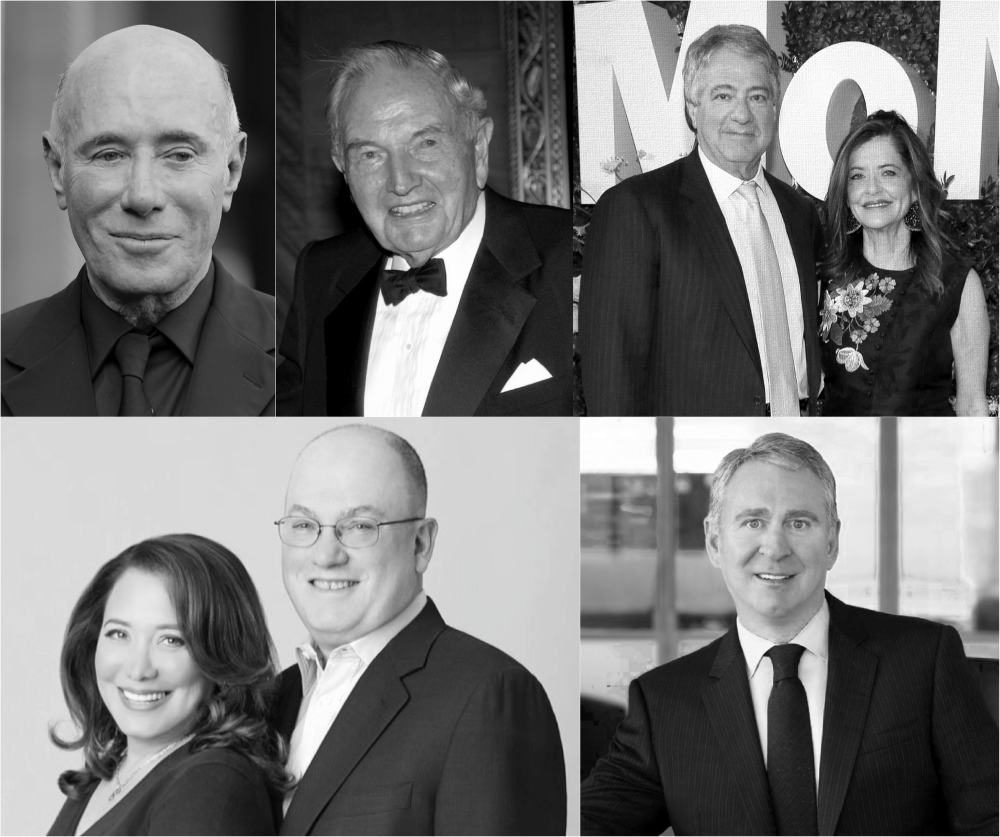
Clockwise from top left: David Geffen;
David Rockefeller; Leon and Debra Black; Alexandra and Steven
Cohen; Ken Griffin.
What Matters Most
Beyond these modest elements,
though, the revitalized MoMA has few other features with the
potential to torque the art trade. Spacious, inviting, and
well-trafficked as the new lobby may be, I don’t think it’s going
to provide the American equivalent of Tate Modern’s lusted-after,
sometimes trajectory-influencing Turbine Hall. The second-floor
atrium remains unchanged from the Yoshio Taniguchi overhaul in
2004, even though that space is limited by its
awkwardness.
Maybe the reworked restaurant
and cafe will help lubricate sales by getting collectors’ blood
sugar up so they don’t sleepwalk through a curator-led tour of the
galleries… but if that happens on a scale that moves the needle in
the overall market, frankly, it’ll be time for all of us to
reevaluate a lot of things about our lives.
In the end, just as my
colleague Ben
Davis felt that MoMA’s
initial rehang did more to reinforce the established canon than to
atomize it, the museum’s expansion does more to reinforce the
art-market status quo than to disrupt it. The Kravis studio
matters, as does an exhibition of Latin American works from a major
gift by media magnate Patricia Phelps de Cisneros. But two freshly
christened, much larger spaces arguably matter
more.
The museum’s nearly 50,000
square feet of augmentations to the west are known as the David
Geffen Wing, in recognition of the mega-collector’s $100 million
donation in 2016. Its sixth floor, still dedicated to temporary
shows, has been named the Steven and Alexandra Cohen Center for
Special Exhibitions, in honor of the couple’s $50 million gift to
MoMA in 2017. Although there are no visible signifiers of its
presence inside the renovation, the museum also benefited from an
estimated $228 million from the late David Rockefeller since 2017,
as well as additional major
donations from familiar faces like Ken Griffin and Debra and
Leon Black.
Geffen, Cohen, and their
contemporaries have certainly been generous to institutions and
beneficial to their favorite artists’ prospects over the past few
decades. Rockefeller’s transformative impact on the art world
outlives him. But in an American museum system still largely
subject to the preferences of super-rich private patrons, it’s
important to recognize that the new MoMA was largely made possible
by checks bearing the same old signatures. If that fact doesn’t
tell us something meaningful about the limited degree of change we
should expect the revamped institution to have on the market, we’re
not listening closely enough.
The post What the New $450 Million MoMA Means for the Art
Market of Tomorrow appeared first on artnet News.
Read more https://news.artnet.com/opinion/moma-expansion-art-market-1682983
Further reading


Leave a comment