
Tad Smith Went From the Entertainment World to Remake Sotheby’s. Now That He’s Out as CEO, Where Does the Auction House Go From Here?
There were two competing schools
of thought about Monday’s news that Sotheby’s CEO Tad Smith, who
joined the auction house in 2015 from Madison Square Garden, would
be replaced by Charles
Stewart, the CFO of
telecom provider Altice USA, effective immediately. The first was
that the move came out of the blue, particularly in light of
Smith’s steering of the storied house to a lucrative sale of $3.7
billion to
French-Israeli tycoon Patrick Drahi. The second was that the
C-suite switch amounted to business as usual in a corporate
acquisition, with the new owner wanting his own team in place
regardless of the previous regime’s merits.
No matter which argument you
subscribe to, the fact remains that Smith’s four-and-a-half-year
reign is now over. It’s only natural, then, to look back on his
time at the Sotheby’s helm to see how the company evolved under his
leadership—and to ask how those mutations might portend what comes
next in the company’s return to private control.
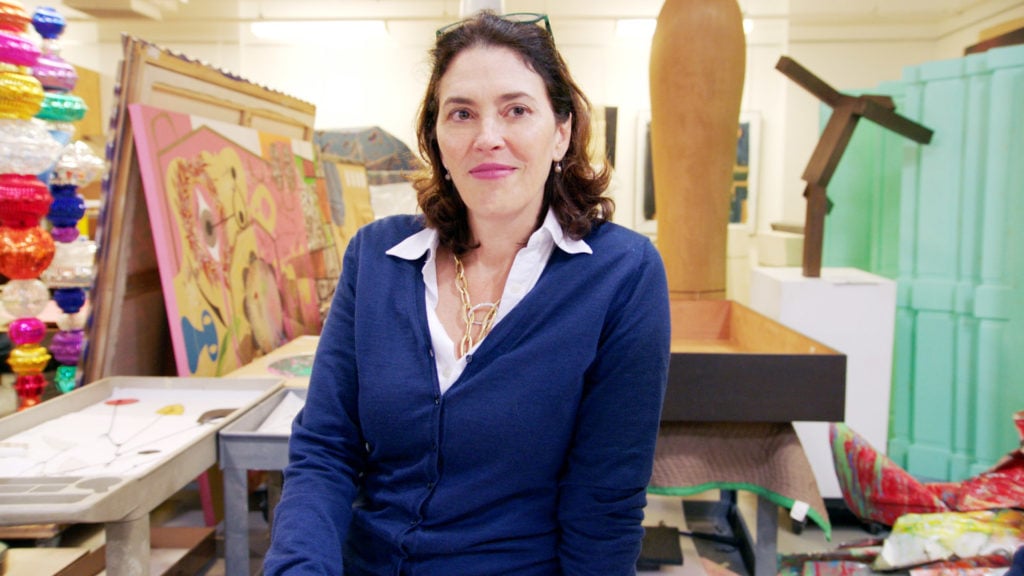
Art Agency, Partners co-founder and
Sotheby’s chairman and executive vice president Amy Cappellazzo in
The Price of Everything. Image courtesy of HBO.
Acquisitions and Adaptations
Arguably the defining aspect of
Smith’s tenure was a varied slate of corporate acquisitions that
began only nine months after his hire. The first of these
was Art Agency,
Partners (AAP), the
high-end art advisory firm then led by rainmakers Amy Cappellazzo,
Allan Schwartzman, and Adam Chinn. The deal cost Sotheby’s a grand
total of $85 million, including performance incentives that AAP
eventually reached in the succeeding years. But the auction house
was just getting started.
In the next 25 months, Sotheby’s
also absorbed the Mei Moses Art
Indices, a set of
art-market analytics tools primarily focused on works sold multiple
times at auction; Orion Analytical, a forensic art analysis firm
whose founder, Jamie Martin, would be named the head of the auction
world’s first department of scientific research at
Sotheby’s; Thread
Genius, a
machine-learning startup intent on creating algorithms capable of
recommending works of art and design to users; and Viyet.com, an
online retailer of design and vintage and antique furniture that
was rebranded as Sotheby’s Home in 2018.
Art Agency, Partners, aside, the
cost-benefit analysis of these acquisitions is a hazy calculus. The
acquisition price of the Mei Moses indices, Orion Analytical, and
Viyet were all undisclosed, while Thread Genius’s cost was low
enough to be considered “non-material” to
Sotheby’s.
Yet the value of these moves was
about more than dollars and cents. Together, Sotheby’s acquisitions
arguably became a harbinger of, and contributor to, the trend of
galleries and auction houses alike transitioning from simple
dealerships to full-service firms capable of fulfilling a client’s
every need. In that sense, the buying spree fundamentally altered
the market’s perception of Sotheby’s, which at the time was the
oldest company on the New York Stock Exchange.
In the span of roughly three
years, the company used acquisitions and technology to transform
itself into a multifaceted actor boasting clear strategic
differences from chief rival Christie’s—a differentiation that
could make Sotheby’s enticing to potential buyers interested in an
auction house facing the future.
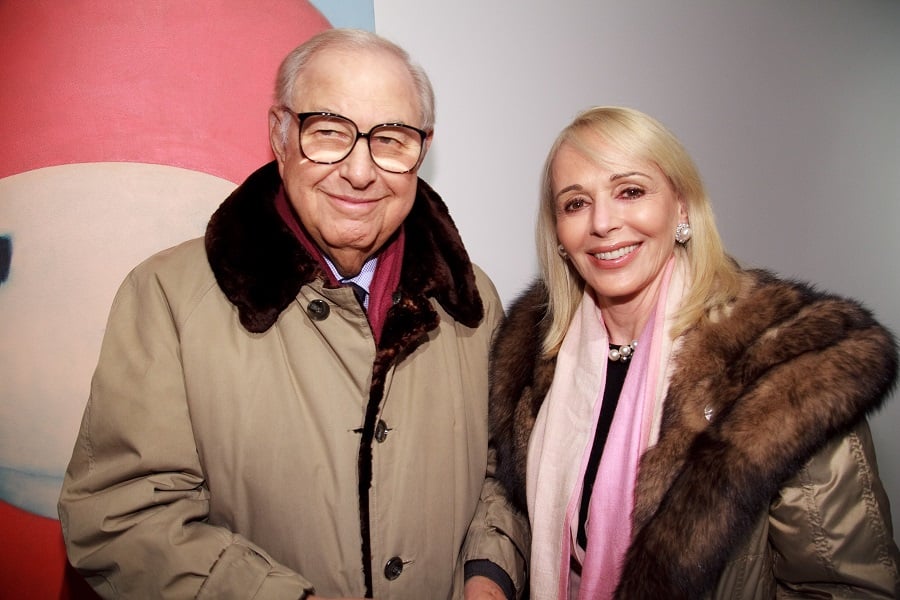
Former Sotheby’s CEO A. Alfred Taubman
and wife Judy Taubman. Photo: Dustin Wayne Harris/Patrick
McMullan.
The Guarantee Game
Sotheby’s also distinguished
itself in its approach to guarantees, financial tools that help
auction houses secure high-value materials but also sometimes cost
them big money if works fail to meet expectations.
Christie’s and Sotheby’s both
experienced heavy losses on guarantees in the fallout from the 2008
global financial crisis and cut back sharply on risk in the ensuing
years. When the market picked up steam again from 2010 onwards,
both steered away from direct guarantees to third-party guarantees
as a way to offload risk. But that’s where the two houses diverged
a bit in strategy. As a public company, Sotheby’s was held to a
higher standard of financial reporting, and generally trended
toward being slightly more conservative in the deals it
structured.
And when Sotheby’s took a risk
that didn’t pay off, it was under much more scrutiny than its rival
to explain its misstep. A key test of Smith’s appetite for risk came
just a few months into his tenure in 2015 when Sotheby’s and
Christie’s engaged in heated competition to win the collection of
A. Alfred Taubman, the longtime former CEO of Sotheby’s. Some
observers said Sotheby’s couldn’t be seen losing out to arch-rival
Christie’s on a collection so tied to its brand, though others said
it might not be worth the investment—particularly since Taubman was
the only person sentenced to a year in federal prison for his role
in a wide-ranging price-fixing scandal with
Christie’s.
In the end, according to SEC
filings that September, Sotheby’s shelled out a $500 million
guarantee to the late
Taubman’s heirs. Several months later, the house disclosed it would
lose $12 million in the fourth quarter as a result of the
deal—though Smith insisted it was an isolated
case. “There was only
one Alfred Taubman,” Smith said in a conference call with investors
at the time.
The Taubman estate was, however, a key example of how Sotheby’s,
as a public company, faced unique consequences when a deal didn’t
pay off. A similar dynamic surfaced last year when the house was
forced to reveal it had suffered
losses after two high-profile guaranteed works failed to
meet expectations, requiring them to give up a portion of the
buyer’s premium.
Now that Sotheby’s is private, such disclosures will no longer
be required, allowing the house greater flexibility (but not
necessarily greater profitability) in its approach to
dealmaking.
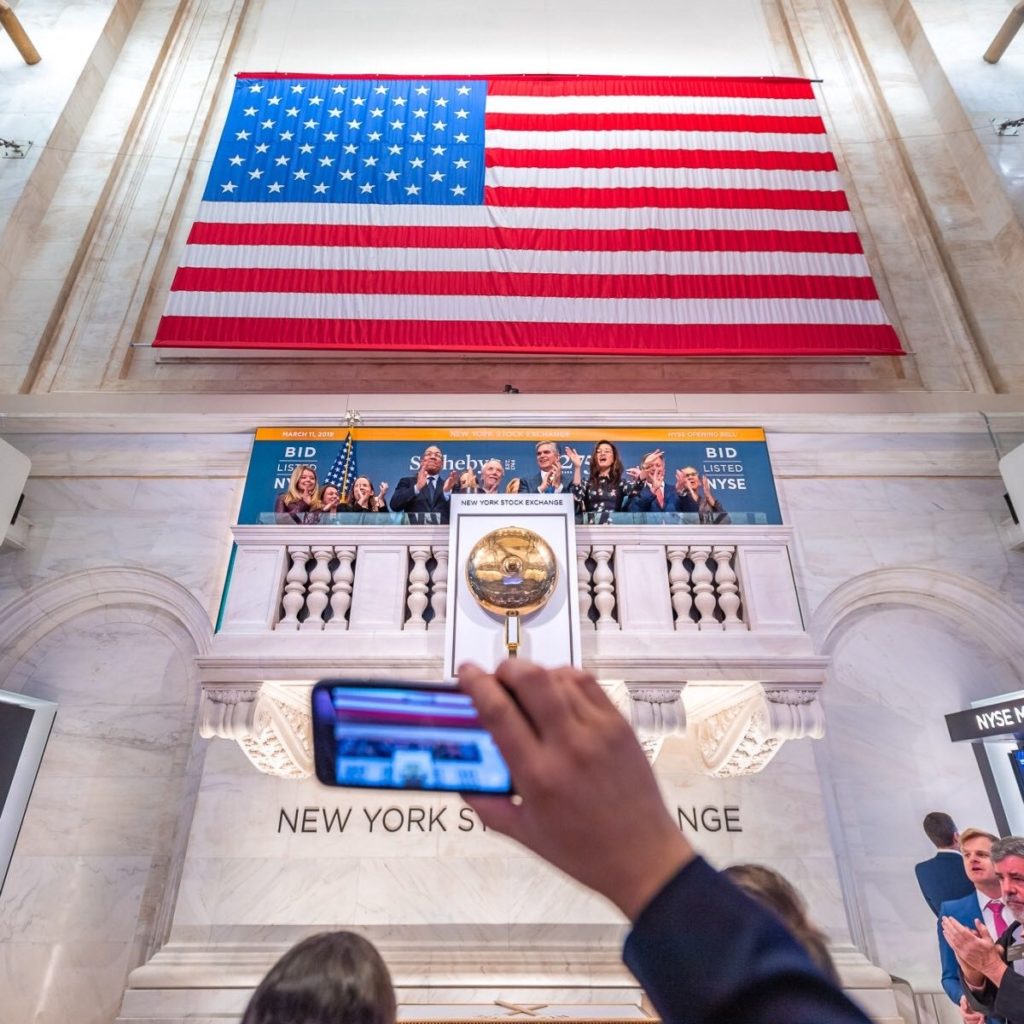
Sotheby’s representatives at the New
York Stock Exchange. Photo courtesy of Sotheby’s.
Private Sales and Public-Market Performance
Smith counted private
sales—which receive less public scrutiny and on which the house
often enjoyed higher margins—as a priority from the start. In
February 2017, Sotheby’s hired David Schrader to lead the division,
and he began building out a dedicated team. That year, private
sales totaled $744.6 million, up from $583.4 million in
2016. And in 2018, Sotheby’s
hit a milestone when it topped $1 billion in private
sales.
Meanwhile, in another move to make the house appear in a strong
position, Sotheby’s also accelerated its stock buyback program
under Smith, returning approximately $815 million to shareholders
and repurchasing approximately 24 million shares between 2015 and
2018.
But savvy acquisitions and stock
buybacks aside, Sotheby’s stock dropped roughly 15 percent from the
time Smith was hired in mid-March 2015 ($41.36) until right before
the acquisition was announced ($35.27) with a premium of 56.3
percent. During his tenure, the stock price ranged from lows near
$20 per share to highs near $60 per share.
Depending on who you speak to,
Smith and his team either did a stellar job convincing Drahi of the
auction house’s potential value, or they dressed up the appearance
of the company with sophisticated moves like stock buybacks and
staff cuts just enough to make it appear as a worthwhile
acquisition target. (While some of Sotheby’s acquisitions, like
Orion Analytical, have already proven their worth by confirming
valuable attributions or helping Sotheby’s through ongoing
litigation, it remains to be seen exactly what the house has
planned for, say, Thread Genius.)
“What did Drahi really inherit?”
asked one auction house veteran. Smith “spent money on buying back
shares and got rid of the people with institutional knowledge and
now he goes off with his money. Does that really serve the company
and the industry to lose institutional knowledge? It’s really hard
to change the business… it’s based on experience, it’s not a brand
to be exploited. You don’t manufacture at all and you can’t control
supply.”
Art advisor Todd Levin put it
more bluntly: “The stock is down when every other index has been on
one of the greatest historical tears ever experienced by market
indices. I’m still unclear what he [Smith] has done to bring
serious value.”
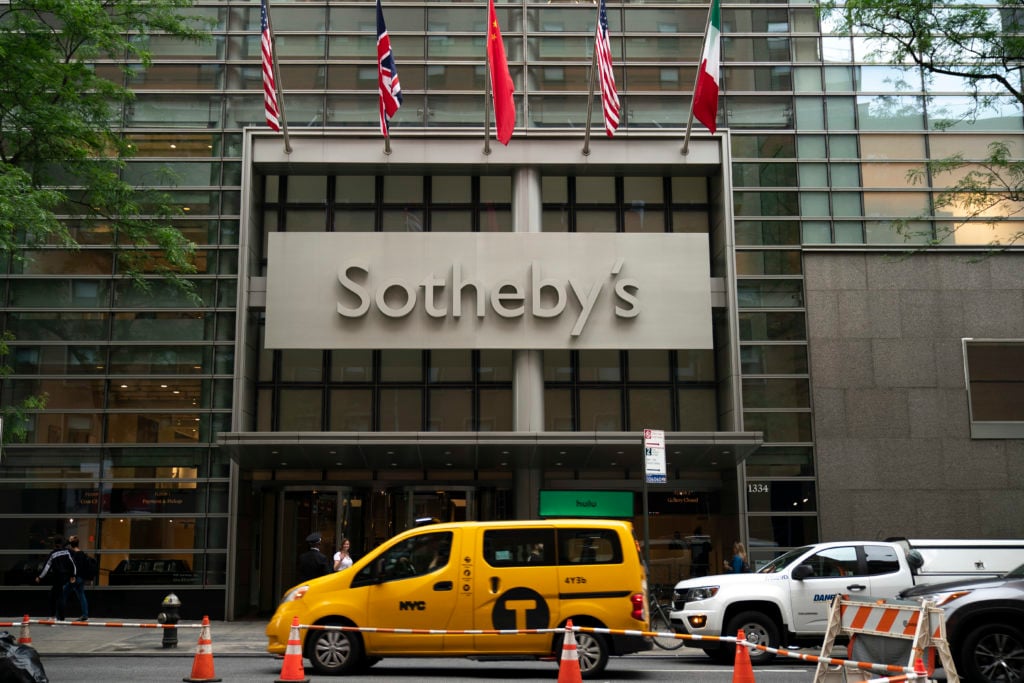
Sotheby’s headquarters on the Upper East
Side in Manhattan, June 17, 2019 in New York City. (Photo by Drew
Angerer/Getty Images)
A Look Ahead
Despite critics’ opinions,
though, Smith transitions from the C-suite into the role of senior
adviser to newly appointed CEO Charles Stewart with roughly $28
million in severance swelling his pockets. The question that looms
larger than his legacy (and departure) is what Stewart’s hire means
for the future of Sotheby’s.
At the moment, the responsible
answer is that speculation seems like no more than just that.
Sotheby’s shares stopped trading on the NYSE after the proposed
deal with Drahi’s Bidfair USA was finalized in the opening days of
October. Since that time, the house’s new owner has done little
more than shuffle personnel at the top of the organizational chart.
Apart from Stewart’s replacement of Smith, Drahi installed
Jean-Luc
Berrebi, the head of his
family office, in place of former CFO Michael Goss. A regulatory
filing announcing the move also included news that executive vice
president and chief commercial officer John Cahill would be
departing as well.
Beyond these moves, Drahi’s
vision for the company remains even more mysterious than
his
past. It seems
reasonable to think that his history in telecoms and media, along
with his choice to plant some of his closest confidants at the apex
of the company, indicates an intent to ride a beefed-up media
presence and online services to new heights in the auction world.
But this line of thought assumes that humans are perpetually
rational actors whose prior histories always sync up with their
next moves.
In truth, this vision of human
nature is a convenient fantasy. A priest uncharacteristically late
to an important engagement can easily ignore a beggar, and the
founder of a social-media giant allegedly premised on free speech
can easily refuse to take live
questions from an audience of students. Similarly, it is entirely plausible that
Drahi’s choice to surround himself with longtime allies—and even to
tap a top executive at one of his telecom companies to be
CEO—indicates nothing more substantial about his strategy for the
house. Whether someone aims to be bold or conservative, they tend
to want those they trust most nearby.
In the end, all we can be sure
of is that, after four-and-a-half years, Tad Smith leaves Sotheby’s
a fundamentally different auction house, while carrying a colossal
bag of cash out the door. What remains to be seen is how much more
value can be added onto the structures he built—and what his
replacement will do independent of the answer.
The post Tad Smith Went From the Entertainment World to
Remake Sotheby’s. Now That He’s Out as CEO, Where Does the Auction
House Go From Here? appeared first on artnet News.
Read more https://news.artnet.com/market/tad-smith-sothebys-legacy-1692742
Further reading


Leave a comment