
Botticelli Is Buried at the Feet of His Muse—and 9 Other Stories Behind Artists’ Unusual Final Resting Places
“I always thought I’d like my
own tombstone to be blank,” Andy Warhol once quipped. “No epitaph
and no name. Well, actually, I’d like it to say ‘figment.’” While
Warhol didn’t get his wish (as you’ll see below), death does become
a kind of funerary performance piece for some artists. From
scripted ceremonies to show-stopping tombstones, the last rites for
a number of art-historically important figures offer fascinating
insights into their lives and legacies.
If your interest in art extends
beyond (or let’s say to) the grave, you’re in luck. Just
in time for Halloween, here’s our guide to the 10 most unusual
art-historical tombs.
Antonio Canova
(1757–1822)
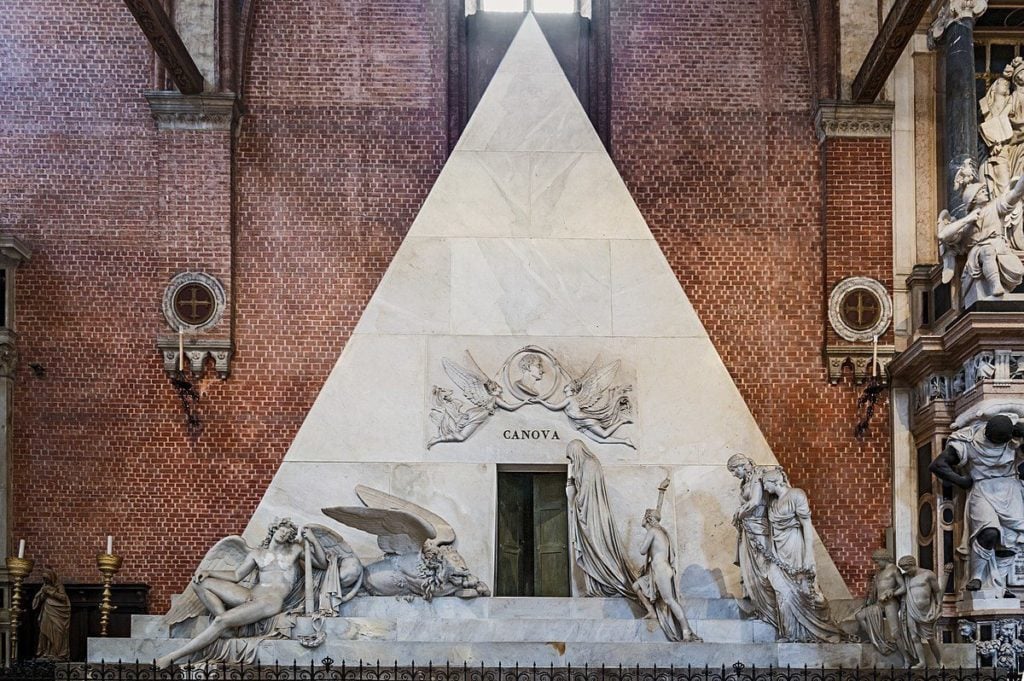
Italian neoclassical sculptor Antonio
Canova’s funerary monument basilica di Santa Maria Gloriosa dei
Frari, Basilica dei Frari, Venice, Italy. Courtesy
of Flickr.
Date of Earthly Departure: October 13,
1822
Eternal Resting Place: Santa
Maria Gloriosa dei Frari, Basilica dei Frari, Venice (at least some
of him)
Deathly
Details: Though the
fervor for the Italian neoclassical sculptor has diminished in the
nearly 200 years since his death, Canova enjoyed unparalleled
artistic celebrity in his time—as evidenced by the elaborate (and
frankly sort of bizarre) tomb erected for him by a group of his
students. The monument itself is derived from designs Canova made
for the tomb of Titian, but with symbols that reference his own
association with Freemasonry, like a pyramidal entrance. Oh, and to
make things even stranger, we should note that the only part of
Canova entombed here is his heart. His death apparently invoked a
relic-crazed zeal that resulted in the divvying up of the rest of
his body.
Andy Warhol
(1928–1987)
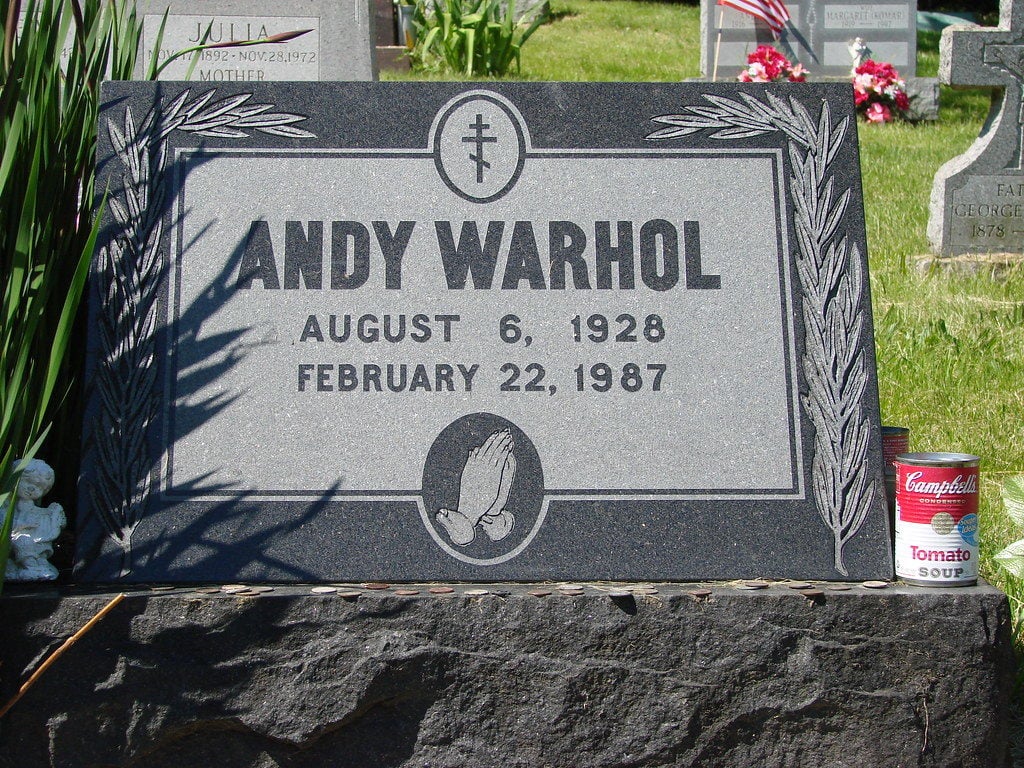
Andy Warhol’s tombstone at St. John the
Baptist Byzantine Catholic Cemetery, Bethel Park, PA. Courtesy of
Flickr.
Date of Earthly Departure: February 22,
1987
Eternal Resting Place: St. John the
Baptist Byzantine Catholic Cemetery, Bethel Park,
Pennsylvania
Deathly
Details: The spirit of
death hovered over all of Andy Warhol’s career. From the Pop icon’s
“Death and Disaster” series to his attempted assassination,
his life seemed a long flirtation with the grim reaper. And while
one might expect his grave site to be something of a colorful
culmination of this preoccupation, Warhol’s burial place in a
Catholic cemetery alongside his parents seems the opposite of
attention-grabbing—at least at first glance. For those in the know,
however, Warhol’s cult of fame lives on. His grave site is
live-streamed
24-hours a day by the
St. John Chrysostom Byzantine Catholic Church.
Frida Kahlo
(1907–1954)
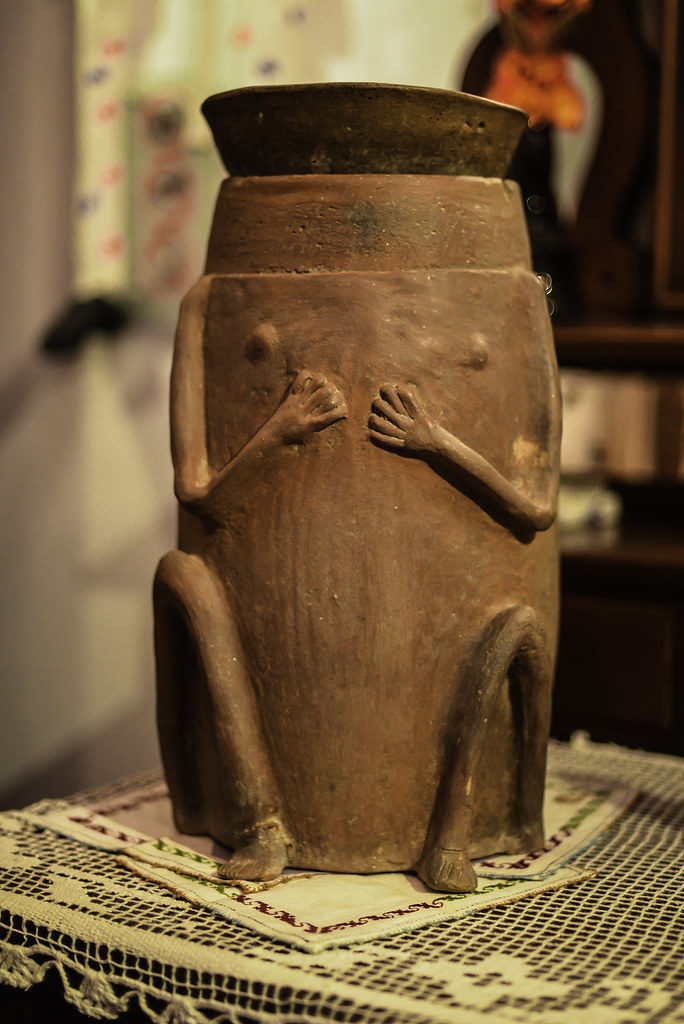
Frida Kahlo’s urn at her home, Casa
Azul, in Mexico City. Courtesy
of Flickr.
Date of Earthly Departure: July 13, 1954
Eternal Resting Place: a frog-shaped
urn at her home in Mexico City
Deathly
Details: After a tragic
bus accident nearly killed her in her teenage years, Frida Kahlo’s
brief life was marked by surgeries, illnesses, and immense physical
suffering. Her last diary entry before she died at the age of 47
read: “I hope the exit is joyful—and I hope never to return—Frida.”
Anticipating her death, Kahlo requested that her ashes be placed in
a frog-shaped pre-Columbian urn and kept at her beloved home, Casa
Azul, where they remain on display to this day.
Patricia Cronin (b.
1963)
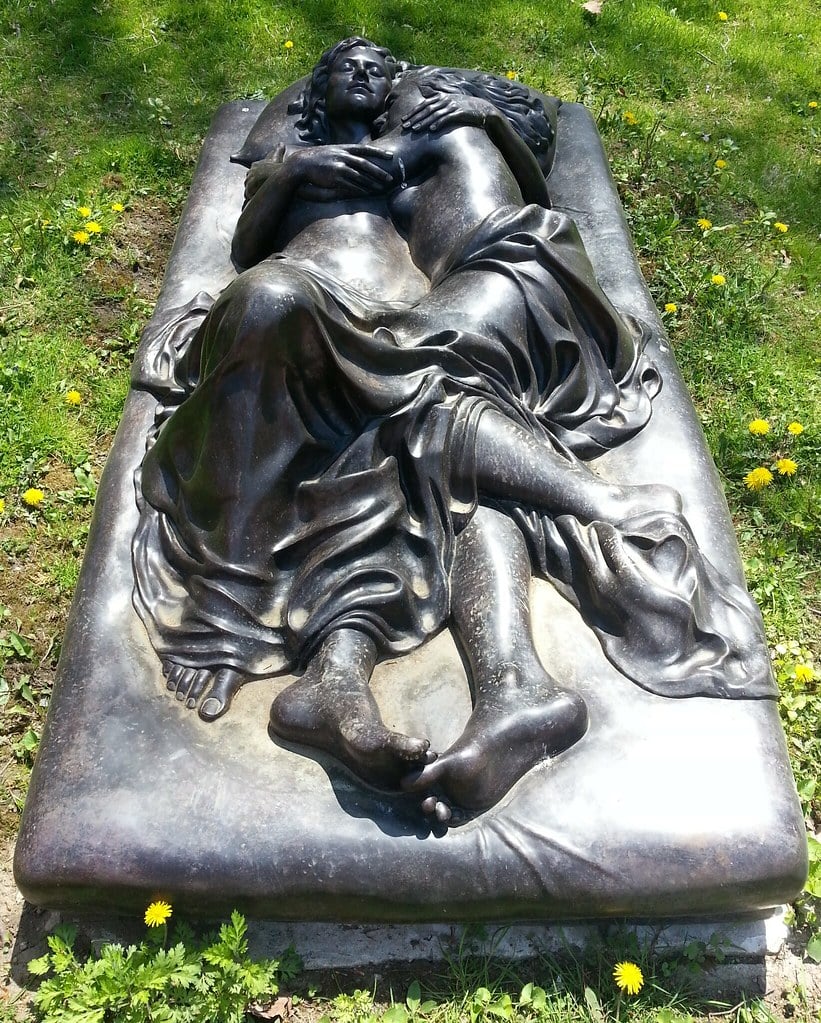
Patricia Cronin’s Memorial to a
Marriage (2011) at Woodlawn Cemetery, Bronx, New
York. Courtesy
of Flickr.
Date of Earthly Departure: Fingers crossed for a far-off
future
Eternal Resting Place: Woodlawn
Cemetery in the Bronx
Deathly Details: Patricia Cronin has got to be a project
manager’s dream. While many artists have been bequeathed with
elegiac monuments many years after their deaths, Cronin has already
got her sepulchral future all set. In 2011, the artist installed a
bronze version of Memorial to a Marriage, a sculpture
that depicts her and her wife, the artist Deborah Kass, embracing
in bed, at a cemetery in the Bronx. The seemingly Etruscan-inspired
tomb will mark the couple’s resting place whenever the time comes
(hopefully a long time from now).
Ricardo Menon
(1952–1989)
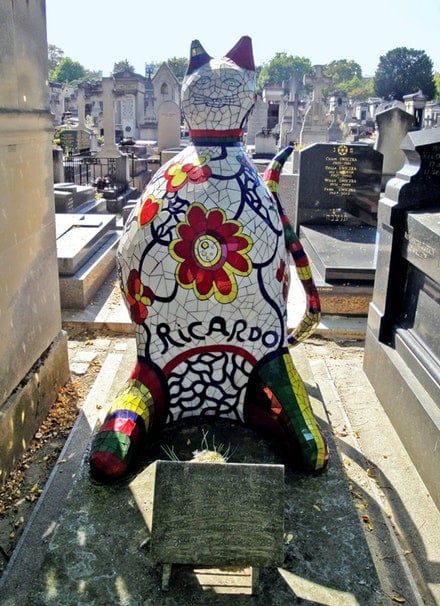
Tombstone designed by Niki de Saint
Phalle for her studio assistant Ricardo Menon at Cimetière
Montparnasse, Paris. Courtesy of Flickr.
Date of Earthly Departure: September 21,
1989
Eternal Resting Place: Cimetière de Montparnasse,
Paris
Deathly
Details: Second only to
Père Lachaise Cemetery in the number of creative
geniuses it boasts as permanent
residents, Cimetière de Montparnasse is the chosen
resting spot of Baudelaire, Sartre, and Brancusi, to name a few.
But among all of these, the most eye-catching tombstone is
certainly a dazzling white cat designed by the artist Niki de Saint
Phalle for her dear friend and decade-long studio assistant Ricardo
Menon. Menon worked with the French artist on her ebullient
sculptural wonderland, the Tarot Garden, in Tuscany, and cared for
Saint Phalle as she endured debilitating arthritis. Before Menon’s
death from AIDS in 1989, Saint Phalle promised to make him a
tombstone in the shape of a cat, the animal she most associated
with him for its mysterious beauty.
Auguste Rodin
(1840–1917)
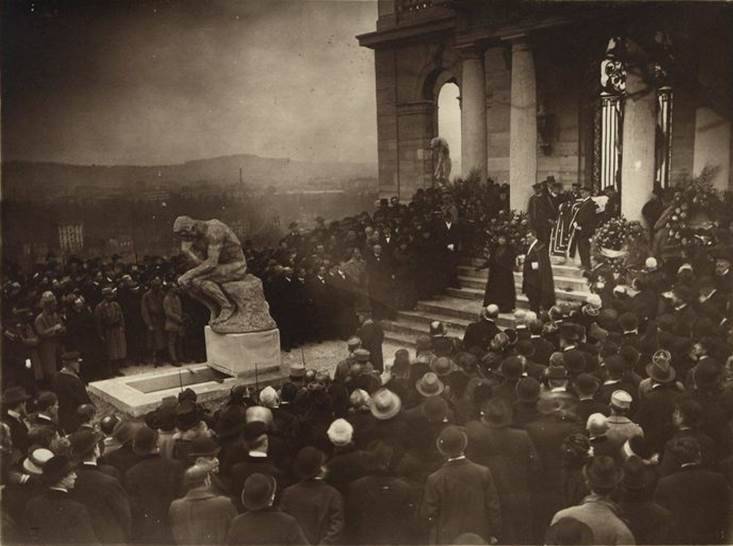
Pierre Choumoff, Rodin’s
funeral (November 24, 1917). Courtesy of Wikimedia
Commons.
Date of Earthly Departure: November 17,
1917
Eternal Resting Place: Beneath his cast of
his sculpture The Thinker at what is now the Musée Rodin,
Meudon, France
Deathly Details: Rodin’s most
famous sculpture, The Thinker, garnered
great acclaim as a societal symbol went it was first exhibited on a monumental
scale Paris in 1904. But for the artist, the sculpture must have
assumed a more tragically romantic significance as well. Just two
weeks after Rodin married Rose Beuret, his lover of 53
years, she died on February
14, 1917 (yes, Valentine’s
Day). She was buried in the grounds of his chateau
in Meudon, France, and
there, Rodin erected a smaller version of his Thinker. A
few months later, Rodin died as well. He was buried alongside
her.
Michelangelo
(1475–1564)
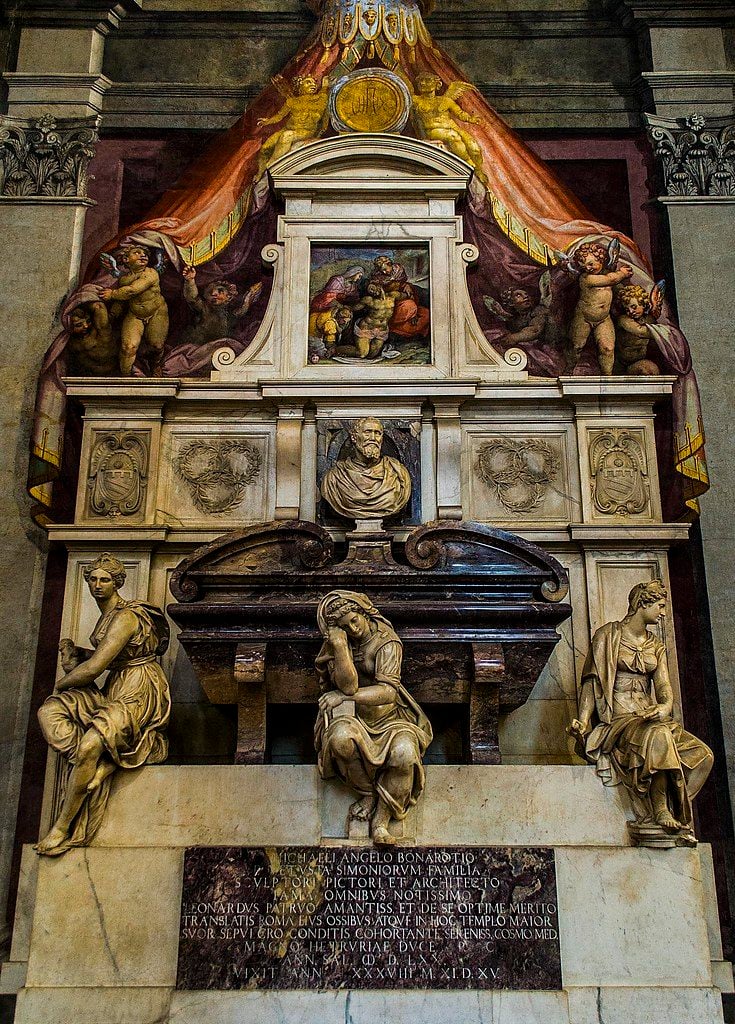
Michelangelo’s tomb at Basilica of Santa
Croce in Florence. Courtesy of Wikimedia Commons.
Date of Earthly Departure: February 18,
1564
Eternal Resting Place: Basilica
di Santa Croce, Florence
Deathly
Details: When Michelangelo
died in Rome at the age of 88, he’d been in a self-imposed exile
from his beloved Florence since the 1530s, when Alessandro de’
Medici (whom Michelangelo considered a tyrant) had been made the
first duke of Florence. Soon after Michelangelo
was laid to rest in Rome, Duke Cosimo I de’ Medici decided to
make amends and had the artist’s body brought back to Florence for
a state burial and commemoration. In his honor, this monumental and
decadent tomb, designed in part by Giorgio Vasari, was erected at
the Church of Santa Croce. Crowning the monument are figures
representing painting, sculpture, and architecture, each weeping
over the death of the Renaissance master. Michelangelo rests in
good company, with Galileo entombed just a few steps
away.
Agnes Martin
(1912–2004)
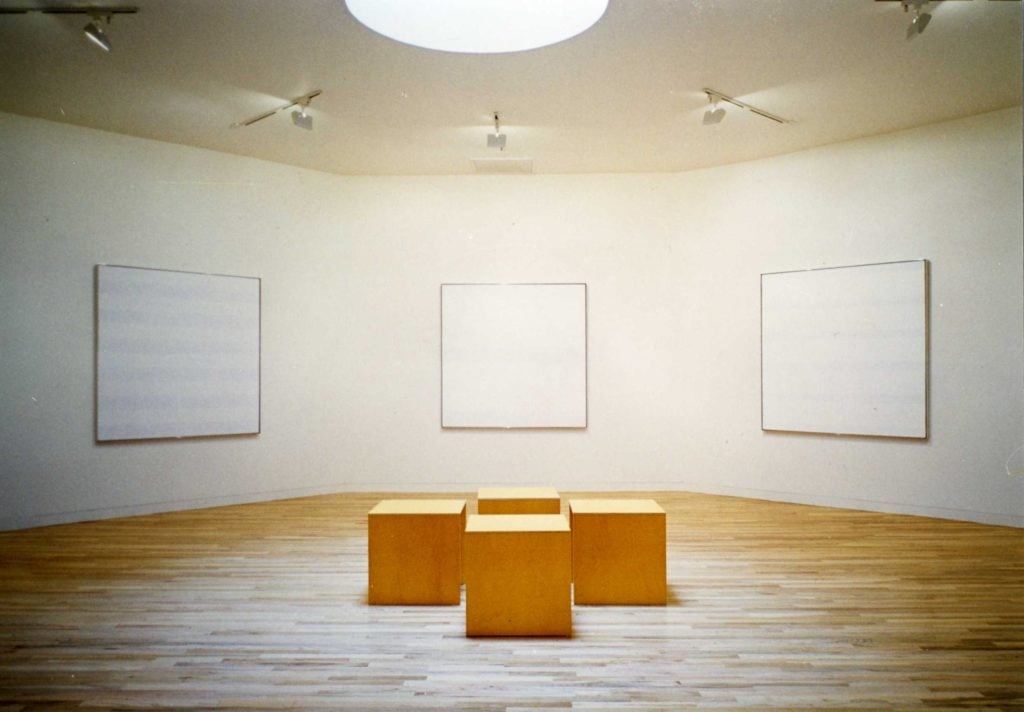
The Agnes Martin Gallery in the Harwood
Museum of Art, with benches by Donald Judd. Courtesy of the Harwood
Museum of Art, Taos.
Date of Earthly Departure: December 16, 2004
Eternal
Resting Place: The courtyard of the Harwood Museum of Art,
Taos, New Mexico
Deathly
Details: Agnes Martin’s
life in the New Mexico desert has taken on nearly mystical
associations—but, if her burial is any indication, the southwestern
town is also where she found some very loyal friends. In 1993, the
artist created a special suite of paintings for Taos’s Harwood
Museum of Art, and, before her death in 2004, asked that she be
buried in the museum courtyard. That request, however, was
forbidden by New Mexico state law. That’s why, in the spring after
her death, a group of Martin’s devoted friends gathered past dark
and, with a ladder, scaled the adobe walls of the museum. In the
moonlight, they buried her ashes under an apricot tree, where they
remain to this day.
Sandro Botticelli
(1445–1510)
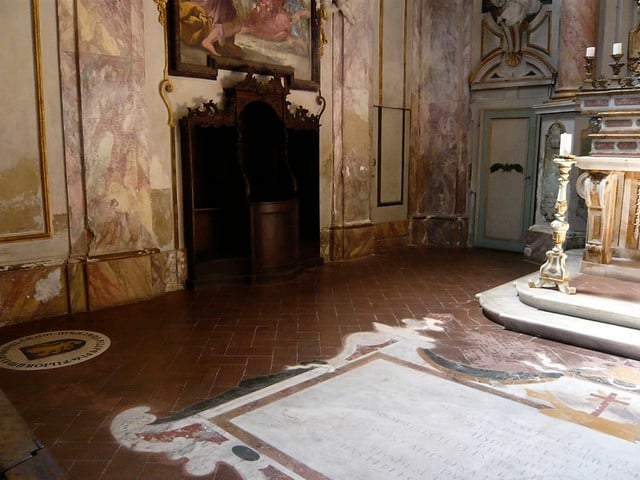
Botticelli is bured at Chiesa di San
Salvatore in Ognissanti, Florence. His burial place is marked by
the circular emblem on the floor, while the banner emblem marks the
burial place of noblewoman Simonetta Vesspucci. Courtesy of
Flickr.
Date of Earthly Departure: May 17, 1510
Eternal Resting Place: Chiesa di San Salvatore di
Ognissanti, Florence
Deathly
Details: Have you ever
marveled at the ethereal beauty of Venus in Botticelli’s
Birth of Venus
and wondered whose likeness
inspired it? Many suspect the figure is based on Italian noblewoman
Simonetta Vespucci, of whom the 15th-century master was deeply
enamored (others say that’s wishful thinking, as she’d been dead
for a decade by the time he painted the picture). Regardless,
Botticelli adored Vespucci, and before he died, asked to be buried
at her feet. When he died in his 60s, his request was
granted.
Marcel Duchamp
(1887–1968)
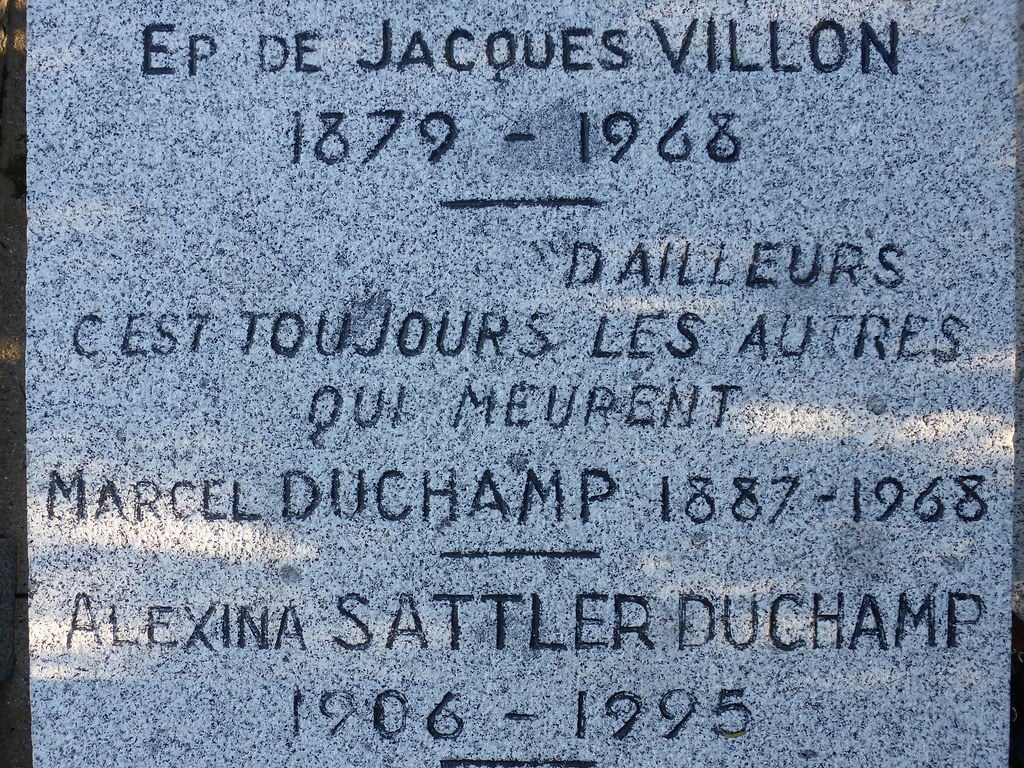
Marcel Duchamp’s headstone at Rouen
Cemetery. Courtesy
of Flickr.
Date of Earthly Departure: October 2,
1968
Eternal Resting Place: Rouen Cemetery,
Roeun, France
Deathly Details: The Dada
artist had a quick wit—even in death. After a night spent dining
with photographer Man Ray and art critic Robert Lebel, Duchamp
collapsed from a heart attack in his studio just past one in the
morning. The devout atheist was buried at Rouen Cemetery in France
and his tombstone bears the epitaph, “D’ailleurs, c’est toujours
les autres qui meurent” or, “Besides, it’s always the others who
die.”
The post Botticelli Is Buried at the Feet of His Muse—and 9
Other Stories Behind Artists’ Unusual Final Resting Places
appeared first on artnet News.
Read more https://news.artnet.com/art-world/artists-graves-unusual-and-elaborate-1691752
Further reading


Leave a comment