
‘All Culture Is Going to Trash as Soon as the Food Runs Out’: Why Extinction Rebellion’s Climate Activists Are Targeting Art Basel Miami Beach
As Miami Beach teeters on the knife’s edge of the climate
disaster, it’s becoming harder for the attendees of Art Basel
to ignore the harsh reality facing the coastal city. And that’s
precisely the goal of the global climate-justice advocacy group
Extinction Rebellion, which is planning to stage several actions in
Miami this week targeted at the wealthy members of the cultural
elite jetting in and out of town for the fair.
Activist William Skeaping, co-editor of the Extinction Rebellion
handbook This Is Not A Drill and a founding member of
the organization Culture Declares Emergency, also happens to comes
from a background in art history. This summer, he was at the table
with Antony Gormley, Cornelia Parker, and Mark Wallinger during a
discussion that led the Tate Modern to declare a “climate
emergency.” He was also on a panel at Frieze London this fall
with Serpentine curator Lucia Pietroiusti to
discuss the paradox of legacy building in a world beset with
climate change.
The day I spoke to Skeaping, the BBC had published an article
suggesting that several key tipping points in global warming may be
reached much sooner than previously thought. So what is it going to
take for the art world to reach its own tipping point when it comes
to addressing climate change? Skeaping discussed why the industry
needs to imminently change course, and why Art Basel holding a
panel discussion on climate change just isn’t enough.
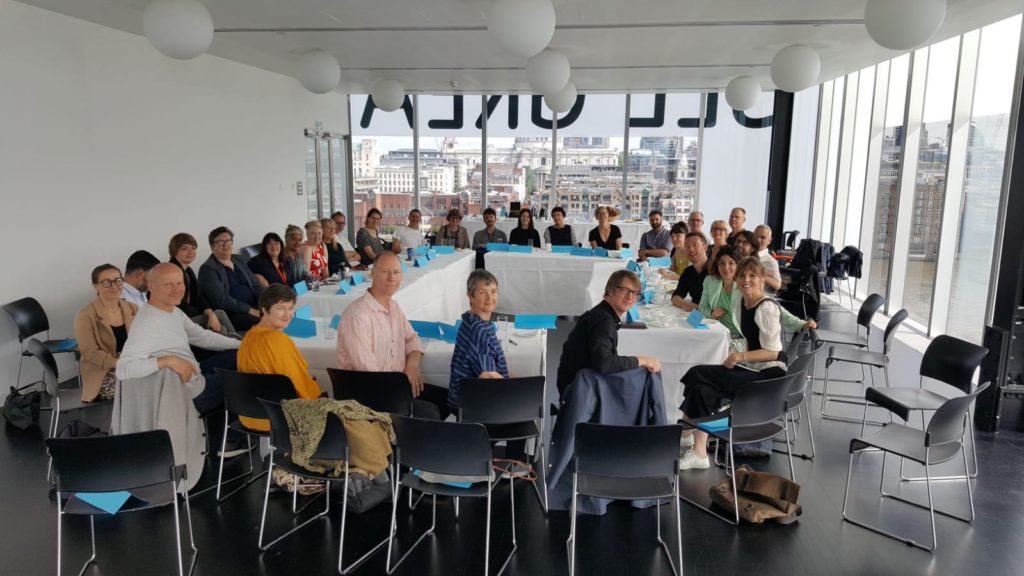
Culture Declares Emergency Meeting with
France Morris and Tate Modern’s team, as well as artists Antony
Gormley, Mark Wallinger, Cornelia Parker, and Gary Hume, among
others.
Tell me why Extinction Rebellion is interested in
targeting the art industry in particular.
If we are not doing this for the art, what are we doing it for?
The people with the power are those who can afford to collect
artworks worth millions of dollars—we are not naive about where
that power lies and where it comes from. We are not trying to smash
the system or destroy anything, we are trying to get people to work
together and challenge business-as-usual, while there is still
time. We need to bring intergenerational and indigenous voices on
climate justice into the fold, but then we need to act on these
things. The talking is done, it is time for action. This is not an
Olafur Eliasson stunt.
You have an art history degree and are, in some
respects, one of Extinction Rebellion’s art experts. What is your
reaction to events like Art Basel Miami Beach?
The art world represents the massive inequality that has, in
many ways, led to this situation. People are flying in to Miami on
private jets to buy art in a region that is on the frontlines of
climate change. How are we promoting and allowing this insane
global circus to continue? All these people with art collections
and new foundations in Miami are actually threatened by the people
who come to visit them—the loop is completely unsustainable. If
business-as-usual is taking place, then the art world is buoyant.
When it comes to the commercial art world, we are challenging that
business-as-usual approach.
What would you like to see done
differently?
This cannot be a conversation about whether you serve vegan food
in your canteen or whether you use plastic bottles—that is the
lowest hanging fruit. Organizations like Art Basel have the power
to influence all of its subsidiaries. Art fairs are amazing places
to speak to power, because there you can catch the ear of
celebrities, thousands of visitors, and hundreds of galleries.
Talking about plastic water bottles is not enough. Extinction
Rebellion wants to help these institutions use their platforms to
help people in this crucial moment in human history, and we expect
to see a proactive approach from Art Basel Miami Beach to address
these concerns. If we don’t, that will be the kind of trigger
we need.
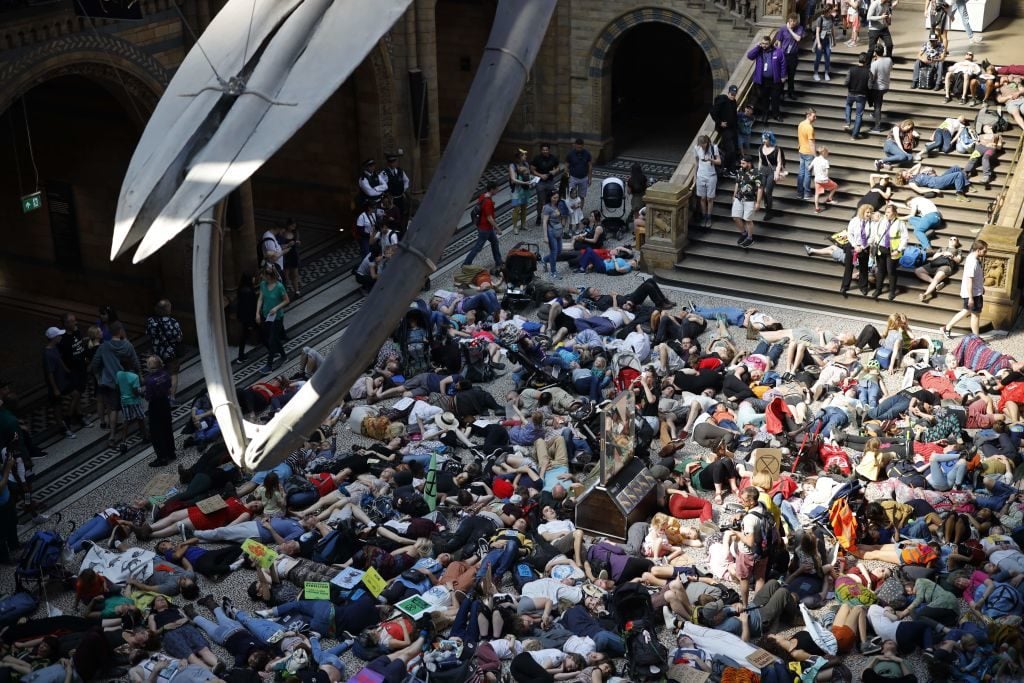
Extinction Rebellion climate change
activists perform a mass “die in” under the blue whale in the foyer
of the Natural History Museum in London on April 22, 2019. Photo by
TOLGA AKMEN/AFP via Getty Images.
Many art institutions and collectors are in coastal
cities like Miami, Los Angeles, and New York that are under
threat.
When people put together an art collection, what do they hope
will be seen in the future? If we don’t cope with this, will these
legacy collections that are supposed to live on and define your
tastes for years to come be seen as toxic if they do not address
the global ecological crisis? How are the most powerful people in
the world, those who can afford to generate buildings and stock
them full of priceless works of art, not deeply invested in the
legacy of their value?
We should also be discussing Gen-Z audiences, that generation of
future collectors who will be looking at these works in future
museums in Miami. What are they going to think about the art
that is being made right now, these depositories of willful
ignorance? People in the art world, including artists, who
have not joined this conversation are ignoring a huge elephant in
the room. There is going to be a swathe of late capitalist works
ignoring this issue that are going to be rendered completely
irrelevant in the near future. We are going to have to look back at
this monstrous moment of wanton and intentional denial.
Art Basel Miami Beach is hosting a panel called
“Confronting Climate Change Denial” this weekend as a part of its
Conversations series. What is your response to that?
It’s a bit of a tokenizing thing to do, like having a panel on
diversity in a box in a corner, another focused on dodgy funding
for museums in a box in another corner. These panels discussions
are where you hide stuff that you know you have to deal with, but
that you don’t really want to want to engage with because it
disrupts the flow of business-as-usual.
These issues, like the climate crisis, are not events to be held
or nouns to be coined. Rather, they are a lens that we need to look
through the world with. The climate emergency cannot be put into a
tick-the-box panel with a celebrity guest, a best-selling author,
and someone from the local community. Demonstrate through
action, not through words. The panel discussion is around climate
change denial, which is a big problem in the US. At this point
though, do we continue to discuss with [climate change
deniers] whether it’s real or not, or do we now just start taking
action?
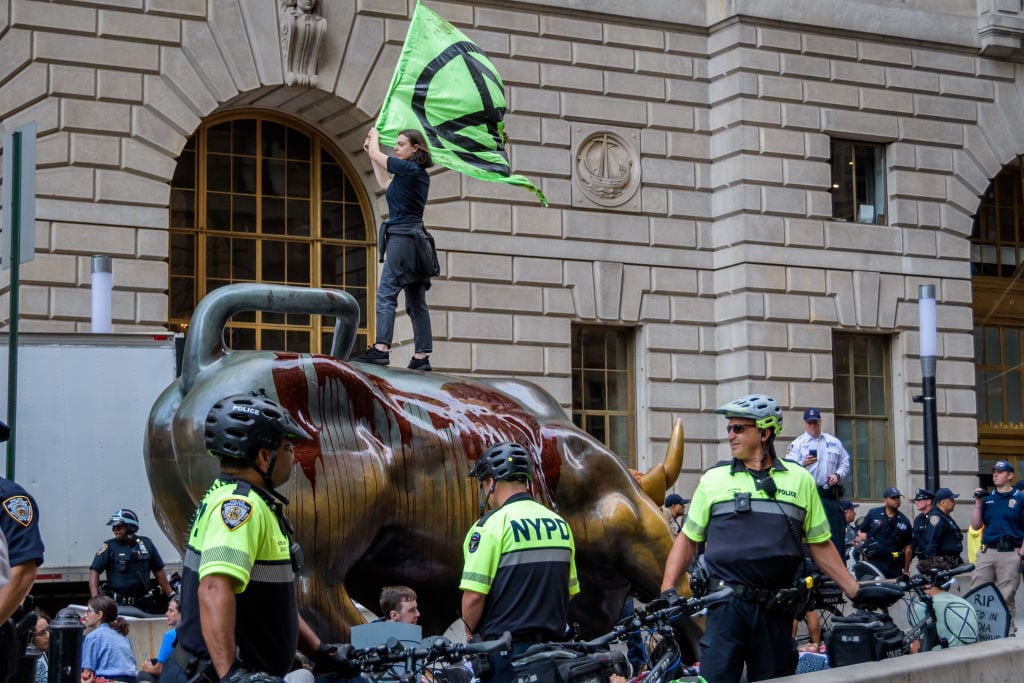
An Extinction Rebellion protester stands
on top of the Wall Street Bull. Photo: Erik McGregor/LightRocket
via Getty Images.
What do you think of the view that wealthy figures like
art collectors, who are often from the global north, have had a
latent response to the climate crisis?
It is due time for the people at the top to recognize where
their duty is in this. This is simply about shared responsibility
and climate justice. The art world is a scene where people will
throw a dinner at a whim for a budding artist. Where are the
dinners for the climate, so to speak? The philanthropic money that
is currently being funneled to feed soft power and self-indulgence
could be funding climate activism. The Amazon forest was burning
down as the Frieze art fair was taking place. How bad does it have
to get? What will the tipping point for the art world be to embrace
and face the biggest threat to its value system, its heritage, and
its very existence? We need to value our planet the way we value
our art.
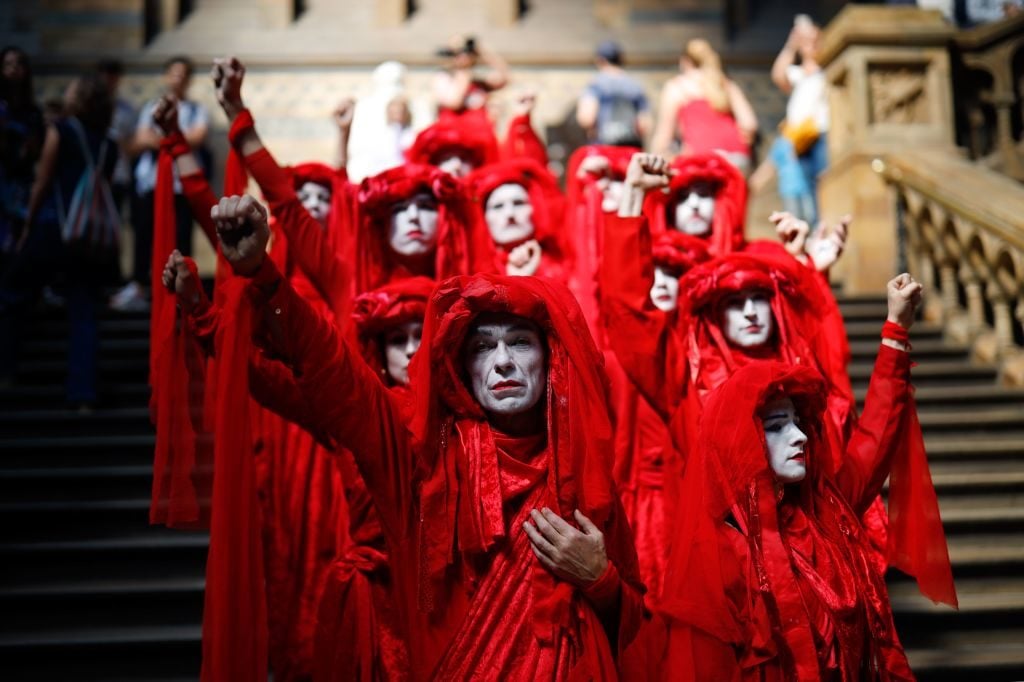
Extinction Rebellion activists in red
costume attend a mass “die in” in the main hall of the Natural
History Museum in London. Photo: Tolga Akmen/AFP via Getty
Images.
That’s a real pain point, the deep hypocrisy between the
values portrayed by art world discourses compared to the values
portrayed by actions (or inaction).
The art world almost co-opts the values of humanity, diversity,
compassion. These are themes that are buzzy as hell in the art
world. But we have got to look at the bigger picture. The structure
is not fit for purpose, and culture is not an indulgence. You
cannot hang a piece by Kara Walker in your house and have that
reflect, somehow, on your business practices, for example.
Indeed, if this is about culture, all of human culture—museums,
artifacts, and all the 5,000 years of interesting creations we
hold, as well as new works—it’s all going in the trash as soon as
the food runs out. As society begins to decline and break down in
the face of imminent effects of climate change and ecological
collapse, then we are going to have to ask ourselves what the
actual purpose of the arts is.
Extinction Rebellion held a talk and an action at Frieze
London this fall. Can you tell me a bit about how it was
received?
During Frieze London, members of Extinction Rebellion invited
collectors and other VIPs to walk through Regent’s Park to get from
Frieze London to Frieze Masters, as opposed to taking the available
BMW cars. During the walk, we discussed the climate emergency. What
you realize is that this has not become a part of the conversation
among the wealthy collectors.
There is no thought leadership in the art world on this issue.
We’re encouraging the Zwirners, the White Cubes, and the Hauser and
Wirths of the art world to get together and figure out how they are
going to radically transition to carbon-net-zero emissions or, at
the very least, an immediate drop in their carbon emissions.
The post ‘All Culture Is Going to Trash as Soon as the Food
Runs Out’: Why Extinction Rebellion’s Climate Activists Are
Targeting Art Basel Miami Beach appeared first on artnet
News.
Read more https://news.artnet.com/market/extinction-rebellion-art-basel-miami-beach-1718208
Further reading


Leave a comment