
‘Everything That Could Go Wrong, Did Go Wrong’: George Condo on How a Brush With Death Enlivened His Latest Exhibition
Late last month, at his home on new York’s Upper East Side, the
painter George Condo hosted an evening recital by the violinist
Leila Josefowicz and her longtime collaborator, pianist John
Novacek. The elaborate affair, arranged for 61 guests, included a
catered dinner, performances of pieces by György Kurtág and Igor
Stravinsky, and, “as always, great wine,” as it said on the
invitation. Among the guests were Vija Celmins, Max Hollein, Calvin
Tomkins, and Dodie Kazanjian. But the party almost never
happened.
Just hours before the crowds were due to arrive at 7 p.m., the
power in Condo’s home went out, and the increasingly anxious host
watched as the clock ticked forward without resolution. “At 3:30,
it started to get darker and darker, and whether the lights would
come on was a big question,” Condo told me the next day, in his
studio on Gramercy Park, where we sat on two mismatched chairs
beside a table splattered with oil paint.
“It was like we had 20 minutes to decide whether to call 61
people to say, ‘Sorry, but we had a power failure,’ knowing that in
15 minutes, it would probably start working.” Condo spent the
afternoon sweating out his dwindling options when—by the grace of
the power supply—the lights came back on. And with it came an
enormous burst of heat, pumped up through the building’s radiator
system, which presented its own problem.
“The performers loved it because they like to keep their hands
warm,” he said. “But I was just melting. And the stress of it all
was too much. Because all I wanted was for it to be right. But
everything that could go wrong, did go wrong. Except for the
performance, which was fabulous.”
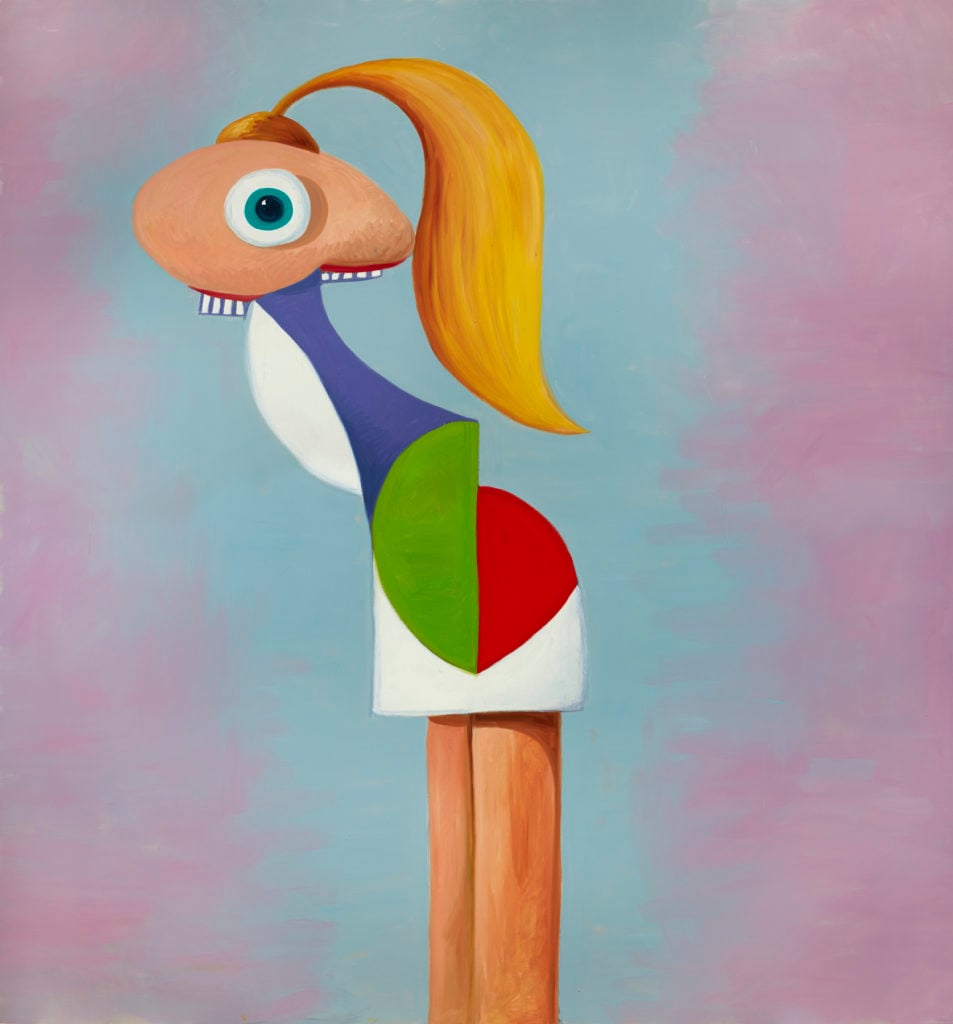
George Condo, Fashion Model
(2019). Courtesy of Skarstedt.
Catch Me if You Can
As part of their recital, Josefowicz and Novacek performed
Maurice Ravel’s Sonata No. 2 in G major, a three-part movement that
ends, appropriately, in a maddening dash to the finish, with the
pianist and violinist racing to settle the score. Which is pretty
much how Condo works, too. By the time the New Museum in New York
hosted “Mental States,” a 30-year survey of his paintings,
sculptures, and drawings, in 2011, curators had around 2,000 works
to choose from. When I asked him how he was able to work so
prodigiously, having averaged more than 65 paintings per year in
that period, he shrugged.
“One of the things I have to say that’s puzzling to me is
artists who work slowly,” he said. “I find that really bizarre.
Because it just doesn’t take that long to put a line down on a
canvas. I don’t want to sit back and say, ‘Wow, it’s going to take
me 15 minutes to decide if a line should go here or there.’ The
quicker you work, the better.”
Condo has mostly maintained his momentum. His current show at
Skarstedt gallery in New York includes 25 works, all of them made
in 2019. This year, he also made new pictures for the Venice
Biennale and for a solo exhibition at Sprüth Magers in Los Angeles,
and he completed his first public sculpture, a gold-leaf-covered
Cubist head, at Lincoln Center in New York.
“If I make a parallel with music, let’s say you have an
incredibly fast piece,” Condo said. “Take one of the Bach violin
partitas that’s just really ripping. You can’t miss a note, but
you’ve got to play it at an accelerated speed. The amount of time
it takes to work on each phrase, pretty soon that becomes muscle
memory. And pretty soon you can up the tempo. With painting, after
doing it for 40 years, I feel like it’s all muscle memory.”
The speed at which Condo works has something to do with the
furious pace of New York, where he has lived, on and off, since
1979. He moved to the city from Boston after a chance encounter
with Jean-Michel Basquiat that year at a club called Tier 3. The
two became close friends, and Condo found a job at a print shop run
by Rupert Smith, who produced works for Andy Warhol. Condo met the
Pop artist three times: twice while delivering proofs for approval,
and a third time in the studio of Keith Haring, where Condo was
working on a mural-sized painting. Upon arriving at Haring’s and
seeing Condo at work on the picture, Warhol asked: “Do you just go
up to a painting and do whatever you like?” Condo told him yes, and
Warhol replied: “Gee, I could never do that.”
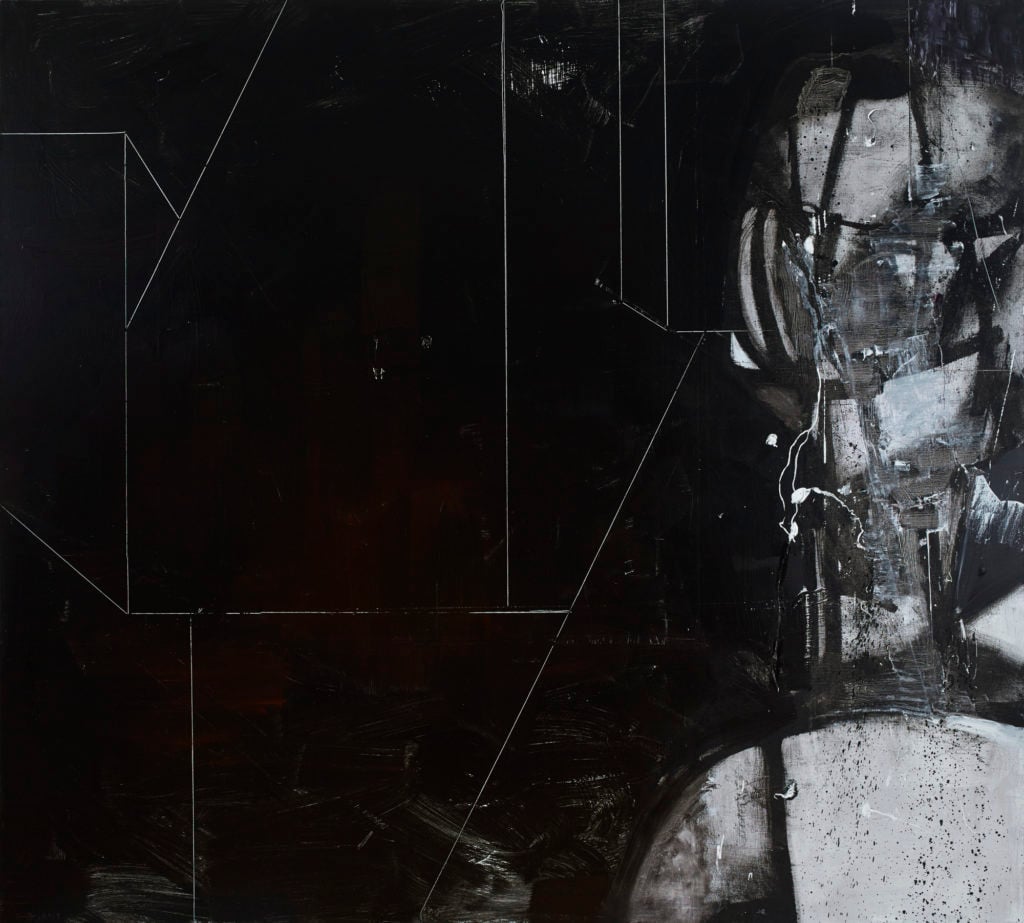
Pushed to the Edge (2019) was
made after Condo underwent heart surgery late in the summer.
Courtesy of Skarstedt.
The “Heart Attack”
For those who have kept up with Condo, his current Skarstedt
exhibition mostly fulfills expectations. Among the pictures are a
drawing of a physically stunted butler named Willy with an enlarged
eye and a separated left shoulder; a crayon-on-paper image of a
deranged clown with a smeared face plopped atop a billowing
Elizabethan collar; and an enormous painting of an overly delicate
blonde fashion model with one eye and two sets of teeth.
These are perverse pictures of ugly people, done in a style
palatable to anyone with even the slightest taste for Modern
painting. And despite Condo’s sometimes aggressive scrawl—his
fierce depictions of women with broken teeth and enormous breasts
owe quite a bit to Willem de Kooning—his work is appropriately
reverential of tradition, and thereby reassuring and comely. Even
if in strange and demented ways.
Yet tucked away on the gallery’s second floor is a suite of five
black paintings that seem altogether more ponderous. One of them is
titled Pushed to the Edge; another is called The Heart
Attack. And in each one, a truncated figure, outlined in faded
white pigment that barely emerges from a pitch-black background, is
shoved off to the far side of the scene, as if it’s being forced
into oblivion.
The works were made in the late summer, just after Condo began
experiencing chest pains. “I’ve always seen heart attacks on TV and
in movies and read about them,” he said. “So what happened with me,
I thought, ‘It doesn’t feel like the way I’ve seen it. It just
feels normal.’” Three days later, the pain had still not subsided,
and he went to the hospital and was told that his timing was very
fortunate. At this point, doctors said, he wouldn’t even be able to
survive the exertion involved in a cardiac stress test.
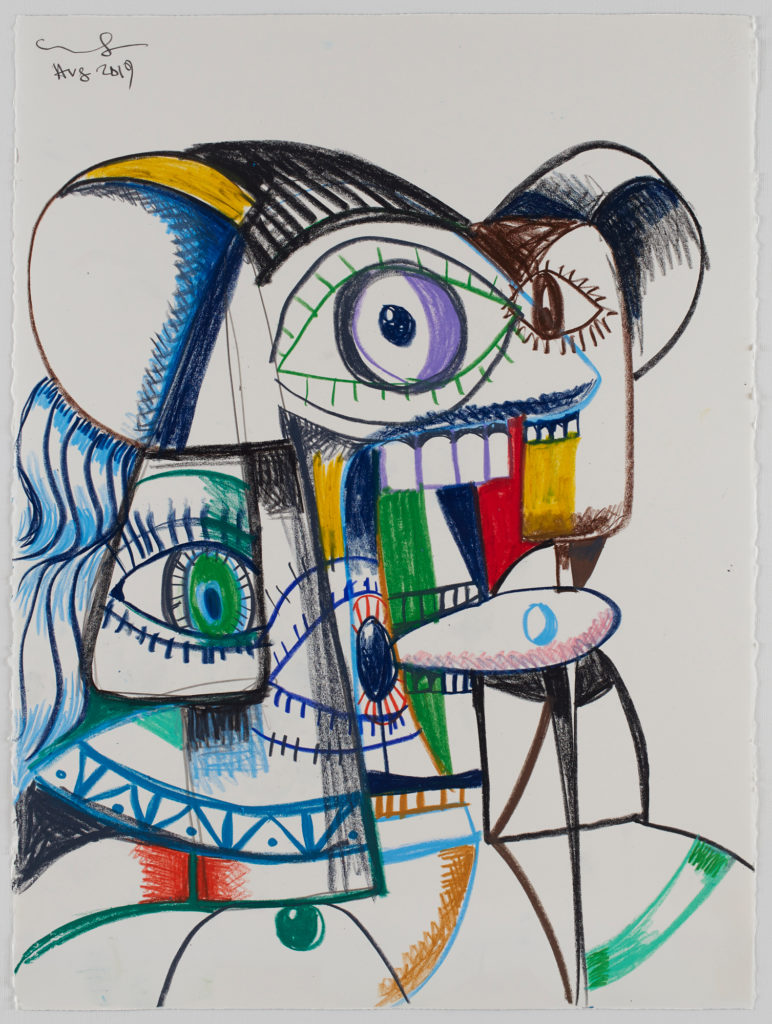
George Condo, Multiple Portraits
(2019). Courtesy of Skarstedt.
To assess their options, doctors took internal photographs of
Condo’s heart and recommended surgery to insert two stents. After
the procedure, Condo was released with clear orders to avoid heavy
lifting and strenuous activity. That made painting pictures like
those of his fashion model, which is an overwhelming 11 feet tall,
impossible. So he put away his ladder and reflected on the dark
photographs doctors had shown him of his chest cavity, which found
their way into the black paintings.
The first work in the series, The Consequence of Random
Perspectives, in which a man’s head evaporates into mist, came
to him easily. “Let me deconstruct for a change, and take
everything out of my paintings that anyone could possibly
recognize,” he remembers thinking. But the further he took the
idea, and the more his figures began to disintegrate, the harder it
became. The artist worried that the paintings were too understated,
that there was too little painterly articulation, that his
signature style had evaporated too fully. He was anxious that
if he wasn’t painting people in the throes of psychological crisis,
the paintings “wouldn’t be me,” he said.
“But maybe I don’t care about that so much anymore,” he said.
“Maybe what I’m interested in is an internal dialogue with my own
thoughts, and using the language of painting in a way that doesn’t
involve a figure. That was the part that was exciting to me.”
Of course, as Condo later admitted, the figure never truly
disappears from these works; it’s only ever in the process of
dissolving into something else. But what struck me, upon revisiting
the black paintings after meeting with the artist, was how peaceful
dissolution could be. Compared with Condo’s often vicious
depictions of agitated bankers and butlers, cardinals and nuns,
clowns with shattered faces and all manners of unhinged men and
women involved in unspeakable acts, these paintings are downright
tranquil, no matter their implied violence. The figure
in Pushed to the Edge, whose melted face is dripping
down the surface of the picture plane, has a resigned, rather than
unsettled, look in his single eye. His body is being reconfigured,
and soon, he will be another being entirely. What will become of
him?
The painting reminded me of
something Condo said back in his studio. “Whatever you have in your
mind needs to be transcribed before you lose the image. Before it
just fades off and morphs into something else.”
The post ‘Everything That Could Go Wrong, Did Go Wrong’:
George Condo on How a Brush With Death Enlivened His Latest
Exhibition appeared first on artnet News.
Read more https://news.artnet.com/art-world/george-condo-interview-skarstedt-1720380
Further reading


Leave a comment