
Tamara de Lempicka Joins Magritte and Giacometti as the Star of Christie’s $138.9 Million Impressionist and Modern Sale
Christie’s had amassed more lots than Sotheby’s for its opening
sale in the London Impressionist and modern art series tonight: 49
versus the rival house’s 33. It
also had a significantly higher £74.1 million ($108.8 million)
estimate. Good buzz filled the salesroom, and by the end of the
night, Christie’s sold all but 8 lots, with 4 going for over $10
million, hitting a couple of massive new artists’ records along the
way. Overall, the sale realized £106.8 million ($138.9
million).
Still, compared to last February, lot numbers were down by 40
percent, the low estimate by 60.5 percent. The final
total fell short of last year’s £165.6 million.
Last year, Christie’s offered a £40 million Monet waterlily
painting that didn’t sell—a huge
disappointment. This year, there was no similar mega-lot. As a
consequence, the spotlight was taken, unexpectedly, by Tamara de
Lempicka.
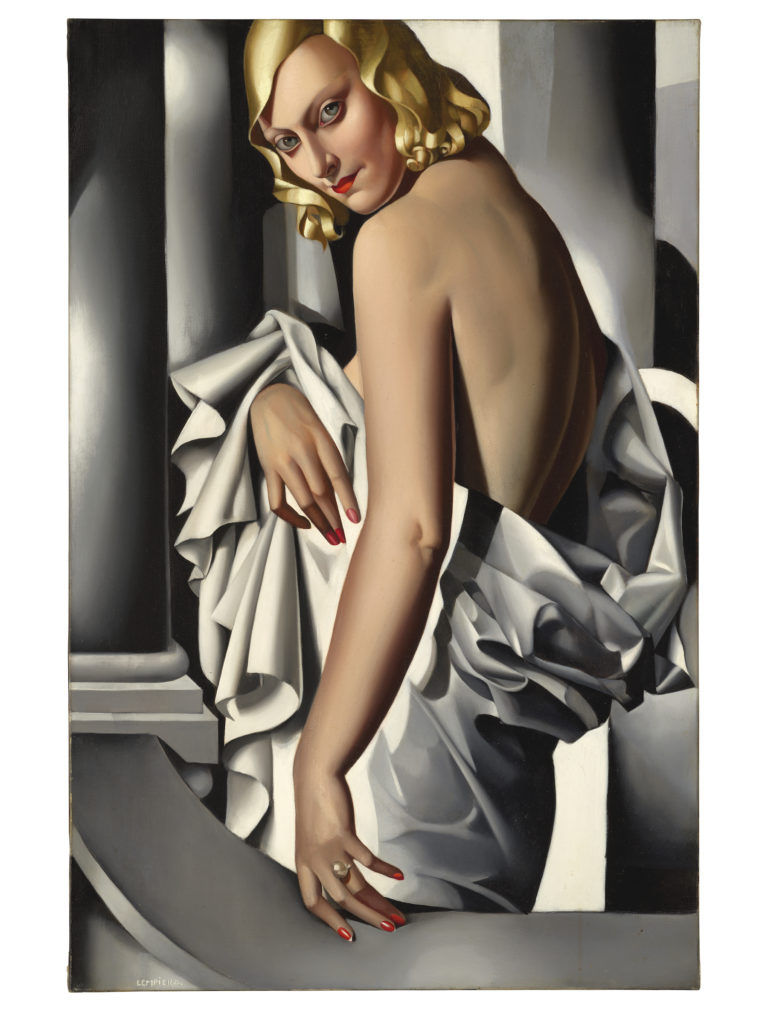
Tamara de Lempicka, Portrait de
Marjorie Ferry (1932). Sold for £16,280,000 at Christie’s
London on January 5, 2020. Image courtesy Christie’s.
Paintings by the bisexual society artist once described as
“lighting by Caravaggio, tubism by Fernand Léger, and lipstick by
Chanel,” used to be found in Art Deco rather than Modern art sales.
But because of the appeal they have to Hollywood stars (Madonna,
Barbara Streisand et al) and the wealthy owners of period
properties in Florida and the Upper East Side of New York, they now
receive star billing alongside Picasso and Giacometti. Following
the auction record of $13.3 million last November for her
seductive La Tunique Rose, de Lempicka’s star is
ascendant; her particular price trajectory is one of the positive
aspects of this market.
This evening’s work—a slinky 1932 portrait of the Parisian
nightclub singer, Marjorie Ferry—was sold back in 1995 for
$552,500. Fourteen years later it rose to $4.9 million. Tonight, it
was offered at £8-12 million ($10.4–15.7 million), protected by a
third party guarantee.
But it didn’t need protection. Two phone bidders, one from the
US and another from the chairman’s London office, slugged it out to
a new record £16.3 million ($21.2 million). Not a bad return: $16
million in ten years.
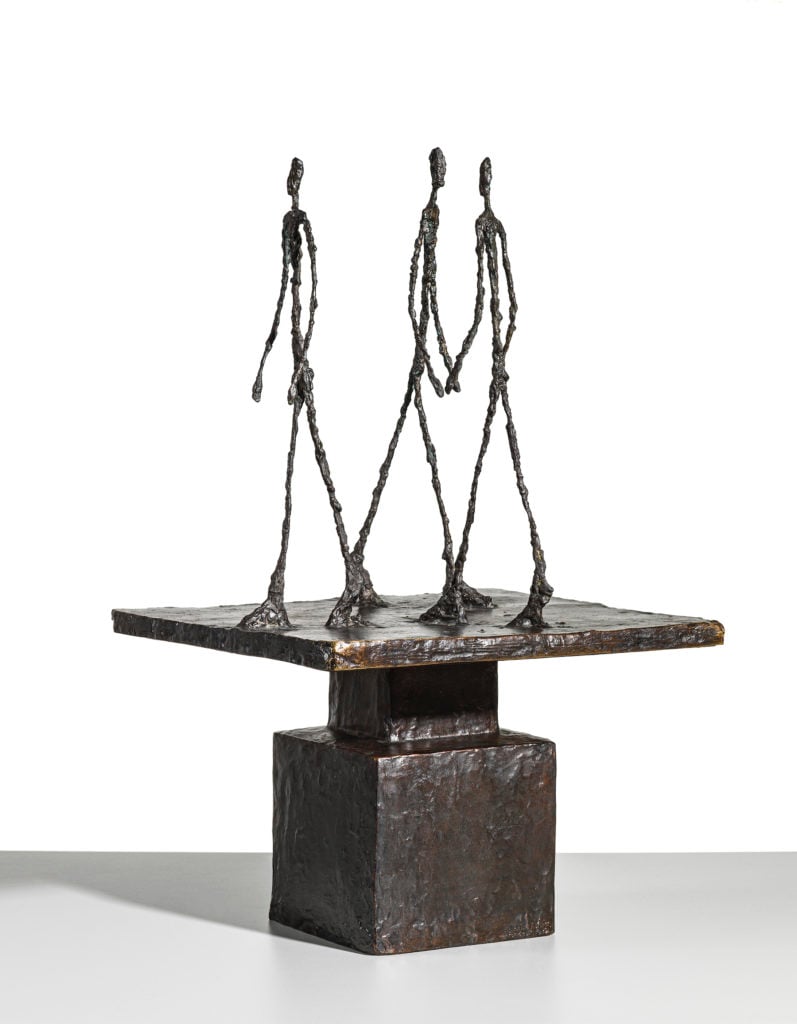
Alberto Giacometti, Trois hommes qui
marchent (Grand plateau) (1950). Sold for £11,272,500 at
Christie’s London on January 5, 2020. Image courtesy
Christie’s.
On the same level with de Lempicka’s estimate was a 2-foot
Giacometti lifetime cast of three standing figures that was last
sold in 2008 above the estimate for £9.4 million (twice the amount
of the de Lempicka in 2009). This evening it realized only a
modest mark-up, selling for a mid-estimate £11.3 million ($14.6
million) to US art advisor Nancy Whyte. There must have been some
after-sale dinner chat about how de Lempicka outperformed
Giacometti.
A slightly weak backbone to this section of the sale was a
selection of six Picassos (Sotheby’s had none), ranging from an
early 1905 sculpture to a painting from 1972, the year before his
death. Four were guaranteed and five found buyers—but mostly below
estimates.
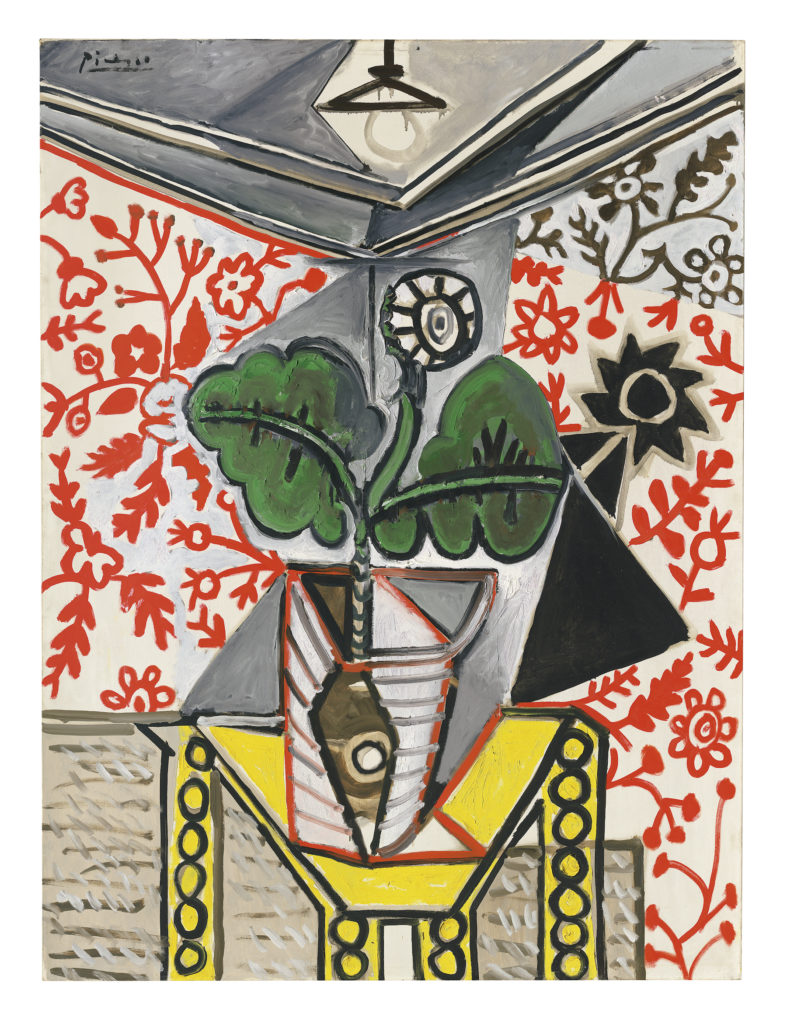
Pablo Picasso, Intérieur au pot de
fleurs (1953). Sold for £7,243,250 at Christie’s London on
January 5, 2020. Image courtesy Christie’s.
None were really top drawer. Leading the group was a 1953 still
life of a potted plant against a backdrop of riotous wallpaper
design. Estimated at £7-10 million, it last sold in 1999 for £1.9
million and attracted phone bids from Israel and Hong Kong before
selling to the chairman’s office bidder (a new private client for
the market?) below estimate for £7.2 million ($9.4 million).
A later still life with a dog, from 1968, had been through the
Halcyon Gallery in London and was guaranteed with a £4 million
estimate. It seems the Asian bidder who bought it must have been
the guarantor, as the hammer price of £3.8 million was below
estimate.
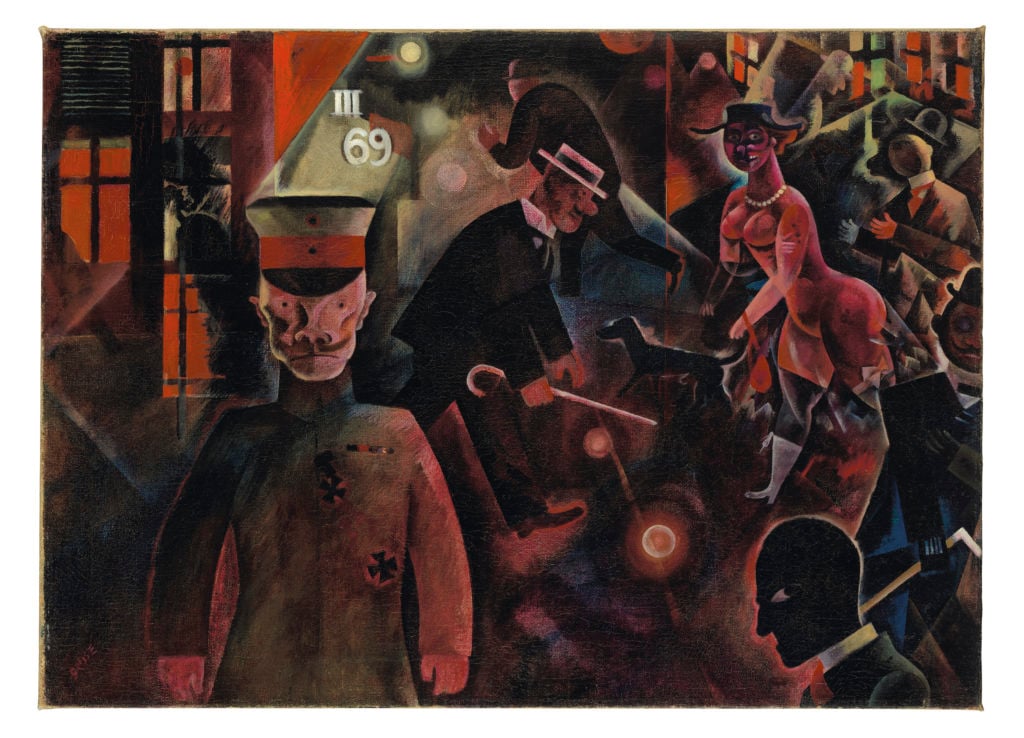
George Grosz, Gefährliche
Straße (1918). Sold for £9,740,250 at Christie’s London on
January 5, 2020. Image courtesy Christie’s.
An ace in Christie’s pack was a First World War painting of a
bustling street scene in 1918 by the German expressionist George
Grosz, with a record-beating £4.5-6.5 million estimate. The lot was
particularly rare because there are only three known paintings in
private hands from the 1917-18 period, when Grosz returned to
Berlin from the Front.
Gehfarliche Strasse or Dangerous
Street depicts war survivors in various states of
confusion in a city street at night. Grosz himself looks on
menacingly from the lower right of the canvas. New York dealer
Richard Feigen bought it from the artist the year he died in 1959.
After that, it remained in the same Swiss collection for 60
years.
Entered for sale with a guarantee, it sold to a US phone bidder
for a record £9.7 million ($12.7 million). An undisclosed
percentage of the upside from the reserve price, usually near the
low estimate, will go to the happy guarantor.
Christie’s final advantage over its old foe was in the
Surrealist section, which had 24 lots estimated at £26-39 million
overall (Sotheby’s didn’t enumerate their much smaller offering).
Amongst these were 7 Magrittes which accounted for nearly 75
percent of the value of the Surrealist sale, or £30.2 million.
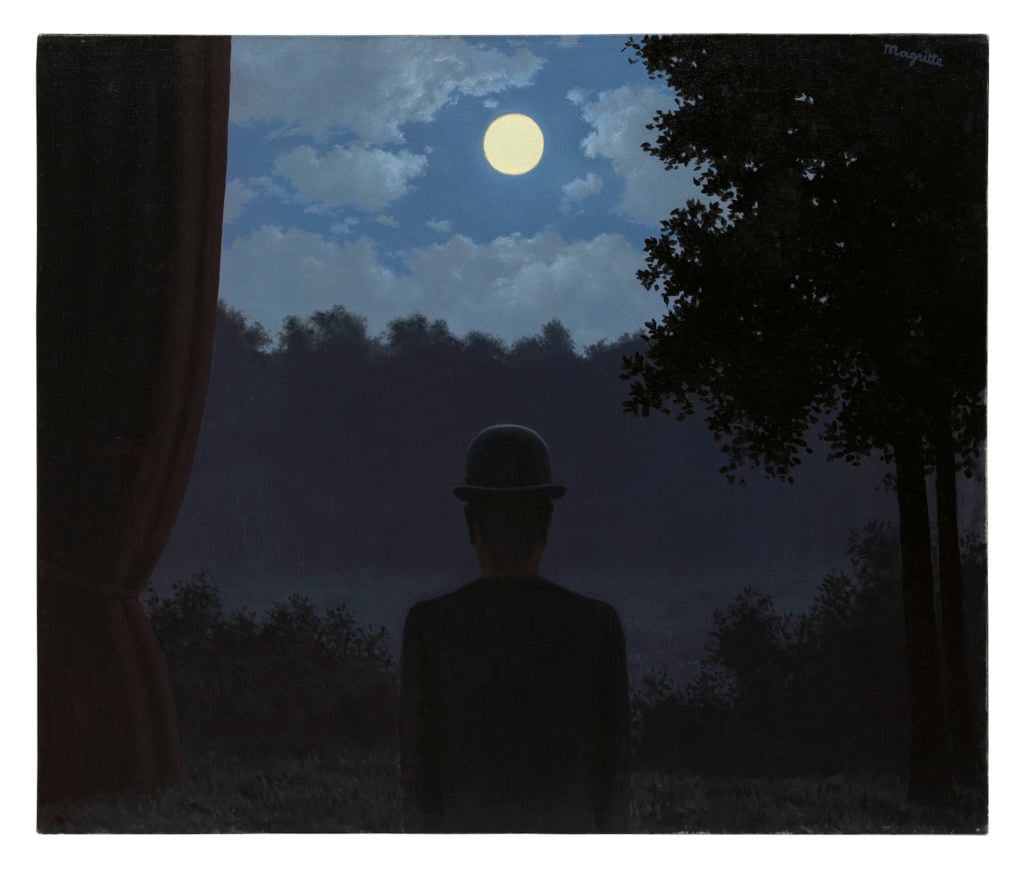
René Magritte, A la rencontre du
plaisir (1962). Sold for £18,933,750 at Christie’s London on
January 5, 2020. Image courtesy Christie’s.
Leading this pack was a moonlit 1962 landscape with a shadowy
bowler hatted figure that made the second highest price for a
Magritte, selling to Christie’s global president Jussi Pylkannen,
above-estimate for £18.9 million ($24.6 million)—the top lot of the
evening.
Returns on Magritte continue to be worthwhile as his market
marches on. A gouache, Le Baiser (ca. 1957), showing
a bird in flight had sold in 2015 to New York dealer David Benrimon
for an upper estimate £2 million (the fifth-highest price then for
a work on paper by Magritte). This evening, it sold on the low side
of its estimate—but nonetheless profitably—for £2.9 million.
Also of note in the Surrealist section was a Picabia
transparency painting, Ligustri, which sold to a
Russian bidder above estimate for £3.5 million, and a late,
decorative work, recently discovered in the artist’s dentist’s
family collection which sold above estimate for £877,250 to Hauser
& Wirth (according to the Baer Faxt).
London dealer Daniella Luxembourg bought a Max Ernst painting of
an owl above estimate for £175,000 and underbid a Dali painting of
a skull that sold near the top estimate for £587,250. The latter
painting last sold in 1987 for £46,000.
The Nahmad family made only one bid all
evening—unsuccessfully—for an early grattage by Max Ernst which
sold above estimate for £539,250, while US art advisor Mary
Hoeveler stuck it out at the end to buy a painting of a romantic
red-haired woman by Magritte, within estimate for £1.2 million.
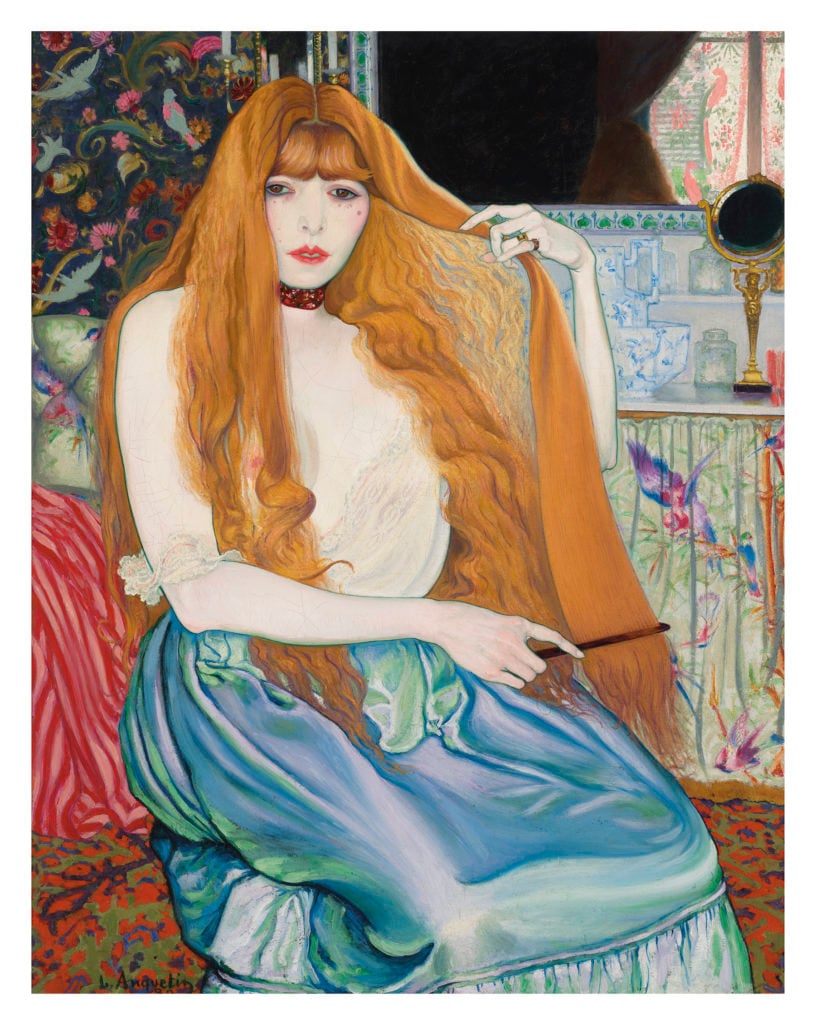
Louis Anquetin, Femme à sa
toilette (1889). Sold for £1,331,250 at Christie’s London on
January 5, 2020. Image courtesy Christie’s.
Another redhead to shine was Louis Anquetin’s Femme a
sa Toilette, which sold to a US bidder for a double-estimate
£1.3 million (a record in £’s sterling, though not US dollars).
Christie’s Surrealist mastermind, Olivier Camus, commented
afterwards that the success of his Surrealist sale was the appeal
of that genre to younger generations. While unusual narrative
pictures by de Lempicka and George Grosz can cause a stir, mediocre
Impressionist works are in a long-term trough.
A fairly drab Matisse woman in an interior was seen at auction
three times between 1990 and 2005, the last time with a £1-1.5
million estimate, but failed to sell on each occasion. In 2006, it
had found a buyer after it failed to sell again, at £480,000. This
evening, it was offered by the purchaser with a £600,000 low
estimate. But the market has not changed its view and the painting
found its level below estimate at £551,250.
Looking at the heyday of the Impressionist market, two Pissarros
tell a story. Between 1975 and 1990, a 1901 Eragny landscape soared
in price from $82,000 to $1.3 million. Then came the recession and
the exit of the Japanese from the market. By 1999 the painting was
still in loss territory, selling for £441,500. Twenty years on, and
estimated a £1.2 million, the landscape is still trying to find its
level. It did not sell tonight.
Another Pissarro, of ducks feeding at Montfoucault, escalated
from £24,000 in 1968 to £462,000 in 1986. By 2007 the pace had
slowed and it sold for £524,000. This evening, nearly 13 years on,
it sold below estimate for £611,250. The hammer price of £500,000,
minus the commission the seller has to pay Christie’s, will leave
the private Asian owner out of pocket.
Asian bidding, meanwhile, was not that apparent. Apart from some
underbidding on the Picassos, it seemed a shadow of its former
self.
The post Tamara de Lempicka Joins Magritte and Giacometti as
the Star of Christie’s $138.9 Million Impressionist and Modern
Sale appeared first on artnet News.
Read more https://news.artnet.com/market/christies-de-lempicka-138-9-million-1771053
Further reading


Leave a comment