
Artist Beverly Pepper, Who Long Rejected Critics’ Attempts to Define Her Brawny Sculptures, Has Died at 97
Beverly Pepper, the sculptor of
mammoth artworks who refused to be tied to any groups or circles,
died on Wednesday in Todi, Italy, at the age of 97.
The artist died at her home,
where she had lived with her husband, the journalist Curtis Bill
Pepper, since the early 1970s. The news was confirmed by her
daughter, the Pulitzer Prize-winning poet Jorie
Graham.
Long considered one of the most
powerful artists of her generation, Pepper shunned typical
classification, leaving confused critics to lump her in with the
Abstract Expressionists, Kinetic artists, and Land Art pioneers.
They even called her a late Constructivist.
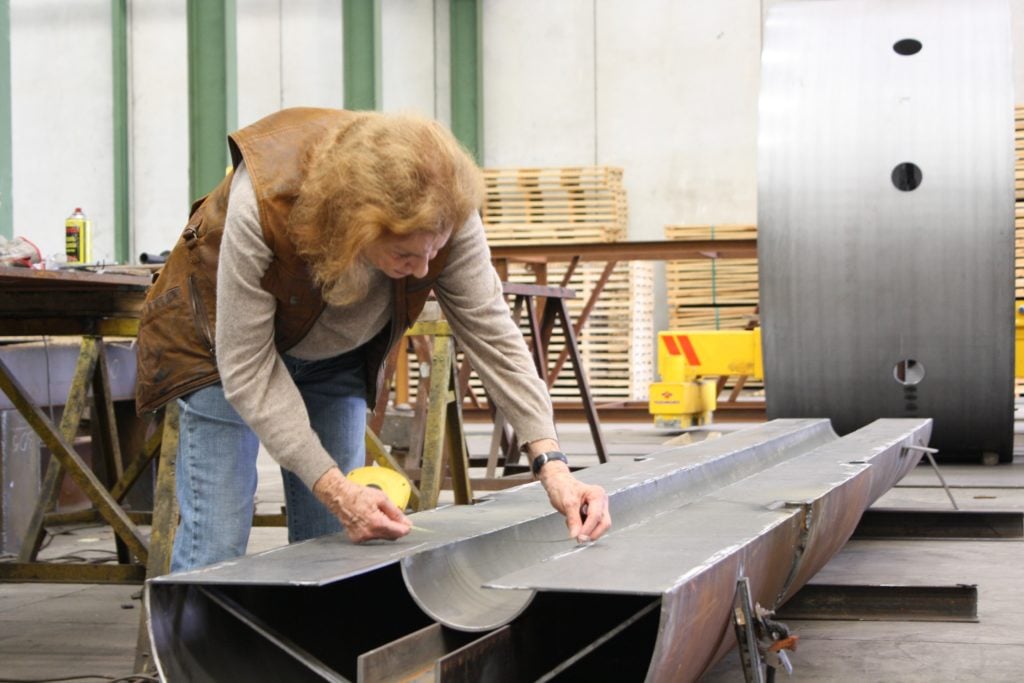
Beverly Pepper in 2009. Photo ©Beverly
Pepper, courtesy of Marlborough Contemporary, New York and
London.
Pepper was known for working
with the kind of hefty, industrial media—iron, stone, and Cor-Ten
steel—usually associated
with brawny male sculptors like Richard Serra and David
Smith. Yet she retained a
sense of buoyancy and grace that belied the heaviness of her chosen
craft.
She was born Beverly Stoll, the
daughter of Jewish immigrants, in the Flatbush neighborhood of
Brooklyn in 1922. She graduated from James Madison High School and
studied design at the Pratt Institute before working as an art
director in advertising agencies. The work was unfulfilling,
however, and she spent her nights taking art history classes at
Brooklyn College.
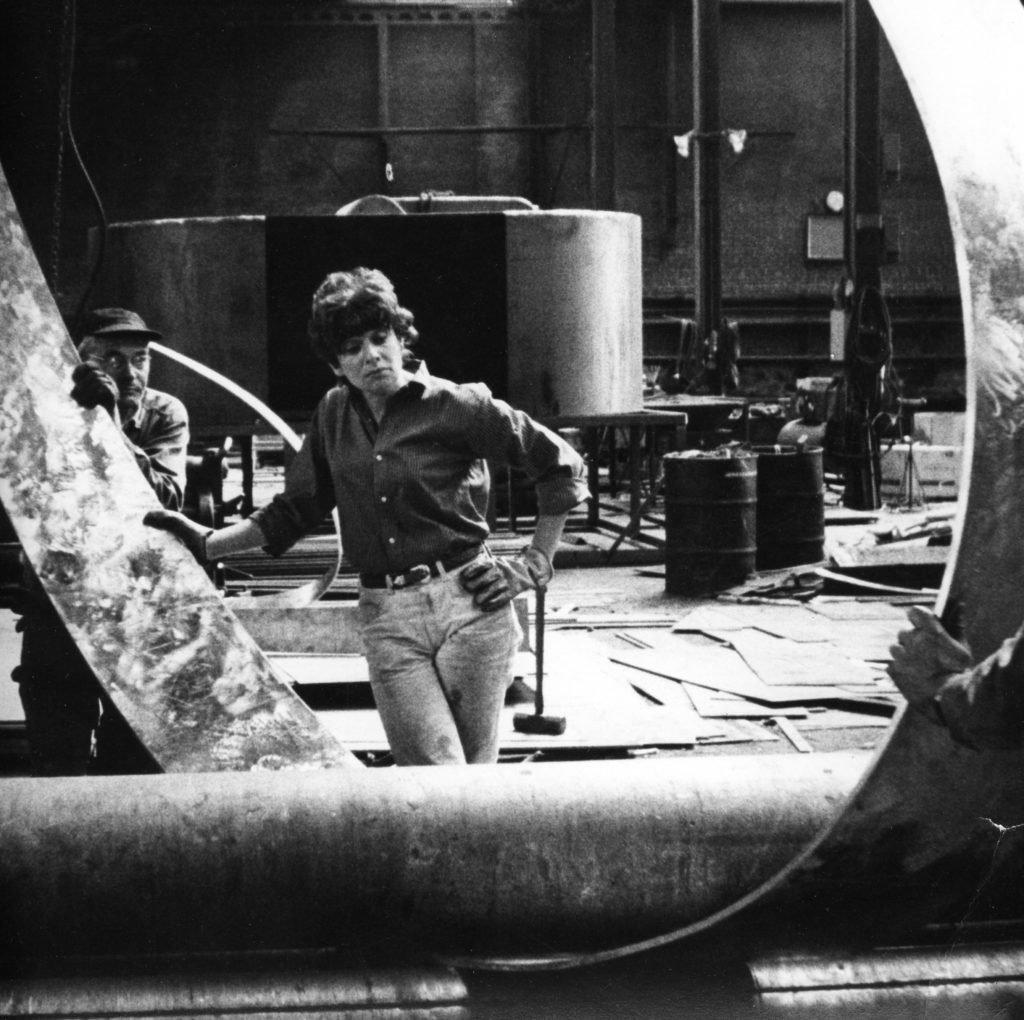
Beverly Pepper working at a foundry in
Italy (circa 1960s). Photo ©Beverly Pepper, courtesy of Marlborough
Contemporary, New York and London.
In the late 1940s, she moved to
Paris and studied painting with André
Lhote and Fernand Léger
before meeting her future husband
and moving to Rome, where he worked as the Mediterranean bureau
chief for Newsweek.
As a respected painter
throughout the 1950s, Pepper was included in high-profile shows
across Europe, but she never felt comfortable with the
medium.
“Paintings reach too small an
audience,” she told the Smithsonian
Archives of American Art in 2009. “It’s utterly ridiculous to try
to make waves with a painting. You may wake a very small group of
people.”
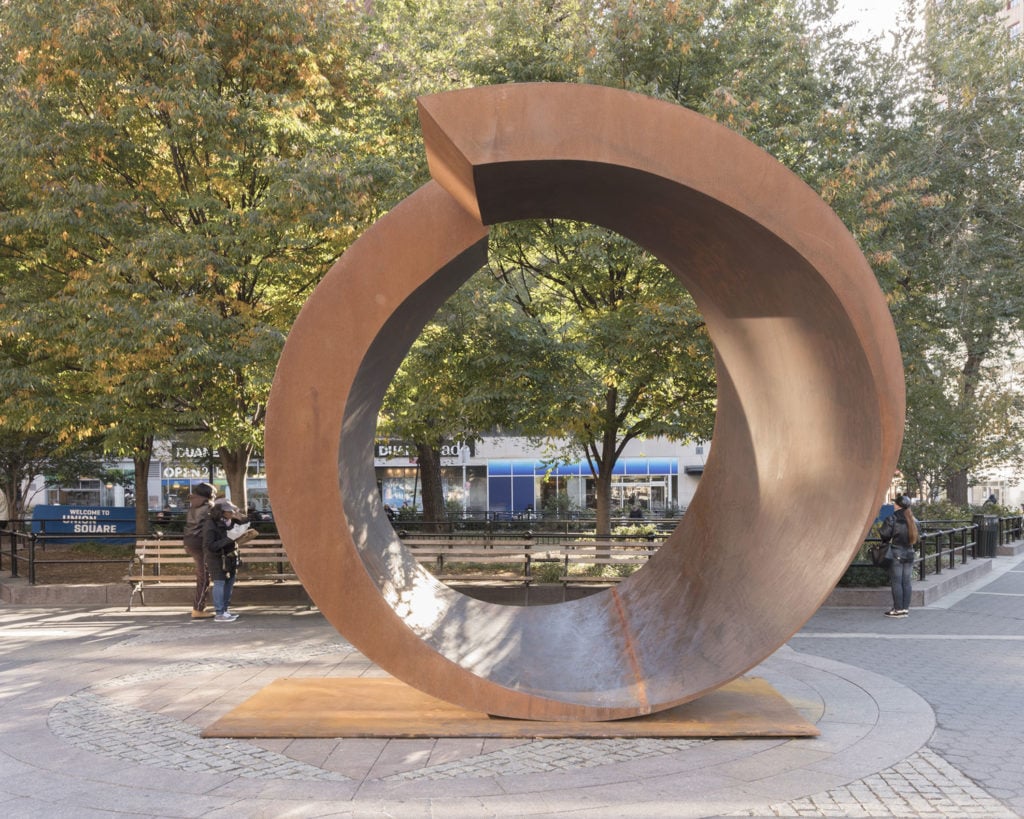
Beverly Pepper, My Circle.
Photo: courtesy Art in the Parks.
A trip to the temples of Angkor
Wat with her daughter in 1960 inspired her to take up sculpture, a
medium in which she had no formal training. Upon returning to Rome,
she bought a jigsaw and other carpentry tools and carved up fallen
trees in her garden.
Two years later, Pepper was
invited to participate in an exhibition in Spoleto, Italy,
alongside Alexander
Calder, Henry Moore, and
David Smith. She lied about being able to weld so she could work in
the Italian steel plant sponsoring the show.
In the years that followed,
Pepper became a master craftsman, known for shaping tons of metal
into seemingly weightless forms. Among her best-known works are
towering steel plinths such as the Manhattan
Sentinels (1993–96),
installed in New York, and The Todi
Columns (1979) in
her adopted Italian hometown.
She made polished steel structures that play with
perception, such as a zig-zagging work in the collection of the
Albright-Knox Art Gallery in Buffalo, and sculptural interventions
in the land, like Land Canal — Hillside (1971–75) in Dallas and
Sol i Ombra Park (1987–92) in
Barcelona.
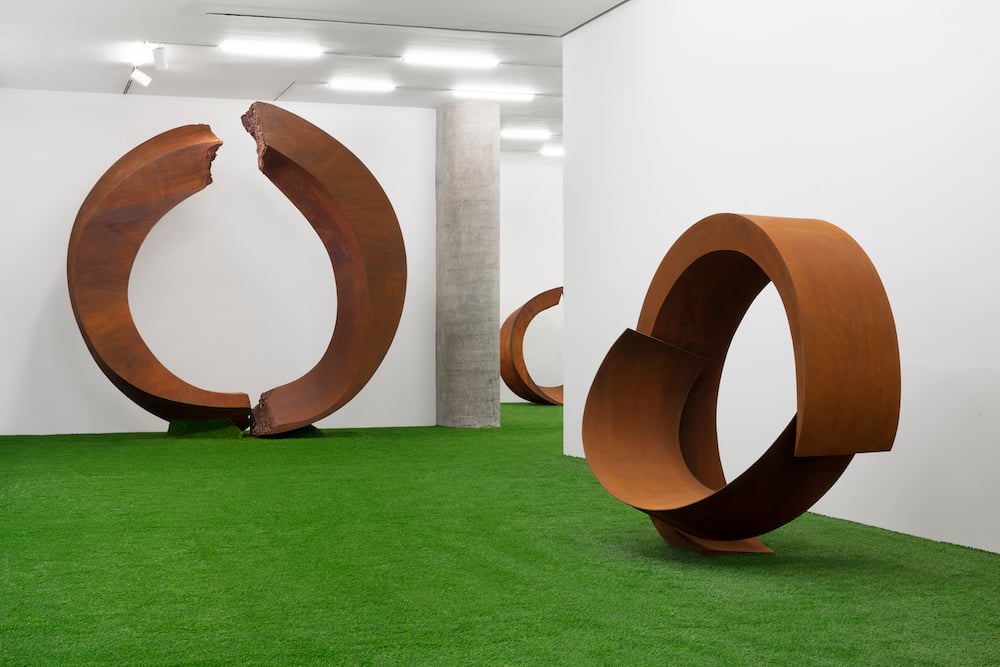
Installation view of Beverly Pepper
“Cor-Ten” at Marlborough Contemporary.
Until her last days, Pepper
continued to work every day in the studio.
Her works
are in the collections of the Metropolitan Museum of Art, the
Whitney Museum of American Art, the Barcelona Museum of Modern Art,
the Galleria Nazionale d’Arte Moderna in Rome, and the Centre
Georges Pompidou in Paris, among many others.
Her sculptures, usually designed for public spaces, are permanently
installed in cities throughout the world, including in New York,
Dallas, and Assisi.
“My sculptural language has
developed and grown for 60 years,” the artist told Artnet
News last year on the occasion of a show at the
Marlborough Contemporary gallery.
“Seeing, touching, and physical
sensory engagement is the way into my sculpture; my intention is
that the meaning of my work rests in experiencing it.”
The post Artist Beverly Pepper, Who Long Rejected Critics’
Attempts to Define Her Brawny Sculptures, Has Died at 97
appeared first on artnet News.
Read more https://news.artnet.com/art-world/beverly-pepper-obituary-1770933
Further reading


Leave a comment