
The New Bling Ring? How the Big Three Auction Houses Raked in a Whopping $1 Billion in Watch and Jewelry Sales in 2019
Fighting fiercely over major Rothkos and Hockneys is nothing new
for Christie’s, Sotheby’s, and Phillips. But now, with the jewelry
and watches market heating up considerably, the competition is just
as stiff for these luxury design items.
Last year, the Big Three auction houses carved up a $1 billion
pie, and staggering prices and records have become the norm. Case
in point: Sotheby’s sold a pink diamond weighing a hefty 59 karats
in 2017 for a record $71.2 million. Even prices for period gems are
soaring to new heights. At Sotheby’s, Queen Marie-Antoinette’s
pearl-and-diamond pendant flew past its $2 million high estimate to
sell for $36.2 million to set a record for an antique jewel.
Meanwhile, Christie’s racked up a record $109.3 million in a June
sale of items from the vastly overlooked Indian jewelry and jeweled
objects category.
When it comes to watches, Phillips reigns supreme. A mere year
ago, the auction house’s worldwide head, Aurel Bacs, hammered down
12 watches that drew more than $1 million each for a total of $22.7
million.
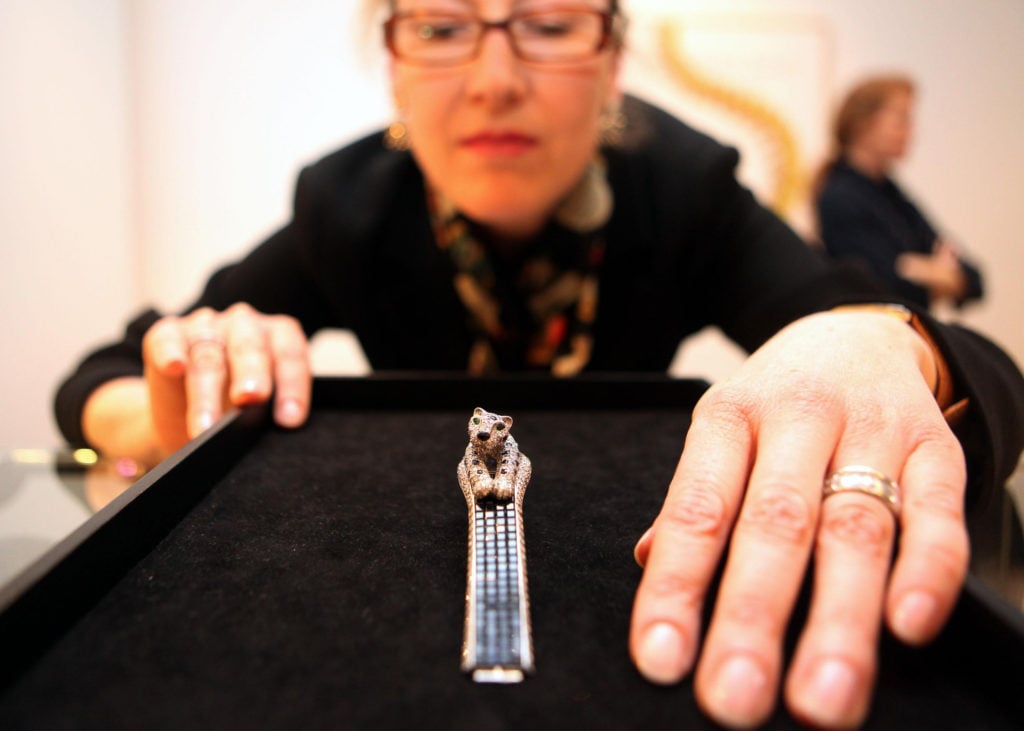
A Sotheby’s employee models a Platinum,
Diamond and Sapphire ‘Panthere’ wristwatch by Cartier. Photo by
Katie Collins/PA Images via Getty Images.
Conspicuous Consumption
Exponential wealth, the ever-greater concentration of money in
the hands of a few, and a vastly expanding client base is
driving prices up, up, and away. New collectors are even coming
from the African continent, and an increasing number of women are
snapping up jewelry on their own.
And while the three auction houses have somewhat different
strategies in hunting for new buyers, they’re all placing a
heightened emphasis on online sales and social media. Last year at
Christie’s, 25 percent of jewelry sales were to new buyers, with
total sales jumping to $433 million.
“Clients are buying sight unseen like never before, and digital
media is driving sales,” says Daphne Lingon, who heads Christie’s
jewelry division in the Americas. She says online sales have jumped
by 32 percent.
Even so, Sotheby’s beats Christie’s hands down when it comes to
the web. Fifty percent of Sotheby’s buyers placed bids online,
says David Bennett, the company’s worldwide chairman for
jewelry. And the auction house has been expanding its international
footprint: three years ago, it began holding watch auctions in
Dubai, and in 2018, it launched jewelry sales in Paris.
Last year, Sotheby’s added up $287.3 million in jewelry
sales.
Overall, Sotheby’s has a far broader approach when it comes to
catering to clients. Bennett has set up three different tiers of
sales with a “Magnificent Jewels” division, which encompasses
high-priced rocks and other gems, at the top. The “Fine Jewelry”
hits lower price points, and online sales are for even lower-priced
items.
“That particular audience goes after jewelry in the $3,000 to
$5,000 range, like Bulgari earrings from the ’70s that you can wear
to the grocery store,” says Quig Bruning, a vice president at
Sotheby’s, of online bidders.
By contrast, Phillips raked in $22.8 million at their jewelry
sales—a significantly smaller figure, but a 225 percent increase
since 2014, when former Christie’s CEO Ed Dolman took the helm of
the company. Since signing on, he has reined in a stunning 15 new
hires for Phillips’s jewelry and watch department,
including Susan Abeles in New York and Graeme Thompson in
Hong Kong.
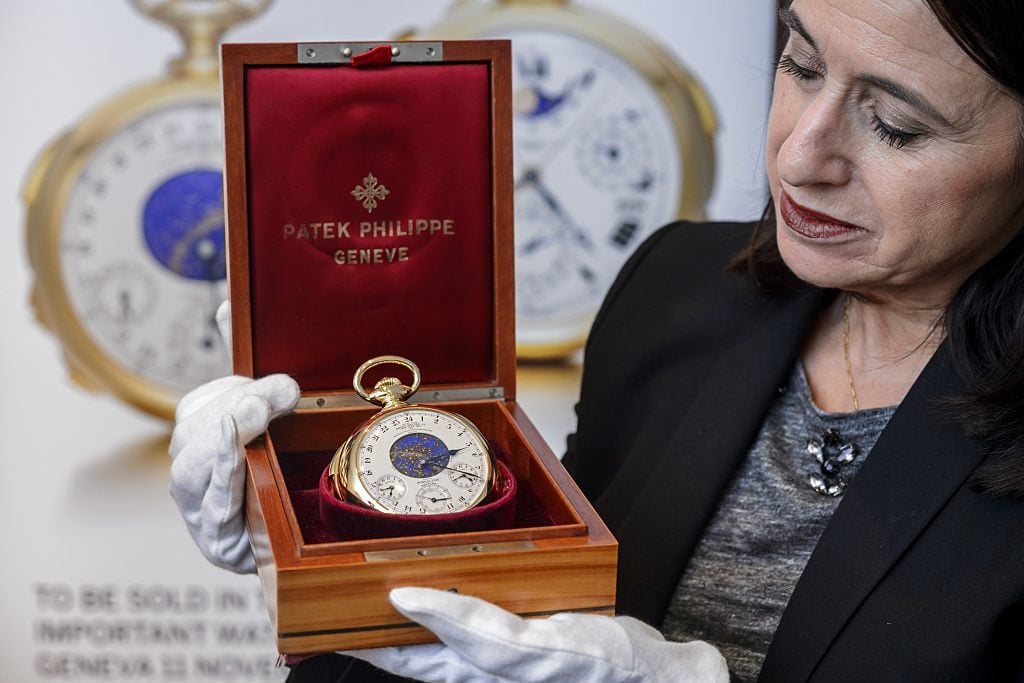
Sotheby’s head of International Watch
Division Daryn Schnipper holds the Henry Graves Supercomplication
timepiece by Patek Philippe. Photo courtesy of FABRICE COFFRINI/AFP
via Getty Images.
The Race for the Asian Market
And of course, each auction house is going after collectors out
East.
“Asians are the most active buyers in the world, and more than
30 percent of our art, jewelry, and wine clients hail from Asia,”
says Rahul Kadakia, who leads Christie’s international jewelry
department. He also notes that 30 percent of the under-bidders
for jewelry came from Asia, and that another 30 percent of the
buyers at Christie’s Indian jewelry sale in June came from
Asia.
Thompson is seeing a generational shift among these collectors.
“For them, it’s no longer solely about pearls and jade,” he says.
“What’s new is that, just like our other clients globally, they
want contemporary jewelry to go with their art and design
holdings.”
Thompson, Kadakia, and Bruning all say that some jewelry
collectors cross over into art, and vice versa. “But those who buy
at our ‘Magnificent’ sales are the biggest art collectors,” Bruning
adds.
When it comes to hawking watches, Bacs takes a totally different
tack and focuses solely on the top end of the market.
“We have no secret weapon,” says Bacs, who maintains an advisory
firm with his wife called Bacs & Russo, which partners
with Phillips. “Rather, we appeal to the heart and the
mind.”
“We offer more knowledge,” he adds. “Practically not a single
day goes by when we don’t hold an event, whether it be cocktails,
dinners, seminars, or private meetings with clients.”
Bacs contends that, among watch collectors, who are
overwhelmingly male, a growing number own in excess of 20
pieces, with many priced in the high six figures and up.
Twenty-five years ago, he says, his clients were predominantly
between 50 to 75 years of age. “Today they’re from 30 to 50 years
old, with some in their 20s,” he says.
Just like his counterparts at Sotheby’s and Christie’s, Bacs is
seeing some art collectors taking on watches. “Many cross over from
cars, wine, and design,” he says.
But will watch and jewelry collectors jostle for contemporary
artworks tagged with mega-million-dollar price tags? Only time will
tell.
The post The New Bling Ring? How the Big Three Auction
Houses Raked in a Whopping $1 Billion in Watch and Jewelry Sales in
2019 appeared first on artnet News.
Read more https://news.artnet.com/market/sothebys-christies-phillips-watch-jewelry-market-1794519
Further reading


Leave a comment