
A Highly Collectible Rock Plays a Key Role in the Oscar-Nominated Film ‘Parasite.’ Here’s the Actual Meaning Behind It
Can a rock change your luck? The Oscar-nominated Korean
thriller, Parasite, argues that it might. But not just any
stone slab will do, of course; it has to be a suseok, a type of
natural rock collected across Korea, China, and Japan for
centuries.
When the film’s director, Bong Joon-ho, was a kid, he used to
hike with his dad and hunt for these collectible stones. That isn’t
a popular Korean weekend pastime anymore; many youngsters don’t
even know what suseok are. Still, Bong incorporated one such rock
into Parasite, which is competing for Best Picture (and
five other categories) at this week’s gilded awards ceremony.
It was a “deliberately strange choice” to embed suseok in the
film, Bong admitted to The Hollywood Reporter. The rock
appears within the first 10 minutes of the tragicomedy, when
wealthy twenty-something Min-hyuk delivers a suseok to the grimy
basement apartment of his down-and-out friend, Ki-woo, and his
family, the Kims. “This stone here is said to bring material wealth
to families,” Min-hyuk explains of the gift, taken from his
grandfather’s personal collection. Meant to give the destitute
family a leg up out of poverty, the suseok reappears throughout
Parasite during important plot points.
(Warning: major spoilers below!)
What qualities do these
“scholar’s rocks” have?
Suseok are shaped naturally, by elements like wind and water,
and can range in size from monumental boulders used in landscaping
to smaller stones that were historically kept on scholars’ writing
tables (giving them the nickname, “scholar’s rocks”).
Connoisseurs who collect suseok—either by going out into nature
and finding them, or buying them through a dealer—know to look for
certain qualities. “Collectible rocks should be hard in density,”
explains Kyunghee Pyun, an art history professor at New York’s
Fashion Institute of Technology specializing in the history of
collecting. Those in the know “don’t collect loose, granuled rock,
or get a rock that might break.”
Surfaces with a bit of a pattern or a wave, like the striated
suseok in Parasite, are also more desirable, Pyun notes.
“Round, three-dimensional is better than sort of a thin slab of
stone,” she adds. “Almost like a porcelain type of quality, it
should be seen from all directions.”
What role do suseok play in
Parasite?
Min-hyuk presents the suseok, fitted with a custom-made base, in
an impressive wooden box. The striking collectible is clearly out
of place in the Kims’ dingy, subterranean apartment, where socks
hang from a ceiling rack and stink bugs amble across the kitchen
table.
“This is so metaphorical!” Ki-woo says, holding the rock for the
first time. The suseok seems to be charmed; things quickly start to
improve for the family. Though the family is all unemployed,
without phone service, WiFi, or enough to eat at the beginning of
Parasite, they gradually all land service jobs working for
the wealthy Park family—helping clean house, drive, and tutor the
children.
But the suseok resurfaces when the Kims’ luck starts to fail.
When their basement apartment floods during a dramatic storm, one
of the few things Ki-woo salvages from his home is the rock—which
magically (and gravity-defyingly) floats up to him through septic
water. He hugs the rock tightly later that night while sleeping in
an emergency shelter, clinging to hope that the suseok will rescue
him from poverty.
The rock next pops up when Ki-woo brings it to the Parks’
mansion, intending to kill an unfortunate couple, living in a
secret subterranean bunker, who are blackmailing the Kims. By now
the suseok (stripped of its base and box) isn’t just a fancy
collectible. Chekhov famously said that a gun that appears in the
first act of a play must later be shot,
and Parasite‘s suseok would make Chekhov proud. The
sculptural rock returns as a weapon, as we watch the man hidden in
the Parks’ bunker use it to smash Ki-woo’s head in, over and
over.
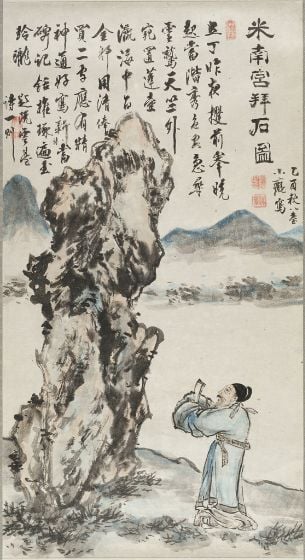
An 1885 Korean painting of the Chinese
scholar Mi Fu (1051-1107) paying homage to a fantastic rock, by Hô
Ryôn. Image via Wikimedia Commons.
How are suseok
made?
Prized suseok are found in nature. Ideally, they’re never
altered by human hands. “In China or Japan, in order to accentuate
the dramatic effect, they put varnish types of materials or trim a
little bit,” Pyun notes. “But for Korean rock collectors, the
essence is you never touch it. As is, the nature is the beauty of
the rock.”
Hardcore collectors, who often fish suseok out of river streams,
look for rocks that are whole entities. “It’s not like they’re
going to cut out a chunk from a cliff or a rock,” says Pyun. “It
doesn’t work that way.”
Who owns them in real life?
How fancy are they?
Suseok grace the homes of sophisticated Korean families, but
they’re not the highest valued Korean art objects—painting and
calligraphy come first. “In the hierarchy of collectors, people who
only collect rocks are at the bottom 30 percent,” Pyun explains,
noting that top-tier art collectors might have one or two suseok,
but don’t make it the focal point of their collection.
This stratification matches the hierarchy in Parasite,
with the basement-dwelling Kims and their suseok reflecting the
lowest level of would-be collectors.
When did suseok become
popular?
The golden age of suseok collecting was during the Joseun
dynasty (1392–1897), but they regained popularity in the 1980s
among a class of businessmen (like Parasite’s newly
wealthy Mr. Park).
The Korean economy was burgeoning during that decade and
produced fresh wealth among manufacturers of clothing, wigs, and
sneakers. With their new resources, these businesspeople
rejuvenated the suseok tradition. “Nouveau riche [suseok
collectors] are usually businesspeople, who are self-made and come
from not a great academic background, but somehow made a lot of
money,” Pyun notes.
“Old money doesn’t collect rocks,” she adds. “It’s new people,
who need to adapt to a new status but also want to exude this air
of sophistication. It’s like an easy step towards
sophistication.”
A suseok is the perfect gift for Parasite’s lowly Kims,
who want a shortcut to the rarefied lifestyle of the filthy rich
Parks. In the film’s bloody universe, though, this fabled rock
isn’t a step towards sophistication; it’s an invitation to
violence.
The post A Highly Collectible Rock Plays a Key Role in the
Oscar-Nominated Film ‘Parasite.’ Here’s the Actual Meaning Behind
It appeared first on artnet News.
Read more https://news.artnet.com/art-world/guide-suseok-stone-parasite-1768059
Further reading


Leave a comment