
‘A Master of the Gestural Brushstroke’: Admirers Reflect on the Legacy of Ed Clark, the Late Innovator of Abstract Painting
Ed Clark, a painter and
innovator of the post-war abstract art movement, has died at
age 93.
Clark was a fixture in the New
York art scene of the 1950s, frequenting the Cedar Tavern alongside
peers like Mark Rothko and Willem de Kooning. Though his career
didn’t yield the same level of market success in the decades
following the downtown New York painting boom, Clark’s work has
sparked renewed interest from critics and collectors alike in
recent years.
“We join Ed Clark’s family in
grieving the loss of this remarkable artist, while feeling deeply
grateful for his very long life filled with inspiration, invention,
and love,” said a statement from Marc Payot, partner and vice
president of Hauser and Wirth, which represents the artist
worldwide and currently has an exhibition of his work on view in
Chelsea. “We feel privileged to have been able to open, during Mr.
Clark’s lifetime, an exhibition of his most recent paintings. And
we look forward to continuing the work of introducing Ed Clark to
new generations and ever broader audiences around the world,
exploring his powerful vision and radically original art in the
context of history and contemporary culture.”
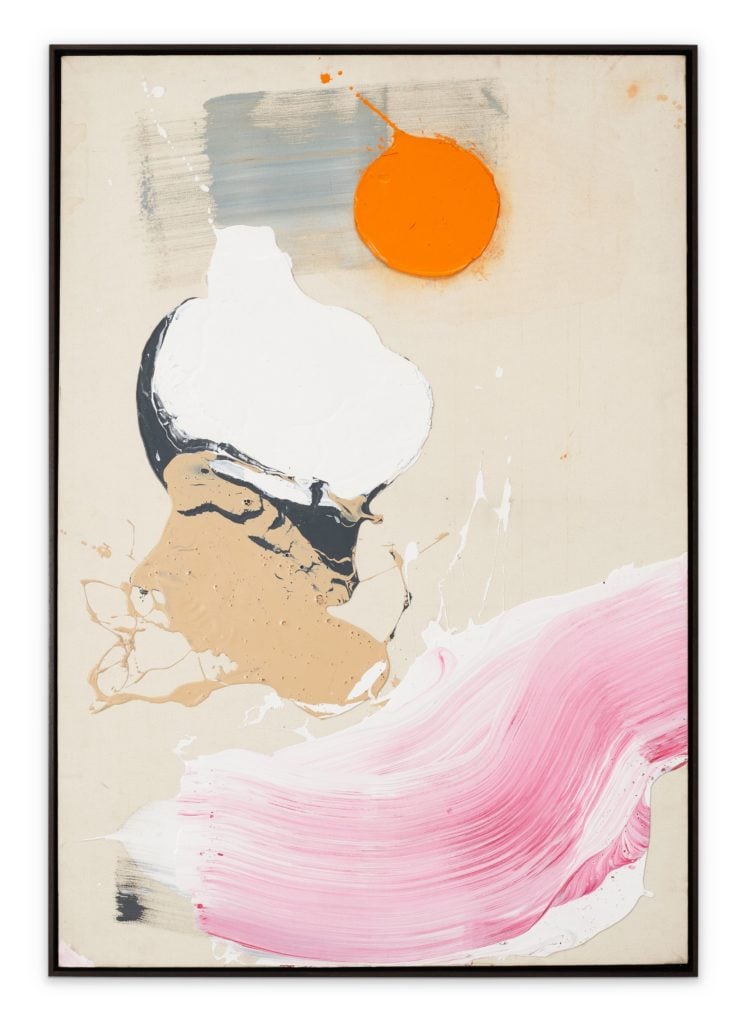
Ed Clark, Untitled (2013). Photo:
Thomas Barratt, © Ed Clark, courtesy of Hauser & Wirth.
Clark was born in 1926 in New
Orleans and raised in Baton Rouge and then Chicago. After a
two-year stint in the Army Air Forces, he enrolled at the Art
Institute of Chicago through the GI Bill. He then moved to Paris to
study at the Académie de la Grande Chaumière, where, alongside
fellow African American expat artists such as Beauford Delaney and
Herbert Gentry, his work transitioned from figuration to
abstraction.
It was during this time that
Clark also turned to a push broom in order to spread large swathes
of gradated paint on his canvases in a manner that conveyed speed—a
technique he would employ for the rest of his career.
“Ed took the idea of using house
painters’ brushes a step further with the janitor’s broom,” says
Sukanya Rajaratnam, a partner at Mnuchin Gallery, which mounted a
survey of Clark’s work in 2018. “Embracing the physicality of the
entire body into painting, he turned a menial tool into an elevated
object, while also perhaps bringing race into the equation in a
subtle way.”
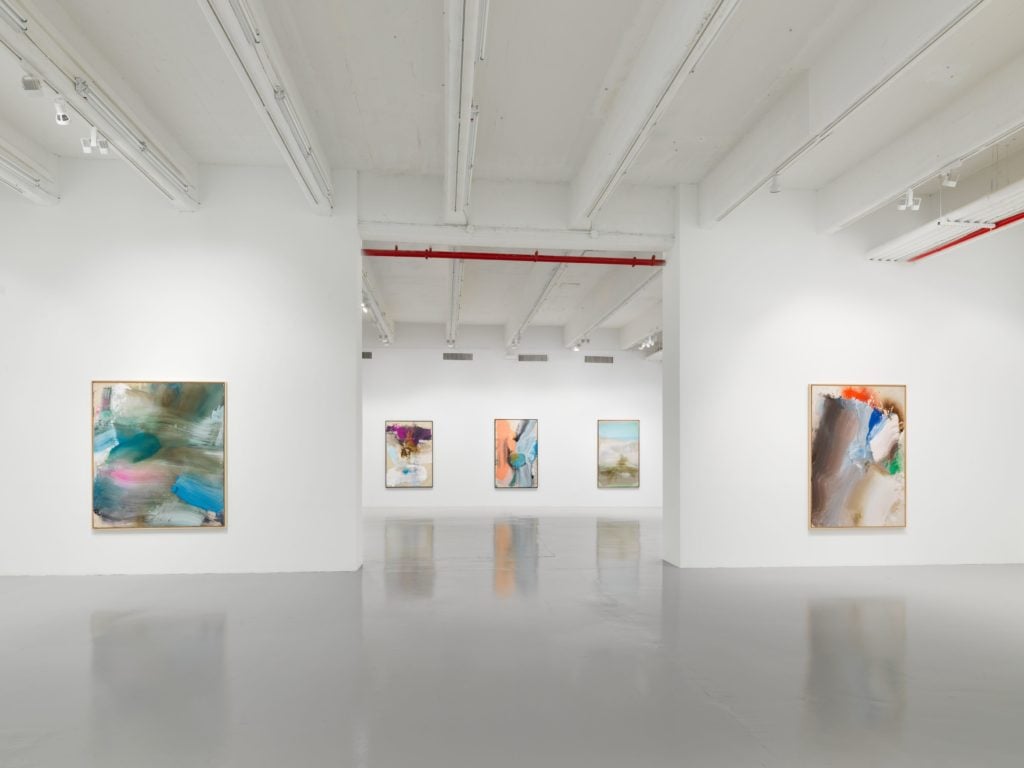
Installation view of “Ed Clark Paintings
2000 – 201” at Hauser & Wirth New York, 2019. Photo: Dan
Bradica, © Ed Clark, courtesy of Hauser & Wirth.
Clark returned to New York in
1956 and found his place among the coterie of post-war painters in
the 10th Street scene. In a group show in 1957, he introduced what
is perhaps his most significant formal innovation: the shaped
canvas. Though the minimalists of the successive generation would
make regular use of the non-rectangular canvas, Clark is thought to
be the first artist to introduce the idea.
“Ed Clark was a great painter—a
restless innovator pushing the boundaries of abstraction, a master
of the gestural brushstroke and a dazzling colorist,” says Nigel
Freeman, director of African-American art at Swann Auction
Galleries. “He broke through in the mid-1950s with collage, a
broom, and dry pigment, painting like no one before. His
contributions to postwar art are just now being
acknowledged.”
Clark’s work remained in
relative obscurity until a pair of retrospective exhibitions—at the
N’Namdi Center for Contemporary Art in Detroit in 2011 and at the
Art Institute of Chicago two years later—put it back on the map.
Since then, Clark’s work has been the subject of several prominent
shows, including the Mnuchin survey and a group exhibition curated
by one of Clark’s most devout followers, David
Hammons.
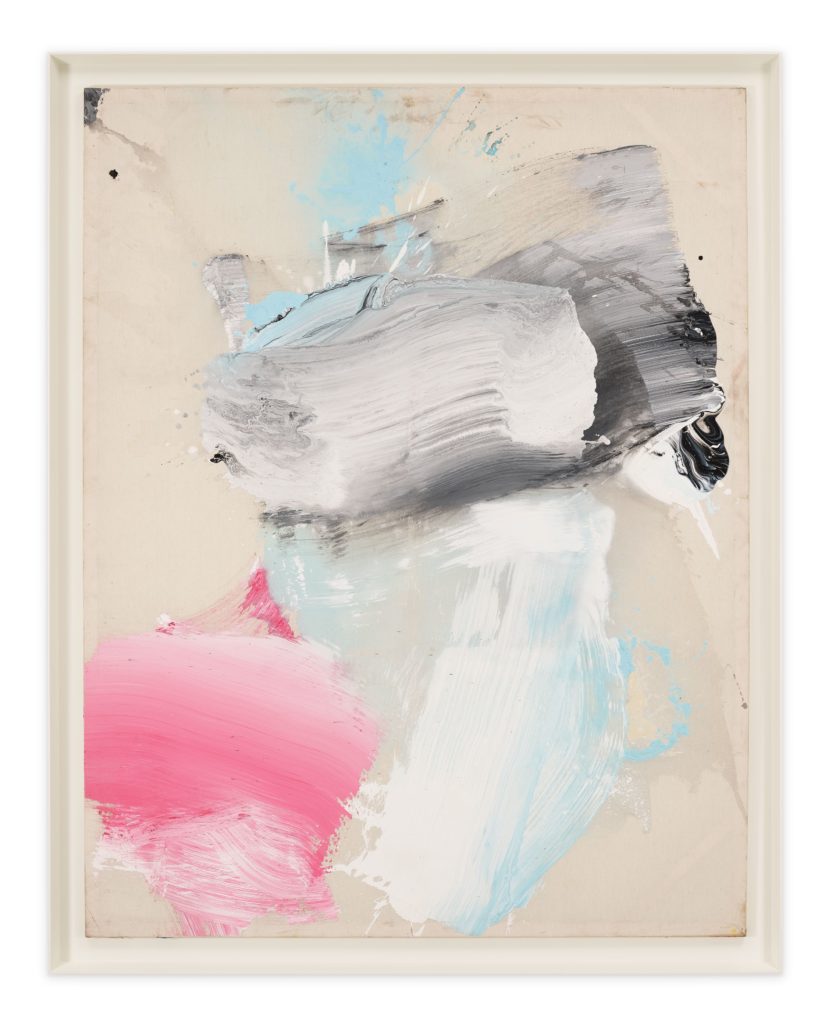
Ed Clark, Untitled (2006). Photo:
Thomas Barratt, © Ed Clark, courtesy of Hauser & Wirth.
Clark’s ascent was cemented when
he signed with Hauser & Wirth this past
July. The show of his
work on view now at the gallery brings together fifteen paintings created
between 2000 and 2013. “One can only imagine the tenacity needed to
hang on for so long, but you get a sense of how Clark’s obstinacy
paired with an unyielding belief in his own art has served him
well,” Charles Moore wrote of the show on artnet
News earlier this month. “Overall, this collection of art radiates a
sense of contentment, at this moment when his reputation has at
last caught up to his achievement.”
“I remember having a painting by
Ed in one of our viewing rooms alongside a de Kooning from the
’70s,” says Rajaratnam of Mnuchin Gallery. “Time and again, the
most seasoned collectors would turn to the painting by Ed and ask
me who it was by. I think to a lot of artists working today, it
might actually look fresher, embodying more chances.”
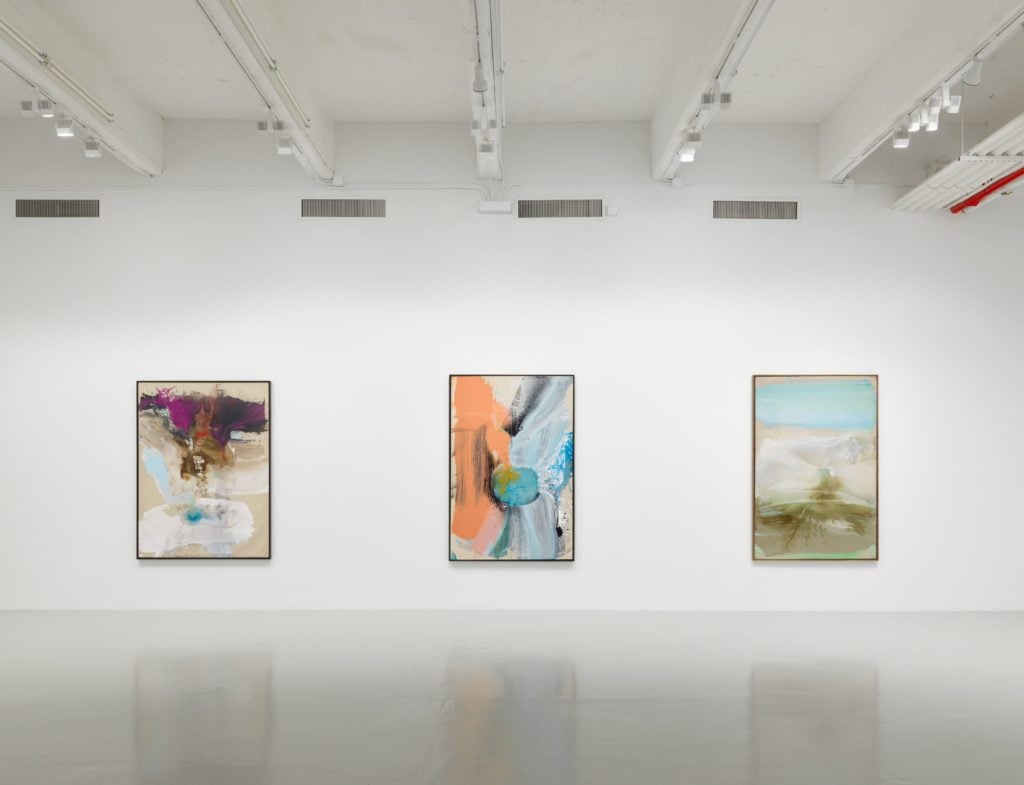
Installation view of “Ed Clark Paintings
2000 – 2013” at Hauser & Wirth New York, 2019. Photo: Dan Bradica,
© Ed Clark, courtesy of Hauser & Wirth.
“Ed Clark” is on view at
Hauser & Wirth, 22nd Street, New York,
through October 26, 2019.
The post ‘A Master of the Gestural Brushstroke’: Admirers
Reflect on the Legacy of Ed Clark, the Late Innovator of Abstract
Painting appeared first on artnet News.
Read more https://news.artnet.com/art-world/ed-clark-obituary-1684708
Further reading


Leave a comment