
A New Report Says Germany Is a Hotspot for the Illegal Antiquities Market. Here’s Why That’s Wrong—and Dangerous
When the entire German art and
antiques trade is at stake, it is important to get the facts
right.
A recent study into the
illicit trade of antiquities has recommended that the
German government clamp down even harder on the beleaguered German
art market. But shockingly, the study’s conclusions are based more
on suspicion and prejudice than scientific research.
Amid concern that Germany was a
hub for international cultural property crimes, the country’s
Federal Ministry of Research began the ILLICID study in April 2015.
The €1.2 million project was carried out over three years.
The resulting 50-page
report, published last month, identified no trafficked items or any
evidence whatsoever that the sale of antiquities helped finance
terrorism.
But, I would argue, the German
ministry that commissioned it has manipulated the results to
support an anti-trade agenda. As the secretary general of CINOA, the largest
trade federation for art and antiques dealers, who has been
campaigning on their behalf in the European Union and elsewhere for
years, I have seen firsthand how statistics can be manipulated to
suit political agendas and are often accepted without being
checked.
Not a Multi-Billion-Dollar Business
Before we get into the specific
flaws of the report, it is important to acknowledge that even its
motivation is built on a false premise. Over the years, there have
been repeated claims from officials that the illicit trade in
antiquities is a multi-billion-dollar industry. But after much
debate, trade and anti-trade campaigners alike have concluded that
these estimates are not only unfounded, but clearly wrong, and part
of the trend now dubbed “zombie statistics”—that is, pieces
of information that are
frequently cited by experts and institutions, despite having no
basis in research or reality.
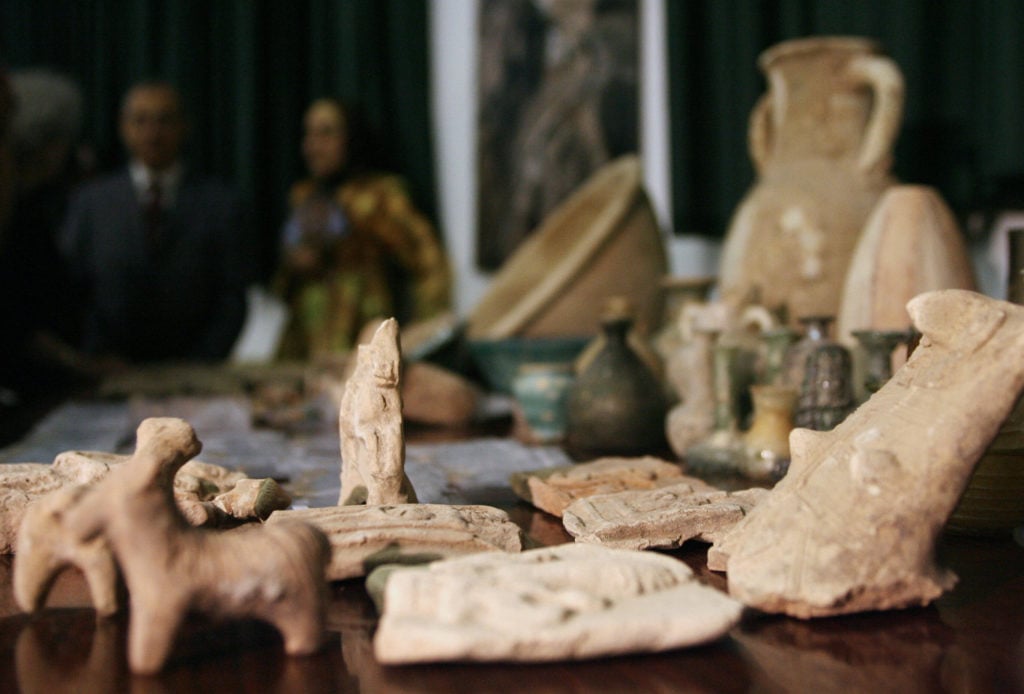
Artefacts looted from Baghdad museum
after the US-led invasion of 2003. Photo by AWAD AWAD/AFP/Getty
Images.
There have been various attempts
to trace where this mistaken belief about the value of the illicit
trade in antiquities originated, and sources invariably lead back
to several media reports from the early ’90s that cited it as a
“belief” held by some experts—but gave no evidence to support that
belief.
The authors of the ILLICID
report weren’t the only ones taken in by faulty reasoning, which
leads to faulty counting. The international criminal police
organization, Interpol, removed similar claims from its website
just last year, acknowledging the lack of evidence to support
them—but not before they had informed some European
policies.
So what numbers
can we count on? The FBI valued all cultural property
crime at around $4 billion in 2013, including crimes relating to
everything from contemporary art to antique furniture. This figure
was largely made up of domestic burglary and crimes such as fraud
and vandalism.
The most reliable figures
relating specifically to illicit trade currently available come
from the World Customs Organization, whose latest Illicit Trade
Report, published in December 2019 and covering 2018, stated that
cultural property (including all art and antiques, not just
antiquities) accounted for 0.08 percent of trafficking seizures
reported through its network. In 2018, a total of 314 trafficked
archaeological items were seized globally and reported via the
network, down from 703 in 2017.
Unrealizable Provenance Requirements
The ILLICID report
examined more than 300,000 items
and valued the objects
it studied (note: not illegal objects, but all objects) in Germany
at around €850,000 per year for the course of the study. A lack of
access to criminal evidence means that the report does not even
mention illegal excavations, looting, or terrorist
financing.
The authors identified a total
of four suspicious transactions, but concluded that “potential
money-laundering cannot be excluded, however neither is it
inevitable.” In one of these
cases, it appears that the object in question was a “sleeper,” as
in, a misattributed masterpiece whose true significance was simply
not recognized by the German auction house that catalogued
it.
But perhaps the most sensational
figure, widely repeated in media headlines, was that around 98 percent of Eastern
Mediterranean antiquities sold in Germany were of questionable
origin. This, however, is a skewed interpretation of the
facts.
Fewer than two percent of the
items studied—a total of 6,133 objects—“potentially” came from
regions of interest around the Middle East, and it was 98 percent
of that slice deemed to be of questionable origin. So the
conclusion might be more accurately framed as: just under 0.02
percent of all of the items studied are of “questionable
origin.”
Filing cabinets. Photo by Jan
Woitas/picture alliance via Getty Images.
The suspicion about origin is
largely based on what the researchers see as incomplete provenance
history, including the absence of previous owners’ names, despite
the fact that data protection rules prevent this in many cases. The
absence of full documentation for antiquities that have been
circulating in the market for years is not only commonplace, but
the norm.
Countries of origin often had no
export licensing system when items were exported originally and,
even where they did, detailed invoices were rarely required.
Family heirlooms often do not come
with paperwork that pinpoints their trade histories. None of these
scenarios gives rise to suspicion of crime, yet the ILLICID
report—and the ministry recommendations arising from it—act as
though it does.
A German law introduced to
protect cultural assets, passed in August 2016, ignores these
reasonable factors and instead demands proof of legal export from a
country of origin before it will allow import. But this is
impossible in the majority of cases. Believe me—dealers would love
to have an unbroken provenance for everything they sell. It would
not only make their lives much easier, but would also add to the
value of what they trade in.
If ILLICID deems such objects as
failing to meet the requirements of the law, then it simply shows
how misguided that law is and how little those in power understand
the market or even care to do so. In the end, absence of evidence
is not proof of guilt.
Even with all of this, ILLICID
notes that only 10.9 percent of the objects it studied lacked any
provenance at all. The remaining 87 percent have information, but
the study does not consider it sufficient.
No Terrorist Financing
This is not the study’s only
flaw. There is also a lack of evidence to support its claim that
antiquities sales significantly finance terrorism and, principally,
the activities of IS. The recommendations offered assume that IS
control of any given region, and the increasing vulnerability of
cultural heritage amid the political instability, means that it
financed itself significantly through the looting of
antiquities.
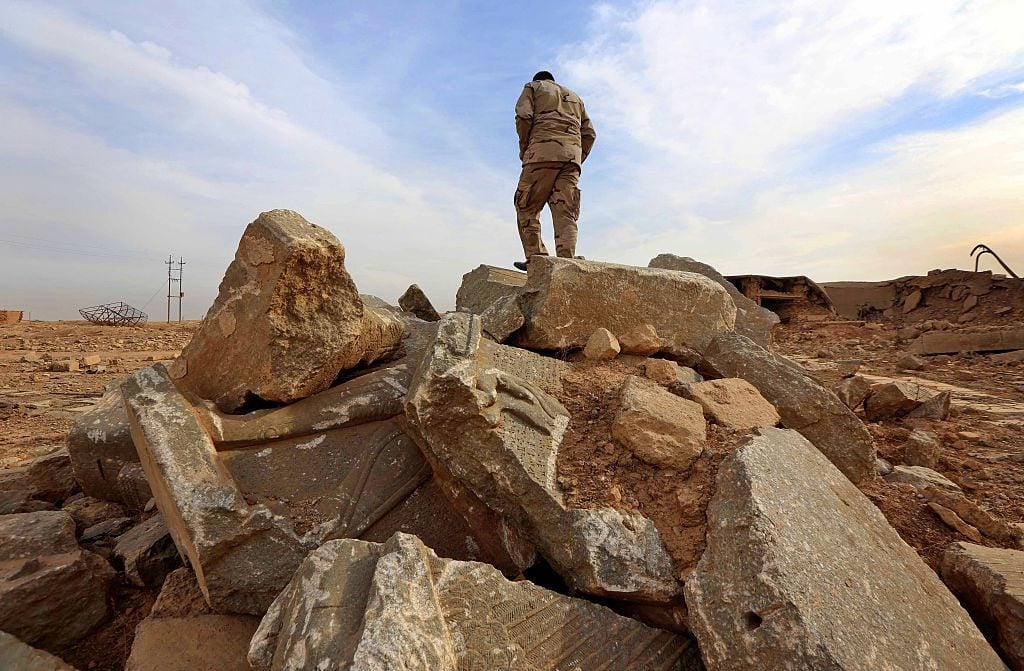
An Iraqi soldier stands on November 15,
2016, on the ruins of the archaeological site of Nimrud, which were
severely damaged by ISIS. Photo courtesy SAFIN HAMED/AFP/Getty
Images.
But the UN Security Council’s
monitoring team reported in 2019 that the IS had not systematically
used cultural assets as a source of funding. A 2017 study by
Deloitte ordered by the EU Commission to justify stringent new
import licensing regulations found that none of the 28 EU member
states could identify the financing of terrorism through cultural
property at all. King’s College, London concluded its research in
the same year with the view that financing terrorism via the
antiquities trade is unlikely.
Grasping at straws for evidence
to back its recommendations, the ministry called on a 2005 article
in the German magazine Der Spiegel that claimed the lead terrorist in the 9/11
attacks financed the operation by selling looted Afghan artifacts.
But in reality, while Mohamed Atta had asked a professor where such
pieces might be marketed, and was referred to Sotheby’s, nothing
ever came of this.
A Suffocating Bureaucracy
It is quite frankly scandalous
that despite the failure of the ILLICID study back up its initial
assumptions with hard evidence, the Federal Ministry of Research
appears now to have manipulated the results to pursue its original
agenda.
I am shocked by the
recommendations for numerous measures to be taken against a market
already brought to its knees by earlier misconceived legislation,
which itself was imposed as a result of political ideology rather
than to solve a proven problem.
This time, the recommendations
include a transparency register in which all archaeological
cultural assets that can be legally traded must be recorded. But
this inflicts more work on dealers while failing to acknowledge the
impossibility of the task. If accepted, the recommendations will also mean
yet another database being set up for known or allegedly
counterfeit cultural goods. It also recommends digitizing all trade
publications after 1945, but fails to provide any budget by which
already struggling dealers could do so.
The list of regulations already
in place or proposed covers every eventuality already. These
include—but are not limited to—the new EU import licensing laws,
which also cover export licenses from source countries; UN
sanctions specifically targeted at Syria and Iraq; and, perhaps
most importantly, the EU’s fifth anti-money laundering
directive, which explicitly targets the art market and comes
into full force at the beginning of 2021, with severe penalties for
those who break the rules.
Germany has little more than a
handful of antiquities dealers these days, and most are
micro-businesses. How are they going to cope if this latest set of
ridiculous measures is adopted? And what are the implications for
the rest of the market? It is a suffocating bureaucracy that is
undermining an already vulnerable trade.
Erika Bochereau is the Secretary General of the
Confédération Internationale des Négociants en Œuvres d’Art
(CINOA), a trade organization for art and antiques
dealers.
The post A New Report Says Germany Is a Hotspot for the
Illegal Antiquities Market. Here’s Why That’s Wrong—and
Dangerous appeared first on artnet News.
Read more https://news.artnet.com/opinion/why-germany-is-not-a-hotspot-for-illegal-trade-1834536
Further reading


Leave a comment