
A New Thriller Starring Mick Jagger Paints a Dark and Dramatic Picture of Art Dealing, But Its Director Says It’s ‘Not a Satire About the Art World’
Italian director Giuseppe Capotondi doesn’t want art audiences
to take his new thriller, The Burnt Orange
Heresy, too seriously.
The film, which opens in New York and Los Angeles today, is
based on the 1971 novel of the same name by Charles Willeford. It
stars Claes Bang as a womanizing art critic named James Figueras
who appears to have pulled some dubious market related stunts in
the past. Elizabeth Debicki plays Berenice Hollis, his lover turned
travel companion, while Rolling Stones frontman Mick Jagger takes a
turn as a scheming, white-suited art dealer named Joseph Cassidy
who sports a perpetual evil grin, while a shaggy Donald Sutherland
plays a mysterious artist genius named Jerome Debney.
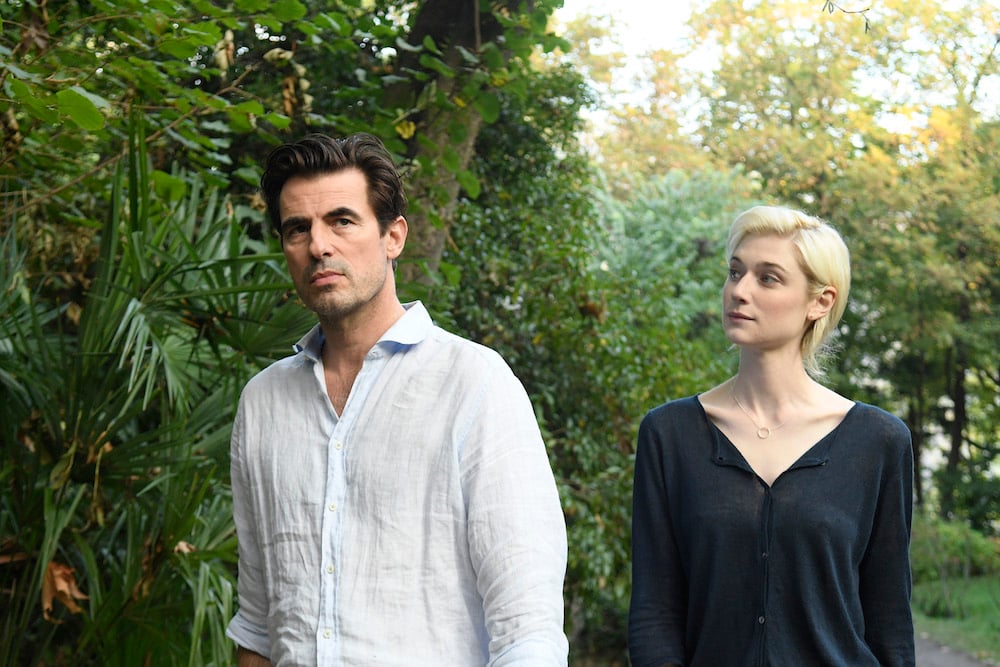
Claes Bang as James Figueras and
Elizabeth Debicki as Berenice Hollis. Photo by Jose Haro. Courtesy
Sony Pictures Classics.
When Cassidy summons Figueras to his lavish villa in Lake Como,
Italy, it’s not without a questionable agenda, starting with
getting Debney to agree to an interview and to uncover the mystery
of the devastating studio fires that destroyed the artist’s work.
The ensuing plot twists, insider jokes, and wry conversation make
for an entertaining mashup that lands the film somewhere between
Velvet Buzzsaw and American Psycho.
Capotondi says that the first thing he did when he got the
script was change the setting from Palm Beach, Florida, to Lake
Como to increase the film noir effect. “I thought it would make it
more moody” to serve as a more fitting backdrop for the plot’s
darker undertones, Capotondi told Artnet News.
Then, finding visually appealing actors with a commanding
presence was key. “First off, given such beautiful dialogues, I
needed the cast to be very handsome in an old-fashioned, film noir
style. All of the characters are tall, beautiful, and commanding.
They’re all very well dressed and well spoken,” he said. “I needed
a sort of devilish character for the dealer and I thought Mick
Jagger would play it very well and in fact he did. It was really
nice to work with him. He was very gentle and humble, in fact the
contrary of what you see on set.”
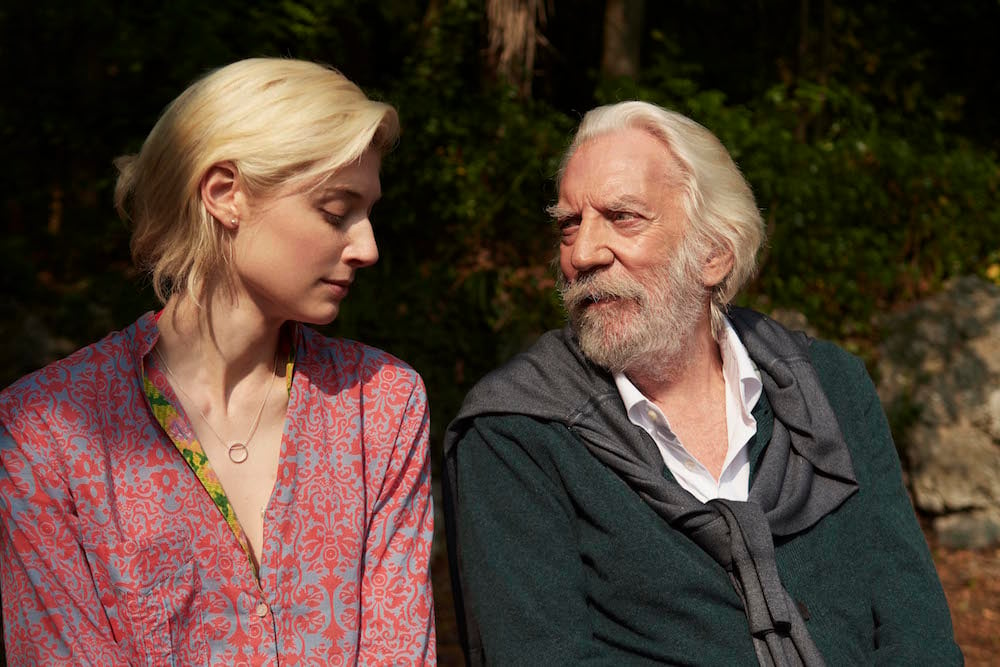
Elizabeth Debicki as Berenice Hollis and
Donald Sutherland as Jerome Debney.
Photo by Jose Haro. Courtesy Sony Pictures Classics.
Several real-life players in the art world also make cameos,
including writer and curator Phong Bui and Pace Gallery’s David
Goerk, as does art by Carol Rama and Alighiero Boetti, alongside
Arte Povera stand-ins such as a white wrinkled canvas that looks
distinctly like the work of Piero Manzoni. (Arte Povera occupies “a
special place in my heart,” Capotondi says.)
There’s gems of dialogue throughout, such as when Cassidy asks
Figueras which living artist he would most like to interview, and
Figueras responds, “Anselm Kiefer.” Cassidy fires back: “Kiefer
would speak to anyone with an open notebook.”
When Figueras and Hollis first arrive at the villa and are
waiting on Cassidy to appear in the dining room for lunch, they’re
eyeing two canvases with raw, graffiti-style block letters that
spell out versions of the word “STAMMER.” Figueras weighs in on the
works, which Capotondi says were inspired by artist Christopher
Wool, telling his friend: “He overpaid for these, in a few years
they will be worth a lot less.”
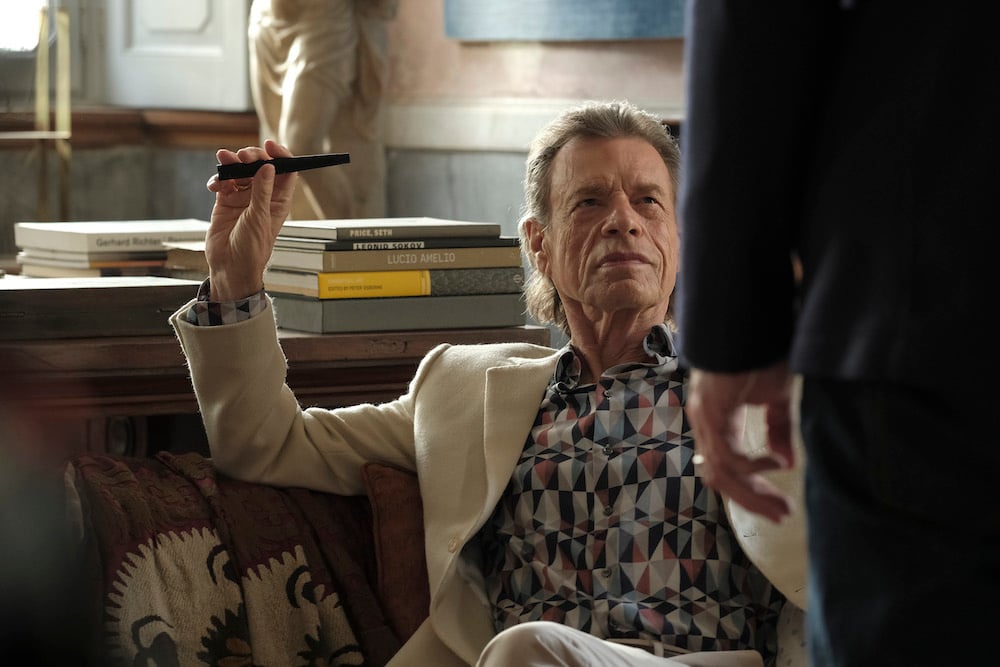
Center: Mick Jagger as Joseph Cassidy.
Photo by Jose Haro. Courtesy of Sony Pictures Classics.
Unbeknownst to him, Cassidy is just outside the door but within
earshot and, as he strides in, he explains that the market value is
meaningless to him. He loves the works because they resonate with
his having overcome a terrible childhood stammer, adding:
“I like the reminder that they
bring that I shouldn’t let a thing’s worth obscure its
value.” The chastened critic is clearly
embarrassed by the exchange, particularly in front of his newfound
love interest.
Is the film as a whole a cynical take on the art world? Not
exactly, says Capotondi. “It’s not a satire about the art world. I
don’t want to look like I’m grandstanding. It should be fun to
watch and carries a little message.” For instance, noting one
of Figueras’s lectures in which the critic toys with an artist’s
biographical details, he says: “It’s very easy to make something
that’s a fake pass for something real if you know what to say or
how to say it.”
At heart, he says, the film is a Faustian tale, but the art adds
another layer, including questions about truth. “The art critic is
obviously a key role here but it could have been anyone, a famous
blogger or journalist. Obviously the fact that it’s set in the art
world adds another layer, of beauty, and everything, including the
dialogue is made more interesting because of it.”
“I really wanted to make a
film that was fun to watch,” he said. “At the end of the day, it
shouldn’t be taken too seriously.”
The post A New Thriller Starring Mick Jagger Paints a Dark
and Dramatic Picture of Art Dealing, But Its Director Says It’s
‘Not a Satire About the Art World’ appeared first on artnet
News.
Read more https://news.artnet.com/art-world/art-thriller-mick-jagger-director-interview-1794429
Further reading


Leave a comment