
A Stunning Legal Decision Just Upheld a $6.75 Million Victory for the Street Artists Whose Works Were Destroyed at the 5Pointz Graffiti Mecca
In a sweeping 32-page decision eviscerating the legal arguments
of a disgruntled Queens real estate developer, a US Appeals
Court affirmed the rights and monetary damages awarded to a group
of graffiti artists whose works were destroyed without warning or
consent in 2013.
The artists sued the developer, Gerald Wolkoff, in 2013 for
violating their rights after he whitewashed their work at the
famous 5Pointz graffiti art mecca in New York to make way for
condos. A jury ruled in favor of the artists in November 2017, but
it was up to a judge to determine the extent of the damages.
In February 2018, Brooklyn Supreme Court judge Frederick Block
awarded the artists a total $6.75 million in a landmark
decision. The sum included $150,000—the maximum legal penalty—for
each of the 45 destroyed works at the center of the case.
The trial was a key test of the Visual Artists Rights Act
(VARA), which grants visual artists certain “moral rights” for
their work. Previous VARA cases rarely made it to trial, and were
instead settled privately.
But the act, which was added to copyright laws in 1990,
disallows the modification of works in ways that could be
considered harmful to artists’ reputations, and grants protections
to artworks deemed to be of “recognized stature.”
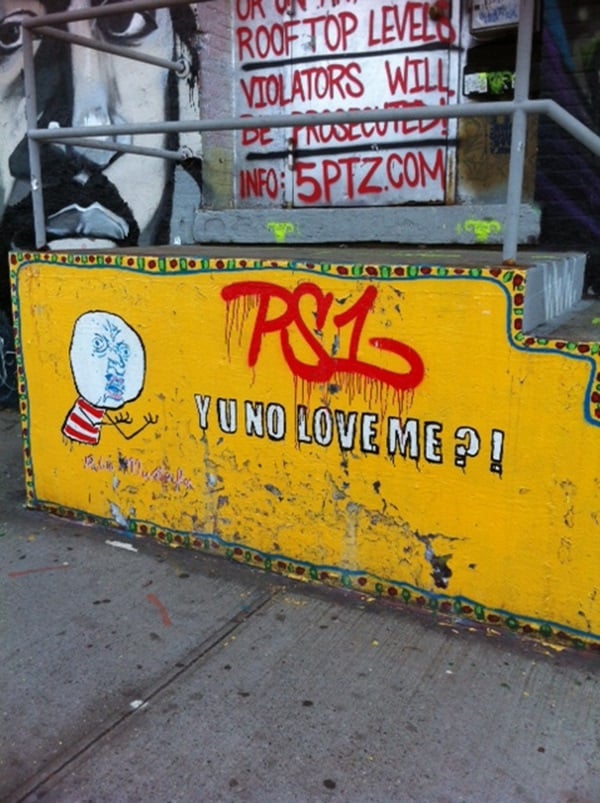
No more love in the 5Pointz. Photo:
Eileen Kinsella
In his appeal, Wolkoff challenged practically every aspect of
the decision by Judge Block, from the amount of the award, to the
suggestion that the graffiti murals at 5Pointz merited protection
under the “recognized stature” clause.
But Wolkoff was rebuffed on all points in the latest ruling, and
the court took the additionally extraordinary step of citing his
own lawyers against him. “Wolkoff’s own expert acknowledged that
temporary artwork can achieve recognized stature,” according to the
decision.
The ruling also took Wolkoff to task for
making misrepresentations about how his business would have
been harmed if he did not move to immediately whitewash the works.
In his arguments, Wolkoff claimed that certain tax credits
available to him would have expired if he did not move quickly to
paint over the works.
Yet he did not even have a demolition permit for the building
when he began his campaign to cover up the murals.
The court also, in two separate instances, took issue with
Wolkoff’s assertion that he “would do it again” if faced with
the same situation.
“In these circumstances, a maximum statutory award could serve
to deter Wolkoff from future violations of VARA,” the decision
says. “It could further encourage other building owners to
negotiate in good faith with artists whose works are incorporated
into structures.”
“It’s just complete vindication,” says expert Renee Vara, who
testified at trial for the plaintiffs.
“It doesn’t look like the court struggled with it at all.
If 5Pointz doesn’t have the legacy of a space, it has the legacy of
allowing creative rights, and artists to be able to pursue them in
respectful ways.”
Wolkoff’s attorney did not immediately respond to a request for
comment.
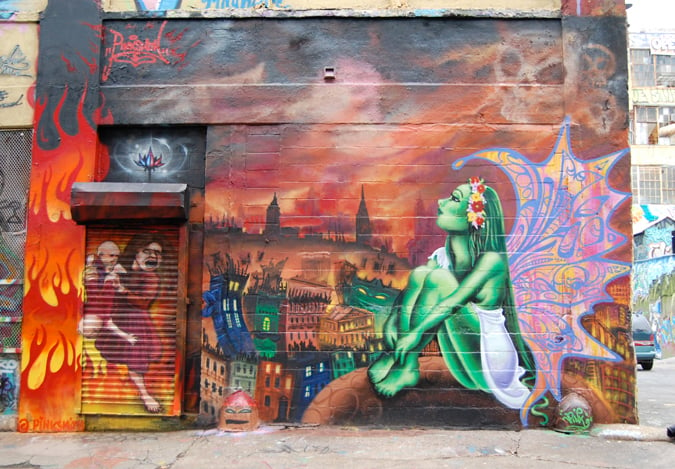
Lady Pink, Pink (2007) at
5Pointz. Photo courtesy of the artist.
The court went to pronounced lengths to explain its affirmation
of Judge Block’s decision, citing the importance of works by
unconventional artists such as Christo and Banksy.
“For example, noted street artist Banksy has appeared alongside
President Barack Obama and Apple founder Steve Jobs on
Time magazine’s list of the world’s 100 most
influential people,” the decision reads.
It also notes that although his images are often painted over,
“Banksy’s work is nonetheless acknowledged, both by the art
community and the general public, as of significant artistic
merit and cultural importance.”
The document goes on to cite the spectacular sale and self-destruction
of Banksy’s Girl With a Balloon at
Sotheby’s in October 2018: “With Banksy’s street art, the temporary
quality of this work has only added to its recognition.”
“The Second Circuit’s landmark decision is a monumental win for
the rights of all artists in this country,” attorney Eric Baum, who
represented the plaintiffs, told Artnet News via email.
“The artists are humbled by and thankful for the ruling. The 2nd
Circuit affirms Judge Block’s thoughtfully reasoned decision
that our clients’ art is to be cherished and protected and not
destroyed. This decision ensures that future artists and their
moral rights will have the protections that they and their
works of art rightfully deserve.”
The decision additionally notes that Jonathan Cohen, aka Meres
One, “a distinguished aerosol artist,” started working with Wolkoff
in the early 2000s, when the developer undertook to install artwork
in a series of dilapidated warehouse buildings he owned in Long
Island City.
“Cohen and other artists rented studio spaces in the
warehouses and filled the walls with aerosol art, with Cohen
serving as curator. Under Cohen’s leadership, [5Pointz]…
evolved into a major global center for aerosol art. It
attracted thousands of daily visitors, numerous celebrities,
and extensive media coverage.”
Vara said the final decision was also vindication for Cohen. The
court “upheld that Meres One was valid as both a curator and an
artist and that his selection had meaning.”
The post A Stunning Legal Decision Just Upheld a $6.75
Million Victory for the Street Artists Whose Works Were Destroyed
at the 5Pointz Graffiti Mecca appeared first on artnet
News.
Read more https://news.artnet.com/art-world/5pointz-ruling-upheld-1782396
Further reading


Leave a comment