
A Surprising Number of Artists Were Elected to Hong Kong’s District Council. What Comes Next?
Late in the evening of November
24, Hongkongers were joyously smiling and laughing for the first
time in nearly six months. They were celebrating the landslide
victory of the pro-democracy camp in the District Council
elections, which were widely seen as a de facto
referendum on the
ongoing protests that
have been gripping the city since June. The record turnout rate of
71.2 percent—2.94 million registered voters—collectively voted out
the pro-Beijing camp, which ended up winning only 59 out of 452
seats.
With the pro-democracy
contingent controlling the council for the first time, the election
results ushered in a new chapter in Hong Kong politics. But they
were also a milestone for an unlikely contingent: Hong Kong’s arts
and cultural scene. Never had the city seen such a significant
number of artists and cultural practitioners taking part in an
election—and winning. And these newly elected district councillors
vow to bring artistic thinking into policymaking.
“In recent years, the growth of
community art and socially engaged art have brought artists closer
to the society and politics,” said the artist and curator Clara
Cheung, one of the newly elected pro-democracy district
councillors. “The next step is to take action within the system and
make changes.”
As both artists and passionate
citizens, she said, “we hope our way of thinking can influence the
community… to cultivate our culture and the city’s cultural
identity from a community level.”
Politics Is the New
Canvas
The Hong Kong protests sparked
by the now-withdrawn extradition
bill in June have
morphed into a broader pro-democracy movement. These weeks of
activism have been widely regarded as a political awakening for
many Hongkongers, artists among them. Despite peaceful
beginnings, with millions of
people taking to the
streets, the protests have become violent at times. There have been
increasing clashes
between police and frontline
protesters, resulting in more than 5,000 arrests and over 10,000
tear gas canisters fired, with young demonstrators shot with live
rounds. One young protester
died from falling from a
building during a clash. In mid-November, university campuses
became battlegrounds as
they were besieged by the police. Just before the District Council election the
US Congress passed the Hong Kong Human Rights and Democracy Act,
which allows the US to annually review the city’s status as a
special trading entity separated from mainland China, and place
sanctions against those who undermine the city’s autonomy.
President Donald Trump signed it into law after the
election.
Hong Kong holds elections every
four years for the city’s Legislative Council and District Council.
The Legislative Council is a lawmaking body and their election is
based on proportional
representation, with
only half of the 70 seats open to public votes. The majority of the
district council members, on the other hand, are directly elected.
Council members serve as advisors for the government, weighing in
on local affairs and the allocation of funding for district
use.
November’s District Council
elections saw at least seven artists or cultural professionals
running, the most robust political participation from the city’s
arts community since artist Chow
Chun-fai’s bid in the
Legislative Council election in 2012. Many have said that they took
part only to ensure that a pro-Beijing candidate would have some
competition. The triumphant outcome was
unexpected.
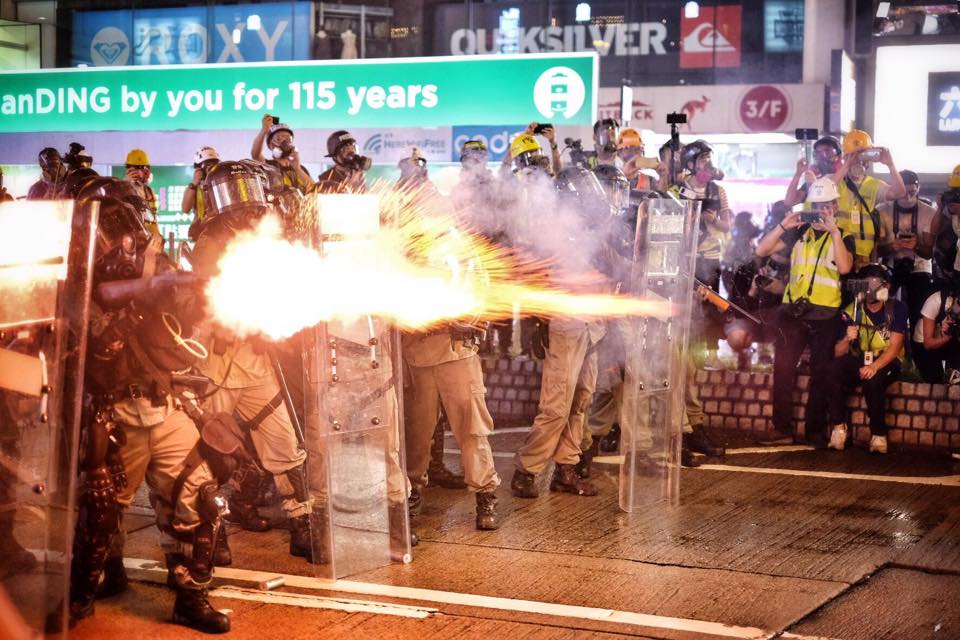
Pakkin Leung, newly elected to the
District Council, captured this picture of police clashing with
protestors.
In addition to Clara Cheung,
elected district councillors with an arts background include
Susi Law
Wai-san, manager of the
Art & Cultural Outreach (ACO), which oversees
the Foo Tak
Building, an artists’
hub in the Wan Chai district; sculptor and arts educator
Wong
Tin-yan; artist and
incumbent district councillor Clarisse Yeung; and Pakkin Leung, a
photographer and photojournalist who has been covering the protests
on the front lines.
Artist Kacey Wong, best known
for his protest art, helped with Cheung’s campaign. He said the
election has given artists an unprecedented opportunity to reinvent
themselves. They are no longer confined to simply reflecting their
feelings and observations through art that is exhibited in
galleries and museums.
“Chow Chun-fai set a very good
example back then, showing fellow artists that an artist’s life and
career are not limited by his body of work,” Wong said. “He was
using the society as his canvas.”
The artists recently elected to
the District Council, he added, will in some ways be “running a
four-year art project, where the stage and the setting is the
community.”
But at the same time, of course,
they will also be doing the real work of governing.
“Being a district councillor
means that they have to deal with various power sects, from those
on the government level to local community, as well as those
executing the will of the Beijing,” he noted. “They also have to
deal with the mundane paperwork and meetings. Do artists have such
stamina? Time will tell us the results.”
Bringing Artistic Thinking to
Policymaking
“The people I have dealt with,
from government officials to well-educated professionals from the
community, they tend to obey the structure,” said Clarisse Yeung,
32, who has successfully retained her seat in the council of Wan
Chai. “If those from above say ‘no,’ they dare not challenge the
order. There is a lack of imagination. But coming from a fine art
background, I can see things differently.”
Wan Chai
district on Hong Kong
Island is a hybrid commercial and residential area that has a
number of cultural landmarks, including the Hong Kong Arts Centre,
the Academy for Performing Arts, and the historic Blue
House cluster. It is
where Art Basel Hong Kong and all the major art auctions take
place. It is also where the police headquarters are, bordering the
government offices and Legislative Council building, which has been
a site of intense protests. The district also has the biggest
number of elected councillors coming from an artistic
background.
A graduate of the Chinese
University’s fine art department, Yeung is an enthusiast of
cultural policy. Four years
ago, she joined a new generation running for District Council
election for the first time after the 2014 Umbrella Movement died
down without any of its pro-democracy demands met.
Yeung said being a district
councillor means that she has to help local residents to fight for
their benefits, from reviving a cancelled bus route to getting an
ATM installed in their neighborhood. But she has applied her fine
art training during her battles with local officials, helping to
visualize the issues at hand. At one meeting with local officials
to demand the revival of a cancelled bus route, she brought along a
large cardboard bus to make her point.
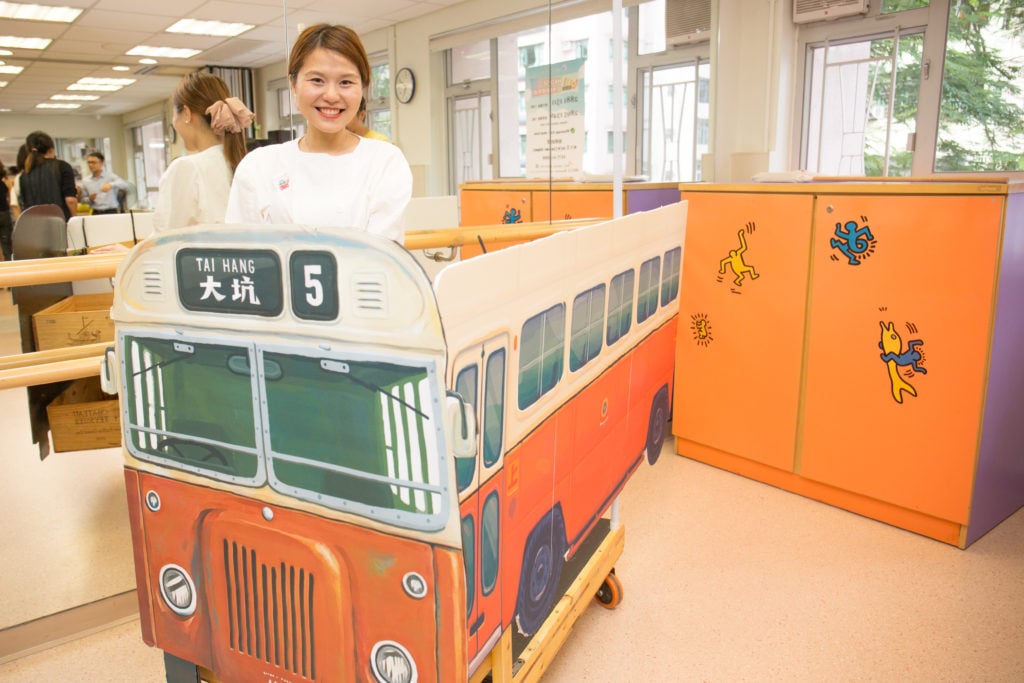
Clarisse Yeung asks officials to imagine
the benefits of bringing back a cancelled bus route.
“When they see the model of the
bus it reminds them of the bus route they need,” she said. “We also
organized a cultural tour of the bus route to explain the cultural
and historical context of this bus route.”
Yeung formed a coalition,
Kickstart Wan Chai, bringing 10 like-minded candidates together.
The group ended up winning six out of the 13 seats in Wan Chai
district. Susi Law is also a member of this group. “With more
councillors with artistic backgrounds, it will be easier for us to
[make] culture-related proposals,” she said.
Clara Cheung ran her campaign in
the Happy Valley constituency, a historic and posh neighborhood
that is home to the privately-run F11 Foto Museum and V54,
an artist-in-residence program housed in a three-story historic
building built in a French style.
Cheung co-founded C&G
Apartment, an
independent art space that responds to social and cultural issues.
Running an election campaign for the first time, the 40-year-old
approached it much like curating a community art project
tailor-made for this district. She came up with events meant to
bond the community, such as tours around the neighborhood to
encourage participants to develop new ways of seeing, and playful
events for families.
“Participants will reflect what
kind of environment they want to live in,” said Cheung. “They will
develop an artistic way of seeing and critical thinking. Then they
will take action next.”
A New Coalition
Pakkin Leung, 39, studied fine
art at the Hong Kong Arts School at the Arts Centre in Wan Chai and
has been working in the district. He ran an election campaign four
years ago but lost to the pro-Beijing candidate.
This time around, he beat the
long-serving pro-Beijing district councillor without even showing
up for his election campaign—he chose instead to document the
protesters trapped inside the Polytechnic
University lockdown as
the campus was besieged by the police for more than 10
days.
Coming from both an artistic and
journalistic background, Leung hoped to bring culture to the
neighborhood by documenting and studying the community in an
artistic way. Leung said he wanted to become a district councillor
who cares about people’s needs. His determination stems from the
brutality he has witnessed on the frontline of the protests,
including shooting one of the most
important videos that
captured the police’s indiscriminate attacks on unarmed civilians
in a subway station on August 31.
“I’ve photographed with tear gas
canisters and bullets flying over my head,” he said. “We need to
reflect the community’s voices and engage the community’s
participation through ongoing cultural projects, and show people
the truth.”
How things will pan out for Hong
Kong after this four-year District Council term is over is beyond
these artistic district councillors’ imaginations. But Cheung
remains hopeful.
“I hope we will have universal
suffrage by then. But as of now, we can make a difference in our
community and build solidarity to keep this movement moving
forward,” Cheung said. “I do not see this movement ending until we
have universal suffrage, which is our most basic right. We cannot
stop, otherwise we would lose everything.”
The post A Surprising Number of Artists Were Elected to Hong
Kong’s District Council. What Comes Next? appeared first on
artnet News.
Read more https://news.artnet.com/art-world/hong-kong-election-artists-1720866
Further reading


Leave a comment