
Alexander Calder’s 1943 Show at MoMA Was an Extraordinary Experiment in the Power of Play, a New Biography Says—Read an Excerpt Here
It’s impossible to overestimate the significance for Calder of
the retrospective of his work that opened at the Museum of Modern
Art on September 29, 1943. He certainly felt that way. In a letter
to Alfred H. Barr Jr., written nearly a quarter century later, as
Barr was preparing to retire from the museum, Calder said, “I have
long felt that whatever my success has been has been greatly as a
result of the show I had at the MoMA in 1943.” The exhibition
brought together about 100 works. They ranged from a tiny sculpture
of a dog that Calder had made of sheet brass when he was 11 or so
to a group of about half a dozen of the Constellations that he had
exhibited at the Pierre Matisse Gallery the previous spring. The
Modern, which after a decade in various temporary locations had
four years earlier moved into a new, capacious International Style
building on West 53rd Street, was the most elegantly inviting
museum in the world. Set in the midst of Manhattan’s hurly-burly,
the museum suggested to one visitor, a curator from Great Britain,
“an air of breathless, imaginative prophecy of cultural worlds to
come.” With modern art in retreat all across war-torn Europe, the
Modern looked like the last best hope for the creative revolution
that had begun with the Postimpressionists in the last quarter of
the nineteenth century. In the fall and winter of 1943, Alexander
Calder was front and center, the keeper of the flame. His
retrospective took up the entire ground floor and flowed into the
sculpture garden.
Visitors arriving at the show were confronted with Calder’s work
almost from the moment they came through the front door. The long
lobby hallway that ran through the museum to doors opening onto the
garden was filled with a selection of his larger recent works.
Turning to the right off that entrance hall, museumgoers found
themselves in a gallery lined with early wood and wire pieces and
toys. Next came a gallery devoted to work from the early 1930s.
Then, in the long room with glass walls facing the garden, there
was a generous display of works from the mid-1930s to the present,
with some larger objects, including Steel Fish and The
Spider, displayed out of doors. Museumgoers were free to
engage with Calder’s kinetic objects, whether by blowing on a
mobile hanging from the ceiling or giving a shove to one or another
element that was within reach. “Do not touch,” the assumption in
just about every gallery and museum in the world, didn’t apply to
this Calder retrospective at the Modern. In the garden, there was
actually a sign posted that read “Please Touch.” In an essay
published the year after the show, Mário Pedrosa, the Brazilian art
critic with whom Calder became good friends, was amazed that
“anyone could touch them, move them, sway them and even push them
with their feet; in particular the large free moving mobiles.” He
was “surprised” at what he referred to as an “overwhelming absence
of taboos.”
This unfettered access to the kinetic possibilities of Calder’s
work was pretty much taken for granted in galleries and museums
until the mid-1960s. The artist was allowing his admirers to test
the limits of traditional museumgoing behavior, much as he had
tested the limits of traditional three-dimensional art when he made
sculpture move. But the free give-and-take between the art and the
audience couldn’t go on forever. After the battering and bashing
that the artist’s legions of admirers gave the sculptures on
display in a huge retrospective at the Guggenheim Museum in New
York in 1964, there was no alternative but to put the old
do-not-touch policy back in place. That has remained pretty much
the situation ever since.
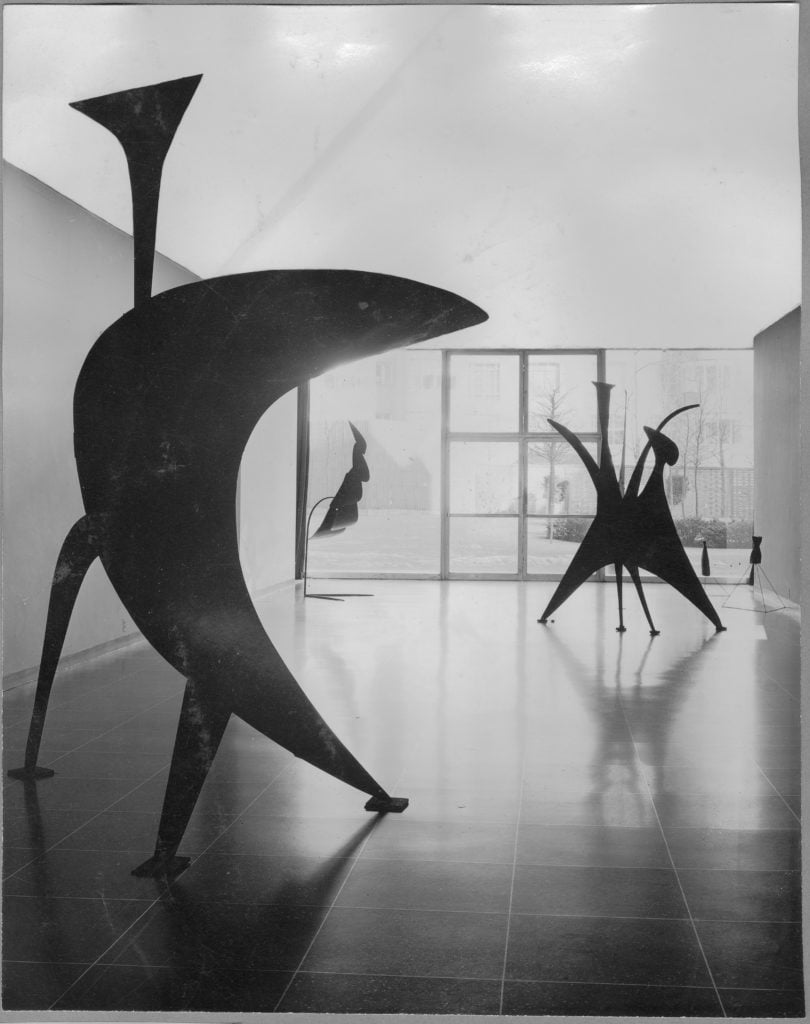
Installation view of Alexander Calder:
Sculptures and Constructions. Photograph by the Museum of Modern
Art, New York, 1943.
Calder threw himself into every aspect of the planning and
execution of the show with his customary gusto—and then some. “I
spent many days,” he later recalled, “like an ant, collecting my
objects here and there and taking them to the museum. I know all
the back roads of Connecticut, now.” There had never been a book or
even a significant catalog dedicated to his work. Now he was going
to change that. Although what was initially discussed was a catalog
of only 32 pages, he managed to end up with something twice as big.
[The exhibition’s organizer, James Johnson] Sweeney, who had a
substantial income from a family import and export business with
which he was at the time still deeply involved, told the Modern
that he would contribute the $300 honorarium he was slated to
receive for organizing the show toward the enlargement of the
catalog. Then Calder, still eager for a bigger book, thought he
might get what he wanted if he offered to give the museum a wooden
horse that he had made in 1928 and that Barr apparently admired.
“Do you think,” Sandy wrote to Sweeney, “we could bait that
catalogue trap with horse-meat and offer them this in exchange for
further expanding the catalogue[?]” However that conversation went,
the Horse did end up in the Modern’s collection and
Calder’s catalog as it finally appeared had 64 pages, much longer
than originally planned, but still not as long as the Miró catalog
two years before, which had 87. The catalog was illustrated with
Matter’s beautiful photographs. Wheeler, using a photograph by
[Herbert] Matter, devised a striking black-and-white dust jacket.
“Monroe,” Calder wrote to Sweeney after he visited Matter’s studio,
“wants the main part of the cover dark so that the book won’t get
soiled in stores (a sales point)[.] I liked the idea of just white
+ black—it seems much strong[er].” For the endpapers, Matter
employed a sheet of Calder’s little sketches of his works (complete
with prices!) presented in negative, white lines on black ground;
this was another nifty effect.
Sweeney’s catalog essay opened with broad, dramatic strokes.
“Exuberance, buoyancy, vigor are characteristics of a young art,”
he declared. He rapidly identified what he saw as the key
characteristics of Calder’s art: his “humor,” his “dignity,” his
“sensibility to materials that induces new forms,” and his
“insatiable interest in fresh patterns of order.” Calder, as
readers were made aware even before they had finished the first
page of Sweeney’s text, was “a child of his own time,” at home in
“the vernacular of his age in America—an age in which the frontiers
of science, engineering and mechanics have dominated the popular
imagination in the same way that the national frontier dominated it
a century ago.” But how was an artist going to make art in such an
age? The answer, Sweeney suggested, had more than a little to do
with the artist’s sense of humor and sense of play. “Through
humor,” he argued, “he satisfies the observer’s appetite for
feeling or emotion without recourse to direct representation.”
Humor became a form of purification. This was, Sweeney explained,
“a humor that stirs up no specific associations and no emotional
recollections to distract the observer’s attention from the work of
art itself. Through this conscious infusion of a playful element,
Calder has maintained an independence of the doctrinaire school of
abstract art as well as of orthodox surrealism.”
To the end of his days, Calder cherished Sweeney’s text, which
he regarded, along with the brief essay that Jean-Paul Sartre
composed a few years later, as the best things ever written about
his work. In his Autobiography, he praised
Sweeney as “a stickler for the very finest language and correct
facts.” He said he was “very grateful to Sweeney for this noble
effort on my behalf. He is one of the very rare critics whom I can
believe—probably the only one—and his book encouraged me, and many
others, to believe I had something!” Those were strong words coming
from Sandy Calder, a man who for all his high spirits was always
parsimonious when it came to offering praise.
***
Sweeney had begun to write about Calder’s work a decade earlier,
and he would still be writing about it after the artist’s death.
What he alluded to but didn’t fully explore in the Modern catalog
was the place of play in Calder’s art. He may intentionally have
avoided any extended discussion, aware as he was that play
was a highly charged word—and that if he wrote too much about it he
might leave museumgoers with the impression that Calder was a
lightweight at the very moment when the museum was honoring him as
a heavyweight. Sweeney knew that if some people associated play
with engagement, discipline, creativity, innovation, and adventure,
there were plenty of others who associated it with escapism, lack
of discipline, dilettantism, anarchy, and even nihilism.
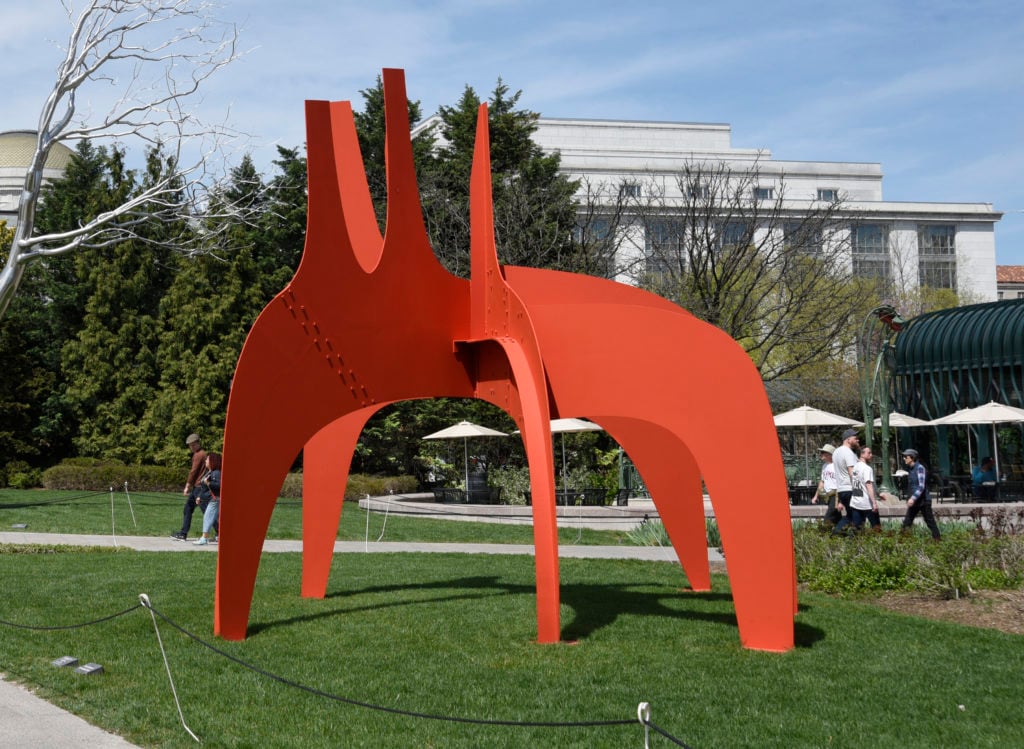
Alexander Calder’s Cheval Rouge (Red
Horse) on display in the National Gallery of Art Sculpture
Garden in Washington, DC. Photo by Robert Alexander/Getty
Images.
Calder’s way of jumping with both feet into anything he was
doing sometimes left him open to the accusation that he was just
fooling around. In 1949, when he made a mobile for Dorothy Miller,
an important curator at the Modern whom he had gotten to know
around the time of his retrospective, he appeared at her Greenwich
Village apartment with his pliers and a suitcase full of wires and
various biomorphic shapes. Although the mobile had probably been
carefully planned well before Calder arrived in Miller’s apartment,
as she told the story years later, she made it seem as if Sandy had
gotten up on a stepladder and begun, on the spot, to fashion the
mobile that for decades hung from an old chandelier knob in her
ceiling. Among the other works by Calder that Miller owned was a
magnificent brooch, with her initials wittily transformed into a
spiral vortex. For Miller, one of the most sophisticated and
influential curators of her time, the appearance in her apartment
of the formidable mobile Red Ghost, with its nine elements
in black, red, and yellow, was an act of imaginative genius—but to
others it might have seemed nothing more than child’s play. Which
brought anybody who cared to think about such things back to the
whole question of play—and where play came from and what it meant
to play.
It was more than a decade after the Modern retrospective had
closed that Sweeney saluted Calder as “a lyricist in play.” He
wrote that Calder valued a game because “it implies rules and
further suggests a matching of contraries—of ‘sides’ in the common
sports usage.” In an essay entitled “Alexander Calder . . . Work
and Play,” he asserted that the basis of Calder’s sculpture was “a
love of play.” “Play with Calder,” he argued, “is never frivolous.
It is serious, but never solemn. Play is a necessity for Calder
which he has to respect, to treat seriously.”30 With Calder the
feeling for play and games, so Sweeney was suggesting, was
expansive and optimistic, a vision of games not as psychological
and inward-turning but as physical and outward- flowing. Calder had
no use for the dark dreams of the Surrealists and the absurdist
dramas of the Dadaists. His art was not a critique of reality but
an engagement with reality. He saw play as strong, clear, and
forceful— a responsibility to be joyously embraced. Sweeney—who had
been one of the group of admirers assisting James Joyce, that
sublime wordsmith, in the years when Finnegans Wake was
being composed—understood as well as anybody that play as an idea
and an ideal had been the lifeblood of the Euro- pean avant-garde.
In 1925, the year before Calder arrived in Europe, Vladimir
Nabokov, a man almost exactly Calder’s age, had declared in a
lecture in Berlin that “everything good in life—love, nature, the
arts, and family jests—is play. And when we actually play—whether
we’re knocking down a tin battalion with a pea or drawing together
across the net barrier in tennis— what we feel in our very muscles
is the essence of that play which possesses the marvelous juggler,
who tosses from hand to hand in an unbroken sparkling parabola . .
. the planets of the universe.”
Visitors to the Modern retrospective in 1943 could see how
Calder’s sense of play had evolved. Some of the first kinetic works
had been driven by a motor or a crank; museumgoers were presented
with a preordained, generally very slow-moving pattern of play.
Then, in the year or so before Sandy and Louisa returned to the
United States in 1933, Calder began to offer gallerygoers an
element of choice; he was urging them to join in the games. He
created at least one sculpture, Object with Red Ball
(1931), in which the relationship of the elements was actually
adjusted by the viewer; the red ball could be moved along the
horizontal white dowel from which it hung, and the rod itself could
be moved into different positions.33 Almost simultaneously he was
developing what might be called the hand-driven mobile—Cône
d’ébène, done just before the return to the United States, was
a good example. He was inviting a viewer to initiate the movement,
to activate forces by giving one of the elements a little shove.
But soon after moving back to the United States and settling in
western Connecticut, Calder began to allow—one might almost say
encourage—his mobiles to take on a life of their own. He found
himself focusing on wind-driven works. He was celebrating the more
mysterious play of forces that nature itself imposed on the
elements that he orchestrated. The mobiles of his high classical
period are freedom incarnate. They play by themselves—they turn,
they twist, they expand, they contract, they reveal an order that
is within or beyond the order that the artist has created.
Excerpted from Calder: The Conquest of
Space: The Later Years: 1940-1976 by Jed Perl. Copyright ©
2020 by Jed Perl. Excerpted by permission of Alfred A. Knopf, a
division of Penguin Random House LLC. All rights reserved. No part
of this excerpt may be reproduced or reprinted without permission
in writing from the publisher.
The post Alexander Calder’s 1943 Show at MoMA Was an
Extraordinary Experiment in the Power of Play, a New Biography
Says—Read an Excerpt Here appeared first on artnet
News.
Read more https://news.artnet.com/art-world/excerpt-jed-perl-biography-alexander-calder-1822803
Further reading


Leave a comment