
‘All My Works Are Harbingers’: How Fourth Plinth Artist Heather Phillipson Found Dark Meaning in the Delay of Her Career’s Biggest Break
The artist Heather Phillipson
has won one of the most prestigious art gigs in London: a coveted
spot on the Fourth plinth, the two-year public art installation
smack in the middle of the city in Trafalgar Square. But while
the splashy unveiling of her
new sculpture was scheduled to take place yesterday, the plinth
remains empty.
With the public locked in at
home all over the city, Phillipson’s big moment has been postponed.
London’s deputy mayor for culture and the creative industries,
Justine Simons, made the difficult decision to delay the
installation until “Londoners and visitors can properly enjoy
it.”
“It feels appropriate that this
should pause along with the rest of human activity,” Phillipson,
who is 41, told me of the development. The UK is now on a partial
lockdown and everyone but key workers are being advised to stay at
home. Asked what she is doing to stay grounded and inspired during
her period of isolation, the artist said she is reading, drawing,
dreaming, watching the spring emerging, “rethinking everything,”
and playing with her dog, who has “always known how to be in the
present tense,” Phillipson said.
A few weeks ago, when London was
still blissful and bustling, I met the artist at a bar around the
corner from her Hackney studio to discuss the commission.
Phillipson first made her proposal for the sculpture in 2016.
Titled THE END it feels particularly poignant now as
life as we know it has ground to a stuttering
halt.
“You could say that all my works
are harbingers in some way,” Phillipson told me then. But the work
was not necessarily a foreshadowing. Rather, she explained, the
piece could be read as a “direct response” to things that were
already in motion. “It feels like, politically, entropy has been
happening for a long time now,” she said.
A Disembodied Eye
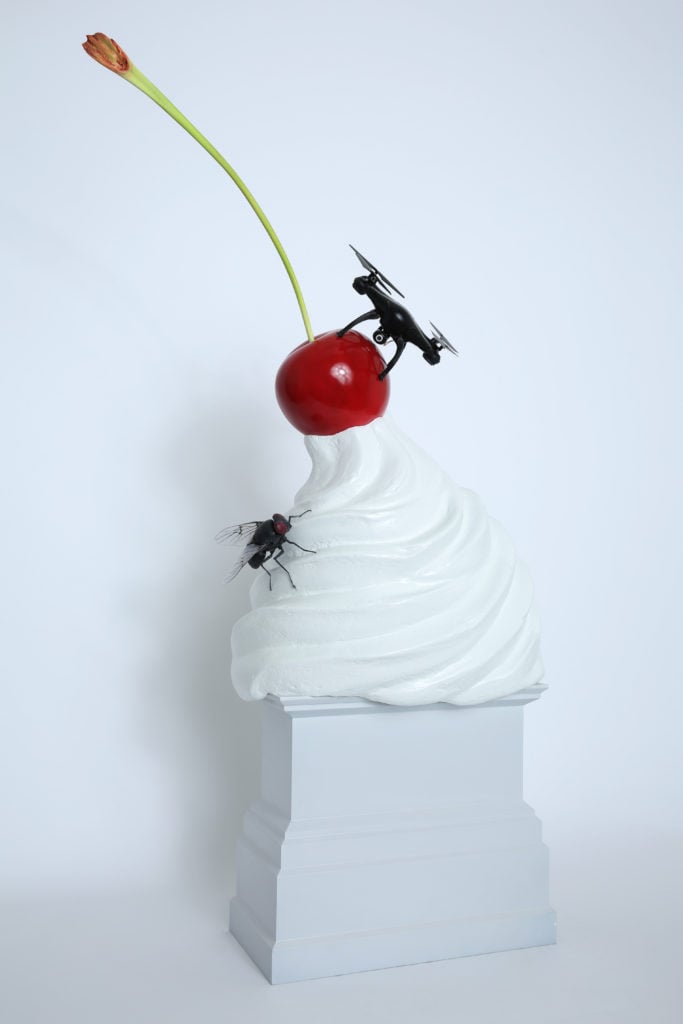
Heather Phillipson, THE END.
Maquette proposal for the Fourth Plinth, Trafalgar Square, 2016.
Photo by James O. Jenkins. Image courtesy of the artist.
Phillipson’s sculpture for the
plinth depicts a towering swirl of whipped cream, topped off with
an enormous cherry, an oversized fly, and a hulking drone. While
the full-scale sculpture has yet to be installed, the maquette has
been on view at the (now shuttered) National Gallery. At first
glance it seems quite joyful and Pop, but there’s a sinister
overtone to the brooding figures that you can only imagine would be
magnified at full size.
Phillipson explained that the
context of Trafalgar Square is “crucial” to the work. Punctuated by
the towering Nelson’s Column, the square is best known as a site
for monuments, but the artist, who is a Londoner, doesn’t associate
it with those odes to “heroic, male, and mostly war-related”
figures.
With its close proximity to
Westminster, the square is, for Phillipson, more a site of
anti-governmental protest. Otherwise, it is a crossing-point to
another destination, and occasionally, it hosts celebratory
events.
“I knew that whatever I made
needed to relate to all of those contexts simultaneously,”
Phillipson said. “That’s where the tone of the work comes in, the
exuberance in relation to the celebrations, but it is also a site
of uneasiness, or distrustfulness of government, and angry,
politicized, activity.”
The whipped cream has been piled
high with an excessive squirt, and is designed to look as though it
is spilling over the edge of the plinth. Full of air, this sort of
cream will not maintain its shape for long. “It sits on the verge
of collapse,” Phillipson said.
The creatures in the sculpture
are not alone among the animals on the other monuments in the
square, which include lions and horses. The artist, who is vegan,
is deeply concerned about creatures that are often disregarded by
humans: the cream derived from an animal product, the fly that we
swat away from the picnic table. She even consulted an avian expert
to make sure the rotating blades of the drone would not put any of
Trafalgar Square’s resident pigeons in harm’s way. “That would be
my worst nightmare,” she said.
The drone is a different, but
related as a sort of alien life form. Its working camera has been
set to transmit live footage of the square to a website, becoming a
disembodied eye that offers “an interesting moment to be looking
back at ourselves and the way we are doing
things.”
Shifting Public Space
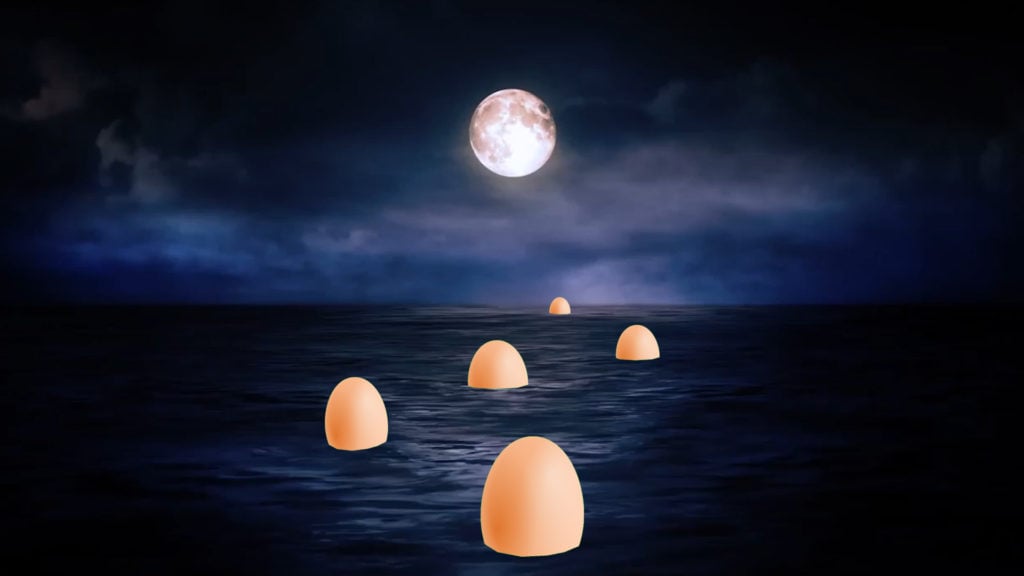
Heather Phillipson, my name is lettie
eggsyrub (2018). Still from multi-screen video installation.
Commissioned by Art on the Underground. Image courtesy of the
artist.
The Fourth Plinth commission is
not Phillipson’s first foray into public art. She previously made a
sculptural audio-video installation in which eggs are whipped and
beaten in the name of human consumption—for the Art on the
Underground series on London’s subway network.
Her oddball subject matter is
part of the point when it comes to Phillipson’s approach to public
works. “I think there’s a problem with public art in that it quite
often becomes part of the corporate landscape. Often what appears
to be public space is actually corporate space that has the look of
public space but is managed by businesses who commission the
artwork,” she said. “They are going to be artworks with an agenda
or artworks that aren’t allowed to take any risks. They are there
to inform of some kind of purely aesthetic function.”
Aside from Rachel Whiteread and
Katharina Fritsch, Phillipson is only the third woman whose work
has graced the plinth since the commission was first conceived in
1999.
“Obviously history has been
dominated here by the straight white male and I think that’s
something that needs to be upset urgently,” Phillipson said. “I
don’t know how much of a space me doing stuff necessarily opens up
to other people, but if I’m ever invited to propose people for
things, that definitely informs my thinking about who I would
propose as that’s a normative standard that I would like to
disrupt.”
Hope for the Future
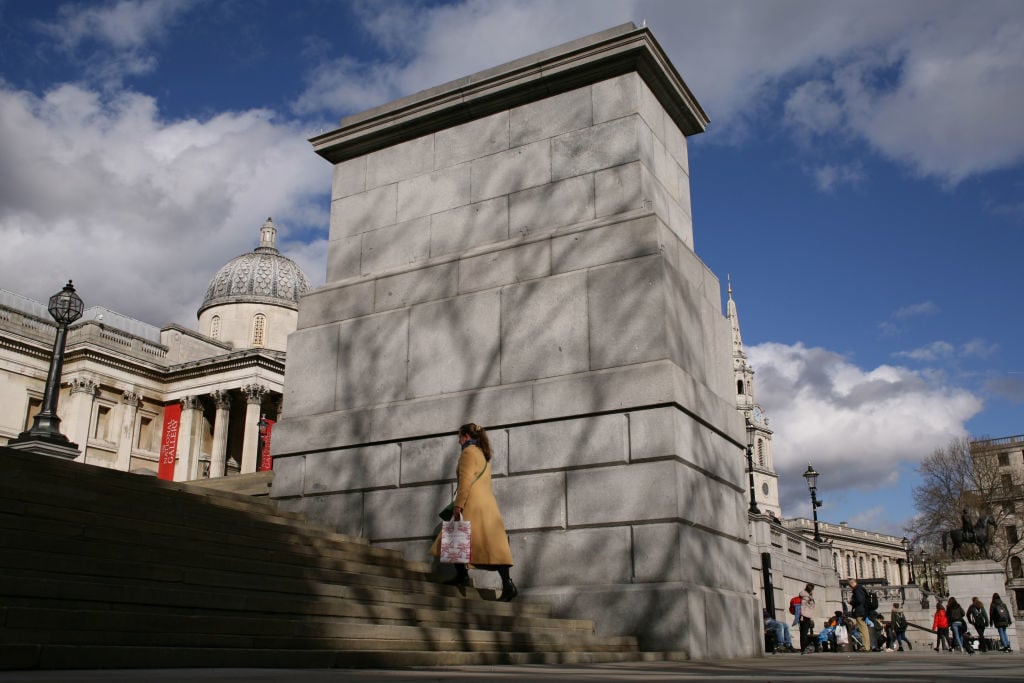
The empty Fourth Plinth in Trafalgar
Square. Photo by David Cliff/NurPhoto via Getty Images.
We looked for a note of optimism
to end on. Perhaps in the future, the “deeply troubling” political
and environmental system we already have been living in could be
upended. Perhaps humanity might “reflect on our relationships to
other creatures, to the environment, to each other.”
Aside from the plinth,
Phillipson has been working on an audio work for radio, a 30-minute
journey with an ear that floats off into space to listen back to
the earth. Like the fly and the drone on her sculpture, the
disembodied ear offers an elevated, aerial perspective that enables
an escape from “the bullshit politics on the ground.”
We briefly discuss her next big
project, the Duveen Gallery commission for Tate Britain, which is
meant to open on June 22. It too will be populated by mutants that
might inspire some self-reflection.
When we approached each other to
say goodbye, there was hesitation. “The fear of getting close to other bodies is also a
very powerful way of ruling people,” she
said. It feels somewhat
defiant, although looking back perhaps ill-advised, that we ended
our meeting with an embrace.
The post ‘All My Works Are Harbingers’: How Fourth Plinth
Artist Heather Phillipson Found Dark Meaning in the Delay of Her
Career’s Biggest Break appeared first on artnet
News.
Read more https://news.artnet.com/art-world/heather-phillipson-fourth-plinth-delay-1816212
Further reading


Leave a comment