
An Art Project From MIT’s Center for Advanced Virtuality Warns How Easily Deepfake Technology Can Be Used to Rewrite History
Fifty years ago the Apollo 11
landing was a success, and Neil Armstrong took that giant leap for
mankind on the surface of the moon. But if they had failed,
then-President Richard Nixon had an elegy for the astronauts,
written by his speechwriter William Safire, at the
ready.
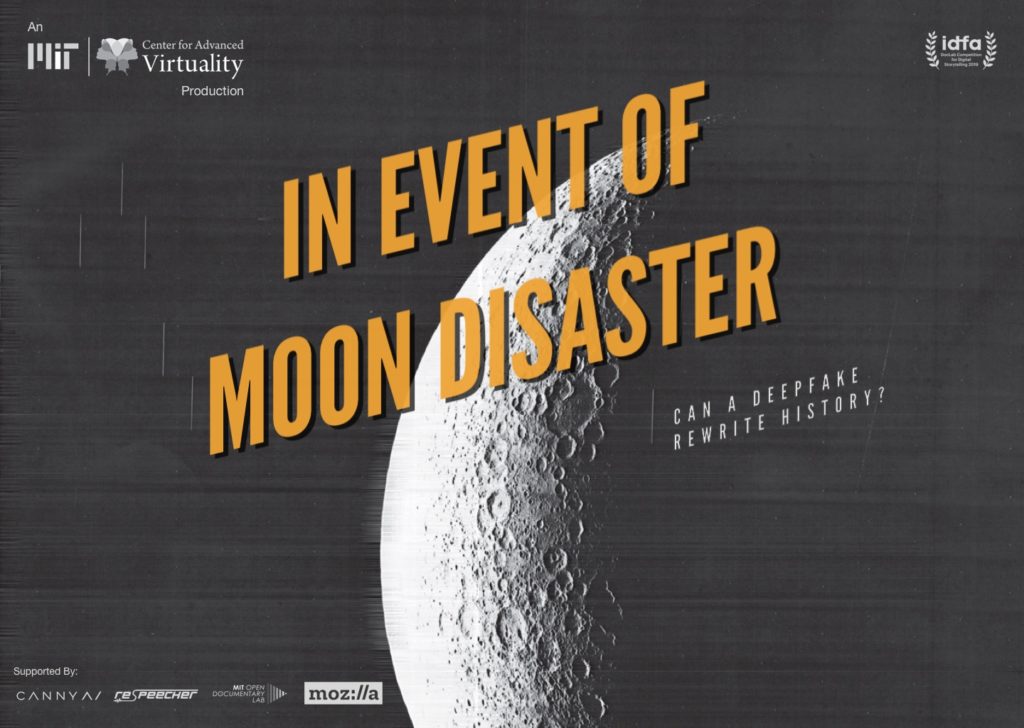
A new art project, In Event of Moon Disaster, by MIT’s
Center for Advanced Virtuality supposes that Apollo crashed into
the moon, using “deepfake” technology to create an alternate
universe in which Nixon actually gives the somber speech. Visitors
to International Documentary Film Festival Amsterdam (IDFA) last
Friday were able to step into a replica 1960s-era living room, read
a fake newspaper, and watch a simulated video of Nixon addressing
the American people in the wake of this tragedy that never was.
“The idea was to take the
current technology that exists and do as good a job as possible to
make something that was very plausible, and do everything we can to
make it as real as possible and create all sorts of context….and
then point to it and say, ‘Hey, this is not real,’” explains Halsey
Burgund, a fellow in the MIT
Open Documentary Lab.
Burgund, along with MIT’s new XR Creative Director Francesca
Panetta, directed the video, working with Israeli company Canny AI
and Ukrainian firm Respeecher to create the vocal effects. They sat
with their actor, Louis D. Wheeler, in a studio and recorded him
speaking and acting like Nixon for days before handing the
recordings off to the deepfake experts. “We had some source
material,” says Panetta. “In this case, we used the resignation
speech of Richard Nixon.”
The video itself is
believable, which is more than a bit scary. The artists go to great
lengths to point out what they’ve done, so people are aware, and
perhaps allow them to not be fooled by the deepfakes that will
certainly be used for nefarious purposes in the future. But, says
Panetta, the fundamental goal of deepfakes–to spread
disinformation–has been around far longer than this specific
technology.
“The idea is not to be
sensationalist about it, and to show that it’s one of the latest
techniques of misinformation, but that misinformation and fake news
is not a new thing,” she says. “We go to pains to point out all of
the various techniques we’ve used in our films–some incredibly
traditional, things like speeding up film, reversing film, and very
carefully selecting which bits you use to tell a story. These are
highly effective, and can be done by almost anyone with a laptop
and phone. And so the idea is to give an awareness of what is
possible and what those techniques are.”
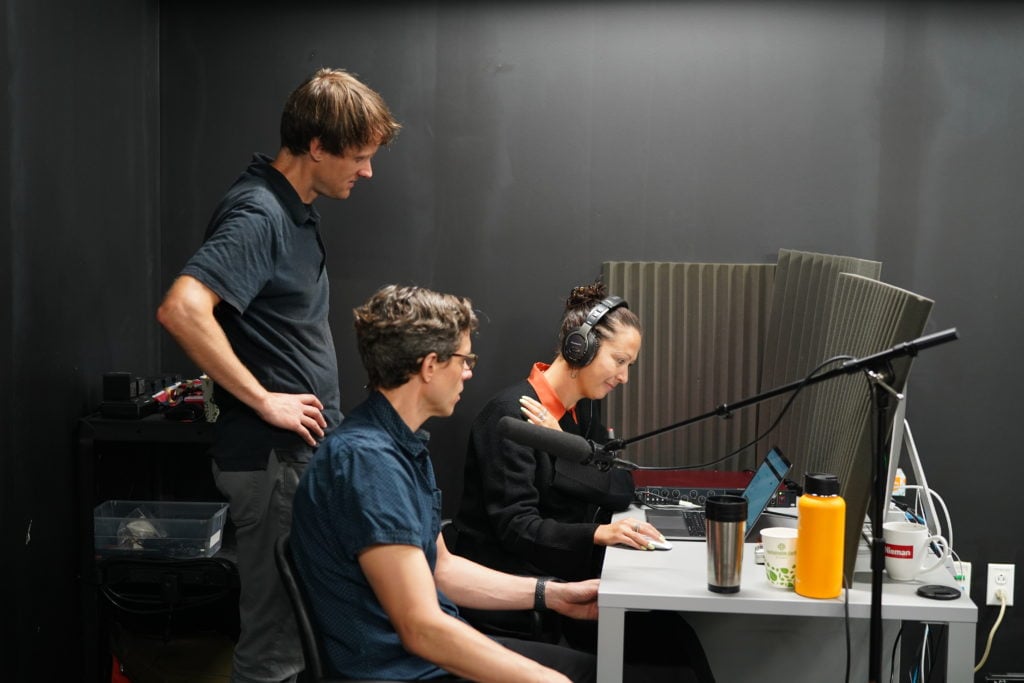
Halsey Burgund and Francesca Panetta
recording actor Louis D. Wheeler as he mimics Nixon’s voice
patterns.
And both Burgund and Panetta are
quick to point out that the Nixon artwork attempts to eschew
politics in favor of a neutral learning experience. “We were
thinking about the anniversary of the moon [landing],” Panetta
says, “and we were thinking about the idea of rewriting history and
historical truths.”
The post An Art Project From MIT’s Center for Advanced
Virtuality Warns How Easily Deepfake Technology Can Be Used to
Rewrite History appeared first on artnet News.
Read more https://news.artnet.com/art-world/mit-deepfake-art-installation-1716672
Further reading


Leave a comment