
Anne Geddes Was Once the Queen of Baby Photography. Now, She’s Hit Hard Times—and Is Asking for Your Help
Like many famous artists, Anne
Geddes both is and isn’t what you think she is, but I never could
have imagined that an interview with the self-described queen of
“spreading joy” would result in anything less than a walk down the
yellow brick road of her memory lane, punctuated only occasionally
by minor hardships, but relegated mostly to talk of babies
superimposed onto the heads of sunflowers. As is often the case, I was in for a rude
awakening.
In truth, the industry that propelled Geddes to superstardom in
the 1990s has all but evaporated. Today, the internet churns out
imagery at a pace with which few photographers can compete, while
email gobbled up the greeting-card industry, leaving Geddes nearly
jobless and in dire straits.
But you wouldn’t know any of this by looking at her life from
the outside, as I did one evening a few weeks ago, when I
unwittingly fell down the rabbit hole of her
Instagram. Comatose from
incessant TV-watching, I longed to rest my eyes
upon something electric, something to shake me awake or at
least keep me afloat. (Reader, things were getting
bleak). I wanted
to get lost in Geddes’s carefully crafted fantasia of costumes and
childlike wonder, nostalgic for another time and place that wasn’t
marked by transient internet imagery and the
coronavirus.
On her feed, I found a grainy
smattering of fan photography instead, featuring smiling, gurgling,
laughing little offspring, sent in from India, Russia, Argentina,
Australia. Here was Federico, a funny 14-month-old with a gummy
grin, and Mason, smirking from beneath a lime green Shrek mask. For
each day, there was a new post of a baby from a different city
featuring their name and age, alongside charmingly specific
details. Collectively, they comprise The Joy Project, an initiative
Geddes recently began to remind people that there is still good in
the world—all over it, in fact.
The morning I called to talk to
her about the project, she tells me that she’s got 64 countries and
counting represented on her grid so far. “And it’s about to be 65,”
she says. “I’m waiting on something from Lichtenstein.”
"background:#FFF; border:0; border-radius:3px; box-shadow:0 0 1px 0 rgba(0,0,0,0.5),0 1px 10px 0 rgba(0,0,0,0.15); margin: 1px; max-width:500px; min-width:326px; padding:0; width:99.375%; width:-webkit-calc(100% - 2px); width:calc(100% - 2px);">
View this post on Instagram
Spreading a Different Kind of Joy
Much like the rest of us
nonessential workers, Geddes spent the first weeks of March curled
into a ball on the sofa, anxiety-scrolling through the headlines,
and venturing outside occasionally for walks with her husband, Kel,
and their dog, Ethel, around downtown New York, where they
live.
But idle hands make
fretful minds, and doing nothing at all proved to be just about as
stressful as the harried pace of the lives we were leading before
all this. Geddes wanted to
help others grapple with the emotional toll of their new reality,
which is, in her view, a different kind of essential work. “Every
day, I was reading about the workers on the front lines who are
really stepping up and facing the moment with some courage,” Geddes
says. “And I kept saying to Kel, ‘What can I do?’ I must be able to
do something, because my name’s out there and people know me for
something positive. My oldest daughter said to me, ‘Why don’t you
get people to send in photographs and share some joy? And I
thought, ‘Well, yes. That’s something that I’ve been doing for my
nearly 35-year career.’”
She put out a call for
submissions and hundreds of mothers began sending in pictures of
their young ones, regaling her with stories of their own youths, a
time when Geddes herself was a buzzy icon. Back then, her
books fronted the staff recommendation section of every
Barnes & Noble around the country, and sidled up next to expensive
perfumes and cashmere sweaters on celebrity Christmas shopping
lists. “There are lots of
mothers with babies who’ll write me to say, ‘Oh, when I was a
teenager, I would buy your greeting cards and calendars and so
on,’” Geddes says. “And I respond to every single one, which I
think they find surprising. I generally just say, ‘Oh hello, sweet
Sterling, for instance, sending love from Auntie Anne.’ And they
all send messages back to Auntie Anne. It’s really
nice.”
Now, the photographer spends the
early morning hours of most days sorting through these entries,
deciding whose day she’ll make and which faces will get to feature
alongside her own enchanting pictures, on her Instagram. To anyone
looking in, life seems abundant and full, and it’s easy to conjure
the image of Geddes snuggled into her sofa, reading through her fan
mail, occasionally peering down from the window of her ivory tower
in Tribeca. In many ways, though, it is nothing like
that.
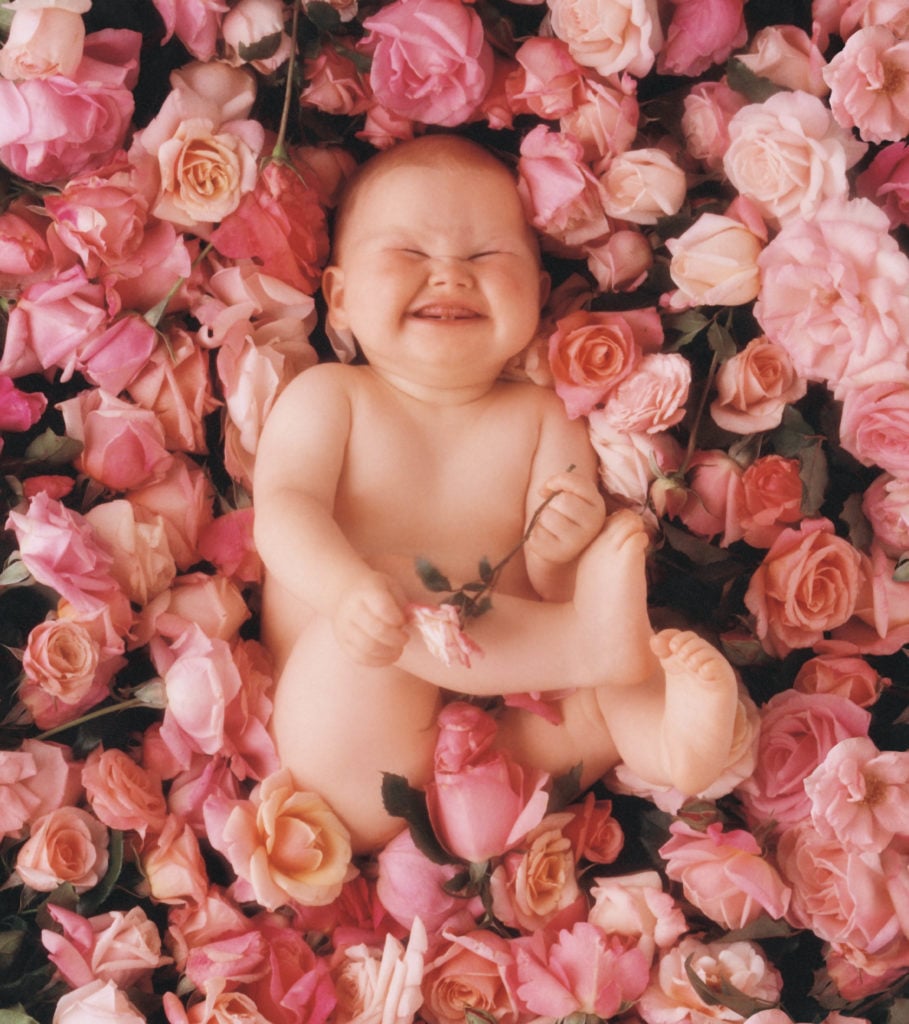
Photo courtesy of Anne Geddes.
The Cost of Change
Geddes hasn’t set foot in a
photo studio since 2016. Paper products, the medium by which she
amassed her fortune and cemented her icon status in the late
1990s—in coffee table books, calendars, and greeting cards—have all
but disappeared, leaving the photographer without reliable or
regular opportunities for work. In many ways, her trajectory is a
microcosm of how the broader economics of studio photography have
changed over the past two decades, as the world has become
increasingly more digital.
While, for many years, Geddes
could leverage the royalty sales of her coffee-table books and
greeting cards to both pay her bills and fund future projects,
those formats no longer sell, nor are they produced nearly enough
to sustain the business model she built her name
upon.
The proliferation of cell
phones, along with social media, has also ensured that “content”—be
it a trivial meme thrown together in two minutes or a shoot like
one of Geddes’s, which often takes six to eight months of planning
alone—can be shared at light speed, most of the time without a
thought as to where it came from.
Naturally, Geddes has become
wary of promoting herself online, aware of an image’s potential to
go viral on the internet and the ease with which artists can have
their material co-opted. There is little financial return for new
work nowadays because people, she says, expect everything to be on
the internet, and everything on the internet to be
free.
For a photographer who was, at
one point, flown to Monaco to photograph the early years of its
crown prince, it is simply not good business sense to just “go
viral.”
“The thing that people don’t
seem to get is that it takes about $250,000 to $350,000 to produce
the kinds of shoots that I do,” she says. “It’s like doing a movie,
for god’s sake. And if there’s no financial return, it’s like money
out of my own pocket. Of course there are more ideas I want to
do—beautiful things that I know would blow people’s minds, but
what’s the point? They’d just say, ‘Thank you, Anne, that’s
adorable,’ and run off with it.”
Geddes is frustrated and has no
qualms about telling me so. In fact, she’ll tell anyone who wants
to listen—for a monthly fee on her Patreon, the site that allows
creatives to amass “patrons,” or paying subscribers, to whom they
deliver exclusive content that their audience—usually
superfans—wouldn’t be able to find anywhere else.
On Patreon, Geddes is candid
with her patrons, expressly letting them know that the future of
her career, in some ways, is in their hands. If they wish to see
more “magic,” as she calls it, they must pay. In exchange, she’ll
share the stories behind her iconic shoots and behind-the-scenes
looks at her new projects. She gives budding photographers advice
sometimes, too. (Geddes’s Patreon is currently paused for now while
the space where she films her videos is closed due to
coronavirus.)
I ask her if it ever feels icky,
and if it was hard to admit that she—a household name whose career
was anointed by Oprah—is more financially vulnerable than
before?
“It was a relief, to be honest,”
she says. “I think everyone thinks I’m this global icon who owns
every photograph of a baby that’s ever been produced, or that
people are copying me all over the world. But that’s just not the
case, and things aren’t now what they were then.”
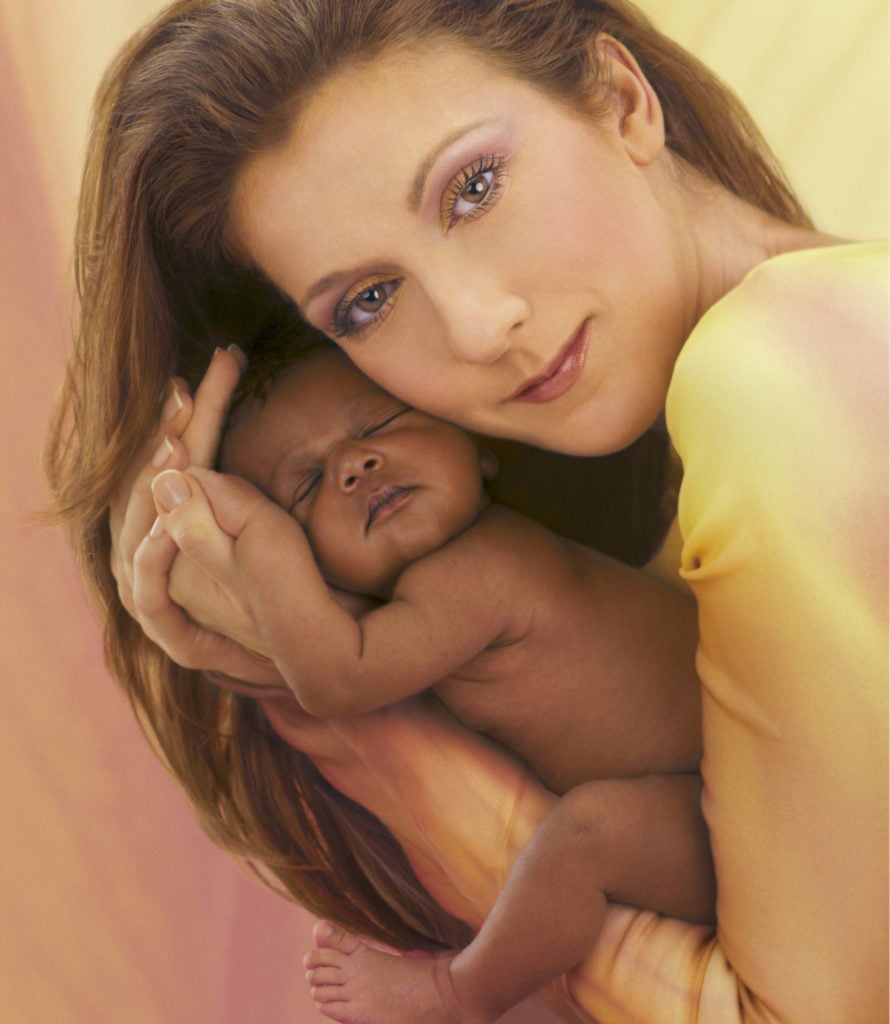
Celine Dion. Photo courtesy of Anne
Geddes.
A New Reality
Geddes grew up in northern
Australia, with aspirations to be a sign painter. She doesn’t have
a single photograph of herself as a baby. But she always loved
photography, particularly the dazzling, full-page images she saw in
LIFE magazine. “I used to stare at them and think, ‘That’s
a moment in time that’s there forever,’” she says. “And I still
think that the power of a still image far outweighs the power of a
moving video.”
In the early 1990s, she began
working as an assistant to a photographer who specialized in baby
portraiture. While she loved shooting children, the static nature
of the work became, in her words, exhausting in the way that all
creative work eventually becomes when it’s not the kind you want to
be doing. To give herself “a bit of a break,” she began shooting
the images we’ve come to file under the Geddes signature style once
a month, letting her wildest fantasies come alive.
In 1996, she published her
book Down In the
Garden, turning babies
into beds of roses, and tucking them between the soft petals of
tulips. Oprah discovered it and flew her to Chicago to appear on
the show, naming the work the best coffee-table book she’d ever
seen. From there, Geddes was catapulted into “the worldwide scene
of being known,” and the book flew to the top of the New York
Times bestseller list, where it remained for weeks. Geddes
went on to appear on an episode of Friends and she
shot a book with Celine Dion.
While she gamely answers my
questions about the fun parts of her career, Geddes recalls them
with a certain fatigue. She is quick to mention that, in addition
to her frothier, arm-tickling work, her lesser-known advocacy
projects done in conjunction with the nonprofit March of Dimes is
equally, if not more, important to her.
“I’d like to do more of that
because I find it really meaningful,” she says. “My favorite memory
of shooting is a project we did in a [neonatal intensive care unit]
in Doha—and whenever I shoot in the NICU, I always say I’ll never
do it again, because I stick out like a sore thumb and
photographers aren’t supposed to be there. But I was working on
this series where I shot preemie babies with sports heroes to
highlight the importance of a healthy lifestyle, and how strong
they can become, and there was this famous Qatari soccer player,
who played for one of the American teams who came to the NICU to be
photographed with one of the babies. He was about
six-feet-eight-inches tall. And afterwards, my five-foot-two-inch
producer walked him out and all of a sudden he started crying. She
asked what was wrong and he said, ‘Oh my god, that’s the best thing
I’ve ever done in my life.’ And really, that’s the power of new
life.”
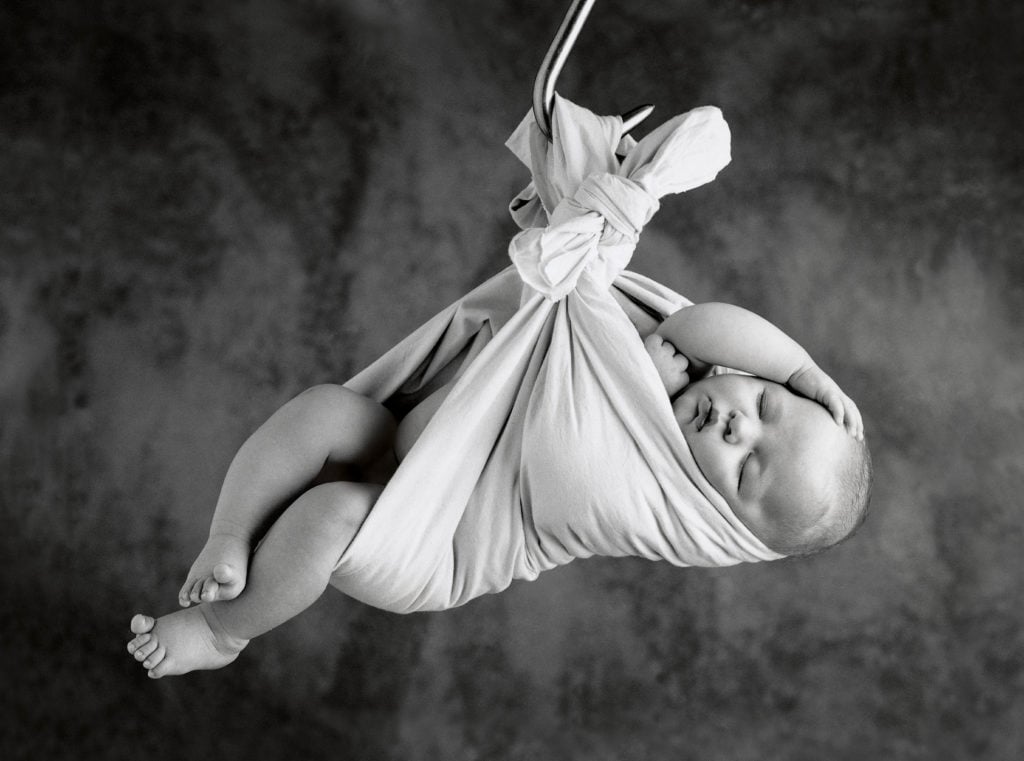
One of Geddes’s first artistic shoots.
Photo courtesy of Anne Geddes.
Despite her enormous success,
there have always been detractors. “You know, when I was first
starting out, other photographers—mainly men—would say to me, ‘Oh,
you photograph babies? I used to do that when I was first starting
out,’ with the implication that your work isn’t important until you
move on to bigger, more ‘serious’ subjects. But I wonder if anyone
ever said to Ansel Adams, ‘When are you going to stop shooting
landscapes? Take up fashion.’”
Still, she is resilient, and
more aware, perhaps more now than ever, of her work’s enduring
purpose. “I think it’s been hugely gratifying that I’ve been able
to lift babies into an art form. And their power is very honest and
pure because newborns are everything to the human race. There’s no
such thing as a mean-spirited baby. It’s what happens to them after
that changes everything. But right at that point of newness, their
little minds are so pure and I think that’s what moves even people
like that athlete, who’s had all this success. They take you back
to the beginning, to the beauty of new life and to the magic of it.
And that’s why I think the work matters. It’s why I do what I
do.”
The post Anne Geddes Was Once the Queen of Baby Photography.
Now, She’s Hit Hard Times—and Is Asking for Your Help appeared
first on artnet News.
Read more https://news.artnet.com/art-world/anne-geddes-profile-1849401
Further reading


Leave a comment