
Archaeologists May Have Uncovered the Secret Ingredient Behind Australia’s Mysteriously Precise Cave Paintings: Beeswax
Archaeologists in Australia believe they have identified a
previously undocumented beeswax stenciling technique used by
ancient artists to create cave paintings.
Most rock art stencils are large in scale. Artists would place
their hand or other objects on the wall and spray liquid pigment,
creating a full-size negative image. But the artworks at a Limmen
National Park site called Yilbilinji, in the Gulf of Carpentaria
region of northern Australia, are much smaller. There are 17
tiny stenciled paintings at the site, some depicting human
figures and animals, such as kangaroos and turtles, others of
boomerangs and geometric designs.
Studying the 500-year-old rock art there, a team from
Australia’s Flinders University and Monash University, have
come up with a new theory about how Aboriginal artists created the
miniature and small-scale stenciled motifs.
The team was able to replicate the mysterious miniature art
using tiny models sculpted from beeswax, publishing their findings
last month in the journal Antiquity. Representatives of
the local Indigenous Marra people assisted with the experiment,
which only used materials that are native to the region.
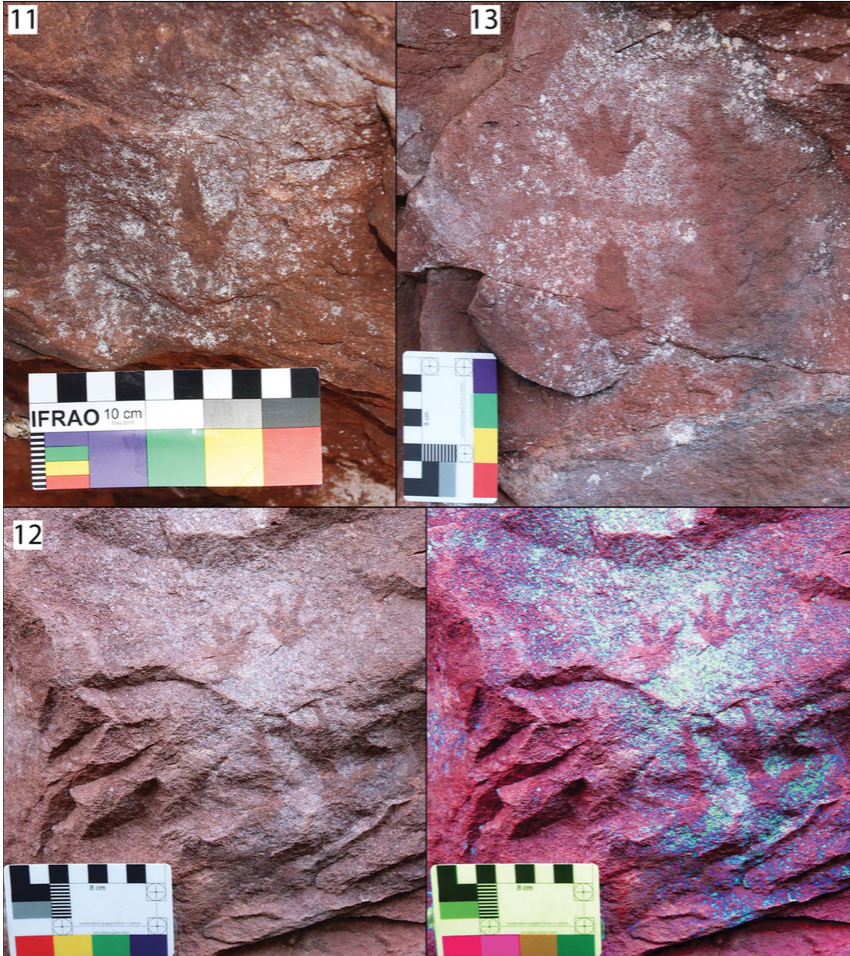
Three examples of the stenciled rock
art, and one digitally enhanced image. Photo courtesy of Liam M.
Brady, John J. Bradley, Amanda Kearney, and Daryl Wesley.
Anthropologist John Bradley pointed out that that people in the
area traditionally used beeswax to make toys and for repairing
spears and other tools, and raised the possibility that beeswax, or
a similar kind of adhesive resin or clay, might have been used to
make the small stencils. In attempting to recreate the artwork,
researchers found that the beeswax worked the best.
“Heating and shaping beeswax into human figures, animals,
objects, and geometric shapes, and then stenciling onto a rock slab
confirmed beeswax was an excellent material for making miniature
stencils,” the paper says.
Similar mini stencils have been found at two other sites, one in
New South Wales, Australia, and the other on Kisar Island in
Indonesia. The earliest known examples of Aboriginal rock art are
44,000 years years old.
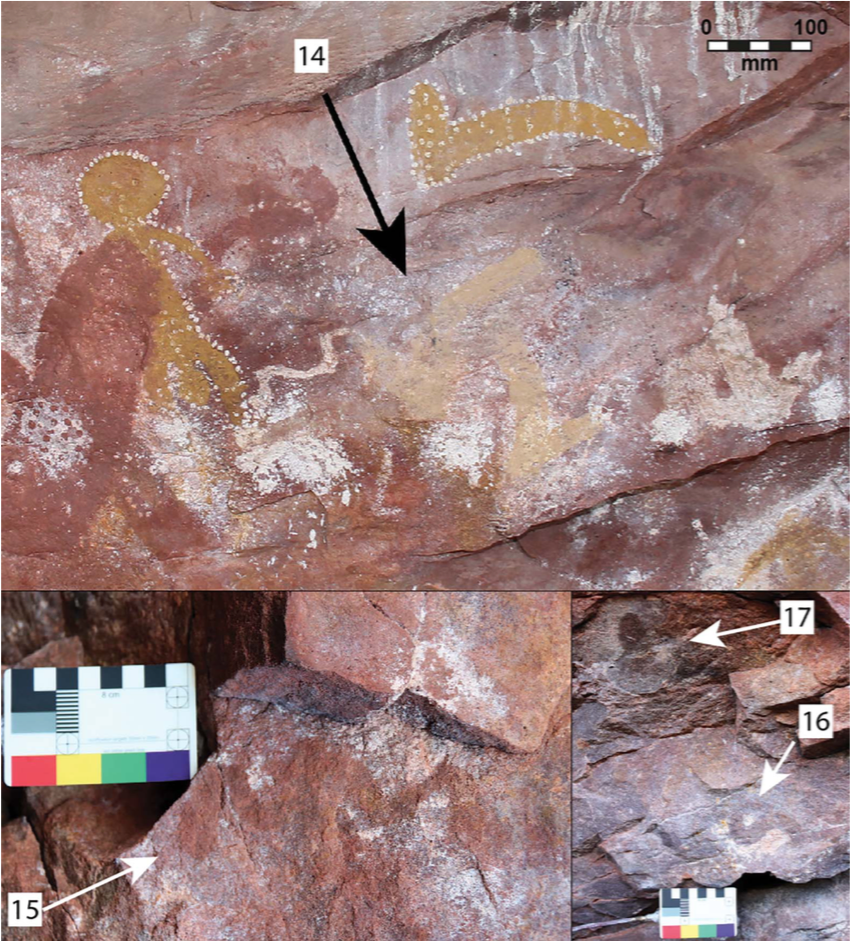
Geometric stencils. Photo courtesy of
Liam M. Brady, John J. Bradley, Amanda Kearney, and Daryl
Wesley.
The researchers believe that the Yilbilinji artwork may
have served a spiritual purpose in religious rituals. On the other
hand, the artwork is placed low to the ground, suggesting it may
have been made by children.
Either way, the paper notes, “the unique nature and quantity of
the miniature and small-scale stencil assemblage at Yilbilinji
clearly adds another dimension to both the Australian and the
global rock art record.”
The post Archaeologists May Have Uncovered the Secret
Ingredient Behind Australia’s Mysteriously Precise Cave Paintings:
Beeswax appeared first on artnet News.
Read more https://news.artnet.com/art-world/ancient-rock-art-beeswax-1877343
Further reading


Leave a comment