
Are People Actually Buying Art in the Age of Coronavirus? Yes—as Long as It’s by a Contemporary Star, or Being Sold at a Discount
Asked how their business is doing this spring compared to one
year ago, the dealers Dominique Lévy and Brett Gorvy look puzzled.
They reject the premise of the question. “You have to compare
apples to apples,” Gorvy says.
We are speaking over Zoom—a far cry from 2019, when we crossed
paths during Art Basel Hong Kong, where the dealing duo was opening
a new gallery and making multi-million-dollar sales. This year,
Lévy says, “the world is a different place. We’re in black and
white circumstances.”
Like other galleries, Lévy Gorvy has swapped expos in
metropolises around the world for online viewing rooms and digital
fair platforms. And while the wave of innovation and collaboration
this era has ushered in is all well and good, the question remains:
Did any of the world’s top galleries, auction houses, and art
advisors really sell any serious contemporary art during the first
month of lockdown?
After talking with more than a dozen market payers, a picture
emerged of once-global elite now working from home (or, often,
their second home), spending the days adapting to a new reality.
Yes, some things are selling, but with the entire in-person
infrastructure placed on hold, the volume of what’s trading hands
is a fraction of a fraction of what it was a year ago—and only a
narrow segment of the market is reliably active.
The conversations reveal that, for all its emphasis on online
bells and whistles, the art market remains, at its heart, an
in-person enterprise.
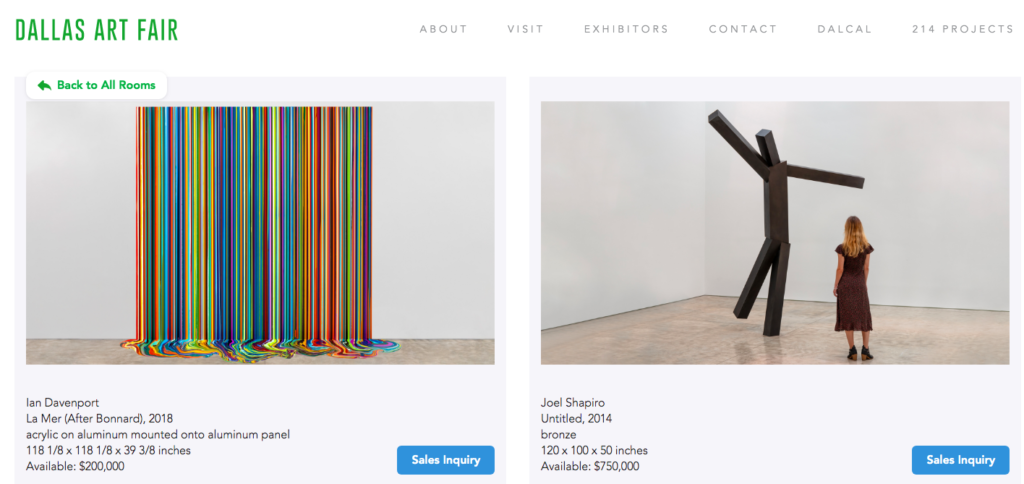
The interface for the online version of
the Dallas Art Fair, which launched Tuesday. Photo courtesy Dallas
Art Fair.
Speculated-upon superstars who, until last month, minted
canvases as currency have seen their markets get a haircut
overnight. Paintings that could flip for $500,000 two months ago
suddenly can’t find homes for $200,000. One advisor who brokers
deals primarily for high-end clients looking for expensive
secondary-market works said that they were “literally selling
nothing.”
“There’s just no secondary market right now, unless it’s at
discounted, distressed, or very reasonable princes,” another
advisor said.
On the primary market, collectors are still going after work in
the $40,000 to $70,000 range, but primary market deals inked last
month rarely topped the $100,000 threshold. “The only regular
business I’ve done is in-demand primary artists under $100,000,”
another advisor said. “I did one a day last week. During a normal
busy time, that’s not a lot of business.”
Smaller Numbers, Little By Little
At the start of the lockdown—just a calendar month ago, but what
for some feels like an eternity of chaos—things seemed somewhat
optimistic. After a month and a half of build-out, Art Basel Hong
Kong’s online edition opened on March 18 with 235
galleries and a total of $270 million worth of art.
There, mega-galleries achieved something that was once
commonplace, and is now a unicorn: the seven-figure sale. David
Zwirner sold a painting by Marlene Dumas for $2.6 million and a
painting by Luc Tuymans for $2 million, while Gagosian sold a Georg
Baselitz for nearly $1.3 million.
But in the weeks that followed, the very real danger of the
virus began to set in. “The people who we were reaching out to,
that conversation was not about buying pictures, it was about
friendships, and saying, ‘Are you OK?’” Gorvy said.
One advisor said that they were using the time to write long
letters to their clients, telling them to seize the moment to
research new artists—not to necessarily to convince them to pull
the trigger on anything.
As March turned to April, some advisors did tastefully bring up
acquiring contemporary art—but it’s been a decidedly mellow period
for transactions. Advisor Lisa Schiff said she sold just two works
above $100,000, and instead focused on what would usually be
considered—for an advisor with offices in Tribeca and Hollywood and
a client list that has included Robert de Niro, Leonardo DiCaprio
and Meg Ryan—on the lower end of things. On the secondary market,
Schiff mentioned that she had negotiated the purchase of a
relatively inexpensive Sherrie Levine drawing.
“It’s just a different approach,” Schiff said. “Things are
selling, we’re doing some primary market, and we did more secondary
stuff mostly in smaller numbers, little by little.”
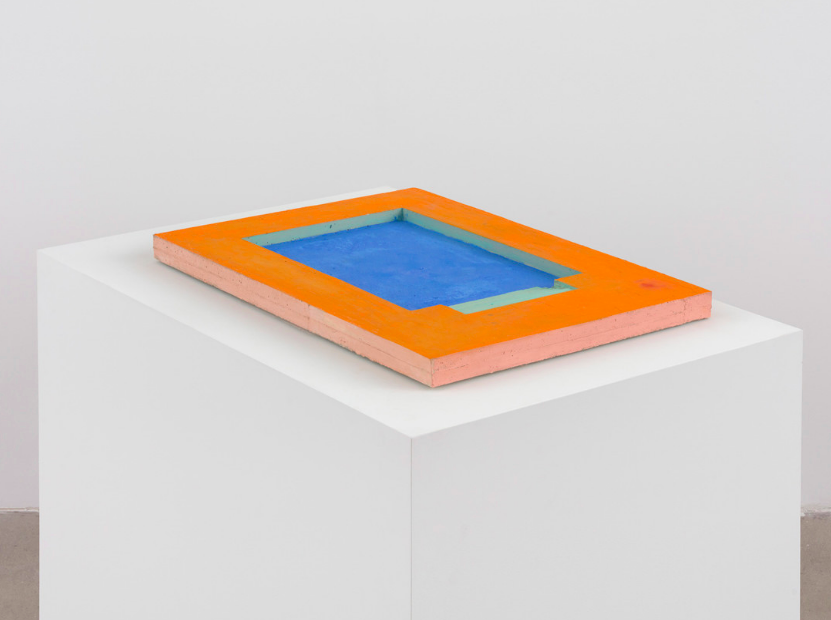
Harold Ancart’s Untitled (2020)
which sold for $40,000 in the David Zwirner viewing room. Photo
courtesy David Zwirner.
What’s Actually Selling
The primary market continues to churn, particularly for work by
artists who were in high demand before the crisis hit. That’s bad
news for long-suffering clients seeking an opportunity to leapfrog
a waitlist, but a good news as a sign of confidence for the market.
“I still can’t get an Njideka Akunyili Crosby primary for my
best clients,” Schiff said.
Among the more sought-after figures right now, according to
another advisor, are Asuka Anastacia Ogawa—whose solo show at Blum
& Poe’s Tokyo space was set to make a splash this spring before
getting postponed—Jennifer Guidi, and Shara Hughes. Hauser & Wirth
sold out of its viewing room presentation of drawings by George
Condo, priced at $125,000 (with 10 percent of the sales going to COVID-19 relief
efforts) and Zwirner sold out of its virtual presentation of
Harold Ancart’s new pool works, priced at $40,000.
There is also an understanding that low supply can help with
what may be lower demand. While it also has online viewing rooms
galore, the Artist Spotlight program at Gagosian makes available
just one work each week, and last Friday a new work by Sarah Sze
sold for $250,000.
Some galleries, meanwhile, are taking the opposite approach, and
releasing editions in high numbers priced low in order to
crowdsource the buying. White Cube released 250 editions of a new
work by Harland Miller priced at £5,000 and they all sold in 24
hours—all of the £1.25 million raised going to a number of causes
tackling the pandemic.
And other galleries are having luck selling more established
artists well past mid-career status. Lévy Gorvy sold a work from
its online show of Chinese artist Tu Hongtao and another from a
viewing room by the centenarian French artist Pierre Soulages—who
was born not long after the Spanish flu pandemic. It sold for
somewhere in the range of $870,000 and $1.3 million.
One way to restart the market, on both the primary and the
secondary sides, is to entice buyers with slashed prices. While
some speculators are unwilling to part with what were once
ready-to-flip works at a loss, some dealers are already offering
eye-popping discounts.
“A mid-level New York gallery just sent an email saying that for
the month of April, it’s 30 percent off everything,” an advisor
said. “It’s crazy. It’s like Net-a-porter.”

László Moholy-Nagy, ‘UMSCHLAG FÜR DIE
ZEITSCHRIFT “BROOM”’ (PHOTOGRAM ‘COVER FOR THE MAGAZINE “BROOM”‘)
which sold at Sotheby’s earlier this month. Photo courtesy
Sotheby’s.
The Last £30 Million Sale?
With all the real-life salesroom action on hold for the time
being—and many expect the June sales to be postponed as well, or at
least reimagined in a radically social-distance-y way—major auction
houses have, like their gallery peers, turned to the great
salesroom in the sky. The performance of online auctions has been
somewhat middling, with the highlight being a László Moholy-Nagy
work that sold in a Sotheby’s photo sale for $524,000—still below
its high estimate.
The real action, however, is happening in private sales,
according to the auction-house duopoly of Christie’s and Sotheby’s.
(Phillips just launched its private sales portal—er, its online
viewing room—this week, and does not have sales details yet.) This
shift makes sense, since the total number of auctions held around
the world and the number of lots sold dropped by 25 percent in
March 2020 compared to the same month the previous year, according
to analysis by the Artnet Price Database—and some of that
squeezed-out activity needed a place to go.
At Sotheby’s, private sales went up immediately as the crisis
was hitting, and department head David Schrader said that they have
closed 30 deals in the last two weeks. “As is not uncommon during
times of economic uncertainty, our conversations and negotiations
with clients around private sales have increased significantly
since the beginning of March, regarding both buying and selling
works,” Schrader said in an email. “We are seeing significant
appetite to transact right now, particularly when the best objects
are available. Interestingly, we are seeing more demand from buyers
than sellers at the moment.”
Meanwhile, sources within Christie’s say that private sales are
up 27 percent compared to the first quarter of 2019. And according
to a spokesperson, one deal brokered by the auction house had the
gobsmacking price tag of £30 million—which means it resulted in a
£4.05 million buyer’s premium for the house, likely more than
perhaps any other sale, across all platforms, in the past
month.
Who, and what, is actually driving the demand? There’s word that
Asian buyers from countries that have relatively stabilized
economies have been very active in private sales at Christie’s.
And, separately, sources said that some transactions are actually
coming out of all the work employees are putting in to beef up
online content. One collector is said to have discovered a work
from an article in Christie’s content section that went up a few
days ago, took a fancy to it, and bought it from the website.
(Christie’s would not confirm the work, but the auction house
recently published a story about the Jean-Michel Basquiat
drawing Untitled (Dynamic Tension), which was
previously in the collection of Andy Warhol.)
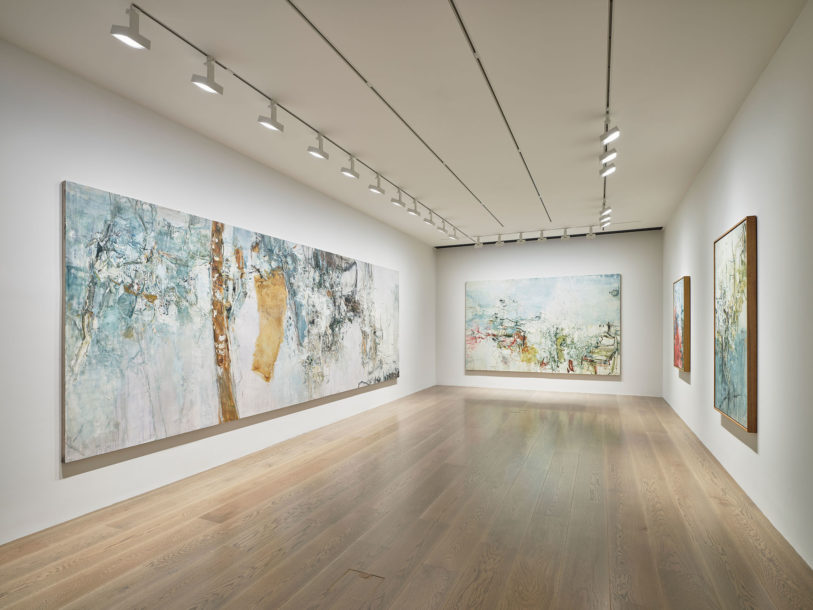
Installation view, Tu Hongtao, Lévy
Gorvy Hong Kong, 2020. Photo: Kitmin Lee. Photo courtesy Levy
Gorvy.
Twice the Hard Work for a Quarter of the Real
Business
Regardless of how many transactions are initiated this season,
the true test will be whether money actually manages to change
hands. A number of sales, particularly those priced in the seven
figures, are currently on hold. “If you’re spending millions
of dollars, you want to see the work, and it’s hard logistically to
show it,” Schiff said.
Any success will be hard-won. A source on the online content
side of a mega-gallery said that they have been working late in the
night in order to put together new viewing rooms for exhibitions.
And independent dealers and advisors are also burning the midnight
oil to keep their businesses afloat.
“You have to work twice as hard to get a quarter of the business
done, but it’s worth it and it’s crucial to keeping our businesses
alive,” said the advisor Meredith Darrow. “I didn’t sign up for a
desk job, but that’s what I have now. I’m at my desk from 8 a.m.
from 7 p.m. every day. It’s boring and its laborious but there is
something gratifying about it and at the end I’ll come out a better
dealer.”
Brett Gorvy is also aware that such transactions often require
in-the-flesh confirmation before cutting a check; the client who
bought the Soulages, for example, saw the painting with their own
eyes before the gallery closed. One solution some dealers are
trying? Making appointments for collectors to see the work in the
real gallery, in a really private viewing room, as long as
all social-distancing measures are followed.
“The most challenging aspect is, how do you get in front of the
work itself?” Gorvy said. “We’re trying to get people into a
completely empty and clean safe space, if that is feasible. We’re
talking about incredible challenges, but there are people who are
willing to do this.”
The post Are People Actually Buying Art in the Age of
Coronavirus? Yes—as Long as It’s by a Contemporary Star, or Being
Sold at a Discount appeared first on artnet News.
Read more https://news.artnet.com/market/coronavirus-lack-of-sales-1834389
Further reading


Leave a comment