
Banksy (and His Lawyer) Explain Why Fakes Have Forced the Artist to Go Into E-Commerce and Sharpen His Art
Why is Banksy taking his art directly to the people with a new
online store, Gross Domestic Product?
Famously, the street artist once directed a film called Exit
Through the Gift Shop—does this mean that he has finally
decided to wholeheartedly embrace the gift shop?
Yes and no. For one thing, the online store—and its physical
pop-up, which opened this week in
Croydon (though you can’t go in)—raises money for a good
cause. For another, he says he was forced into the move.
A recent legal dispute proved the last straw: A greeting card
company has sought to take control of Banksy’s trademark, given
that the artist hasn’t been using it himself. “Banksy has been
forced into the merchandising market,” the artist’s lawyer
Mark Stephens, told artnet News. “The European trademark
categories became his muse—you have a ludicrous court action being
met by creative genius!”
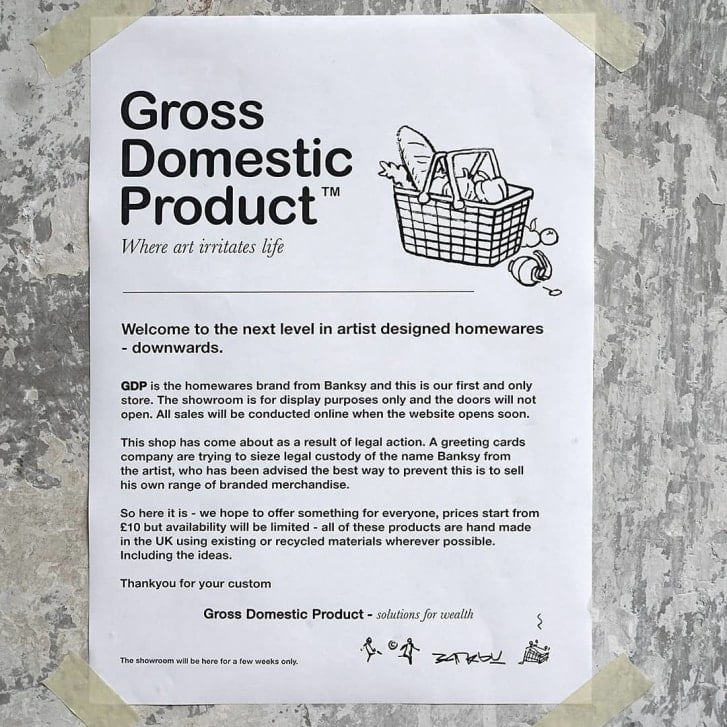
Announcement from Banksy Instagram,
explaining Gross Domestic Product.
This was hardly the first time the artist has had to deal with
unauthorized use of his name (a list of exhibition’s organized
without Banksy’s knowledge can be found on his official site.) “Banksy’s one of the most
ripped off artists in the world,” argued Stephens. “He was being
plagiarized by big business. We would see stuff that was out of
register, in the wrong color, or the wrong way around, facing right
to left instead of left to right as in the original design. The
integrity of the work is being trampled upon, and it’s being done
for commercial purposes.”
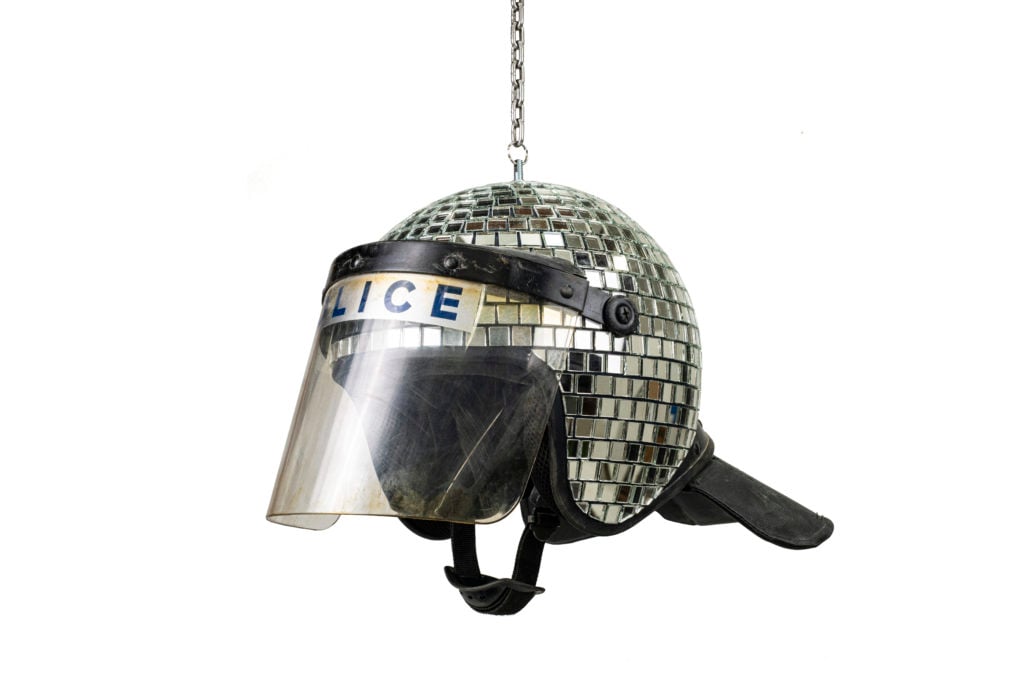
A police riot helmet disco ball is one
of the goods available from Banksy’s new shop Gross Domestic
Product. Photo courtesy of the artist.
All the same, the artist hasn’t changed his stance on copyright,
Stephens pointed out: “He’s quite happy for his work to be used for
activism and personal enjoyment. But big corporate groups
interested in making a profit pervert the art and take away from
its real meanings.”
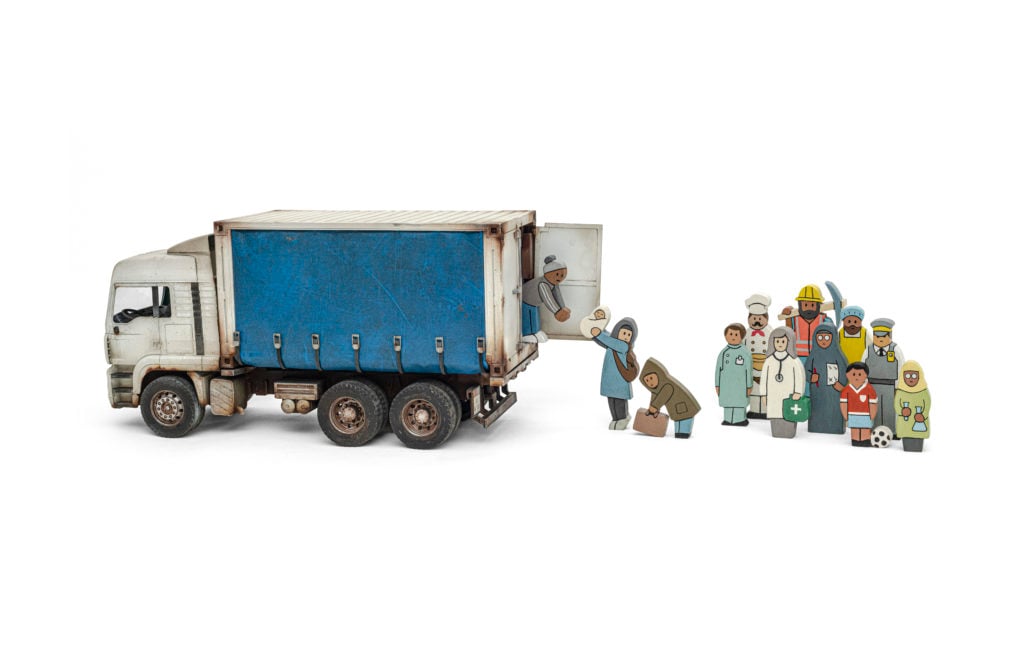
A toy truck full of migrant dolls is one
of the goods available from Banksy’s new shop Gross Domestic
Product. Photo courtesy of the artist.
Among the pointed items for sale are a toy truck filled with
wooden dolls of migrants, police riot helmets that have been
converted into disco balls, and “Welcome” mats stitched from life
vests used by refugees crossing the Mediterranean and sewn by
women in Greek detainment camps.
“This is a range of merchandise which could only be conceived
and executed by Banksy,” Stephens says.
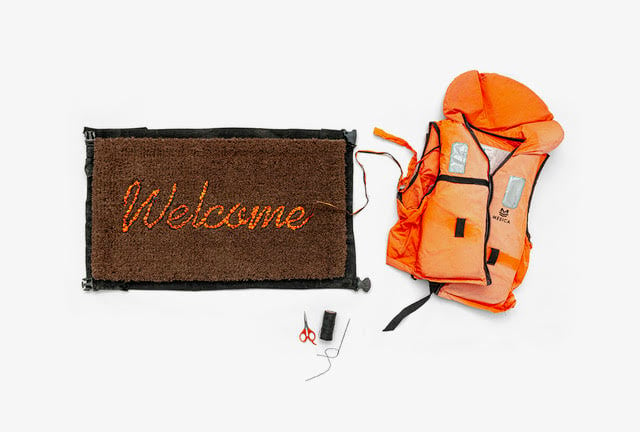
A welcome mat made from a migrant life
jacket is one of the goods available from Banksy’s new shop Gross
Domestic Product. Photo courtesy of the artist.
The fact that many of the items reference the migrant crisis is
no accident. “The proceeds from these products will go towards
buying a new migrant rescue boat to replace the one confiscated by
Italian authorities,” Banksy wrote in a statement, referring
to the Spanish ship, Open Arms, which
was seized by Italian
authorities last year. “So you may well be committing a
criminal offense by purchasing them.”
The physical Gross Domestic Product storefront in Croydon
will be on view for two weeks before the goods become available in
the online store.
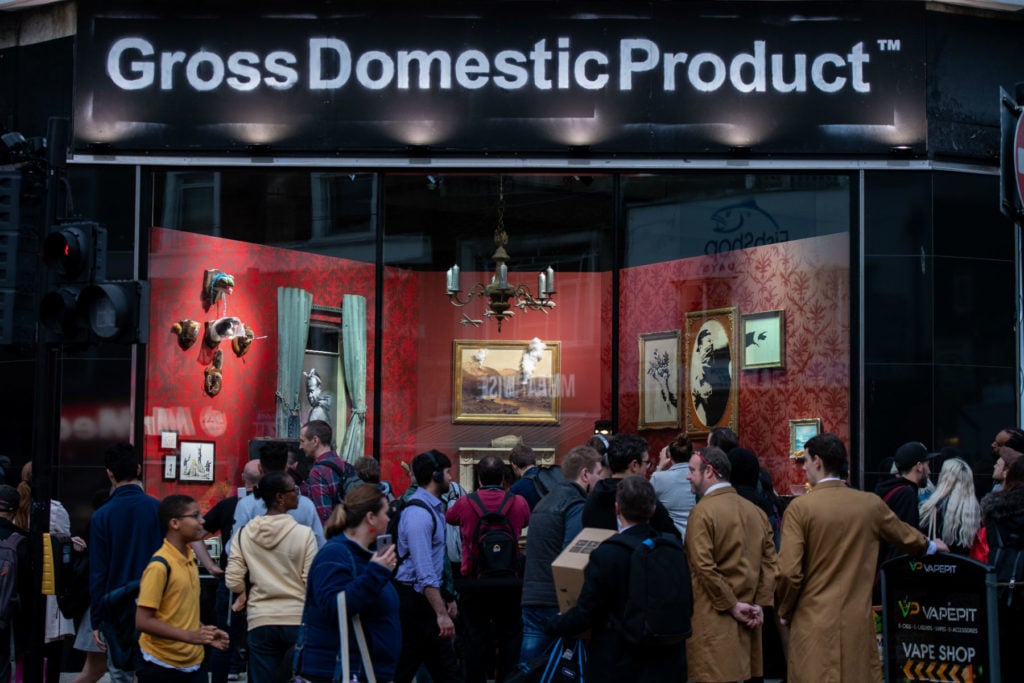
Members of the public queue to look at a
new installation by elusive artist Banksy on October 1, 2019 in
Croydon. Photo by Chris J Ratcliffe/Getty Images.
Because of Banksy’s massive fame, over the years works by the
street artist that originally appeared on city walls have been
quickly snapped up and flipped at a profit, something he has criticized.
Writing to artnet News, he joked about how dealing with the
flippers had changed his work.
“The big problem I had with people removing my street work
wasn’t that it was exploiting and stealing from the community—it
was because the stolen stuff looked so much better than what I was
making in the studio,” the artist said in an email. “The stuff torn
off the walls has genuine history imbued in the dirt, it has these
fantastic rough edges where its been cut out, and the painting is
fast and precise—because it’s been made under the most compelling
motivation there is: police response time.”
Just as in the case of his dust-up with the greeting card
company, which has now spurred a creative solution in Gross
Domestic Product, he suggested that dealing with those out to flip
his murals has inspired his art.
“By contrast my canvases were sterile and labored and fussy,” he
continued. “So although these thieving scumbags are a bit annoying,
I choose to take the positives—they’ve taught me to to paint faster
and rougher in the studio, and that’s made me a better artist.”
The post Banksy (and His Lawyer) Explain Why Fakes Have
Forced the Artist to Go Into E-Commerce and Sharpen His Art
appeared first on artnet News.
Read more https://news.artnet.com/exhibitions/banksy-store-gross-domestic-product-1667449
Further reading


Leave a comment