
Buildings With Skin and Wearable Digestive Systems: How Neri Oxman Is Revolutionizing the Relationship Between Biology and Design
The designer and Massachusetts Institute of Technology professor
Neri Oxman has spent the last 20 years of her career thinking about
new ways to live. She pushes at the boundaries between theoretical
and functional design, the built environment and the natural
one. She has conceptualized workable things that feel like
they shouldn’t exist for another hundred years: a wearable
digestive system of photosynthetic bacteria that processes solar
energy into sugar, for instance, or energy modulating liquid resin
tiles inspired by the way the single structures of some organisms
perform double or even triple duty—an example of what she calls
“materials that think.”
Oxman is an architect by training, but is less interested with
the one-upmanship of many architectural vanity projects than she is
with answering a question that we, as a society, have heretofore
been woefully unable to answer: How can we manage to live on, and
with, this planet without obliterating ourselves?
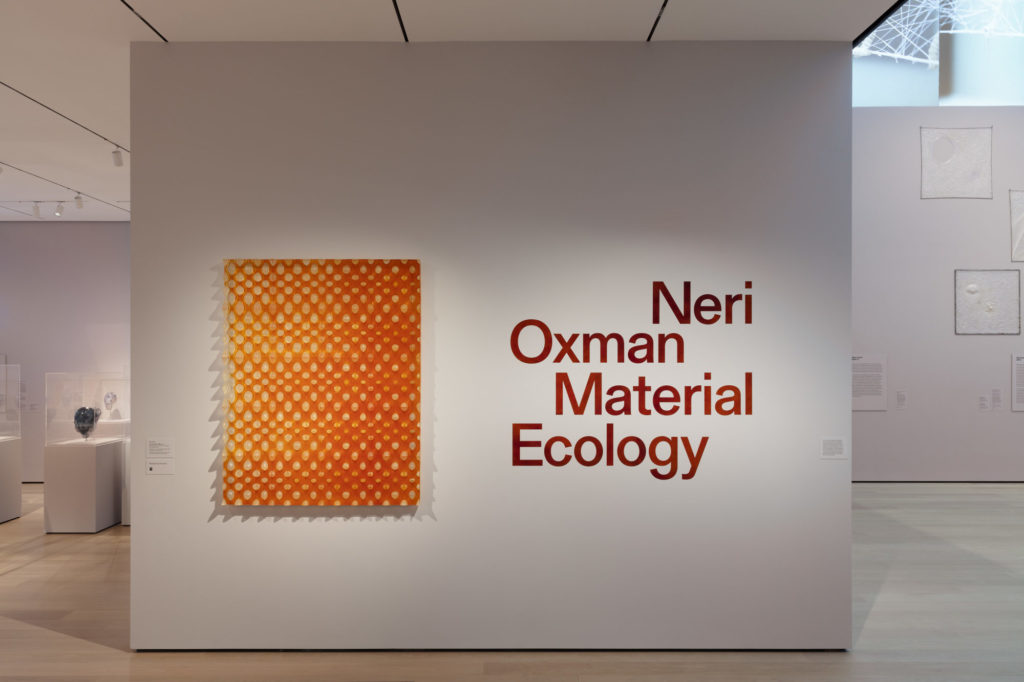
Installation view of “Neri Oxman:
Material Ecology.” © 2020 The Museum of Modern Art. Photo: Denis
Doorly.
That question is the thrust of “Neri Oxman: Material Ecology,” a
survey on view at the Museum of Modern Art. The show is named for
Oxman’s work, which combines elements of architecture, design, and
biological fantasia—a field so new Oxman named it herself.
Oxman founded and directs MIT’s Mediated Matter group, a kind of
interdisciplinary wunderkammer whose research combines
digital fabrication and organic design—such as robotically extruded
biodegradable plastic alternatives made from the molecular
components found in insect exoskeletons, for example. In Oxman’s
work, the organic and the engineered are inseparable partners. Her
approach is informed by an abiding, reverential deference to
nature.
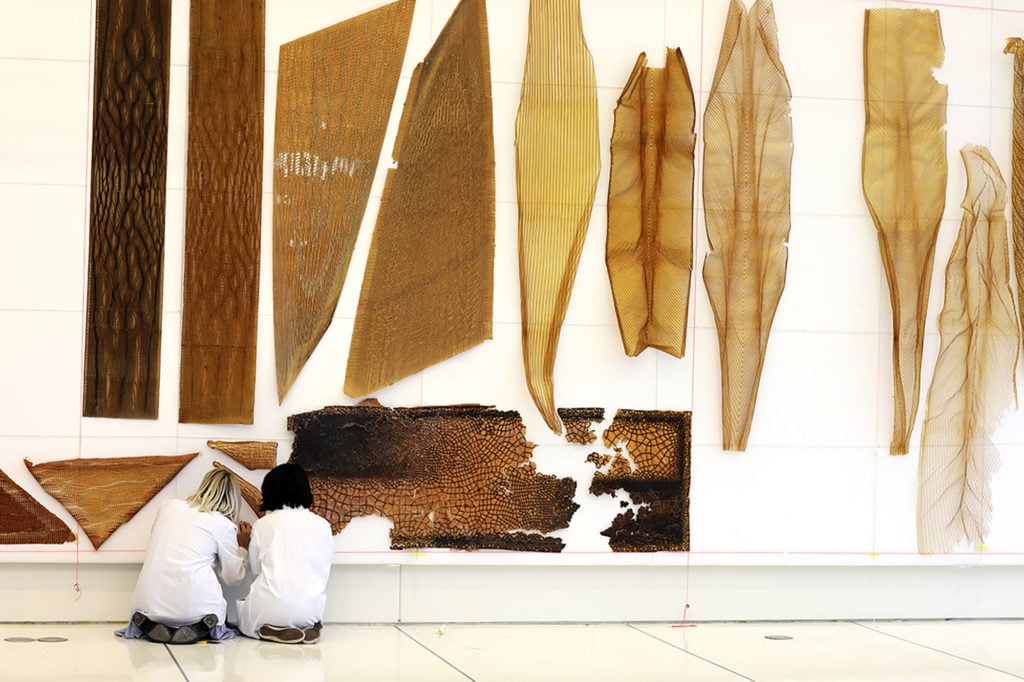
Neri Oxman and the Mediated Matter
Group, Aguahoja I (2018). Photo: The Mediated Matter Group.
Courtesy of the Mediated Matter Group.
Curated by Paola Antonelli, “Material Ecology” presents an
abbreviated primer to Oxman’s work since 2007. It presents seven
projects that hew to the conceptual rather than fully
realized—proof of what is possible, if we want it. The most recent
of these and, based on scale, the most impressive, is Silk
Pavilion II, a nearly 20-by-16.5-foot lattice-framed silk
cocoon suspended from the ceiling like a massive Noguchi Akari
lantern, a joint production of robotic armature and 17,000
silkworms.
Created expressly for the MoMA show, the work is based on an
earlier iteration of Oxman’s research into how silkworms respond to
changes in their environmental conditions, which allowed for an
innovative intervention in the worms’ spinning patterns so that
their output emerged in sheets rather than the typical cocoons,
effectively enlisting the silkworms as individual 3-D printers.
Oxman prefers to think of them as collaborators. “I think perhaps
in Silk Pavillon I they were more of a ‘construction
worker’ and here they’re a designer,” she said.
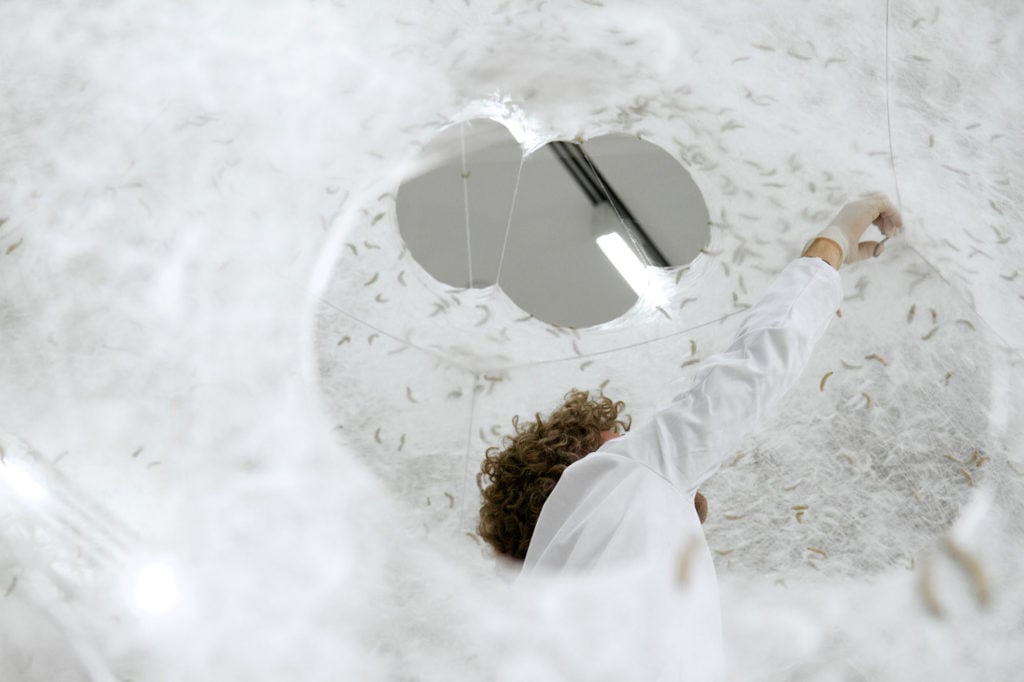
Neri Oxman and the Mediated Matter
Group. Silk Pavilion (2013). View through Silk Pavilion
apertures as the silk worms skin the structure. Photo: The Mediated
Matter Group.
If you’re concerned with matters of worm welfare, silk is one of
the more brutally harvested animal byproducts. Its traditional
production demands that larvae be boiled alive in their cocoons to
extract silk thread (for reference, around 50,000 silkworms are
destroyed in making a single shirt). Oxman’s process not only
demonstrates a more humane alternative, but also suggests what
Oxman calls “a matrix of opportunity,” applications that might be
relevant, down the road, to other fiber-based materials and
constructions.
Almost all of Oxman’s work evinces a philosophical disposition
that is perhaps unexpected in discussing things like biomaterials
and computational fabrication. She mentions “growing” her designs.
She’s given to koans. “What is a building material?” she posits.
“Why should a brick be a brick? Something that’s very close to our
hearts, my team and I, is to challenge typology through material
experimentation. If you end up with a brick, what have you done?
Have you made a better brick, or have you made a different brick?
And the difference between better and different is something we so
care about, and aim to go toward the latter. In our preconception
of building material we think of the brick as the ultimate
component to build a wall, but maybe the wall, if grown, is made up
of entirely different building blocks, and maybe those blocks are
DNA, and on and on and on and on, as my grandmother used to
say.”
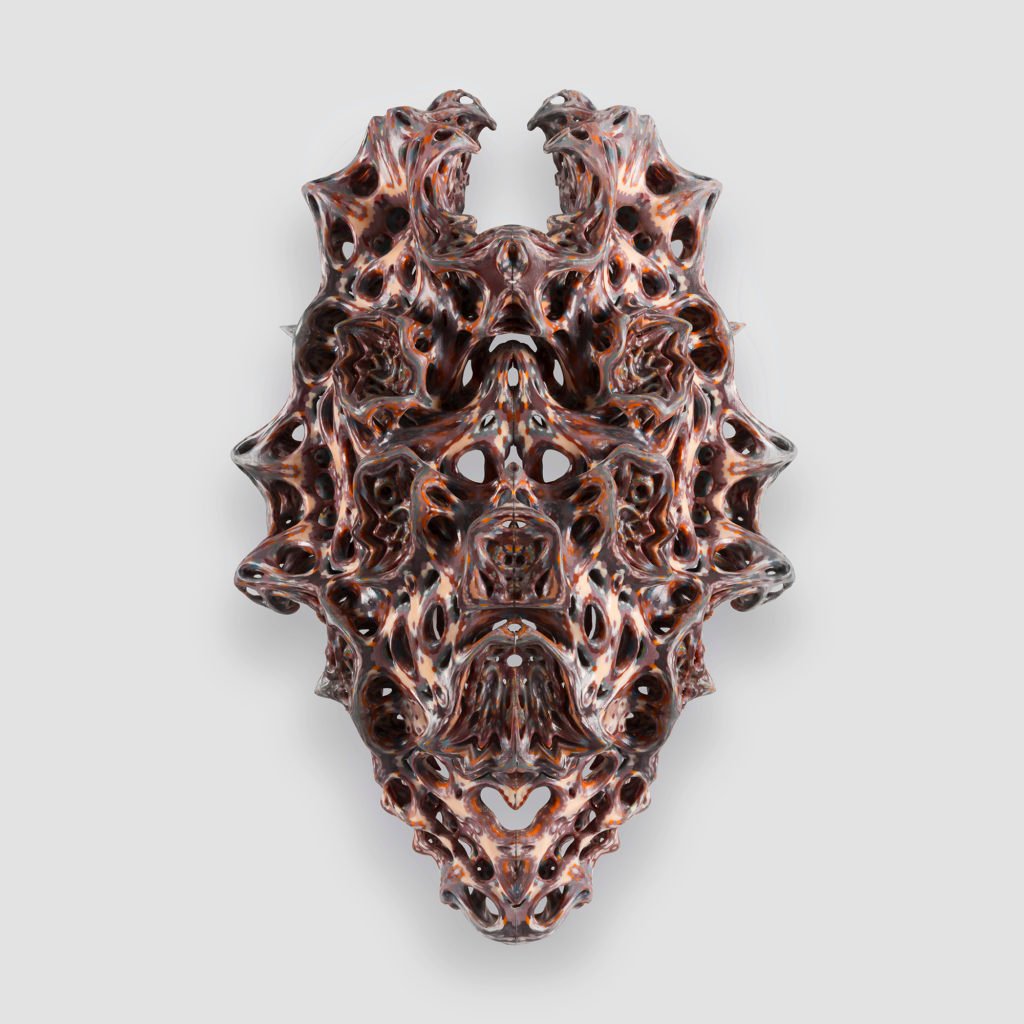
Neri Oxman and the Mediated Matter
Group. Vespers (2018). Series 1, Mask 5, front view.
Designed for the New Ancient Collection. Curated and 3-D printed by
Stratasys. Photo: Yoram Reshef.
In Oxman’s vision, sustainability extends into death. An array
of Vespers, a series of 3-D printed glass death masks, are
a centuries old practice made new, shot through with plumes of
gaseous bismuth and silver and bacteria that are meant to represent
the wearer’s final breath, a memento mori startling in its
tenderness, which is likely the only time that the bacteria,
E-coli, will be characterized that way.
Oxman’s work has a way of communing with nature, augmenting it
without exploiting it, a quality that El Lissitzky identified, in
the Suprematists’ work, as the difference between “acquiring
cognition of nature” and existing as “a limb of nature.” Oxman’s
Aguahoja‚ the aforementioned biodegradable plastic
alternative developed from abundantly available cellulose, fungi
tissue, and fruit pectin, certainly counts as a limb of nature. At
MoMA, examples are pinned to the wall so that they resemble a
trophy case of sloughed off skins, speculative artifacts from a
more verdant future, but materially, you can imagine less abstract
potential. Last year, Oxman fashioned it into a freestanding
15-foot structure that resembled an umber chrysalis.
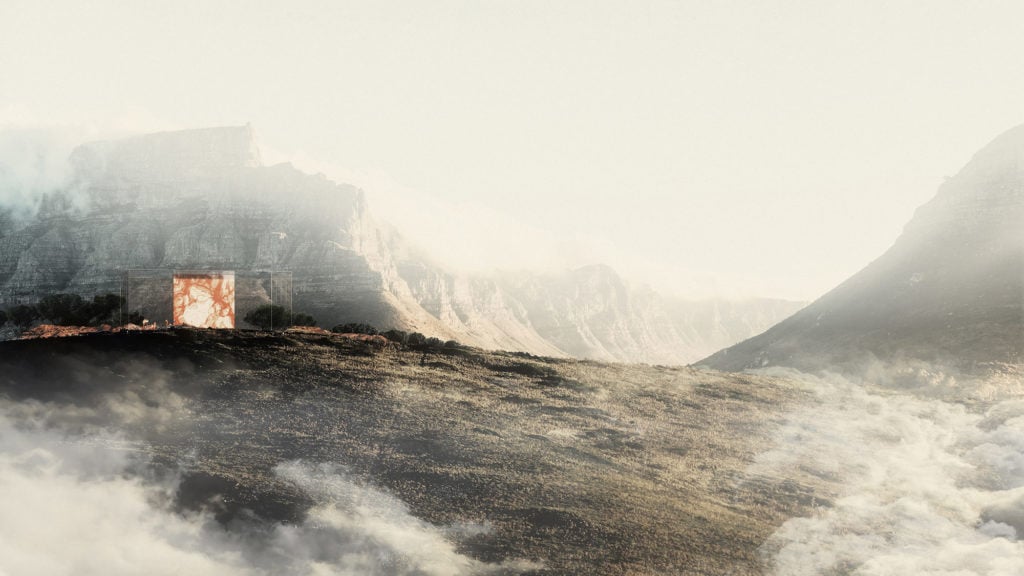
Neri Oxman and the Mediated Matter
Group. Totems (2018). Courtesy Neri Oxman and The Mediated
Matter Group.
Perhaps the most provocative project included at MoMA are
Totems, a set of three 3-D printed columns encasing a
bloom of liquid melanin, the pigment that defines the color of
skin, hair, and eyes in millions of species, but is also capable of
binding metals and regulating thermal energy. Oxman believes that
melanin might someday figure into buildings, creating facades that
behave like real skin, tanning in the sun to regulate heat and
shielding against UV rays. Naturally occurring melanin is currently
more valuable by weight than gold.
Oxman’s team’s breakthrough is figuring out how to synthesize
melanin by extracting mushroom enzymes and amino acids. The name is
exactly right: the three “Totems” are eerie, like a shrine to a
capricious god, which is appropriate, considering the cultural
weight we ascribe to it, and the pain our preoccupations continue
to incite. Oxman’s work suggests a harmonious way of being in the
world that has been there all along. “If you care to study you can
see it,” she said. “And you have to care,”
The post Buildings With Skin and Wearable Digestive Systems:
How Neri Oxman Is Revolutionizing the Relationship Between Biology
and Design appeared first on artnet News.
Read more https://news.artnet.com/exhibitions/neri-oxman-revolutionizing-biology-design-1787466
Further reading


Leave a comment