
Context Collapse Is Threatening the Future of Big Art Fairs. Here’s Why We Should Be Very Concerned
There are too many art fairs.
The proliferation of fairs over the past 15 years—from 68 in 2005
to more than 220 by 2015, according to one estimate—has resulted in
an overcrowded system. Nearly every week of the year, multiple
fairs open around the world, from experimental and intimate events
to mass-market trade shows that are far more expansive than the
market can support. At their largest, fairs can assemble more than
250 galleries and work by as many as 5,000 artists under one roof
for just around four days.
Unsurprisingly, this can feel overwhelming to the fair’s primary
audience: collectors. Yet for participating galleries, the
challenge remains the same: to build relationships and create value
for developing artists. So lately, we find ourselves in the
unsustainable situation in which the goals of the galleries that
support the fairs, and the collectors that support the galleries,
are at odds with those of the fairs themselves. The issues that result from this art-fair
supersizing are complex, but they can be unified under one term:
“context collapse.”
Context Collapse
“Context collapse” is a term
coined by the academic Michael Wesch in his 2008 lecture, “An
Anthropological Introduction to YouTube.” He spoke of “content
collapse” and “narrative deficiency” as phenomena that characterize
social media, where users have multiple distinct
communities—friends, family members, colleagues—collated into a single audience. Since that
time, multiple industries have begun to address the limitations of
actual face-to-face relationship-based interaction, in opposition
to the infinite audience of social media or, we might logically
extrapolate, businesses that scale in a parallel manner, such as
big art fairs.
It wasn’t always this
way. For the last half century or more, galleries played a
key role in creating contexts for contemporary art outside of the
artist’s studio. The default sites for first encounters with new
art have been solo exhibitions of works directly from the studio.
The context for the reception of an artist’s work, especially the
work of an artist at the beginning of a career, was formed in large
part by the gallery.
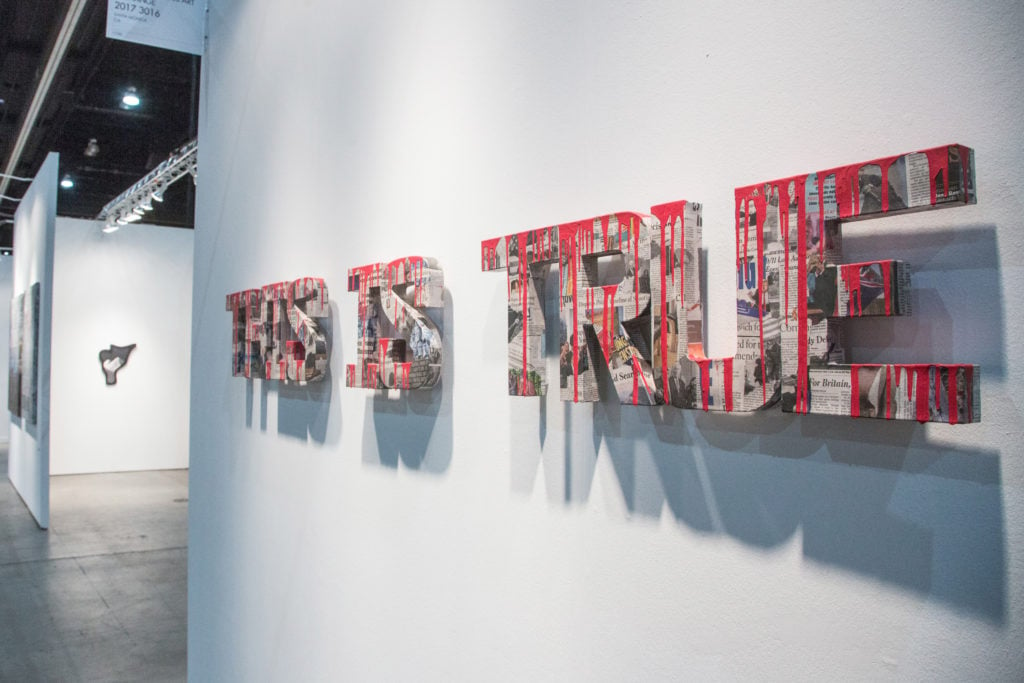
At fairs, even solo shows become group
shows. (Photo by Gabriel Olsen/Getty Images)
Now, at large fairs when so many
of us are introduced to unfamiliar artists, or unfamiliar bodies of
work by artists we know, that context has, to a large degree,
imploded. As a result, art encounters change significantly because
they lack the context that comes from seeing art alongside various
other works from an artist’s studio that evince a sustained
investigation or practice over time, or works by several artists
that share common ideas and interests, and feed each other’s art.
Such associations help to connect the dots, to enable us to better
understand any given work’s relevance.
The impact of this shift—from
seeing works of art in a thoughtful context to seeing individual
works by multiple artists in a group context en
masse—cannot be
underestimated.
Why Fairs Should Care
The sense of being
overwhelmed and confused by the fair experience has become a regular complaint of collectors,
and for good reason. Collectors now find it is challenging to
identify value and opportunity at a big fair, to clarify a
consensus around new artists and ideas, to discover artists they
don’t yet know, to understand the conditions of their markets, and
to forge new relationships.
Yet collectors still prefer the
efficiency of visiting fairs rather than galleries. But even this
benefit has its challenges: collectors can only see so much
art, especially at a moment when we hear from them that the time
they spend on site is decreasing. If a fair has more than 100 galleries, we
cannot expect collectors to see a respectable fraction in the space
of a few hours.
Given that fairs are businesses
for which a big brands and big profits are prized, why should they
care about any of this? They have seen record growth in the last
decade. We might logically ask, if fairs are making money (and the
largest ones most likely are), why would they have an interest in
changing?
The consequences of context
collapse make it imperative for fairs to pay attention and prevent
it.
The dearth of context-rich
fairs—places of both efficiency and authentic discovery—is having an impact,
year-to-year, on how many new collectors come into the art
world—and how many existing collectors broaden their
engagement.
We are now beginning to see
galleries become more selective on fair participation because of a
perceived reduced opportunity to access serious collectors at some
of these events. Subsequently, galleries participating in large
fairs are faced with a narrower selection of work they can
comfortably bring, knowing that sales to their existing
clients will have to cover their costs. And that means certain artists get seen by
default, and certain markets rise, while others
stagnate.
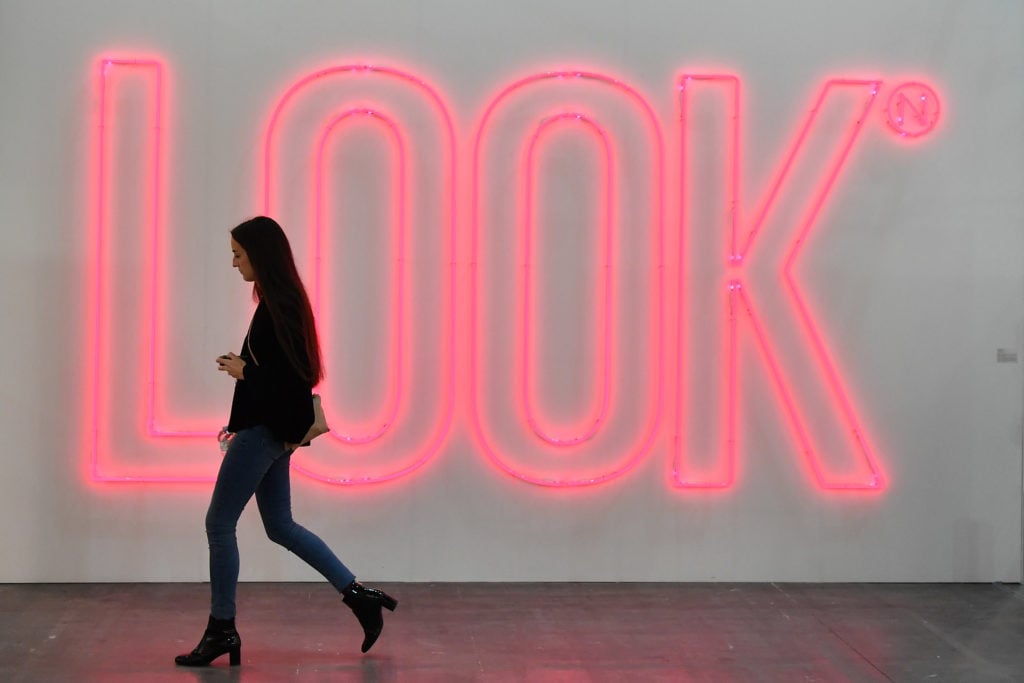
Something that is hard to do at fairs.
Photo by Valerio Pennicino/Getty Images.
What Is At Stake
Most galleries go to big fairs
to sell works of art now, not to sell artists—which is an issue.
That’s why it is rare to see solo booths in a main section
at a big fair: these contexts are often more about showing works that might be the
right size for a particular wall.
The reason fairs should care about context collapse is
because galleries won’t be able to
support artists’ development by selling one or two pieces at a fair
alone. Artists will end up, and have ended up, creating objects for
fairs—not for galleries, not for museums, not for people’s homes,
but for fairs.
With this comes many problems.
An uneven quality of art can lead to uneven sales. There is a loss
of trust on the part of galleries who were loyal to certain branded
fairs for years, but now have to choose between transactional value
and associative value. There is a dwindling set of financial
resources for sustainable growth, a loss of footfall from new
collectors who feel confused by the big trade shows, and a loss of
footfall from experienced collectors who are offered everything via
PDF without even having to attend.
Fairs may be making money for
now, but they are not developing a sustainable marketplace for art
long-term. Galleries are not, on the whole, enjoying big fair
experiences, nor are collectors. Therefore, it is essential for
fairs to fight against this issue of context collapse—from
there, new innovations have the potential to take hold and
develop.
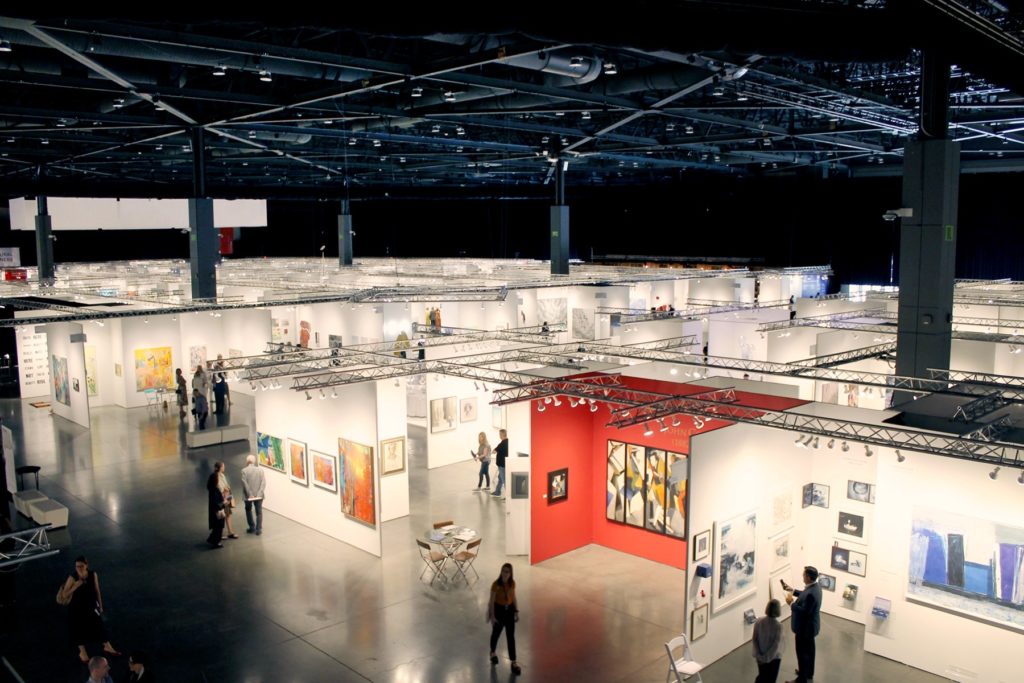
The largest fairs are nearly impossible
to see in one visit. Image Rain Embuscado.
A Path Forward
As a result of this context
collapse, we’re losing something important: authentic art
experiences, and the critical ability to sustain and support
artists. As the art fairs pursue a natural survival
tactic for business—scale—the galleries are losing out.
I think about these issues
daily. As a co-founder and owner of Independent, a fair with no
more than 60 galleries in any given edition, with solo and duo
presentations as the norm, I bring my own research to this
conversation. Independent’s smaller size enables it to formulate a
new context each year, facilitating unexpected encounters for
collectors and helping sustain both galleries and
artists.
In an effort to improve our
field, I’d like to take a look at what is working at fairs that are
seeking to create constructive contexts for their stakeholders. In
the second installment of this two-part series, I will propose
concrete steps fairs can take to help build a more sustainable
future.
Elizabeth Dee is the
co-founder of Independent New
York. Recent
publications include Every Future Has a Price: 30 Years After
Infotainment, an
exhibition publication in collaboration with Distributed Art
Publishers (D.A.P.).
The post Context Collapse Is Threatening the Future of Big
Art Fairs. Here’s Why We Should Be Very Concerned appeared
first on artnet News.
Further reading


Leave a comment