
Dealers Already Give Their Most Valued Artists Money and Space. Now They’re Giving Them Swanky Residencies, Too
Fifteen hundred: that’s how many artist residencies there are
across the world, from those supported by universities and museums,
to smaller, non-profit projects that focuses solely on supporting
the visions of contemporary artists.
Many of these, including those at the Skowhegan School of
Painting and Sculpture in Maine and the Yaddo artists’ community in
Saratoga Springs, are run independently of commercial enterprises.
But dealers are also hosting their own programs, which have unique
challenges and opportunities.
As far back as 1976, the Vienna dealer
Urusla Krinzinger established a residency in Croatia, and since
then has vastly broadened her efforts to Austria, Hungary, and even
Sri Lanka. More recently, the London gallerist Thomas Dane
debuted an exhibition space—which includes an apartment for
visiting artists, curators, staff members, and even authors—in a
grand palazzo in Naples. And Hauser & Wirth, perhaps most famously
of all, has had its residency program in Somerset, England, since
2013.
artnet News peered into these three dealer residencies to catch
a glimpse of their inner workings.
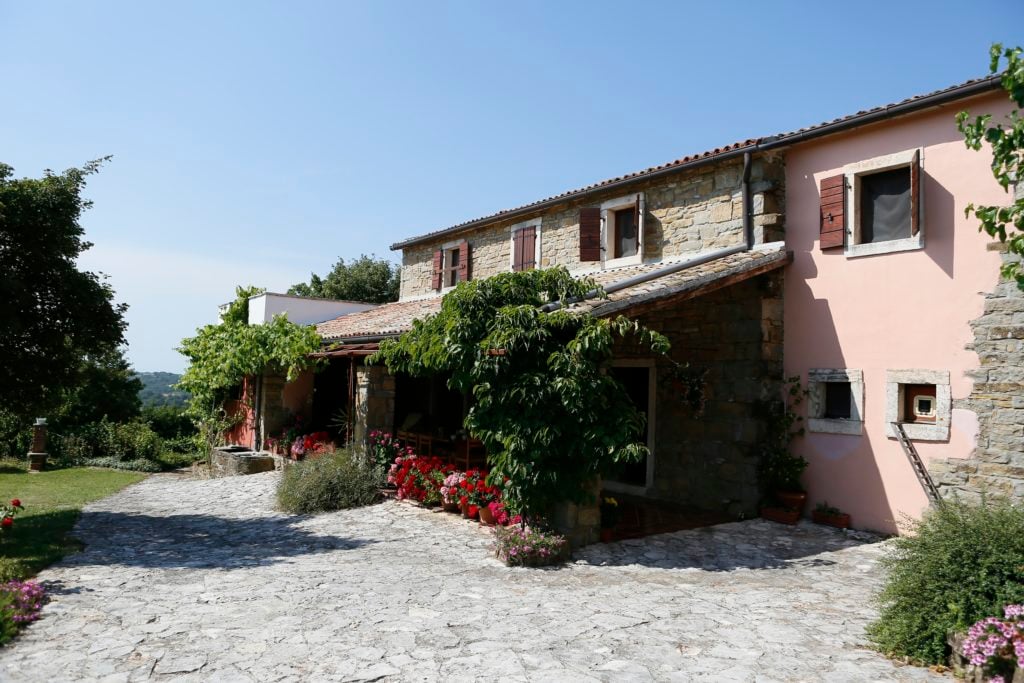
Dealer Ursula Krinzinger has run an
artist residency program in Croatia for more than 40 years.
The Mother of Them All
Krinzinger, who established her
gallery in Vienna in 1971, got the idea of starting a residency
from a surprising source: her artist,
Marina Abramović.
“In 1976, after having organized
one of the very first performances of Marina in
Innsbruck, Marina invited me to visit her studio in Groznjan,
Croatia, where I spent several weeks,” Krinzinger recalls.
“After discussing galleries and
contemporary art, we decided that Galerie Krinzinger should
absolutely do a long-time project in Croatia.” In fact, Abramović
even zeroed in on the perfect venue.
“This big, empty school house was
fantastic for the artists to work in and very suitable for
residencies,” Krinzinger says. “At the beginning, the main
focus was on working with video, which back then something
extraordinary. We supplied the artists with the best equipment that
we [could get]. In addition, all other types of media were
available.”
Exactly 25 years later, the dealer
added another residency, called Krinzinger Projekte, to
downtown Vienna. Each guest is afforded an apartment with a
studio and their projects culminate in gallery exhibitions
accompanied by catalogues.
“During their stay, the artists are
taken care of by specialized people who bring curators and
collectors to visit them, and the artists also have a daily lunch
with art historians working in the Projekt house,” Krinzinger
says.
Over the past 17 years, some 50
artists—among them Johanna Calle, Andy Coolquitt, and Erik van
Lieshout—have taken part in her programs.
For Pakistani artist Waqas Khan, whose
work can be found in the British Museum, the V&A, and the
Deutsche Bank collection, the residency opened new ways of
working.
“Prior [to the program], I had only
completed small drawings and barely dreamed of doing large ones,”
he says. Because the studio was three times the size of his Lahore
space, Khan was able to produce drawings some four feet in length,
which he says are “akin to tapestries”.
And he likely would never have begun such works without the
program. “Ursula did everything for me far beyond paying for my
airfare, while nurturing me,” Khan says. “And I fell in love with
Vienna.”
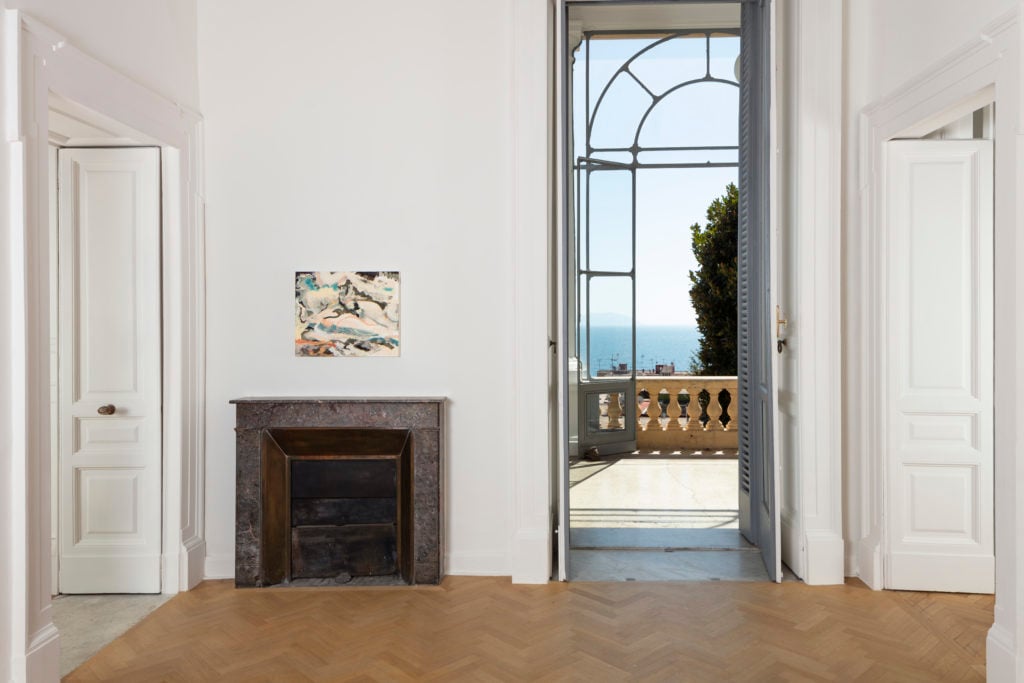
A look at Cecily Brown’s exhibition, “We
Didn’t Mean to Go to Sea,” at Thomas Dane’s Naples location.
Courtesy the artist and Thomas Dane Gallery. Photo: Amedeo
Benestante.
Thomas Dane’s Neapolitan Oasis
For Dane, the idea for a Naples
residency to accompany his Italian gallery came about over dinner
with Vogue editor Hamish Bowles and Allegra
Hicks, the London designer. “Allegra said, ‘Why not and have
artists stay?’” Dane recalls.
From there, she introduced him to her
husband, Roberto Mottola di Amato, who spotted a convertible
building and designed the interior and the apartment. Dane
furnished the space with a mix of Italian antiques and an iconic
Carlo Scarpa sofa.
“For me, it was an instinctive choice
and a way to enrich not only artists, but also friends’ lives by
immersing them in an extraordinary city rich in culture,” says
Dane, who heads to Naples once a month.
Though located far from Dane’s two
London galleries, his new venue immediately drew a steady stream of
art world sophisticates. “When planning an inaugural dinner for
100, Cecily Brown immediately said, ‘I’ll come.’” Other guests
included Glenn Lignon and Nick Serota. Since then, Dane has held a
dinner for the American Friends of the Pompidou, and will host
another for the Whitney Museum of American Art Friends in
September.
The London born, Los Angeles-based
artist Walead Beshty has already racked up several stays at Dane’s
Neapolitan guesthouse.
“I took up the Italian
newspaper Corriere [della Serra] for
making collages,” he recalls. “Yet the impact of exploring the
city, from going through Pompeii with archaeologists to studying
Hellenistic vases up close, rather than the ones enshrined in
museums like the Met, gave me a sense of the city’s incredible
layering of history.”
But there was an additional benefit.
For Beshty, it was heading to the outdoor markets and cooking up a
storm. “Thomas never missed a beat and even outfitted the kitchen
with cookbooks.”
And best of all, according to Dane?
“You can sit on the veranda and have an espresso while overlooking
the Bay of Naples.”
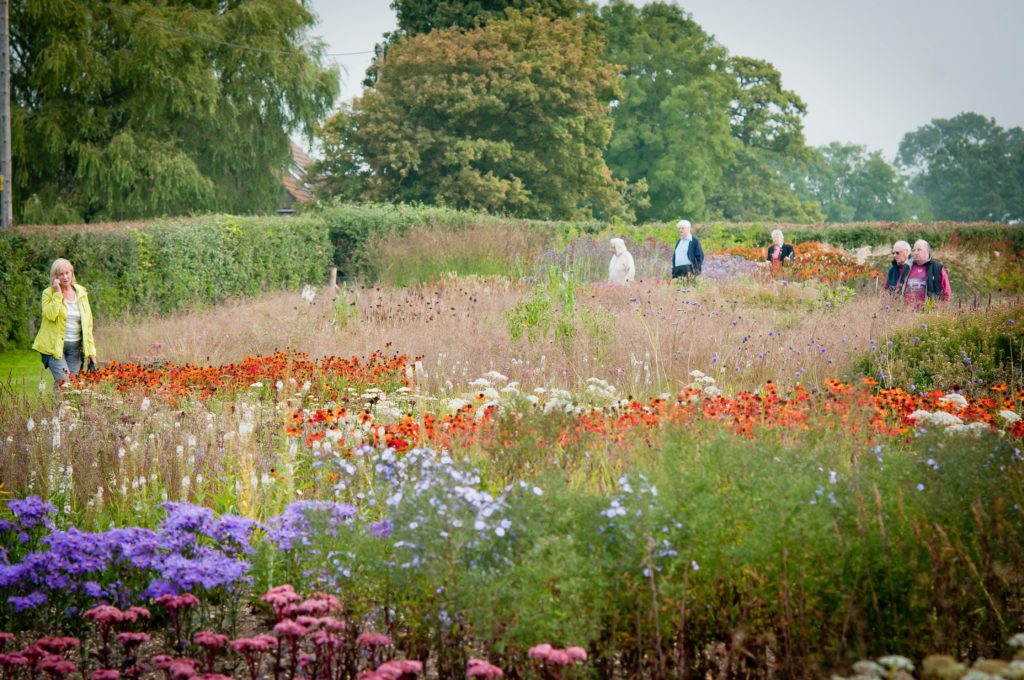
Oudolf Field at Hauser & Wirth Somerset.
Photo: Vincent Evans. Courtesy of Hauser & Wirth.
A Quiet Space in Southwest
England
An artist’s residency has long been a
pillar of Hauser & Wirth’s prodigious program.
In 2013—a year before the gallery
opened an exhibition space on its vast estate in Somerset, which
also includes a garden by Dutch landscape artist Piet Oudolf—it set
up a formal residency program in a complex of 18th-century stone
buildings, complete with a capacious apartment and two studios in
the nearby village of Bruton.
Pipilotti Rist, the inaugural resident, was followed soon after
by Martin Creed, Rashid Johnson, and Guillermo Kuitca. In
addition to artists, British horticultural specialists, academics,
and those who specialize in crafts have also participated in the
program.
“There is no set rule around artists
that are selected,” says Alice Workman, a senior director at
the gallery who oversees its cultural centers. “Some are
represented by Hauser & Wirth and others are invited.”
Some are even invited twice. The New Delhi artist
Bharti Kher, for example, is set to return to Bruton in
September.
“For me, setting down roots in Bruton
for the summer was an incredibly productive experience,”
says Kher, whose first residency was spent making drawings and
visiting foundries to delve deeper into the process of bronze
casting.
“Sometimes it’s great to remind
yourself that you can do and make everything you want to alone,”
she says. “Stripped bare without my safety net of books, things,
familiarity, and most importantly, my team, it was good for me to
remind myself how to be alone and how much I liked it.”
The post Dealers Already Give Their Most Valued Artists Money and
Space. Now They’re Giving Them Swanky Residencies, Too appeared
first on artnet News.
Read more https://news.artnet.com/market/artist-residencies-1619275
Further reading


Leave a comment