
‘Everyone Is in a State of Panic Right Now’: 7 Mid-Career Artists on How They Are Facing the Enormous Challenges of the Coronavirus Pandemic
Nationwide lockdowns, closures of non-essential businesses,
disruptions to supply chains: the impact of the coronavirus can be
felt everywhere.
The art world is no different.
Cancelled exhibitions mean lost income for artists, while studio
shutdowns leave assistants wondering when they will get their next
paycheck. The obstacles seem endless.
To get a sense of the landscape, we asked seven artists how the
crisis has affected them and what they expect its long-term
consequences to be.
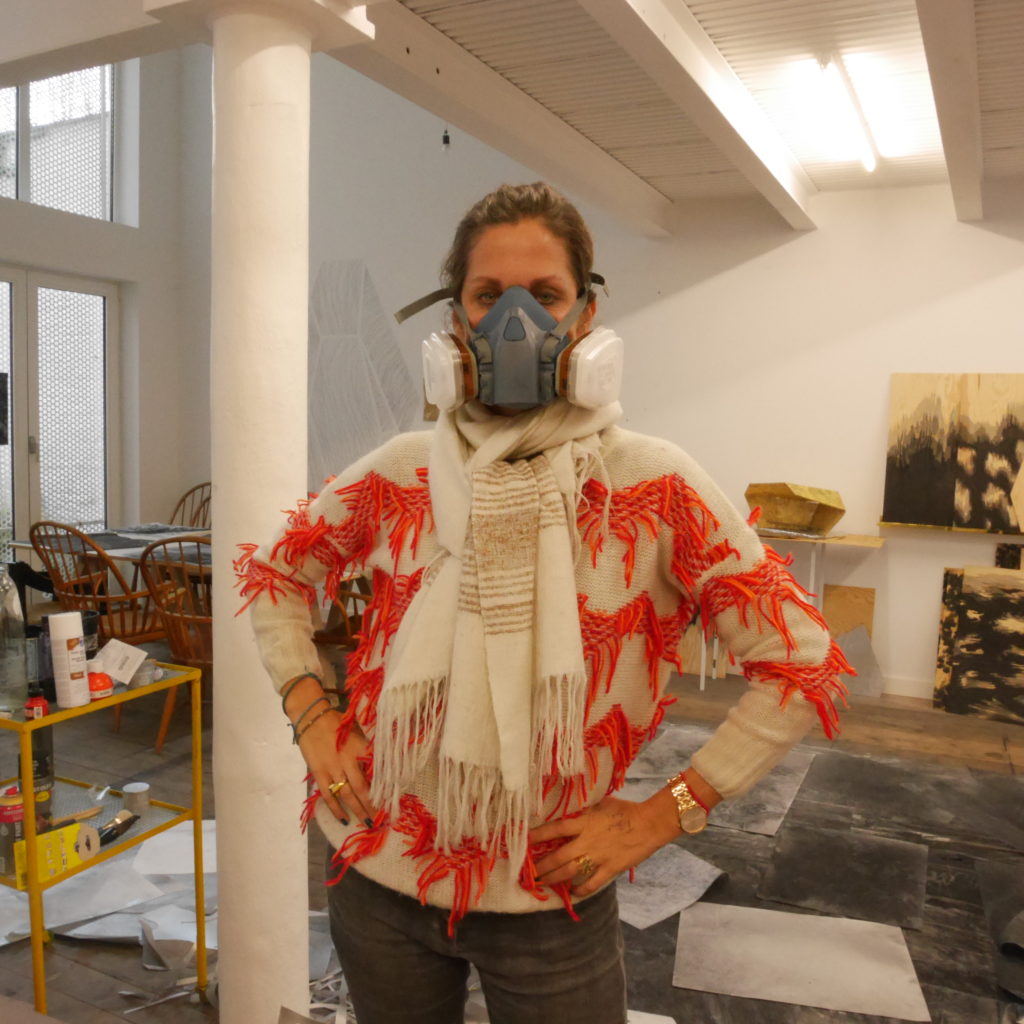
Janaina Tschäpe
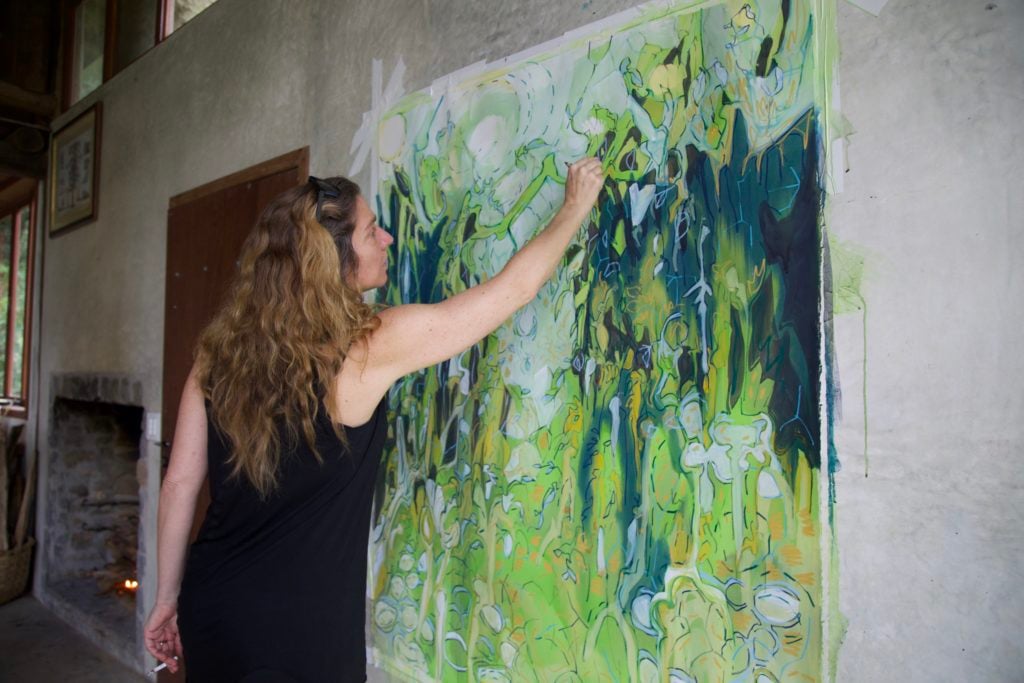
Janaina Tschäpe at work in her home
studio in April 2020. Photo courtesy the artist.
At the beginning of March, when a lot of galleries, collectors,
and friends were in New York for the Armory Show, we were still
going to openings, dinners, and visiting the fairs. Late Sunday, I
remember my daughter saying there were something like 150 cases in
New York State by that time. The next day, I drove her to and from
school because I didn’t want her to take the subway. By Wednesday
morning, we came to the decision that my studio assistants should
start to work from home and I made the decision to go to Brazil
with my daughter before her school closed.
I am lucky to have a farmhouse in the mountains. We are pretty
much self-sustainable here, and my daughter can attend school
online and I have a studio where I can work.
It was a little traumatic, actually, when we first got to the
farm. I didn’t realize how much anxiety I would cause the locals
due to the fact that I was coming from New York. An audio recording
started circulating on social media spreading fake news that my
daughter and I were sick and were the first cases of the virus in
the countryside. It was quite painful because as you can imagine, I
started getting phone calls from everyone and even had an ambulance
show up to the farm. I couldn’t install my internet or get gas or
basic supplies because people were too scared to come near us. I
finally sent around a video stating that we weren’t sick and just
quarantining in our house.
Everyone is in a state of panic right now, with the closing of
borders, people succumbing to racist sentiments, and fear driving
people towards horrible actions. It is so worrisome that both
Brazil and the US are stuck with ignorant leaders who continue to
guide us in the wrong direction, concerned only about the economy
and not about people. This situation is revealing a lot of our
mistakes, and that we are putting a little too much money and
attention in the wrong places.
I have now started a project to produce 2,000 masks for the
community here. The nearby town is completely unprepared to deal
with the virus, there is no infrastructure and no support. We’re
trying to get someone from health services to go around the
community and provide information to elderly people who are at
greater risk of complications. We have already bought the fabric
for the masks and recruited the help of local women to sew them.
Hopefully, our efforts will make the town a little more prepared if
the virus does spread to the countryside.
Kader Attia
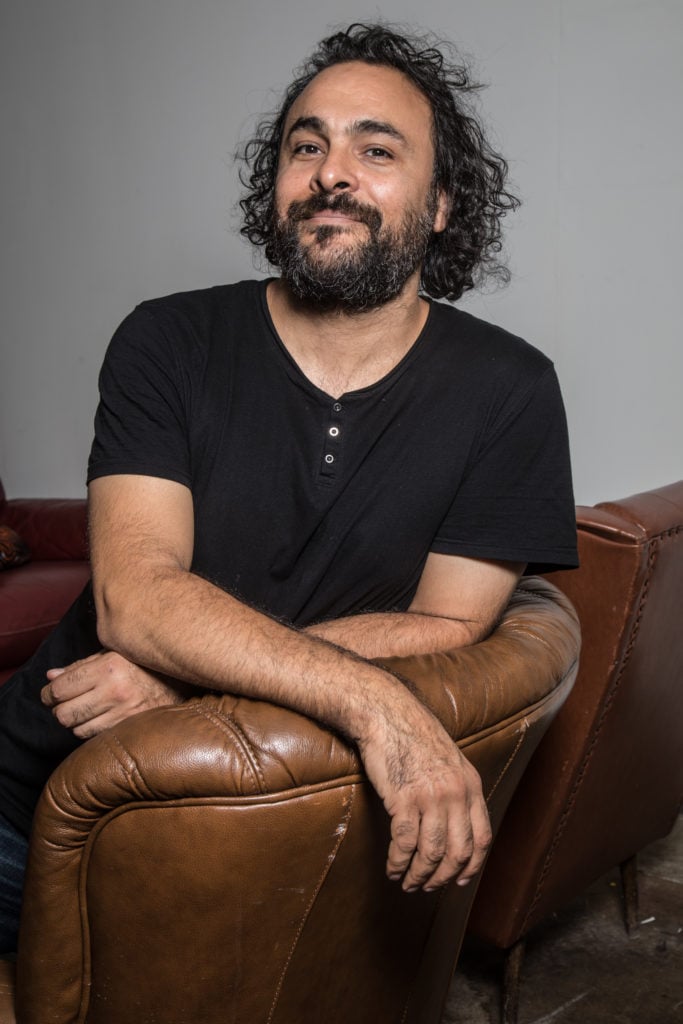
Kader Attia. Photo by Camille
Millerand.
In mid-February, I was in Lebanon for a workshop, and there,
people were already talking about the virus and wearing masks in
the street. That’s when I discovered that there was actually a
coronavirus epidemic. When I came back to Europe at the end of
February, I was very surprised to see that people were not taking
this seriously.
In addition to my artistic practice, I run a space for debates
and exchanges in Paris named La Colonie. On March 15, the French
government ordered all cafés and restaurants to close. We have been
happy to do our part to flatten the curve and help reduce the
virus’s spread, but this also hits us very hard. The space is
totally self-funded, so being closed is a financial disaster for
us, and we don’t know if we will be able to come back from
that.
Like everybody now, I am quarantining. I am using this time to
read and try to reflect on and make sense of what is happening.
There were inequalities and injustices before this pandemic, and
with the economic crisis that will follow, they will only get wider
and deeper. We need to invent new ways to deal with our
environment, but also to anticipate the social and economical
disaster that has already started. I am thinking about the
acceleration of forms of racism that already existed before the
pandemic, like the rise of fascism all over Europe and North and
South America. There is a high risk that many countries could be
seduced by the nationalist sentiment that this virus and the
narrative surrounding it exacerbates.
There is a lurking neo-nationalism that is emphasized by this
virus. Despite the French government’s efforts, both extremist
left-wing and right-wing nationalist parties can criticize the
French healthcare system for becoming neo-liberal, because
hospitals are being treated more and more like companies and asked
to generate profit. They could push the idea that the healthcare
system needs to be nationalized, like other essential
activities.
The problem with these kind of ideas is that, even if there is
some truth to them, they are very dangerous because they can be the
ground for helping nationalist ideologies to come to power. And we
all know that nationalist ideologies are fueled by racism,
exclusion of the other, isolationism, authoritarian policies, and
so on. We need to be careful with this. I speak about France
because it is the country I know best, but other countries can be
tempted by this too.
Liu Xiaodong
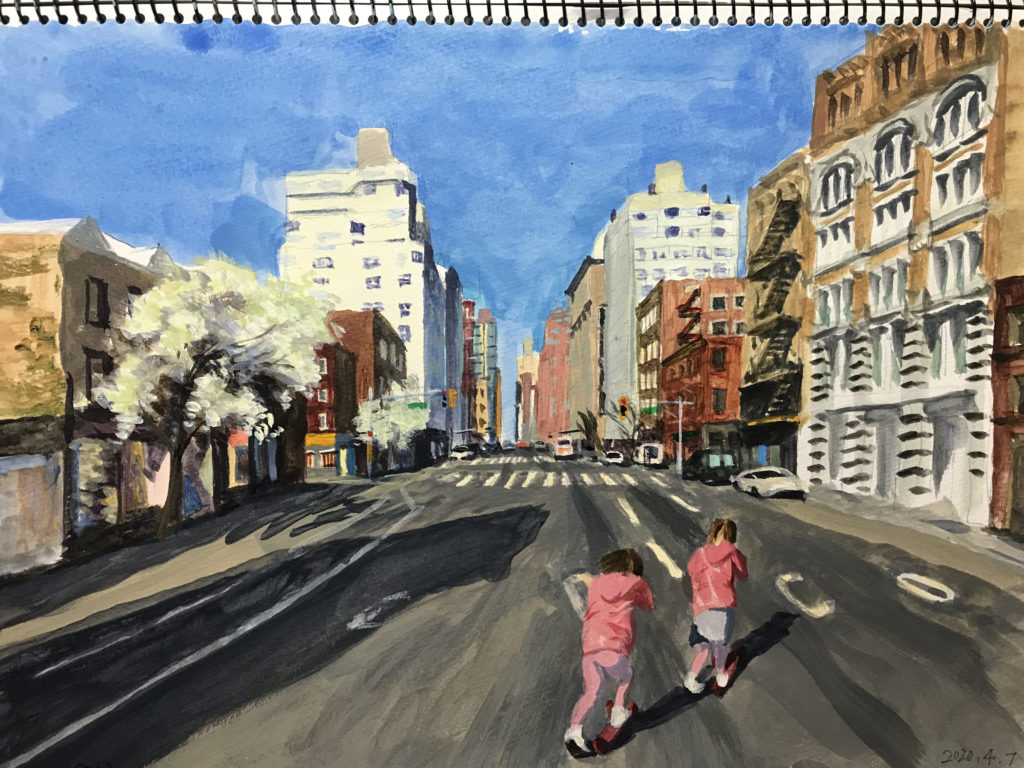
©Liu Xiaodong Studio.
At the end of January, I went to Eagle Pass, Texas, to paint,
and since the opening of my show at Dallas Contemporary was
scheduled for April 14, I came to New York to wait for the opening.
As of today, I haven’t been able to return to my home in China. My
shows—”Borders” at Dallas Contemporary and “Uummannaq” at the
Faurschou Foundation in New York—have both been cancelled. Having
shows cancelled is not a big deal, we all had to quit what we were
doing and wait. Fortunately, these shows will be rescheduled for
after the pandemic, hopefully in autumn.
Now, I’m in my New York apartment where I spend time cooking and
doing watercolors of the streets. In the long-term, learning to
slow down my life’s pace will be a good thing—to reduce what is
unnecessary, to live a simpler life.
Kathe Burkhart

A work in progress by Kathe Burkhart.
Photo courtesy the artist.
My generation has already been through the AIDS and Hepatitis C
epidemics. Here we go again—except the now the whole world has to
live the way we did, with so much fear and loss.
I work between Amsterdam and New York, and was due to fly back
to New York this week. Now I’m stuck in place for an indeterminate
time. The international borders are closed. I worry about my
friends in the States, especially in New York. Someone dear to me
has been sick.
I had a solo show that was scheduled to open at Fredericks &
Freiser on April 30. It has been postponed to the fall. If there is
a fall. This means loss of sales and income, loss of visibility,
disappointment, life and work on hold.
We are on an “intelligent lockdown” here, so I am social
distancing and staying at home mostly, since I have some autoimmune
issues and have to be very careful. I go to my studio, which is a
10-minute walk away, but less frequently. I’m still working, and
reading and writing, when I’m able to concentrate.
The long-term impact of the crisis remains to be seen. My
transatlantic lifestyle may become impossible if it’s not safe to
fly. I really don’t want to risk it until there’s a vaccine or a
medicine that works, but I may have to. I may have to lose a
country. It’s bad here, but it’s worse there. For those of us who
can survive, the aftermath could radically restructure New York. In
recent years, the city has become unsustainable for artists to work
in. So maybe there’s a potential for radical positive change. But a
best-case scenario could be a long way off.
Patricia
Cornin
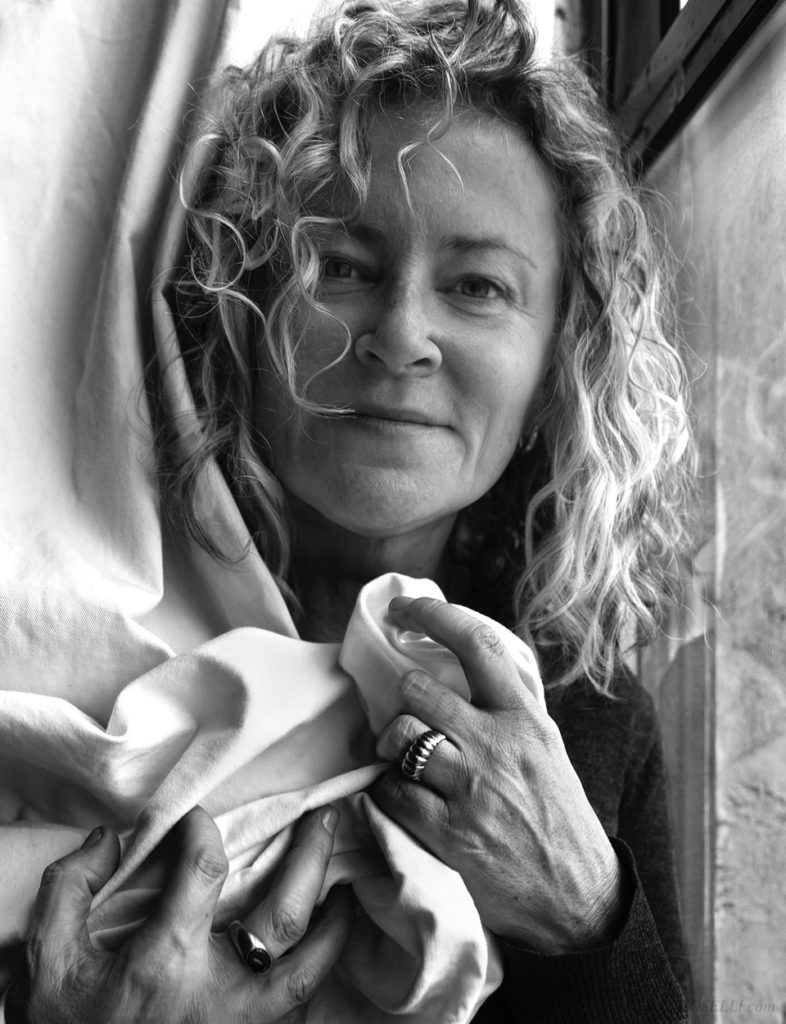
Patricia Cronin. Photo by Grace Roselli
for Pandora’s BoxX Project.
A major national museum cancelled a large commission [of mine].
I don’t think most salaried curators understand artists are
actually small businesses with substantial financial
responsibilities. I think artists are the most optimistic people.
We rent commercial real estate, pay commercial real estate taxes,
pay for insurance, electricity, and heat before we buy one brush,
tube of paint, or block of clay. And then most of us work alone day
after day, year after year, decade after decade, on something we
believe is important, serious, hoping someday someone will trade us
money for some of that work. If that isn’t optimism, I don’t know
what is.
I’m obligated to pay the studio rent, [but] the [US
government’s] Small Business Administration money that I’m eligible
for is tiny, and will go straight to the landlord and cover less
than 3 months. Artists are pretty much on their own. Art supply
stores and foundries are closed now, so I’ll use materials I
already have. It might not be the best business model, but it’s a
meaningful way to spend a life.
Sophie Whettnall
Sophie Whettnall at work. Image courtesy
the artist.
The crisis hit me when I realized I had to stay confined at home
and face the reality of having two wild kids 24 hours a day. So I
went directly to my studio and brought back home a kind of survival
kit to be able to work from here. Right now, I am getting back to
work with a simple notebook, or just paper, scissors, and a pencil.
When I start a new work, I find these are the best tools for me to
put down my thoughts. Luckily, I am just coming out of two very
intense years of exhibitions and books. The beginning of this year
was dedicated to an intense studio practice, so I am continuing to
do that, but on a smaller scale.
Until now, none of my projects have been cancelled but
everything has been postponed. I have a lot of public projects for
Belgium and France, and let’s hope they will [still happen].
My days are sober and quite well-organized. I do homework in the
morning with kids, and in the afternoon and evening, I work for
myself. I must say, I deeply enjoy this very simple life: no rush,
no stress, no hurry. But there is of course a big “but.” What are
we going to become after this big pause? How will the world recover
from this crisis? What will the world be like?
All this is constantly in my head and I am sure it will transfer
into my work. We have always managed to overcome wars, crises, and
drama. Let’s hope we will make something constructive out of it for
the planet. Of course, art has an important role in this,
as it has always had.
Ann Craven
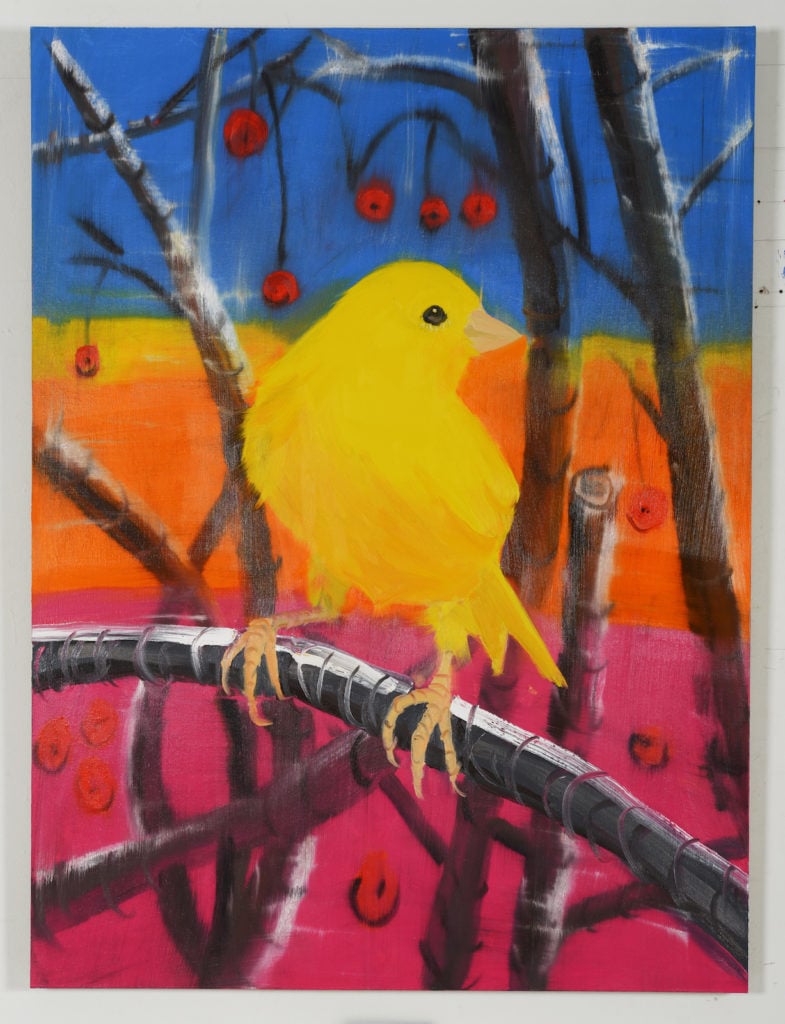
Ann Craven’s Yellow Canary (Stepping
Out in Pink Sunset, in Snow) (2018). Courtesy of the Artist and
Maccarone and ADAA
Photo by Ann Craven Studio.
My main concern right away is my studio assistants and how to
make things work with quarantine. So I am trying to get grants and
loans that are being offered to small businesses and trying to keep
it going for them. They need to work and pay rent and live life, we
all do, so I’m trying my hardest.
Some group shows [that I’m in] have been cancelled, but I’m
working on shows for the end of this year that are staying put. I
am working on a US Embassy Project of Sri Lanka birds that is
helping to keep my creative spirit in gear. The birds in Sri Lanka
are unreal, gorgeous, and thriving, and nature always wins, you
know. So for me to be painting these magnificent birds right now is
really an incredibly uplifting experience.
I am in close touch with a local Sri Lankan bird photographer
who takes photos of the local birds in his spare time. There is a
huge lockdown in that country, so this gives the photographer an
excuse to get out and shoot more photos when he is allowed.
The post ‘Everyone Is in a State of Panic Right Now’: 7
Mid-Career Artists on How They Are Facing the Enormous Challenges
of the Coronavirus Pandemic appeared first on artnet
News.
Read more https://news.artnet.com/art-world/artists-coronavirus-1833540
Further reading


Leave a comment