
Friends and Former Students of the Late John Baldessari Look Back on an Artist Who ‘Always Knew What He Was Doing’
Until he died on Thursday at age 88, the artist John Baldessari
was engaged in a lifelong battle against good taste.
“Twenty feet back, all paintings look the same,” he said in a
1981 interview, reflecting on his struggle to find a voice after he
graduated from art school in 1957. “I couldn’t spend the rest of my
life making different combinations of colors.”
So he evolved. In 1970, Baldessari burned more than 100 of his
canvases, folding the charred remains into cookie batter and
stowing a separate portion inside a book-shaped urn that became a
fixture on his studio shelf.
“I’d be busting my ass on a painting and look over at the trash
and think that’s much better than what I’m doing.” He would often
joke like this, but the artist knew what he had was a breakthrough,
writing to curator Marcia Tucker that his Cremation
Project was “[his] best work to date.” Years later,
Tucker would describe Baldessari’s work as “Pandora’s Box.”
Yet he remained unconvinced that art was his vocation. During
his lifetime, he wondered if he should have become a writer, a
filmmaker, or a chemist. Friends recall him wanting to become a lay
brother, traveling the country in his van to help people. And even
later in life, he distrusted the idea that art could change the
world.

President Barack Obama presents the 2014
National Medal of Arts to John Baldessari. Photo by Alex Wong/Getty
Images.
“If I think art should do something, then I shouldn’t be an
artist,” he said in a 2007 conversation with the artists Liam
Gillick and Lawrence Weiner. “I should be a doctor, curing people.”
Asked to look back at his career in 2012, Baldessari said he
believed that he would largely be remembered as the guy who put
dots over people’s faces.
But Baldessari’s doubts about his work seemed to have no bearing
on his role as a teacher in an era in which the conventions of
Greenbergian Modernism were flagging. Among his students
were Martha Rosler, David Salle, Meg Cranston, Jim Shaw, Mike
Kelley, Jack Goldstein, and many others with whom he remained in
contact throughout his life.
“It’s hard to imagine a world without him in it,” Rosler told
Artnet News over email. She recalled first seeing his text
paintings in 1968 at the University of California, San Diego, after
driving from New York. “Captions, words busting into silent,
canonical spaces—painting, photography—knocked my certainties up
side of the head.”
“I will miss John terribly,” Salle said. “I can’t believe he’s
gone. I never saw John misplace his sense of humor, even with the
demands of his considerable fame. I used to get postcards from him,
as I’m sure many others did as well, when he was traveling for
shows. I have one sent from Australia just signed ‘Kang-Guru.’”
Despite living in close proximity to Hollywood, Baldessari never
settled into his fame as an artist. He was charmingly
self-deprecating, telling reporters visiting his Frank
Gehry-designed home in Venice, California, to look for the strange
building “where the Muppets would live.” He appeared on the The
Simpsons as a parody of himself. And he allowed the Los
Angeles County Museum of Art to use his text
painting, Wrong (1967), as its 404 error page.
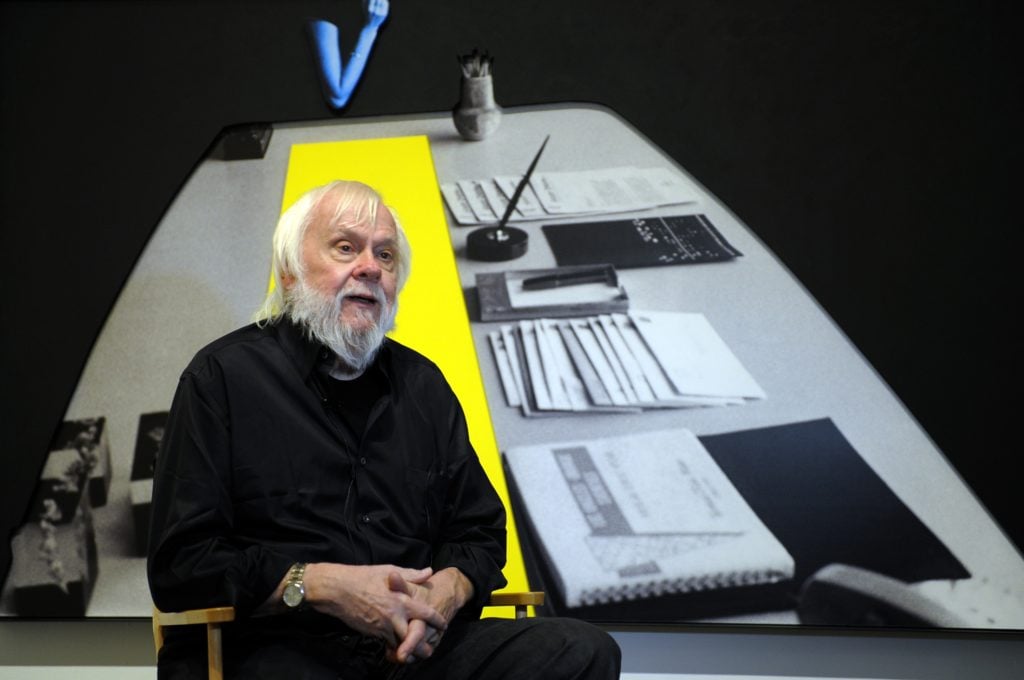
John Baldessari gives an interview at
the Metropolitan Museum of Art in 2010. Photo: Timothy A. Clary/AFP
via Getty Images.
Among the core tenets of Baldesaari’s work is that learning and
conversation involve more than just transforming the space of the
canvas; they require a complete reimagining of logical space
itself. His incorporation of commercial media and film stills into
his work in the 1980s allowed him to explore new dimensions of free
association, and to probe the deeper subtleties of absurdity and
Surrealism.
The lapsed painter even returned to his brush, covering the
faces he saw in photographs with bright dots, lacerating movie
stills and filling in the empty spaces with whatever suited him.
While New York’s conceptual artists bolstered linguistic and
political messages, Baldessari was an overtly emotional artist, a
dreamer.
Weiner, the conceptual artist, fondly remembers the many
arguments he had with his California counterpart about the function
of conceptual art.
“We were friends who didn’t have to agree to disagree,” he told
Artnet News. “I’m at a rare loss of words now that John is gone. He
was literate. He was witty. He was a curmudgeon. But I remember him
always having a list of jokes he had heard.”
“John Baldessari was an artist who always knew what he was
doing,” Weiner added.
Baldessari used images the way Goya used language to expose the
inadequacy of language, as the art critic Peter Schjedahl observed
in a review of the California artist’s series of works devoted to
the Spanish painter. I would agree. We have lost our Goya, our
court jester, our true north.
“A lot of humor comes out of sadness,” Baldessari once said in
an interview, describing the impetus behind some of his work. “I
have this idea that civility is just a thin veneer that could crack
open any minute. And would it be funny? I don’t know. Yes, it could
be funny.”
The post Friends and Former Students of the Late John
Baldessari Look Back on an Artist Who ‘Always Knew What He Was
Doing’ appeared first on artnet News.
Read more https://news.artnet.com/art-world/john-baldessari-rememberance-1747779
Further reading


Leave a comment