
Frieze’s Majority Owner, the Hollywood Colossus Endeavor, Is About to Go Public. What Does the IPO Mean for the Art-Fair Company?
Although the interplay between
the private and public markets always matters in the art trade, it
has been an especially noteworthy topic in recent months. First
came the news in mid-June that Sotheby’s had reached an agreement
in principle to return to private ownership thanks to a $3.7
billion sale to international telecom impresario Patrick Drahi. But
just as one well-known art brand leaves the New York Stock
Exchange, another is entering it.
Tomorrow, the Frieze art-fair
and publishing company effectively goes public as a small piece of
the initial public offering of its majority owner, entertainment
and media conglomerate Endeavor. And just as we asked how Sotheby’s
exit from the public market might affect its business, we now have
to ask how Endeavor’s availability on the NYSE might affect
Frieze.
Filed September 16, the most
recent substantive amendment to Endeavor’s
registration with the Securities and Exchange Commission states
that the company will offer over 19.3 million shares of Class A
common stock priced between $30 and $32 each. The offering could
infuse Endeavor with over $619 million. It also represents a 7.9
percent ownership stake, meaning Endeavor enters the public market
with a valuation of about $7.6 billion—more than twice the price
Drahi will pay for Sotheby’s.
Frieze, however, comprises only
a thin sliver of Endeavor’s overall business. The amended
registration (known as an S-1 filing) confirms what has been known
for some time: that Endeavor acquired a 70 percent stake in
Frieze’s parent company, Denmark Street Limited, in April 2016. The
same month, Endeavor also bought Fusion Marketing (later rebranded
as “Fusion/IMG Live”), billed as an experiential live events and
marketing firm, in its entirety. The S-1 states that these two
acquisitions cost Endeavor a combined $89.3 million, split between
cash and assumption of debts and liabilities.
The further accounting details
on both properties are blended as if Frieze and Fusion were a
single entity. Together, they ended the 2016 fiscal year with
consolidated revenue of $106 million—for perspective, about $5
million shy of the sale price of
Claude Monet’s Meules (1890) at Sotheby’s New York this
May—and net income of $3.6 million. How much of
those totals comes from Frieze alone is something that only
Endeavor’s accountants and underwriters know.
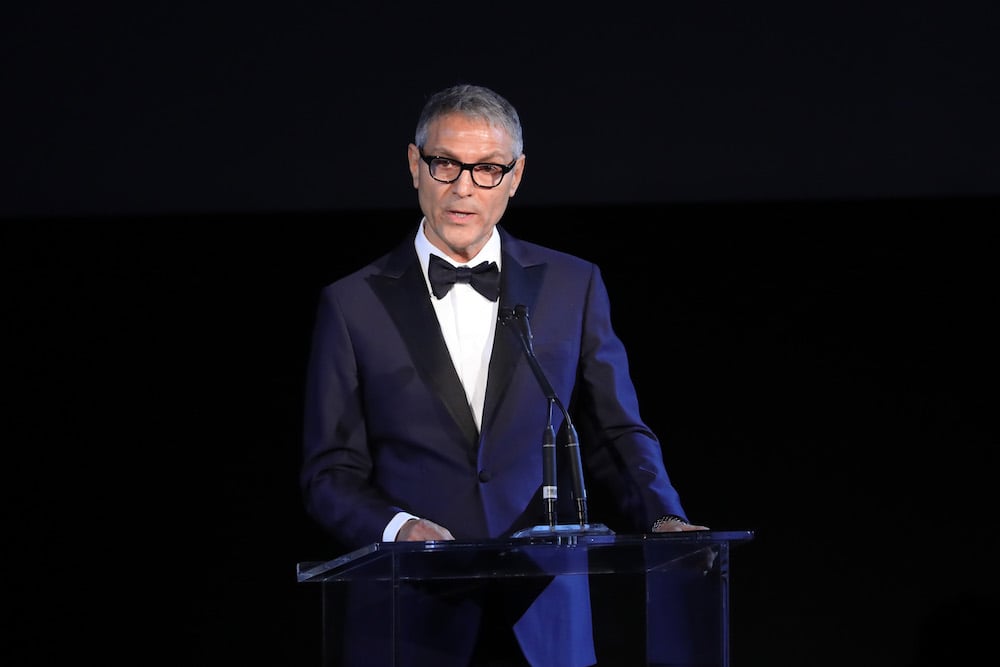
Endeavor co-founder and WME co-CEO Ari
Emanuel speaks onstage during the 2017 LACMA Art + Film Gala
honoring Mark Bradford and George Lucas, presented by Gucci at
LACMA. (Photo by Neilson Barnard/Getty Images for LACMA)
Crystal Balling
The rest of the filing provides
a few details worth keeping in mind vis-à-vis Frieze’s future.
Endeavor uses much of its prospectus to pitch itself as a
“platform” for aggressive growth achievable by integrating the
talent represented by its agencies (WME and IMG) with its various
properties, as well as leveraging those properties and their
underlying infrastructures into new markets both domestically and
internationally.
Frieze is described in the S-1
as an “owned asset” within the event-management department of
Endeavor’s “content platform.” This designation aligns Frieze with
the likes of the Ultimate Fighting Championship (UFC) mixed-martial
arts brand, the Miami Open tennis tournament, and the Professional
Bull Riders league, among other properties in which it has acquired
either a majority or minority stake. Through this segment of its
portfolio, Endeavor claims to already own and/or operate over 700
global events per year.
But the company wants more.
Under a section of the filing labeled “Growth Strategies,” Endeavor
states that it “envision[s] demand for our clients and owned assets
will continue to grow in markets around the world and therefore
aim[s] to improve and increase access and activation opportunities…
particularly in certain large media markets such as China and
Russia.” The company cites last year’s inaugural Frieze Los Angeles
fair among its successful efforts to geographically expand its
owned assets—a process it believes it can “efficiently scale” going
forward thanks to its “existing global sales and distribution
infrastructure.”
In other words, expect Frieze to
consider planting its flag in more new territories in the coming
years. The bigger question may be whether it seeks to do so through
additional fairs, or through alternative projects like
Frieze South
Bronx, its exploratory
(and ultimately shelved) plan for a 280-acre arts district in the
borough’s Port Morris area.
But arguably the largest unknown
of all concerns who will chart Frieze’s course beyond next
year.
The S-1 verifies that, as part
of Endeavor’s deal to acquire its 70 percent stake in Frieze,
co-founders Amanda Sharp and Matthew Slotover retained an option to
sell their remaining 30 percent of the brand to Endeavor at the end
of the 2020 fiscal year. The flip side is that Endeavor likewise
maintains an option to buy out Sharp and Slotover at the same point
in time, or else upon their termination. (The filing notes that the
duo “continued to be employees of Frieze after the
acquisition.”)
In either case, the option price
would be based on the previous year’s EBITDA (earnings before
interest, taxes, depreciation, and amortization) multiplied by 7.5,
a figure projected in the S-1 to be $16.4 million in the 2017
fiscal year and $15.9 million in 2018.
The exact parameters of Sharp
and Slotover’s involvement with Frieze past 2020, including whether
they could stay in their roles with or without retaining an
ownership stake of some size, remain unclear. An Endeavor
representative declined to answer artnet News’s questions about the
option agreement, saying only that the S-1 provides legally
required disclosures. But a source with direct knowledge of the
situation confirmed that Sharp and Slotover maintain day-to-day
control over the brand despite their status as minority
shareholders—and will continue to at least through next
year.
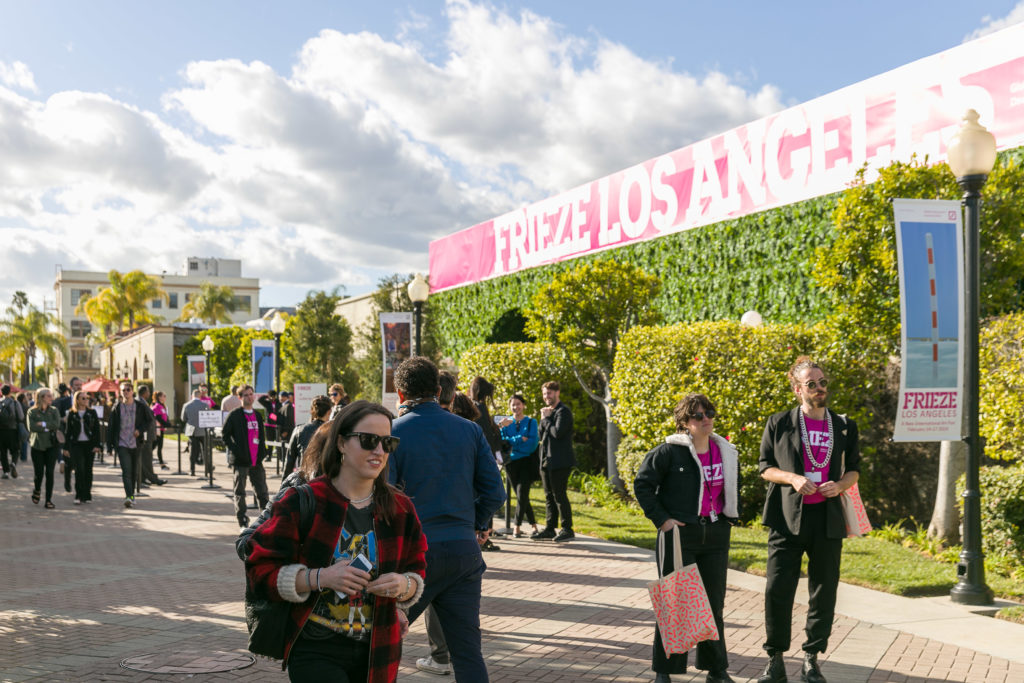
On the Paramount Studios lot at Frieze
Los Angeles 2019. Photo by Mark Blower. Image courtesy of Mark
Blower/Frieze.
The Big Picture
When trying to parse Frieze’s
future prospects, Endeavor’s stated plans may be less useful than
watching how public investors respond to the IPO, as well as how
the stock trades going forward. A sizable cash infusion will me
necessary to fund its ambitious strategy; so far, neither the
company’s fundamentals nor many outside analysts have made an
especially optimistic case.
Perhaps the brightest warning
light is Endeavor’s debt load. In the S-1 filing, the company
reported approximately $7.2 billion in total liabilities as of June
30, 2019, versus revenue of just above $2 billion over the same
period. With less than $1 billion in cash at the same juncture,
Endeavor faces plenty of questions about how it will narrow that
financial gap, and how soon.
This is almost undoubtedly one
reason that Endeavor states that the company does not expect to pay
any dividends or other distributions on its Class A shares “in the
foreseeable future.” Instead, it will retain its future earnings,
most likely to pay down debt and/or acquisition deals. This aspect
alone may turn off many potential investors. Buyers’ resistance
could be worsened, as well, by the company’s decision to adopt a
Silicon-Valley-style dual-class stock structure that effectively
grants the top brass at Endeavor and its major private investors
the power to control the company in perpetuity.
Also of concern is the actual
amount of synergy between Endeavor’s various properties, regardless
of the quality of its underlying sales and distribution
infrastructure. While the company’s language around expansion and
economies of scale sounds compelling, it’s worth asking, for
instance, how many more quality art fairs (a historically
low-margin business) it can realistically produce annually, or how
much growth can really be generated through integrating the
respective infrastructure and audiences for Frieze Masters and,
say, the Professional Bull Riders’ Helldorado Days competition? Is
the company fundraising through an IPO because it merely needs to
extend the timeline so that economies of scale can take root, or is
it pivoting to the public markets because its private investors are
unsatisfied with the strategy’s projected returns otherwise? Also,
are China and Russia really the goldmines of growth that Endeavor
says, or minefields?
And even as Endeavor touts the
high-value promotional possibilities of the many film, music, and
sports stars represented by its core agency, WME, it will surprise
no one in the art world to hear that representing artists of any
kind is a turbulent business.
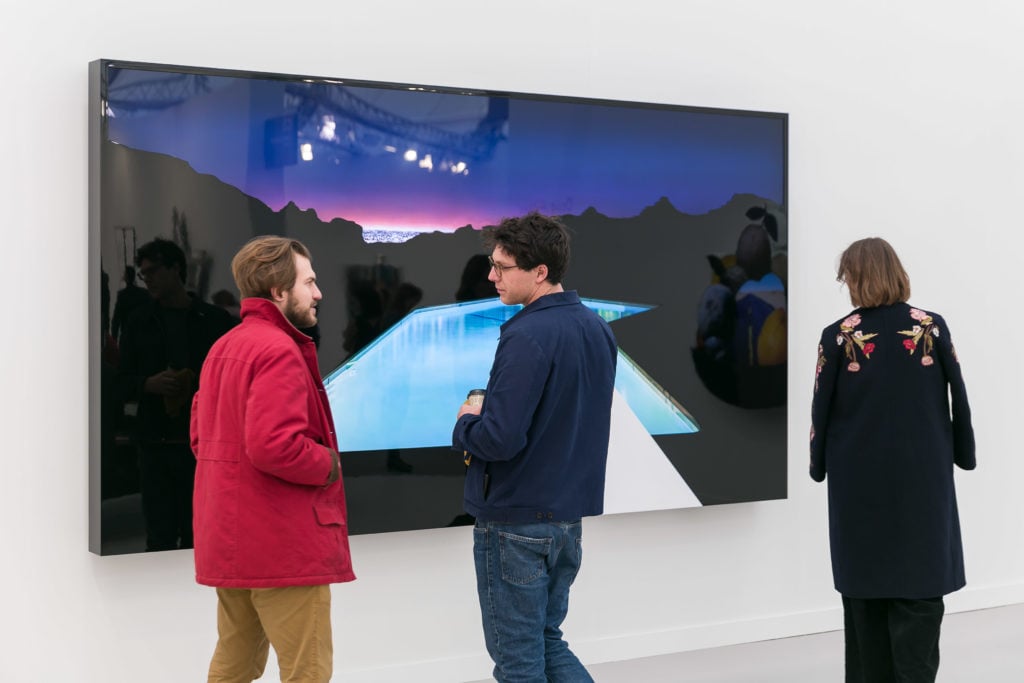
303 Gallery’s booth at Frieze Los
Angeles 2019. Photo by Mark Blower. Image courtesy of Mark
Blower/Frieze.
Case in point: since the spring,
WME and its entertainment-agency rivals have been locked in an
existential struggle with the Writers Guild of America (WGA), the
labor union for writers of film, television, news programming,
documentaries, animation, and new media. The guild advised its more
than 7,000 members to fire their agents en masse in April to
protest what they deemed unfair and unlawful practices surrounding
so-called packaging
fees, alleging that the
agencies have been short-changing their literary clients for years
in order to line their own pockets and benefit outside investors.
(Full disclosure: My brother is a WGA member.)
Even after losing a large swathe
of its writing talent, Endeavor still boasts over 6,000 clients
under management across various entertainment and media sectors.
However, Cynthia Littleton
and Gene Madaus note in Variety that the IPO could make several of those
clients anxious that their career concerns may disappear inside
Endeavor’s cross-platform, world-conquering vision—a feeling that
would make them ripe for poaching. As an unnamed agent at a WME
competitor told them, “Anyone who thinks we aren’t in a free-for-all
right now doesn’t know agents.”
In the end, the ultimate
question is whether even flawless execution of Endeavor’s strategy
would find favor with the average day trader or mutual-fund
manager. As Littleton and Maddaus write of Endeavor,
“It can be difficult to
explain the largesse and uniqueness of the agency business to
investors scrutinizing a profit-and-loss statement.” Exchange the
word “agency” for the word “auction” or “art,” and the sentence
could just as easily describe the challenges faced by Sotheby’s
during its 31 years on the New York Stock Exchange. No matter what
dreams ownership—meaning Endeavor, Sharp, and Slotover
collectively—may have for Frieze in the years ahead, its future
will soon be plotted just as much by the cold reality of how the
marketplace reacts to its offering of shares at $32 or less. Time
will tell whether that road leads to greater heights than it did
for the world’s oldest auction house.
The post Frieze’s Majority Owner, the Hollywood Colossus
Endeavor, Is About to Go Public. What Does the IPO Mean for the
Art-Fair Company? appeared first on artnet News.
Read more https://news.artnet.com/art-world/frieze-endeavor-ipo-1661938
Further reading


Leave a comment