
Fundraising, Venting Frustrations, and Putting Shows Online: Here’s How China’s Art World Is Dealing With the Coronavirus Lockdown
For weeks, Jijie has not been able to leave his home in a
village in the outskirts of Wuhan, the capital city of Hubei
province in central China.
Like the rest of some 58 million people living in Hubei, the
epicenter of the deadly novel coronavirus, the artist and
illustrator has been barred from leaving his home during an
unprecedented government lockdown as officials try to contain the
virus.
Although Jijie and his housemates have stocked up on food and
daily necessities, he is extremely concerned about a recent
development: a family member of his has been infected with the
virus.
Comparing his life to one on a boat struggling to find an anchor
in rough seas, Jijie is now telling his story in a series of
illustrated diaries, in which friends and families, isolated in
separate boats, can only wave at each other from afar.
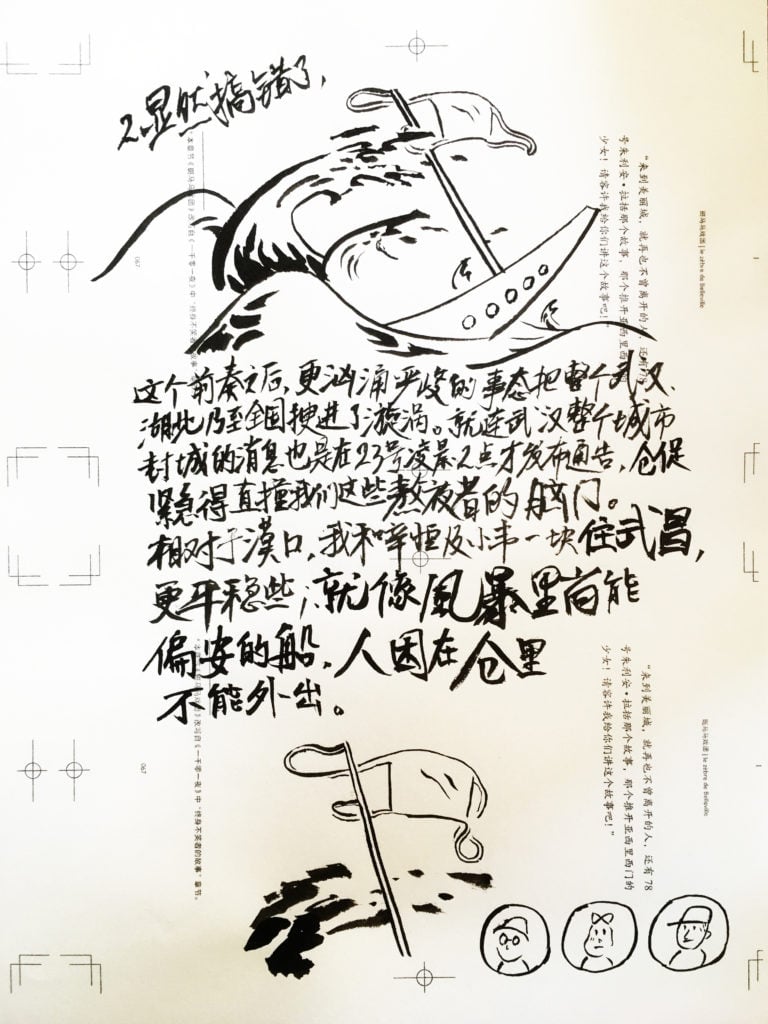
An image from Jijie’s diary, in which
he’s been recording his responses to being under lockdown in
China.
“I just want to do something, to keep a record of what I have
experienced,” Jijie says on the phone from Wuhan. “This helps me
collect my thoughts. I think every one of us wants to keep a
record, a kind of evidence, of this event.”
For most people, art is an afterthought in the face of the
highly contagious COVID-19, which, in mainland China alone, has
infected nearly 76,000 people and claimed more than 2,230
lives.
But for others, creating images from their experiences and
posting observations on social media has been an outlet in a
difficult time.
“We ask ourselves, what can art do?” says Amber Wang, director
of Gallery Weekend Beijing. “It seems that art is so trivial, and
that it cannot solve problems immediately. But with good
intentions, we reflect and do what we do best to contribute.”
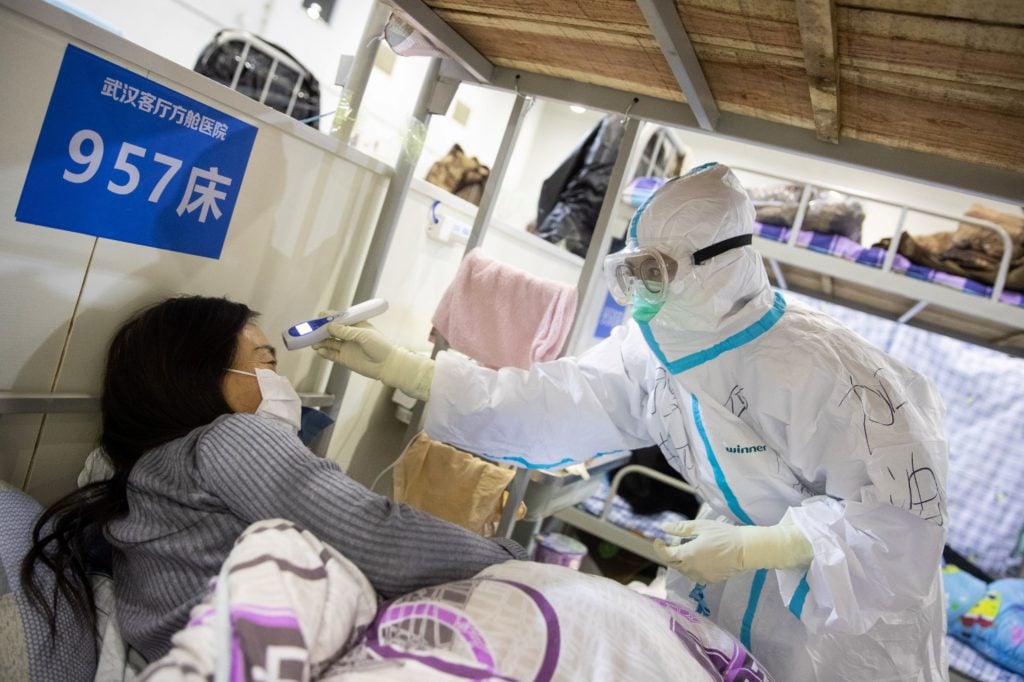
A medical staffer in Wuhan checking the
body temperature of a patient who has displayed mild symptoms of
the COVID-19 coronavirus. Photo by STR/AFP/China OUT via Getty
Images.
The Cassandras of China
Late last year, before news of the coronavirus broke, Dr Li
Wenliang and seven other medical staffers were arrested in China for “spreading rumors” about
the Sars-like pneumonia. And although their names were later
cleared, Li contracted the virus and died on February 7.
“There are many Cassandras,” artist Xiaoshi Vivian Vivian Qin
tells Artnet News, referring to the mythical Greek prophet who made
true predictions that no one believed. “And yet people who know the
truth do not have power.”
Isolated in her home in Guangzhou, Qin has been following
developments closely. She says she feels more anxious about the
novel coronavirus outbreak than she did about Sars in 2003.
As an outlet, she has been channeling her emotions into
images.
One of them depicts Wuhan bridge, overlaid with an image of a
letter signed by Dr Li. Another one is a touched-up picture of a
red banner, which addresses virus-related discrimination against
people from Wuhan. “What we can do now is keep records of what
is going on,” she says.
In Wuhan, Jijie documented the events surrounding Dr Li’s death
in a metaphorical way. The night that he died, Jijie made a
drawing depicting a man with a whistle attached to a necklace. The
man looks as if he is being thrown into the sea.
Others have made works reflecting the boredom of life under
lockdown. Artist Li Nu, in a project inspired by John Lennon and
Yoko Ono’s Bed-In for Peace, recorded himself in his
Beijing studio between January 26 and February 1. The
black-and-white images depicting his mundane activities—reading,
lying in bed—reflect the lonely lives of many people living under
lockdown.
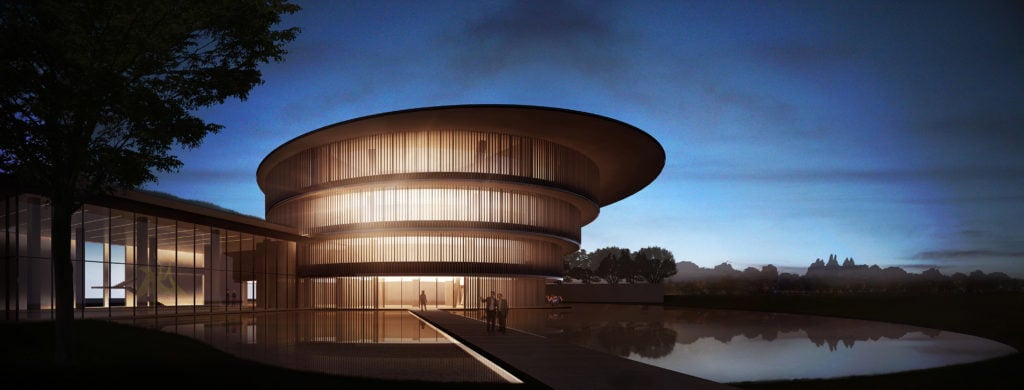
The Tadao Ando-designed He Art Museum
will now open at a later date than originally intended. Image
Courtesy of the museum.
Contingency
Plans
Cultural facilities remain closed in China, delaying exhibition
openings and even the unveiling of new museums, such as the He Art
Museum.
Founded by He Jianfeng, the heir to the electrical-appliances
manufacturer Midea, the institution was originally scheduled to
open March 21. Now, that date has been pushed back to the fall.
“Here in the Shunde district, the situation is not as serious
compared to other places,” says the museum’s director, Shao
Shu.
“All supermarkets are still open and we can have our goods
delivered. But we can’t meet the delivery guy and have to avoid
direct contact. Different cities have different restrictions. Here,
cars that are not registered with the city of Foshan [where Shunde
is located] will need a permit to enter the city.”
But now that the opening shows have been pushed back, loans that
were secured months in advance will likely have to be canceled.
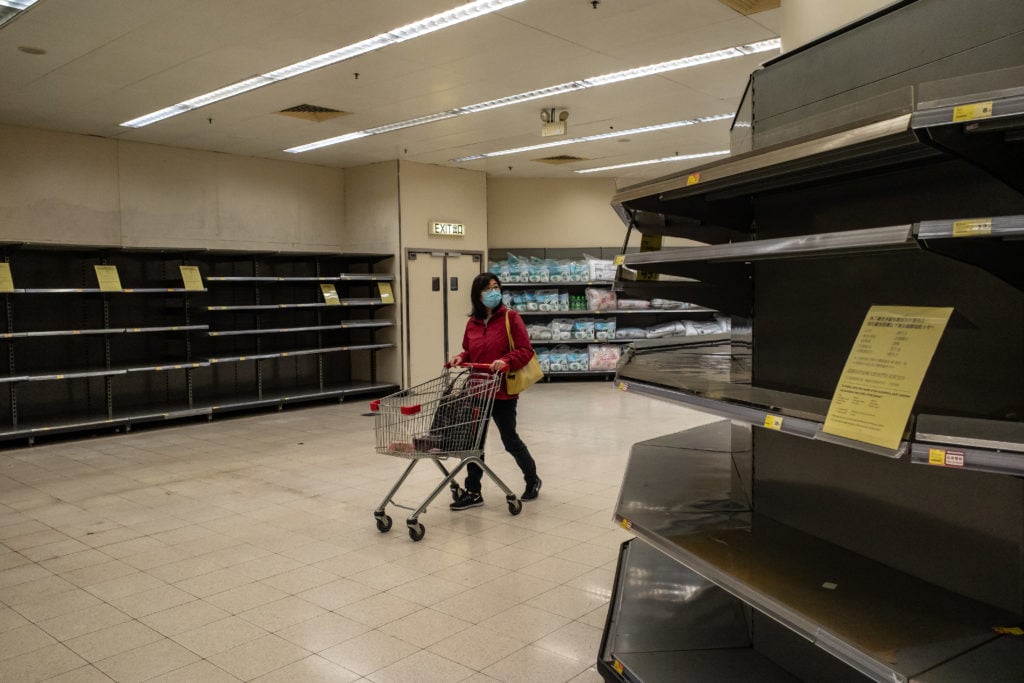
Grocery stores in China and Hong Kong
have become ghost towns in the wake of the coronavirus. Photo by
Anthony Kwan/Getty Images.
“There will be many adjustments of the inaugural exhibition for
sure, but not to the extent of recurating the show,” Shao says.
Although workers were supposed to be allowed to return to their
jobs on February 10, allowing construction crews to complete the
Tadao Ando-designed building, that date has also been pushed
back.
But even after restrictions are lifted, tight controls will be
put in place. Anyone travelling into Shunde from outside the
district will have his or her health and travel history
investigated, and office employees must be seated one meter apart
from one another, all facing in the same direction, Shao says.
Daily temperature checks and health reports will also be part of
the new routine.
But Shao says the delay of the grand opening will give him more
time to beef up the museum’s collection. As of last year, the
museum has more than 480 pieces of modern Chinese art.
“But we want to strengthen the collection by adding more Chinese
and international contemporary artworks,” he says.
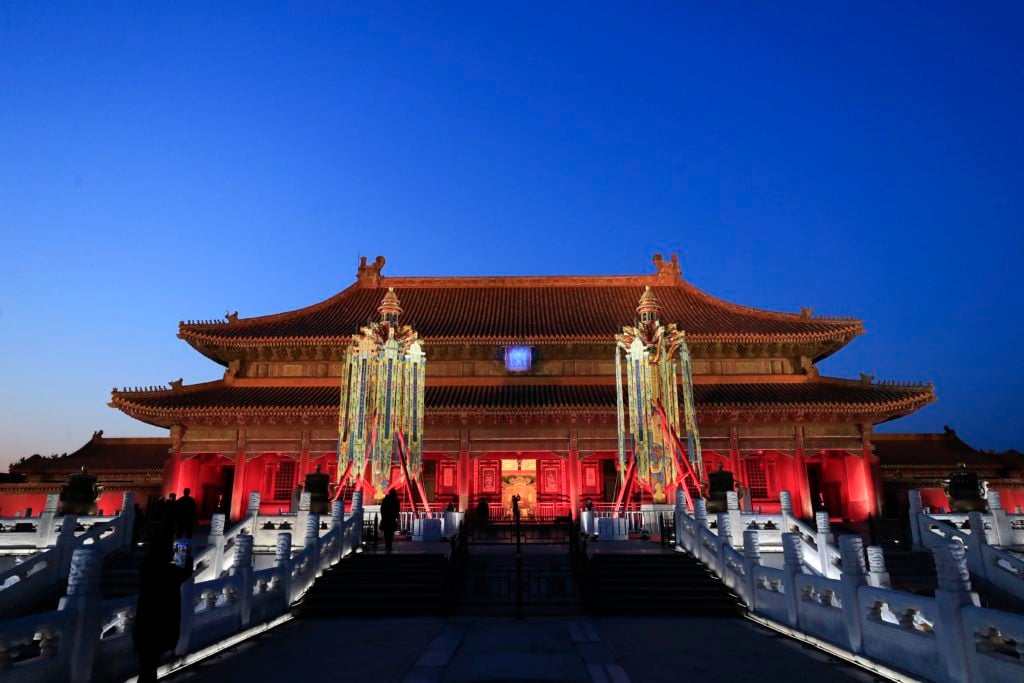
The Palace Museum is now offering an
online-only animated panorama of the famed site. Photo by Du
Yang/China News Service/Visual China Group via Getty Images.
Art must go on—online, at least
Meanwhile, organizers of Gallery Weekend Beijing are still
moving forward, even following the cancellation of the Jingart art fair, which was
scheduled to take place in Beijing in May.
“Despite the challenges of the circumstances, we have not
stopped our work,” says the event’s director, Amber Wang. “We do
what we can by maintaining our voices, and we are still preparing
for the event, aiming for April.”
Wang says she and her colleagues are working from home and are
posting on WeChat, China’s all-in-one social-media app, to maintain
public interest in the show.
Indeed, the internet has become a prime source of cultural
exchange since the government tasked museums with putting their exhibitions online while their
doors remained closed.
The Long Museum, for example, is presenting images from the 25
exhibitions it staged last year on WeChat, including photos of
artworks and explanatory texts.
The museum’s founder, mega-collector Liu Yiqian, has also
donated 30 million yuan ($4.27 million) to the Hubei Charity
Federation and his company, Guohua Life Insurance, has donated
another 200,000 yuan ($28,471) in life insurance coverage to each
front-line medical staffer in Hubei Province.
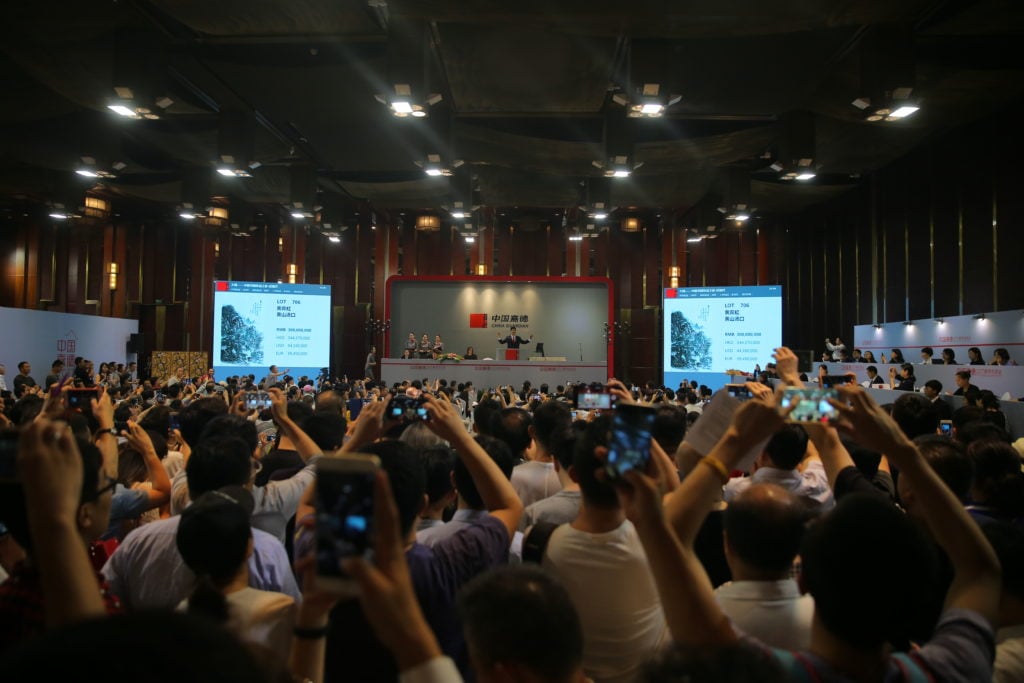
The Salesroom at China Guardian Auction
House.
Institutions like the How Art Museum in Shanghai, meanwhile, are
hosting charity auctions to support victims of the coronavirus. The
museum has donated 30 artworks, worth 1 million yuan ($142,359)
total, as the first items in a sale for which the public is being
asked to donate more objects.
Auctions houses are also holding their own similar events.
Although China Guardian has postponed its Hong Kong spring
auctions, scheduled to begin early April, it will host online
charity sales on March 9 and 10.
According to Hu Yanyan, the company’s president, the auction
house has donated 1 million yuan ($142,359) and secured 113 works
that are expected to raise more than 5 million yuan ($711,875) to
help frontline medical workers and their families.
Hu says that, although the epidemic has caused a great deal of
disruption, it could, on a positive note, drive the development of
the digital new economy.
“But it will be a long time before online sales could replace
traditional auctions or transactions of art,” she says via email.
“It is very difficult for the top level of the art market to rely
solely on virtual transactions.”
Nevertheless, the Beijing Association of Auctioneers is urging
individual auction houses to develop their own online sales
platforms “to not only adapt to the new consumer behavior or expand
business, but also to minimize risks brought by unpredictable
circumstances, such as this virus outbreak.”
But China’s art market, Hu says, is expected to undergo
extensive adjustments even after the coronavirus outbreak is
over.
“This epidemic is more severe than any adversity we have
experienced. Our lives have been put on pause,” she says. “When
normality resumes, the recovery of the art market might be slightly
slower than other sectors.”
The post Fundraising, Venting Frustrations, and Putting
Shows Online: Here’s How China’s Art World Is Dealing With the
Coronavirus Lockdown appeared first on artnet News.
Read more https://news.artnet.com/art-world/coronavirus-china-art-world-1783740
Further reading


Leave a comment