
High-Tech Radar May Have Just Led Researchers to Discover Nefertiti’s Secret Burial Chamber in King Tut’s Tomb
Researchers may have discovered
a hidden chamber in the tomb of Tutankhamun, reigniting a
centuries-old theory about the true final resting place of Egyptian
queen Nefertiti.
A team of archaeologists, led by
former Egyptian minister of antiquities Mamdouh Eldamaty, turned to
ground-penetrating radar technology to analyze the area surrounding
Tutankhamun’s 3,400-year-old tomb in Egypt’s Valley of the Kings.
They detected evidence of an unknown corridor meters away from the
Pharaoh’s burial chamber that led to a 32-foot-wide
chamber.
The scientists’ findings were
presented to Egypt’s Supreme Council of Antiquities earlier this
month and collected in an unpublished report obtained by the
journal Nature, which first reported the
story.
The finding immediately stoked
speculation that this chamber could be the tomb of Queen Nefertiti,
a female pharaoh who many believe ruled Egypt for a short period
during Egypt’s 18th Dynasty in 1300 BC. The prevailing belief among
Egyptologists today is that the queen was Tutankhamun’s mother in
law. Despite her outsized presence in Egyptian history, her burial
place was never found.
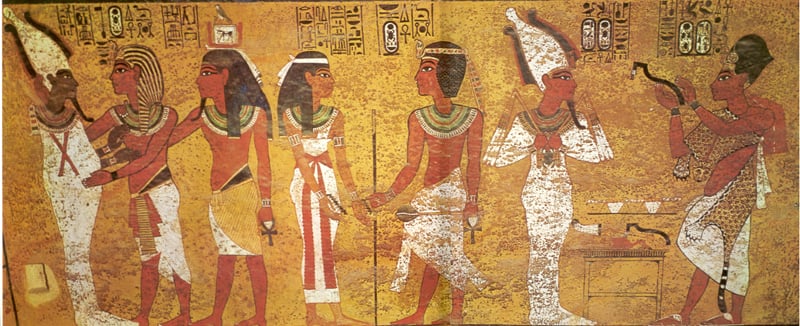
Archaeologist Nicholas Reeves believes
this painting in King Tut’s tomb marked the closing of Nefertiti’s
now-hidden burial chamber. Courtesy of the University of North
Carolina at Chapel Hill.
The discovery made by Eldamaty’s
team is the latest development in an ongoing debate waged by
experts over the existence of a secret chamber connected to King
Tut’s tomb.
In 2015, British archaeologist
Nicholas Reeves claimed that, through high-resolution surface
scans, he found evidence of hidden doorways behind the painted
walls of Tut’s burial chamber. Later that year, in a survey
overseen by Eldamaty, the Japanese radar specialist Hirokatsu
Watanabe corroborated Reeves’s theory with evidence of his own.
However, further radar scans of the area in question—including one
conducted by National Geographic, which was also
supervised by Eldamaty—proved to be inconclusive at best,
leaving many in the field doubtful.
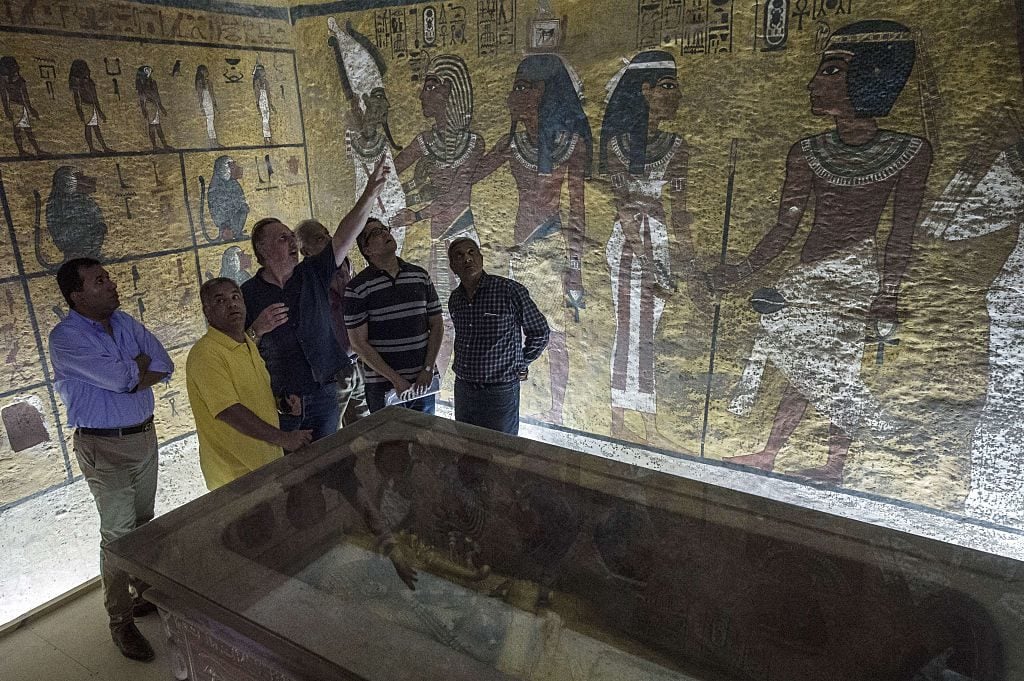
Egypt’s Minister of Antiquities, Mamdouh
al-Damati listens to British Egyptologist Nicholas Reeves near the
sarcophagus of King Tutankhamun in his burial chamber in the Valley
of the Kings on September 28, 2015. Photo: Khaled Desouki/AFP via
Getty Images.
In 2017, the year after Eldamaty
left his post as antiquities minister, the state ordered two new
surveys of Tut’s tomb. The first, led by Italian physicist
Francesco Porcelli inside the tomb, found no evidence of a hidden
room. The second, conducted by UK geophysical survey company
Terravision Exploration, did, but the study was halted by Egypt’s
Supreme Council of Antiquities before its completion.
Eldamaty, currently based at Ain
Shams University in Cairo, returned with Terravision last year to
facilitate the company as it finished its work. Eldamaty now plans
to apply to study the area again in more detail.
“If Nefertiti was buried as a
pharaoh, it could be the biggest archaeological discovery ever,”
Reeves told Nature.
The post High-Tech Radar May Have Just Led Researchers to
Discover Nefertiti’s Secret Burial Chamber in King Tut’s Tomb
appeared first on artnet News.
Read more https://news.artnet.com/art-world/discovery-burial-chamber-queen-nefertiti-1782309
Further reading


Leave a comment