
Hong Kong Is the Undisputed Hub of the Asian Art World. Does Beijing’s New Crackdown Mean It’s Destined to Lose the Title?
Hong Kong marked the 31st
anniversary of the Tiananmen Square protests on June 4 differently
than usual. For the first time since reunification in 1997, Beijing
banned the city’s annual vigil. The move comes as
a sweeping new security
law passed by China last week pulled Hong Kongers back into the
streets and reignited clashes with police.
The legislation, which criminalizes “foreign interference,
terrorism, secessionist activities, and subversion of state power,”
comes in response to the large-scale pro-democracy protests that
dominated Hong Kong from spring 2019 until its public-health
shutdown early this year. And experts say it may forever change the
city’s status as a cultural hub.
Many American businesses
operating there, according to CNBC, are concerned about the implications. And
while those with ties to the art market have remained largely
quiet, some are fearing the worst behind the scenes.
“I think it’s kind of the end of
Hong Kong,” one source with business connections to the city told
Artnet News. “It’s not going to happen immediately obviously, but
in 10 years, Hong Kong will be another Chinese city as opposed to a
great international metropolis.”
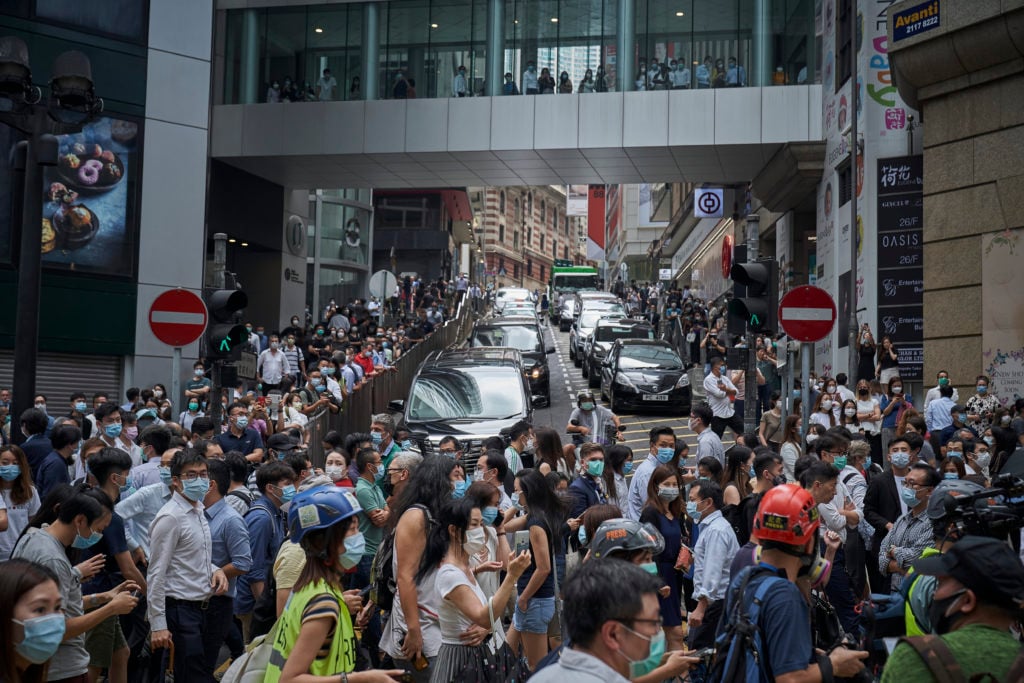
Hundreds of demonstrators flood the
streets of Hong Kong on May 27, 2020. (Photo by Tang Yan/SOPA
Images/LightRocket via Getty Images)
Censorship on the Horizon?
Concerns are twofold. First,
there is the fear that the new law could result in widespread
censorship—not to mention self-censorship—making Hong Kong a
considerably less viable hub for challenging art. Second, there is
a question of what will become of the
special international trade relationships that have enabled the
region to flourish for decades as a global hub for finance and
commerce. At particular issue is the fate of taxes levied on
imports and exports in what is currently a duty-free
zone.
“We have been closely following
the news regarding the new National Security Law in Hong Kong and
consulting experts in the region to better understand if and how
this might impact the arts, the art market, and especially our
gallerists,” said a spokesperson from Art Basel, adding that it is
still “impossible” to predict what the outcome will be.
Hong Kong-based artist Samson
Young is not optimistic. “The most concerning aspect” of the new
law, he said, “is that it is explicitly looking to create new
instruments of policing that circumvent traditional checks and
balances, to enact laws that are so broadly worded that its
coverage is potentially limitless.”
Moving forward, Young said, “the
main thing keeping us out of trouble will be the ‘mercy and
conscience’ of the state, which can of course draw new red lines at
a moment’s notice. For artists, writers and curators in the city
who cannot and do not want to stop making, the stakes of their work
have just been exponentially raised.”
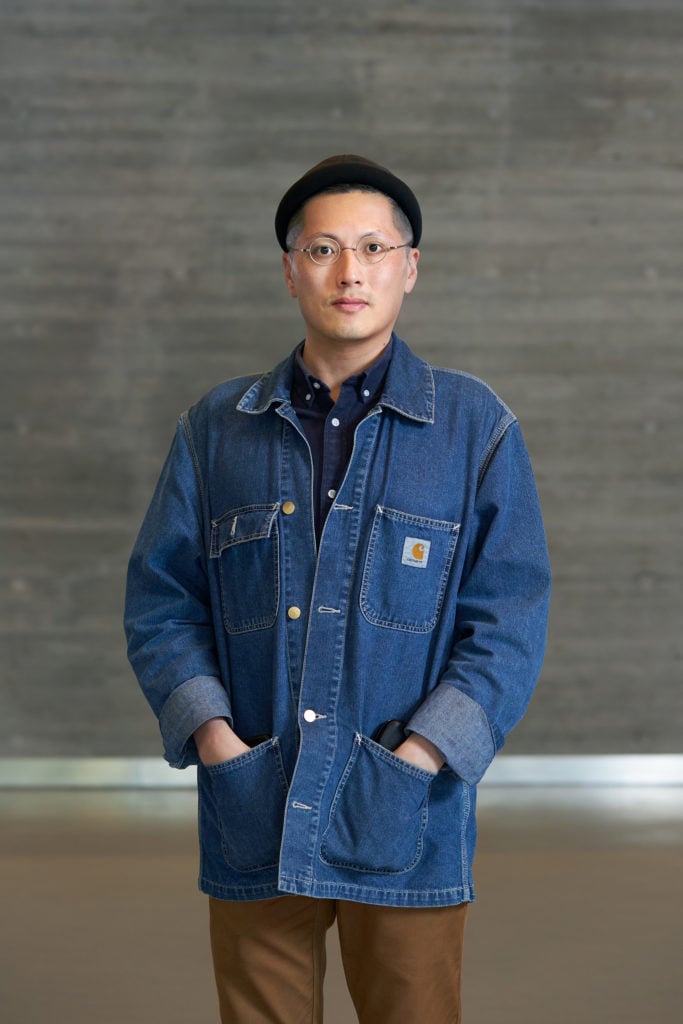
Samson Young. Photo: Winnie Yeung @
iMAGE28. Courtesy of M+, Hong Kong.
M+, the highly anticipated
museum of visual culture due to open in the West Kowloon Cultural
District next year, declined to comment directly on the impact of
the recent legislation, but reinforced the importance of freedom of
speech for Hong Kong’s continued role on the world stage. “A city
can only be a global arts hub if it offers a welcoming environment
for the art that reflects a wide range of perspectives and views,”
a spokesperson said.
Art dealer Ben Brown, who is
participating in a new Hong Kong-based fair called Unscheduled and who was
one of the first Western galleries to open in the Pedder Building a
decade ago, says that he is not giving up on Hong Kong—though he is
bracing himself for major changes.
Brown recently negotiated a
cheaper lease for a larger space in Wong Chuk Hang, a fast-growing
gallery hub about ten minutes from the city center. Though he says
most of the work he shows is not overtly political, he is still
concerned. “I think, by definition, there will be a certain amount
of self-censorship and censorship from China,” he said. “The
censorship issues which we face in China we will now face in HK,
which we never did previously.”
His only previous brush with such censorship came when a
uniformed official told him to take down a work depicting
Shanghai’s Forbidden City by Brazilian artist Vik Muniz. The
official pointed out that an image of Mao had been swapped out and
replaced with a woman, a detail Brown had not even noticed.
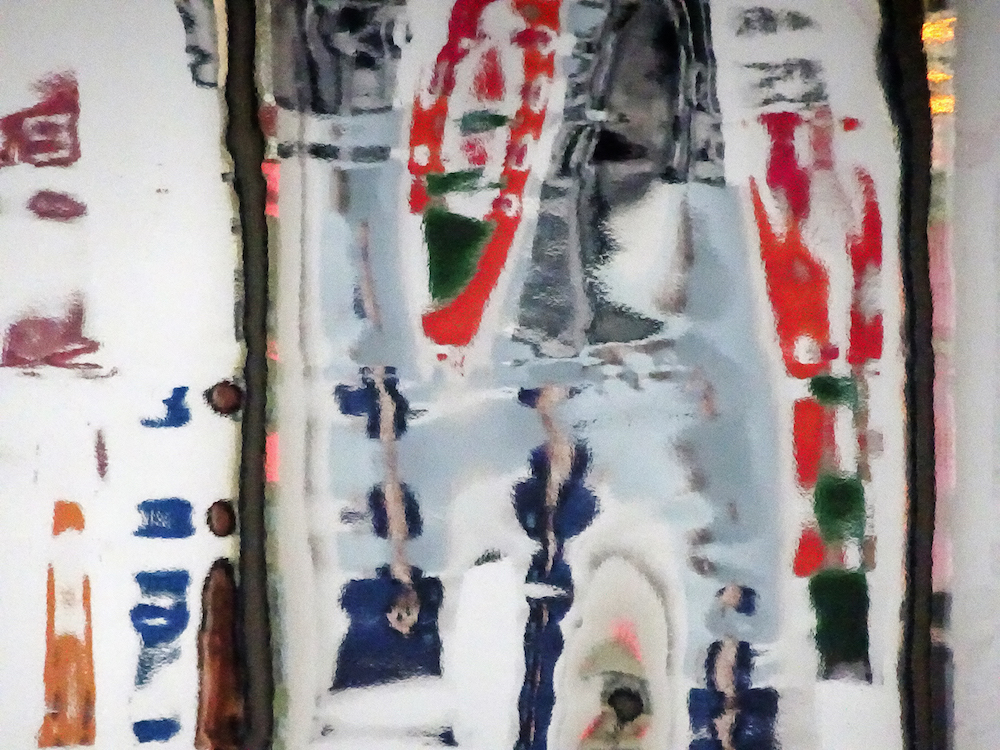
Kitty Chou, White, Red, Blue & Green
#1 (2016). Image courtesy the artist and Ben Brown Fine Arts,
London and Hong Kong
Tax-Free No More?
Then there is the issue of
taxes. Part of the reason Hong Kong became the art market’s capital
in Asia—attracting the lion’s share of Western
galleries as well as Art Basel—is because it is much less
expensive to buy and sell art there. “What is going to be
interesting is what they do about the tax regime because the reason
Sotheby’s and Christie’s and me and Pascal [de Sarthe] and Gagosian
and everyone else is there is because you can take a picture in and
take a picture out with zero taxes,” Brown said. “It’s a piece of
cake to function.” By
contrast, art imported to mainland China is taxed at 34
percent.
Hong Kong not only has no tax on
art imports, but also no wealth, gift, estate, or capital gains
tax. It has also benefitted from relationships it has built with
other countries: the US, for instance, places no
restrictions on currency exchanges and adds few (if any) tariffs
onto goods traded with Hong Kong. That’s a big reason why, between 1991 and 2018,
total sales of fine art in the district’s auction
houses swelled from approximately $11 million to
nearly $1.4 billion.
But all this may change with the new law. Last week, US
President Donald Trump announced his intention to revoke Hong Kong’s special economic
privileges, including its preferential trading status. Other
nations including Australia, Great Britain, and Canada have
threatened the same, in part with the hope of pressuring the
Chinese government to limit the scope of the national security
law.
If Hong Kong’s special economic
status is revoked, some cities are already being primed to emerge as
successors. Due to the censorship and tax issues on mainland
China, cities like Taipei or Singapore may be
preferable. But Magnus Renfrew, the co-founder of ART SG
and co-director of Taipei Dangdai, maintains there is enough buying
power in Asia to go around. “Despite recent challenges, with the
depth, strength, and diversity of Hong Kong’s arts scene, we are
confident in the future of Hong Kong as a leading arts hub in
Asia,” he said.
The true impact will begin to be
understood as the particulars of the final text become public—and
enforcement begins. “It is too soon to gauge the true impacts of
this on our business,” said Shasha Tittmann, director of Lehmann
Maupin in Hong Kong. “They are manifold. Hong Kong has been under
extreme distress for the past year. If there is anything we have
learned, it is that the city and its community are incredibly
resilient.”
The post Hong Kong Is the Undisputed Hub of the Asian Art
World. Does Beijing’s New Crackdown Mean It’s Destined to Lose the
Title? appeared first on artnet News.
Read more https://news.artnet.com/market/hong-kong-art-world-crackdown-1878939
Further reading


Leave a comment