
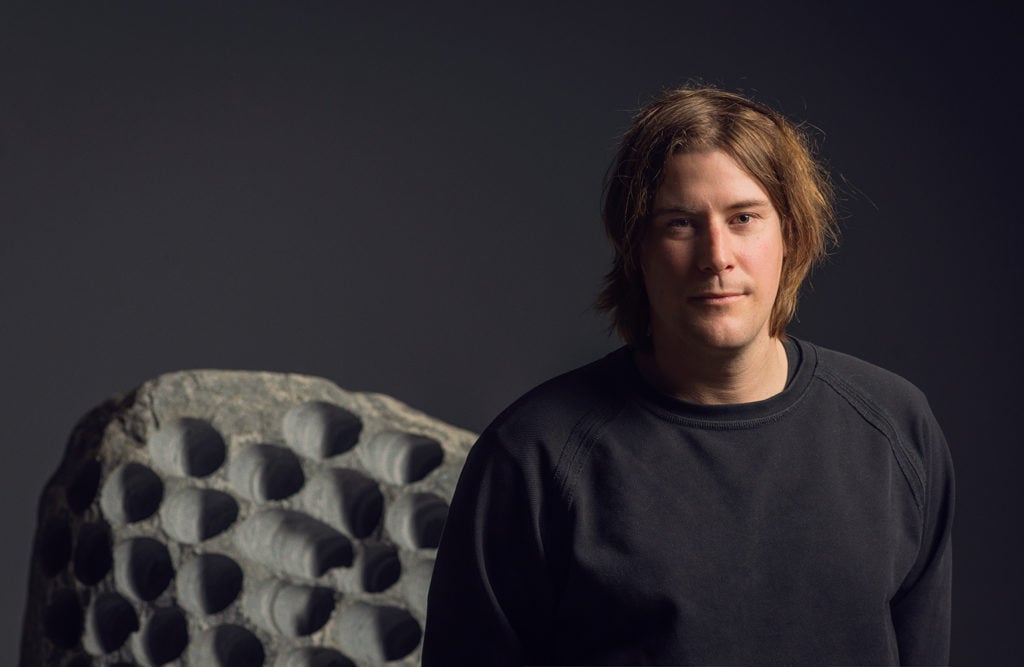
How Far Would You Go for Your Art? Julian Charrière Went to the North Pole (and Got in Trouble With the Law)
In March 2017, Berlin police
raided the studio of artist Julian Charrière to confiscate a
one-ton cannon designed to fire radioactive coconuts. The story
made headlines around the world for its absurdity—a man walking his
dog claimed he was
almost struck by one of Charrière’s flying
coconuts—but for the
artist, the incident was no joke.
A reference to a Jules Verne
novel about American industrialists who sought to access coal
deposits under the North Pole with a cannon of their own, the
sculpture was the artist’s contribution to the inaugural Antarctic
Biennial. Charrière ended
up submitting documentation of the cannon’s confiscation in lieu of
the object itself.
Years later, the coconut episode
stands as a kind of metaphor for Charrière’s practice. The artist,
now 33, deploys a variety of media in his quest to examine the
symbiotic relationship between modernity and Mother Nature—and how
that relationship is mediated through images. It’s not
environmental art, exactly—more like conceptual art in the age of
the Anthropocene.
Often, Charrière hones in on
the conflict between humanity’s hunger for progression and nature’s
need to perpetuate its own existence. For his
series First
Light (2016), he
developed dreamy landscape photos of Bikini Atoll (home to US
nuclear tests in the 1940s and ’50s) with radioactive material.
In Metamorphism (2016), the artist melted down computer scraps
culled from laptops and smartphones into artificial lava, from
which he created scabrous stone sculptures.
Charrière’s latest exhibition,
“Towards No Earthly
Pole,” on view through
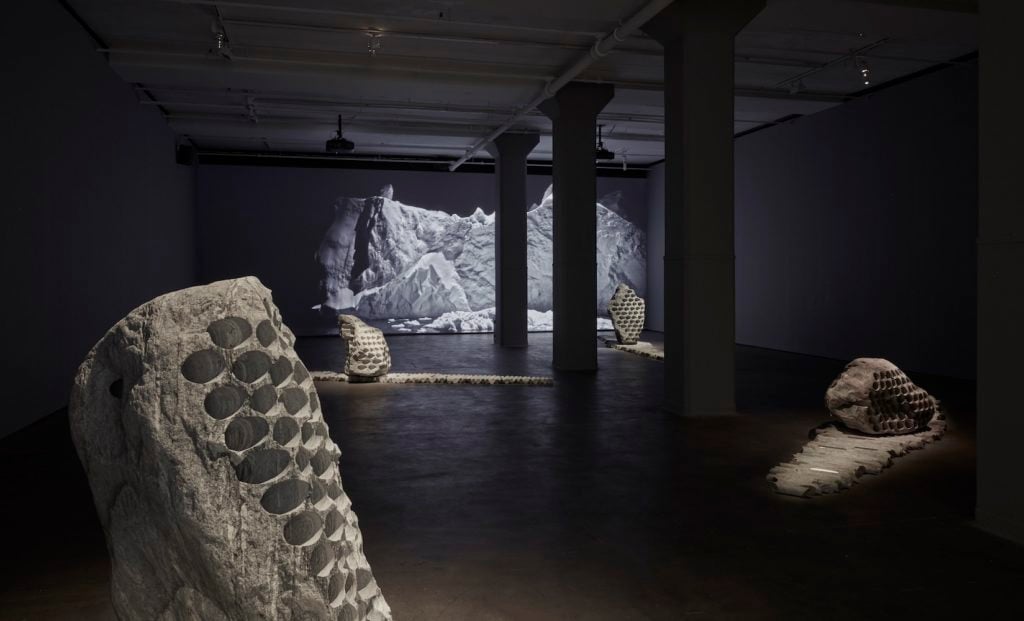
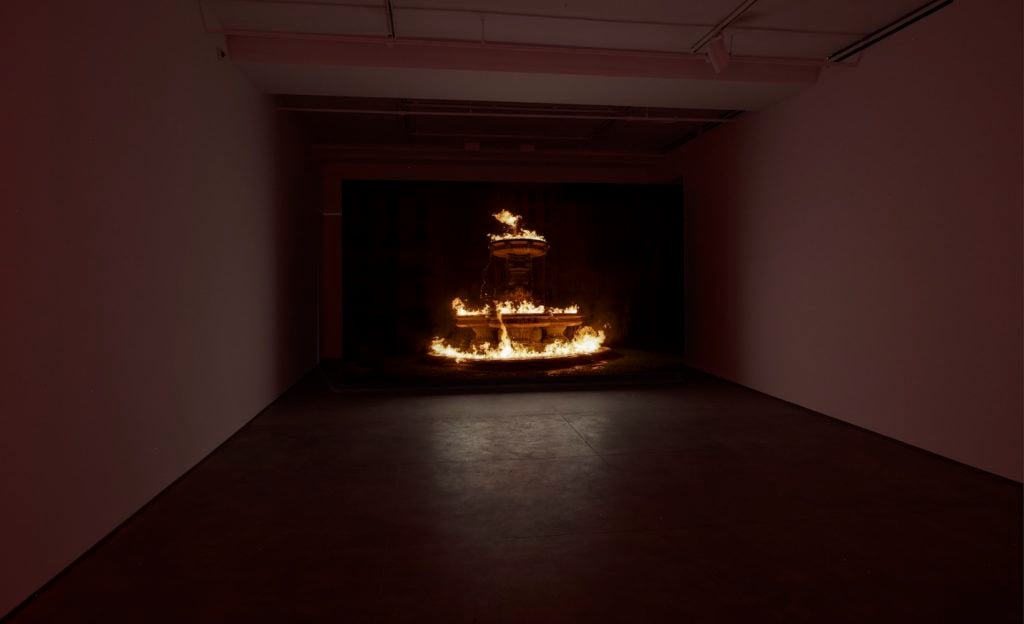
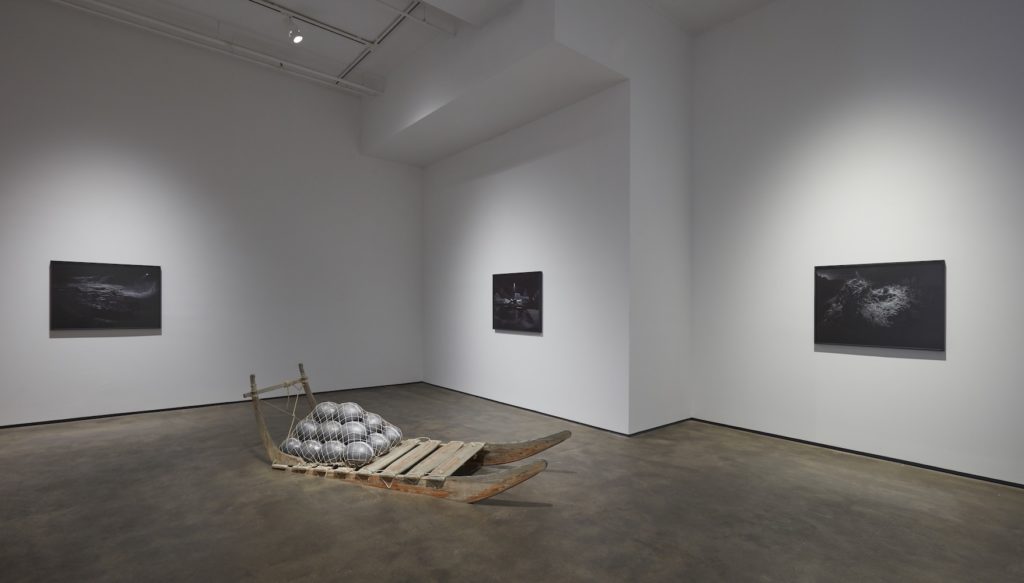
March 21 at Sean Kelly Gallery in New York, features a film of the
same name in which a roving drone captures abstracted footage of
glaciers in Antarctica and Europe. It is installed in the same
gallery is a series of sculptures made from boulders displaced by
glacial ice, which the artist found in otherwise empty fields. To
create the sculptures, Charrière drilled into the rocks and
installed them atop a bed of the samples taken from their cores,
evoking a kind of prehistoric assembly line.
Charrière spoke with Artnet
News about the show, that notorious coconut cannon, and why people
often misunderstand his work.
You’ve mentioned that the inspiration for this show came when
you were preparing for the Antarctic Biennale in 2017. I want to
start there. Can you tell me what your relationship to the
region?
My relationship to the Arctic
started in 2010 with my first trip to Iceland just after the
eruption of the Eyjafjallajökull volcano. Three years later, I went
back to realize a piece called Blue Fossil Entropic Stories
for which I climbed an iceberg and
tried to melt it down with a blow torch for almost eight hours.
Photographs of me standing on the ice and trying to melt it down
became a starting point for a longer dialogue with these
regions. It was also my
first attempt to reverse the romantic idea of separation between
the observer and the surrounding world.
Installation shot of Julian Charrière’s
“Towards No Earthly Pole,” Sean Kelly, 2020. Courtesy of Sean
Kelly. Photo: Jason Wyche.
The Antarctic Biennale was an important moment in your
career—though not, I imagine, for the reasons you may have
originally predicted.
I designed a project related to
a body of work I did on a former atomic test site on Bikini Atoll
in the Marshall Islands. The idea was to build a cannon that would
shoot a radioactive coconut from Bikini Atoll toward the South
Pole. The coconut eventually would hit the ground and give birth to
a new tree—that was the intention, at least. The idea was to embed
this radioactive coconut in the ice, like a time bomb. To me, the
coconut is an alienated seed, a by-product of the friction of the
cultural and natural spheres—a forbidden fruit of western science.
Coconuts have always been ambassadors of life and hope, but in this
case, they became an ambiguous messenger.
The cannon was a reference to
Jules Verne’s novel Sans dessus dessous, a story about an
American secret society purchasing the North Pole. It’s a
controversial fable about global warming and the proliferation of
weapons of mass destruction. But I found it fascinating that, in
1889, a guy wrote a story about the United States purchasing the
North Pole with the intention of melting it down to get to the raw
material—petrol, coal, etc.—while putting half of the earth
underwater in the process. The cannon was a kind of homage to
Verne, but at the same time, it was also about creating a link
between a sinking landscape—Bikini Island, which only has 50 years
before it’s completely subsumed by water—and a melting one—the
Antarctic Peninsula.
At the very end, the
cannon was confiscated by the German police, so I was never able to
realize the project in the way I intended to.
The incident made headlines around the world. Looking back,
it’s kind of ironic.
The biennale did not exist in a
tangible form for the general public; there were only artists on
board [the ship that navigated the continent]. So it was
interesting that the cannon got confiscated and the story went
everywhere, from the New York Times to newspapers in
Australia.
Installation shot of Julian Charrière’s
“Towards No Earthly Pole,” Sean Kelly, 2020. Courtesy of Sean
Kelly. Photo: Jason Wyche.
You also turned the documentation of the cannon’s
confiscation into an artwork itself. I thought that
moment was an interesting metaphor for your practice in general.
How did that change or add to the ideas behind the original
artwork?
The cannon was always meant to
be a story, a myth. It was supposed to be brought there, to be
shot, and then left in a whaling station on Desolation Island to
erode. In a sense, the cannon was never the artwork; the artwork
was meant to be the story that a coconut was shot toward the South
Pole. And then it got confiscated, and the fictional aspect
increased drastically. All these weird, fake stories from German
newspapers spread about how an artist tried to shoot passerby, and
so on. It became a fable that reached a much larger audience and
made the whole story more significant, more complex.
But you still made the trip to Antarctica, correct? Is that
when you conceived of your latest video on view at Sean
Kelly, Towards No Earthly Pole?
Having the cannon confiscated
also meant that I was out there on the boat with no work. I did a
little performance—it was just an hour of silence—and the rest of
the time I was helping my colleagues. But during the night, it was
quite quiet, so I spent a lot of time staring at the landscape.
Because radar and sonar systems are 100 percent reliable in
locating icebergs, there was a guy on the upper deck who was using
a giant spotlight to search for them. All this technology and we
were using this very analog way of scanning the emptiness of the
polar night.
I was also thinking about this
photo series by Frank Hurley. He was the photographer on Ernest
Shackleton’s famous Antarctic expedition in 1914, where their boat
froze and they became stranded on floating sheets of ice for 18
months, eating raw penguin and seals, before making it back to
land. While stranded, Hurley made a photo series of the boats stuck
in the ice. He used up to 30 mechanized flashes, creating this very
strange kind of black-and-white stage photography. Because there
was light all around the object, the photo looked very flat—it
became almost like a scan. That’s what sparked me to film
[glaciers] with the spotlight attached to a drone, a process that
took two and a half years.
Julian Charrière, 2020. Photo: Taylor
Dafoe.
That makes sense. It feels like the camera—and thus the
viewer—is scanning the landscape in the film.
Over the past ten years, with
Google Earth and then with the advent of drone technology, we’ve
started to view things from beyond the perspective of a human
being. We talk about drones as warfare technology, but it’s also
interesting that they have changed the way we actually see our
world and construct our realities. It’s a huge shift in visual
culture.
The film features footage of Antarctica, Greenland, Iceland,
and the Swiss Alps, but it’s cut together so that it appears as one
continuous shot. There’s no sense of place or reference to location
at all. Why did you choose to abstract the landscape in that
way?
The film is addressing the way
we construct our reality through images. If we look at a mountain,
we probably all see the same mountain regardless of its specific
characteristics, right? Because we all have the same background
that makes us understand that it’s a mountain.
Interestingly, polar iconography
is bound almost exclusively to scientific imagery. We know the
South Pole because scientists shared pictures of it. It’s a
collective imagination of geography, one that only exists through
images that have been mediated through science. So for me, it was a
question of, how can I trigger this idea of constructed geography
through images?
Installation shot of Julian Charrière’s
“Towards No Earthly Pole,” Sean Kelly, 2020. Courtesy of Sean
Kelly. Photo: Jason Wyche.
It’s also a very beautifully shot film. Is there a tension
between the aestheticization and abstraction of these regions and
their very unique and pressing geological concerns?
I don’t think so, because the
video is about how we project ourselves onto a place. Because we
see pictures of the Arctic melting every day, we block them out—we
don’t have empathy for the place anymore. For me, [the video] was a
way to show the dark side of the polar region, to give it a new
voice.
People have talked about your work as “environmental art” or
“climate change art.” But that doesn’t seem correct to me. Your
work deals with ecological concerns on a more philosophical
level.
I’m interested in environmental
questions—we need to change our way of seeing and understanding our
world if we want to be able to live on the planet in 100
years. But I’m not
creating the work as a discourse about climate change. It addresses
a lot of different questions about time and perception, about what
we can learn from a place, how we’re reacting to our
world.
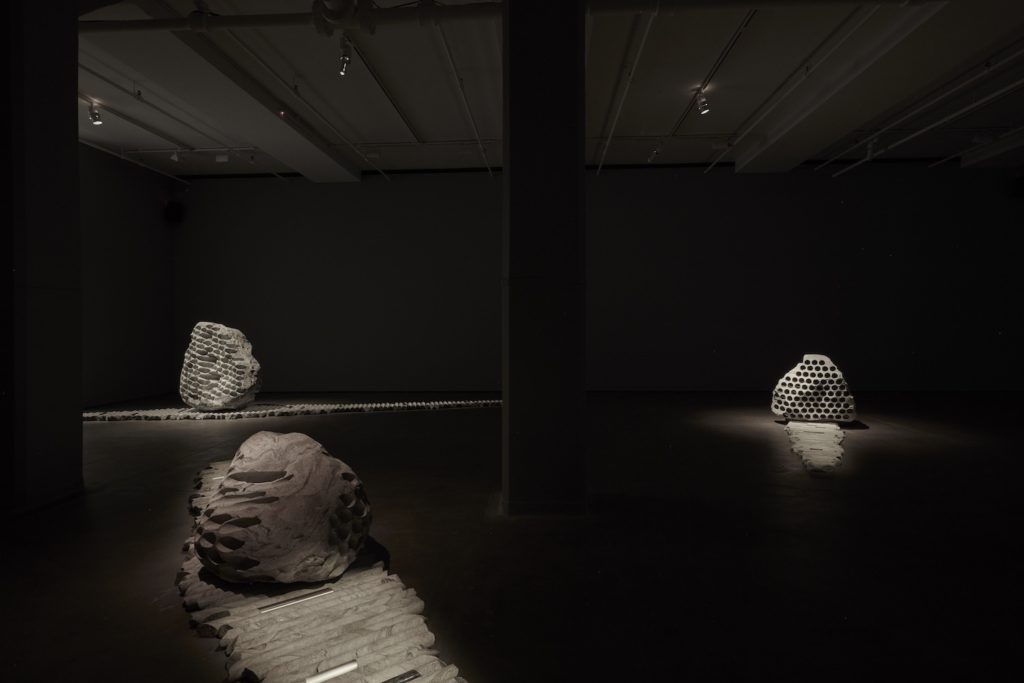
Installation shot of Julian Charrière’s
“Towards No Earthly Pole,” Sean Kelly, 2020. Courtesy of Sean
Kelly. Photo: Jason Wyche.
In the gallery, you relocate boulders to a new,
unnatural context, much in the way that they were once displaced by
large-scale, geological movement. It seems to me that by doing
this, you’re commenting on how human industry has sped up natural
phenomena to the point of provoking a climate crisis. With a piece
like this, how do you negotiate the line between commenting on
humanity’s role in climate change and perpetuating it
yourself?
That’s the inequity of being a
human being. We are ambivalent creatures—and I’m playing on that.
These sculptures were first installed in a museum in Switzerland,
which was not far from where the stones actually came from. They
were moved with the last Ice Age and ended up in a valley far away.
Obviously, there’s something interesting in the misplacement of
these minerals, which look very static and very grounded, even if
they don’t actually belong to that place.
Every time that I move them
forward, it becomes a part of the story. It’s the same way that
every time I create another hole in the stones, it will lessen the
weight so they can move easier. Create enough holes and you might
be able to carry them by hand. The idea was to give them a new
trajectory. They were maybe waiting for the next Ice Age to move
forward again. I changed that.
The places where the drill cores
break were replaced by different metals that evoke ages of great
expansion in human history—bronze, gold, copper. When we talk about
the Anthropocene today, we’re talking about humans as the main
force of movement. The work is not a critique of global movement,
but in a sense, the erratics are now being moved by the art world:
a new destiny and trajectory.
“Julian Charrière: Towards
No Earthly Pole” is on view through March 21, 2020 at Sean
Kelly Gallery in New York.
The post How Far Would You Go for Your Art? Julian Charrière
Went to the North Pole (and Got in Trouble With the Law)
appeared first on artnet News.
Read more https://news.artnet.com/art-world/julian-charriere-on-his-heady-eco-conceptualism-1796415
Further reading


Leave a comment