
How New York’s Downs & Ross Gallery Weathers Difficult Times by Staying Nimble—and Keeping Its Eyes on the Vanguard
Unlike fairs in convention centers—anonymous windowless vessels
that make you feel like you could be in Topeka or Dubai—the
Independent Art Fair, with aerial views of Tribeca’s old
Federal-style mansions and retrofitted factories exploding, is many
glorious stories above the spiraling road to the Holland
Tunnel.
But in case you get lost in the art and forget where you are,
one work at Independent’s VIP preview Thursday, in the booth of
local outfit Downs & Ross, will snap you back to New York City:
Vikky Alexander’s New (1985/2020), vinyl signs that once
hung in the windows of the original New Museum space on Mercer
Street, just a few blocks away.
The location of Independent was definitely a factor that led
Downs & Ross to stage a solo booth of Alexander, a Pictures
Generation artist working in Manhattan in the ’80s, at the fair,
after years of participating in the Armory Show, which opens today
at Piers 52 & 54. It also helped that fair founder Elizabeth Dee is
a longtime fan of Alexander’s work, and that her staff
is well-versed in the artists who once lived in the area
surrounding the fair.
“The project we had in mind was far better suited to a team that
had such profound scholarship with regard to the myth and romance
of Downtown New York in the ’80s,” said gallery cofounder Alex
Ross.
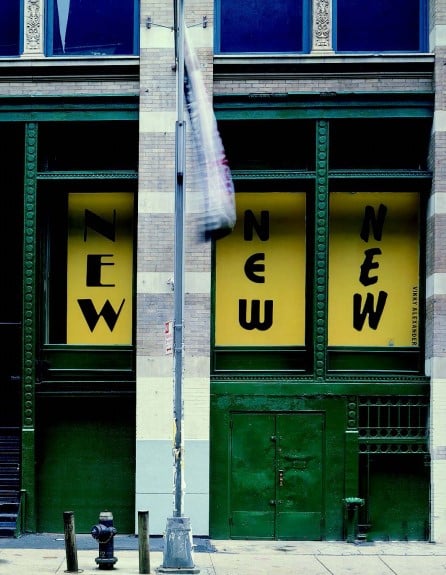
Vikky Alexander, New
(1985/2020). Courtesy Downs & Ross.
Ross was sitting in the back office of his gallery, which he
started with Tara Downs in 2017, and which now occupies a
second-floor space on the lower stretch of the Bowery. Before
coming together, Downs and Ross operated small but influential
Lower East Side outfits: Tomorrow Gallery and Hester Gallery,
respectively.
Downs founded Tomorrow in Toronto in 2011, with the artists Hugh
Scott-Douglas and Aleksander Hardashnakov, and gave early shows to
a stellar and rowdy group of art-makers, each of whom would be a
highlight on any gallery’s roster: Ben Schumacher, Sebastian Black,
Dena Yago, Parker Ito, Kelly Akashi. With Hester, Ross achieved a
level of curatorial rigor perhaps lacking from other white cube
spaces, giving early shows to artists such as Andrea Crespo.
They decided to merge into a single program after a spate of
closings among the
so-called “middle-class galleries,” and housed the operation
out of their two spaces. Soon after their first shows, they vacated
their old spaces in favor of the current larger space.
(Consolidation is certainly a way to cut overhead.) Since then,
they’ve been able to forge ahead with a new identity: though some
of the artists from the old programs are still here, Ross sees the
operation as greater than the sum of its parts.
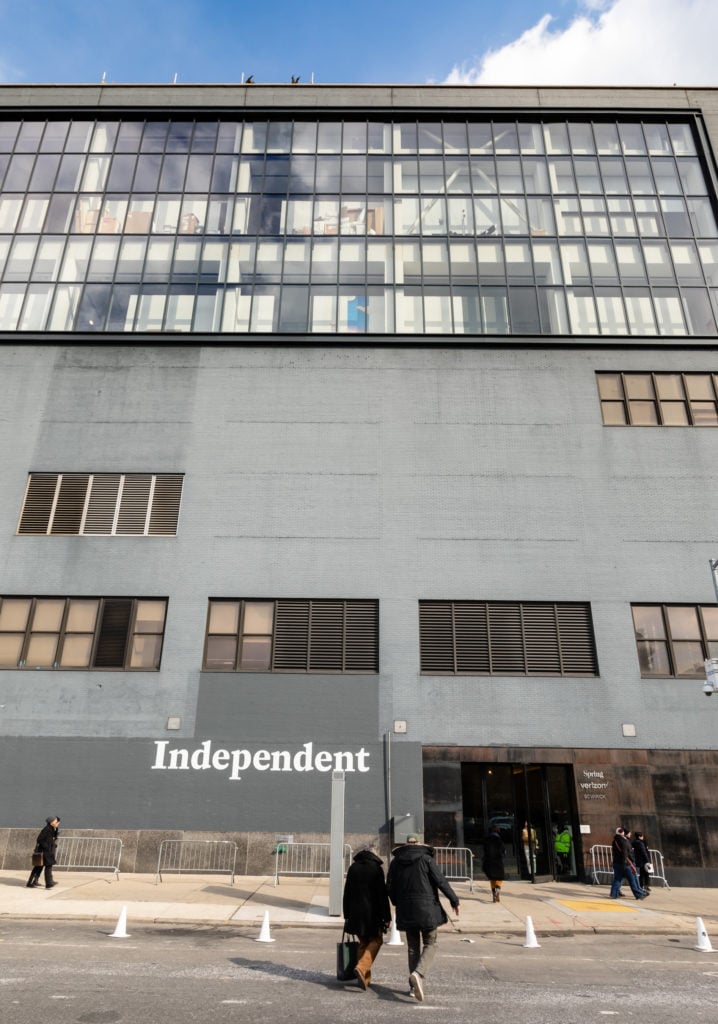
Exterior view of Spring Street Studios,
the venue for Independent New York 2019. Photography by Etienne
Frossard. Image courtesy of Independent.
“I don’t think the gallery’s ever been about our biographic
dimensions, or this conglomerate of our CVs,” he said. “I don’t
think we’d want to romanticize our individual vanguard moments. We
share a lot of similarities. We’re always forward looking, we’re
protesting against forms of forgetting, and contextualizing nascent
developments in visual culture within the context of New York’s
antecedence.”
By presenting a solo booth of important works by Alexander, who
has been working with Downs for years, they’re holding their own at
Independent, which is a thinking person’s fair. Included in the
presentation are works that were shown in landmark
exhibitions, including Alexander’s 1985 New Museum show and a
two-person exhibition with her former husband, fellow Pictures
Generation artist James Welling, held at the Kunsthalle Bern in
Switzerland. The both also includes her first-ever work, which
comes from Welling’s collection.
The involvement of Independent founder Dee, a longtime supporter
of Alexander’s work, helped as well.
“She’s kind of been a continuum of interest, and when we
approached her, she took it up right away,” said Downs.
“It does have that curatorial focus,” she said of the fair.
“People go there because they want to go in deep. It’s not just
this blockbuster event.”
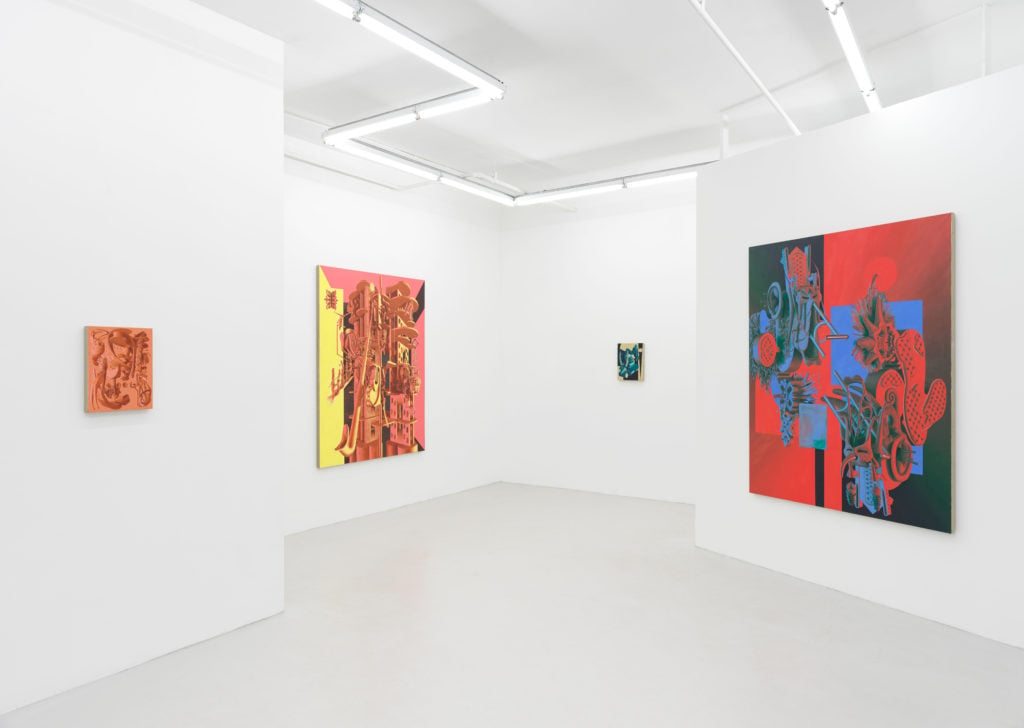
Installation view of “Tom Waring:
Consistent Estimator” at Downs & Ross on the Bowery. Photo courtesy
Downs & Ross.
On Sunday, Downs & Ross opened the first-ever solo show of a
young Brit named Tom Waring, who paints these wacked-out systems
that wind through a series of gears, a reflection of a
interconnected world bursting at the seams—apt painting for a month
that will see the further global spread of a deadly disease, Ross
noted.
The works were made over the last year, but were informed to
some extent by The Decameron, the Italian novel that takes
place outside of Florence during the Black Death, which may have
killed as much as 60 percent of Europe’s population. Like
coronavirus, that plague originated in China before traveling to
Northern Italy, where an outbreak occurred.
“It’s kind of terrifyingly apposite,” Ross said.
And next month, the gallery will stage a show of new work by the
Berlin-based Rute Merk, who has made a series of paintings in
collaboration with semi-reclusive fashion godhead Demna Gvasalia,
the iconoclastic creative director of Balenciaga.
“It was instigated at the invitation of Balenciaga,” Ross said,
being charmingly evasive. “She was invited to produce a body of
work that responds to and interpolates the collection for
Spring/Summer 2020.”
Balenciaga obsessives, take note: It opens April 17.
The post How New York’s Downs & Ross Gallery Weathers
Difficult Times by Staying Nimble—and Keeping Its Eyes on the
Vanguard appeared first on artnet News.
Read more https://news.artnet.com/market/downs-and-ross-independent-1793010
Further reading


Leave a comment