
How Yvette Mayorga’s Luscious Artworks Use ‘Rasquache Aesthetics’ to Address the Dark Side of the American Dream
It’s easy to mistake cake frosting for the medium of
Chicago-based artist Yvette Mayorga’s paintings. Actually, it’s
just acrylic paint piped from plastic bags—but the resemblance is
deliberate, and a small reminder that you shouldn’t make too many
assumptions about this artist’s work in advance.
Currently Mayorga has her first solo show in New York City,
“A Part of US” at Geary
Contemporary in SoHo, an especially rare event for an emerging
Latinx artist. Mayorga’s work is chaotic yet magnetic, like a
collage-covered teenage bedroom luring you into an
unapologetically feminine candy dreamland. And yet as you’re lured
into this world of celebratory pastries and consumerist American
iconography, you also witness the overwhelming anxiety that
accompanies artificial excess and meet Mayorga’s sharp critique of
American xenophobia.
A first-generation Mexican-American, Mayorga paints using the
same technique her mother used to decorate cakes at the Marshall
Field’s department store in 1970s Chicago. But even as Mayorga
mirrors her mother’s labor and technique—which was powered by the
hope of living the “American dream”—she questions the social
realities for immigrants invested in that fantasy. Her perspective
on the intrinsic role of immigrant labor in feeding US consumerism
and shaping American identity comes from a network of family
members, some of them migrants from Jalisco and Zacatecas, who
worked for iconic American corporations like John Deere, Tootsie
Roll, and Tyson Meats in Moline, Illinois, the small town 2.5 hours
outside of Chicago where the artist grew up.
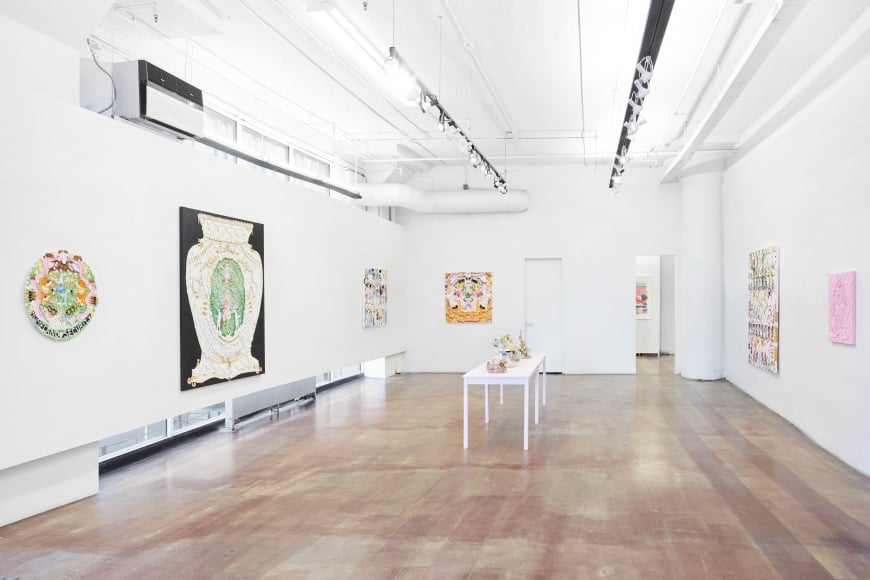
Installation view of Yvette Mayorga, “A
Part of US,” 2019. Image courtesy Geary Contemporary.
For this new show, some 20 paintings and five ceramics are
evenly spaced and organized at Geary Contemporary in a digestible
way, but you get the feeling that the exuberance of her vision
might be better achieved in the form of immersive installation. In
fact, her previous installations have been housed as entire
experiential rooms, from the Refinery29-sponsored “29 Rooms” exhibition in
Chicago to Expo Chicago 2017,
where she presented pink and gold wallpaper with details
of migrants wearing backpacks and ICE jeeps with bodies
hanging out of the trunk; an oversize nameplate necklace inscribed
“Illegal”; and a nine-foot banner with cherub angels holding a pair
of Nike Cortez dubbed Killer Shoes (Hernan Cortés).
It was that work at the Chicago Artist’s Coalition booth at EXPO
Chicago 2017 that got Mayorga noticed by Geary Contemporary. Claire
Voon from Hyperallergic called it one of the
best booths at the fair, saying, “You don’t typically see political
work this personal and raw at art fairs, much less by young artists
of color. Can we get more of this, please?”
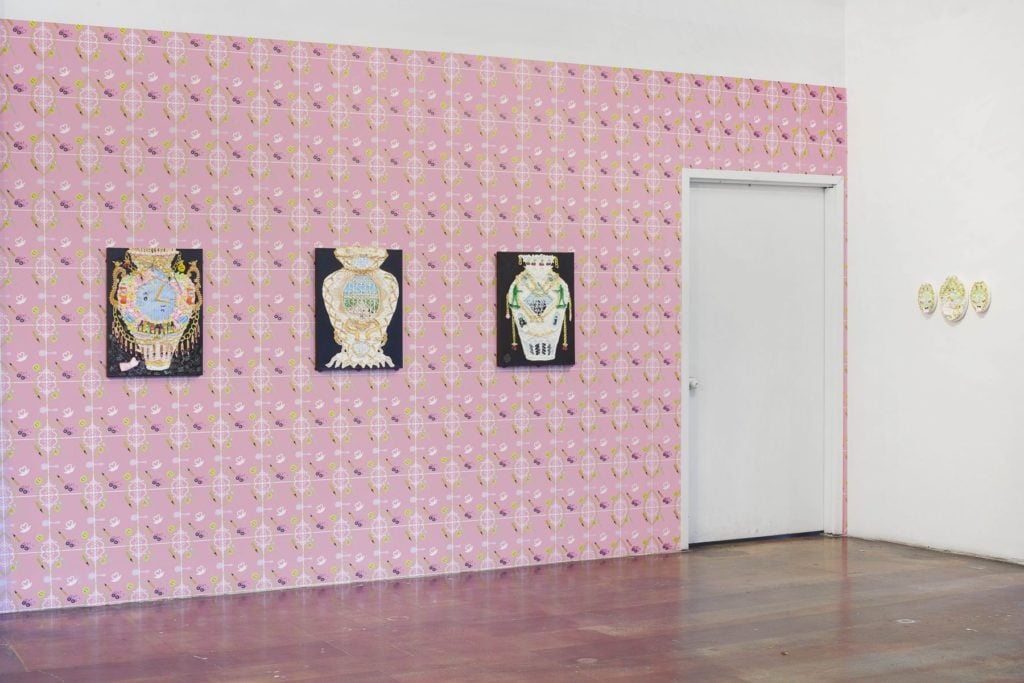
Installation view of Yvette Mayorga, “A
Part of US,” 2019. Image courtesy Geary Contemporary.
Geary gave her a spot in a group show the following year. There,
she showed her “Monument” series of six-foot cake effigies
plastered with toy soldiers, angel figurines, and satin heart cake
toppers. These were completely made from acrylic paint, plaster,
textile, and dollar store trinkets, unlike her earlier monuments
from 2014 which used actual sugar frosting (these are now rotting
underneath their acrylic glaze).
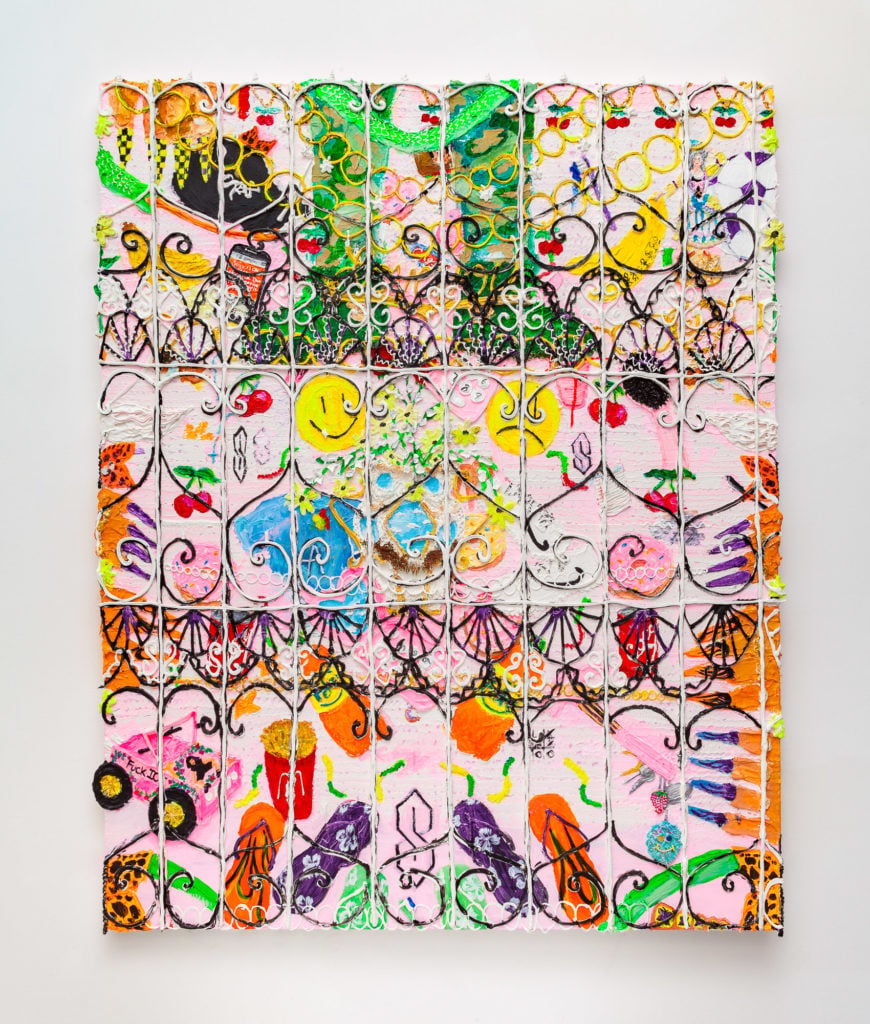
Yvette Mayorga, Through the
Gate (2019). Image courtesy Geary Contemporary.
As for her New York solo debut, one of the two largest
paintings, Through the Gate (2019), shows a wrought iron
fence foregrounding a landscape of sugary detritus: cherries, gummy
worms, donuts, and McDonald’s french fries, amid other obscured
objects. Beyond the sculptural barrier or border lay what looks
like a wonderland of cheap thrills or maybe the fruits of labor.
There are hints of flip flops, fingernails, a pair of Nike Cortez
tennis shoes, and yellow emojis.
Only after you situate yourself in this cluttered scene and lift
your gaze do you see the green camouflage of an Army soldier’s
fatigues and boots surveilling your existence.
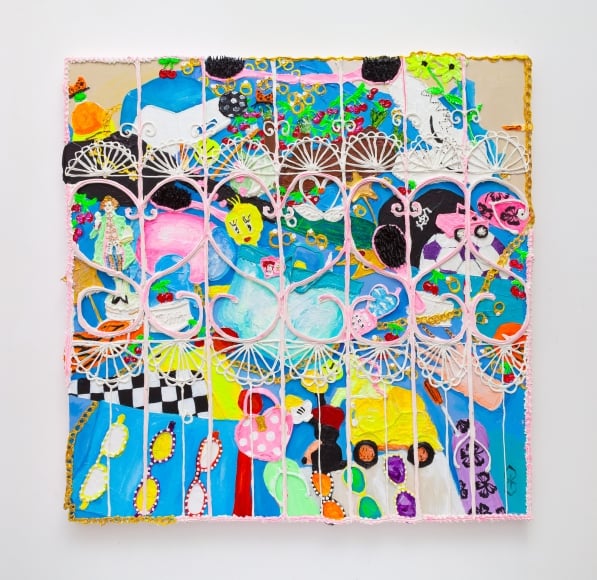
Yvette Mayorga, Objects Left
Behind (2019). Image courtesy Geary Contemporary.
The painting is a metaphor for US migration fantasies. Mayorga’s
faux-naïf style of rendering helps further the sense that the
world it is conveying is based on an illusion. This type of
critique is nothing new for Mayorga. Although some viewers may
guess that the anti-immigrant rhetoric of the Trump presidency
inspired Mayorga’s work, she is quick to dispel that idea: “I’ve
been using frosting to talk about my family and my identity and the
border since 2013,” she tells me. “Now that there’s a heightened
microscopic view of it, people have things to say, but this has
been happening for decades. It’s not new.”
Throughout, Mayorga incorporates pop symbols like Nikes, Hello
Kitty, and Tweety Bird, recognizable to many working-class Latinx
who shop at dollar stores, clean with Fabuloso, and love their
afterschool snacks of hot Cheetos and Fanta sodas. Plastic
sunglasses and trinkets, hoop earrings, acrylic nails, and corn
snacks have lowbrow connotations but also signify abundance and
access to cheap, manufactured goods. The discrepancy at play in
showing these paintings at a white box gallery space in Soho
delivers a thrilling political punch.
The work has a clear art historical lineage in ‘rasquache’ aesthetics,
a term created to describe much of the Chicano art canon, defining
a sensibility of using recycled materials and cultural objects
often described as “kitsch.” Contemporary art spins on
“rasquachismo” can also be seen in the altar installations of
Amalia Mesa Bains and
the candy-painted power tool sculptures of Ruben Ortiz Torres.
Such Chicano art has helped make the case for the value in the
mundane and provided a framework to draw on for Mayorga.
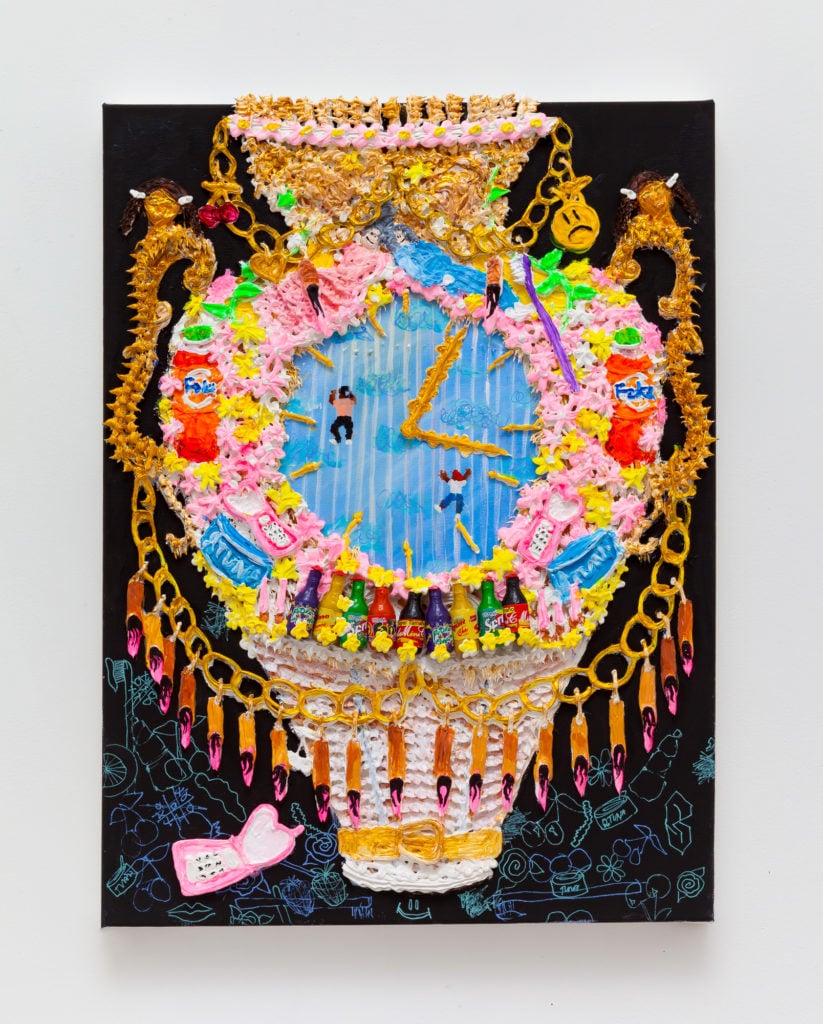
Yvette Mayorga, Vase of the Century
3 (After Century Vase c. 1876) (2019). Image courtesy Geary
Contemporary.
Her influences clearly go beyond insider references. Attempting
to engage with significant and collectible art objects of American
history, she riffs off Karl Müller’s Centennial Vases of 1876, made
to commemorate 100 years of US history. For Geary Contemporary, she
creates her own “Vase of the Century” paintings, switching out the
originals’ patriotic motifs, like buffaloes and George Washington’s
portrait, for images of asylum seekers and the toothbrushes, tuna
cans, and burner phones that migrants leave behind.
A study published in
February 2019 estimated that just 2.8 percent of artists in 18 U.S.
museum’s collections were Hispanic/Latinx. If the message that
American institutions in general exclude the historical
contributions of Latinos wasn’t clear, the text details embedded
among Mayorga’s pieces (“FUCK ICE,” “ILLEGAL,” or “THIS SUCKS”)
should get the point across. Again, she is certainly not the only
Latinx contemporary artist spelling out the omission: Guadalupe Rosales has made her whole
practice an archival one, collecting and documenting her own
community’s history because no one else was going to, while Patrick
Martinez has made neon signs with pointed
political messages that say, “Invest in the Oppressed,” “America is
for Dreamers,” and “Deport ICE.”
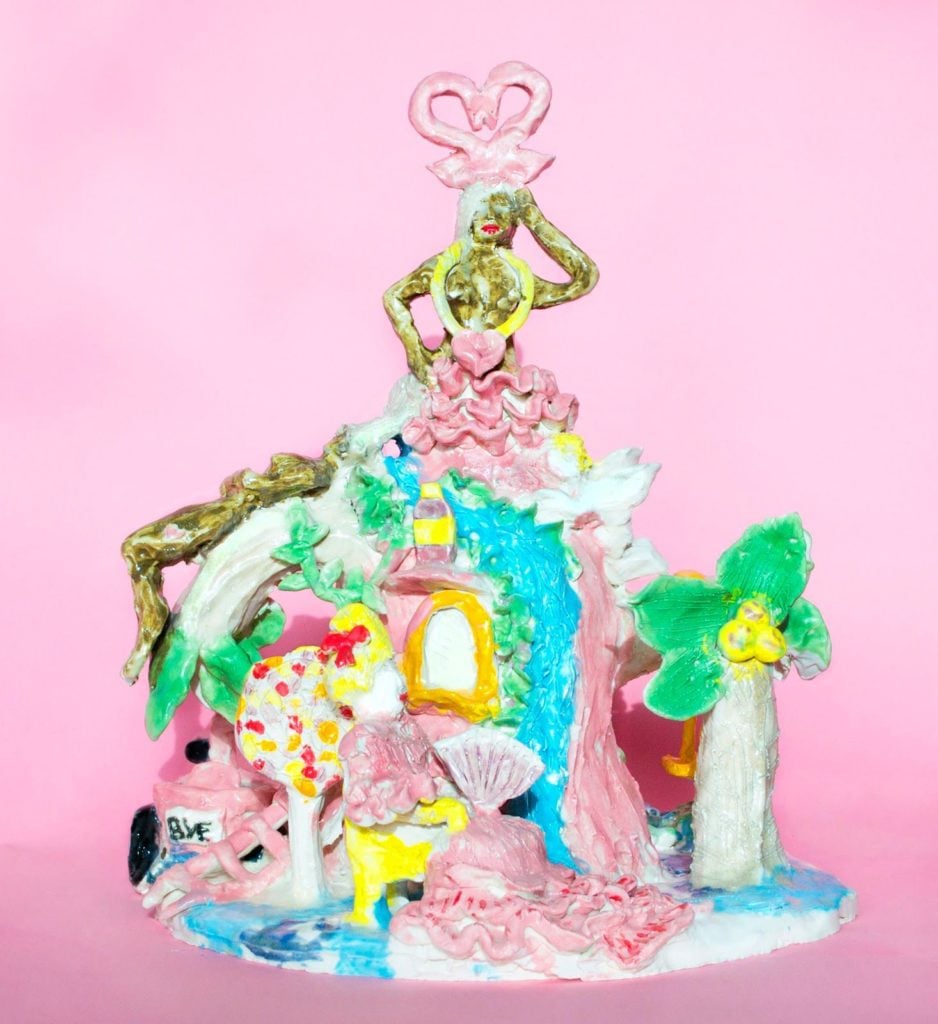
Yvette Mayorga, Sweet Water, After
Lenardi, Giovanni Battista (2018). Image courtesy Geary
Contemporary.
Mayorga is smart to reclaim the language of art history to
enter into a conversation where Latinx are almost always excluded.
Yet though you can give credit to rococo and the decadence of the
Catholic Church’s architecture and art for inspiring Mayorga’s
lavishness, the fête galante aesthetic also comes from
Mexican-American cultural ceremonies like quinceañeras, a girl’s
coming-of-age party. In this show, her sculptures Sweet
Water and Alligator Boots both reference 16th-century
sugar sculptures made for banquet table centerpieces, at a time
when sugar itself was so expensive it created its own luxury art
form. Her versions look like the centerpieces that would dot tables
at a quinceañera. These feature images like a nude woman donning
pointy alligator boots—the iconic footwear of many Latino uncles—or
a flag that reads “No Wall,” and are reminiscent of the iridescent
swans or angel tchotchke you find in dollar stores, artifacts many
Latinos proudly display in their home.
“It’s this soft idea of luxury which all goes hand in hand with
the way I view the American dream and question the desire for it,”
Mayorga tells me. In other words, part of the experience of a
Mayorga work is the sensorial overload, the burden of artificial
sweetness. But, if you aren’t left with an unpleasant aftertaste,
were you even paying attention?
Yvette Mayorga, “A Part of Us,” is on view at Geary
Contemporary through December 20, 2019.
The post How Yvette Mayorga’s Luscious Artworks Use
‘Rasquache Aesthetics’ to Address the Dark Side of the American
Dream appeared first on artnet News.
Read more https://news.artnet.com/exhibitions/yvette-mayorga-geary-contemporary-1712022
Further reading


Leave a comment